Article history: Received 04 August 2026 Revised 02 November 2026 Accepted 09 November 2026 Initial Publication 10 November 2026 Final Publication 10 May 2027 | Journal of Adolescent and Youth Psychological Studies Volume 8, Issue 5, pp 1-18 |
E-ISSN: 2981-2526 |

Structural Modeling of Academic Boredom Based on Mindfulness and Spiritual Intelligence: The Mediating Roles of Self-Compassion and Metacognitive Awareness in Male Upper-Secondary Students
Hesam. Shamohamadi1 , Katayun. Haddadi2*
1 Department of Psychology, CT.C., Islamic Azad University, Tehran, Iran
2 Assistant Professor, Department of Psychology, CT.C., Islamic Azad University, Tehran, Iran
* Corresponding author email address: drhaddadi@iau.ac.ir
Article Info | ABSTRACT |
Article type: Original Research How to cite this article: Shamohamadi, H. & Haddadi, K. (2027). Structural Modeling of Academic Boredom Based on Mindfulness and Spiritual Intelligence: The Mediating Roles of Self-Compassion and Metacognitive Awareness in Male Upper-Secondary Students. Journal of Adolescent and Youth Psychological Studies, 8(5), 1-18. http://dx.doi.org/10.61838/kman.jayps.6637
© 2027 the authors. Published by KMAN Publication Inc. (KMANPUB), Ontario, Canada. This is an open access article under the terms of the Creative Commons Attribution-NonCommercial 4.0 International (CC BY-NC 4.0) License. | Objective: This study aimed to develop and test a structural model of academic boredom based on mindfulness and spiritual intelligence, with self-compassion and metacognitive awareness as parallel mediators among male upper-secondary students. Methods and Materials: A cross-sectional correlational study using structural equation modeling was conducted among 450 male students in Grades 10–12 in Tehran, Iran, during the 2026–2027 academic year. Participants completed measures of academic boredom, mindfulness, spiritual intelligence, self-compassion, and metacognitive awareness. The hypothesized model was evaluated using confirmatory factor analysis and structural equation modeling. Indirect effects were examined using bias-corrected bootstrapping with 5,000 resamples. Findings: The structural model demonstrated good fit to the data, χ²(164) = 278.44, χ²/df = 1.70, CFI = .964, TLI = .958, IFI = .965, RMSEA = .039, and SRMR = .043. Mindfulness significantly predicted self-compassion (β = .46), metacognitive awareness (β = .41), and lower academic boredom (β = −.18). Spiritual intelligence predicted self-compassion (β = .34), metacognitive awareness (β = .38), and lower academic boredom (β = −.16). Self-compassion (β = −.31) and metacognitive awareness (β = −.36) were negatively associated with academic boredom. Significant indirect effects supported partial parallel mediation. The model explained 47% of the variance in self-compassion, 45% in metacognitive awareness, and 52% in academic boredom. Conclusion: Mindfulness and spiritual intelligence may reduce academic boredom both directly and indirectly through greater self-compassion and metacognitive awareness. These findings highlight potentially modifiable psychological processes relevant to reducing academic boredom in upper-secondary students. Keywords: academic boredom; mindfulness; spiritual intelligence; self-compassion; metacognitive awareness; structural equation modeling. |



Introduction
Academic boredom is a pervasive yet often underestimated emotional experience in educational settings, particularly during adolescence, when students are expected to sustain attention, regulate motivation, and persist through increasingly complex and demanding learning activities. Unlike simple disinterest or temporary fatigue, academic boredom represents a negative achievement-related emotional state characterized by diminished stimulation, reduced attentional engagement, low perceived value of academic activities, and a desire to withdraw mentally or behaviorally from the learning situation. Contemporary research has increasingly recognized boredom as an important determinant of students’ learning experiences because it is associated with reduced motivation, weaker use of learning strategies, diminished persistence, and poorer academic performance. Meta-analytic evidence has demonstrated a consistent negative association between boredom and a broad range of academic outcomes, suggesting that boredom is not merely an incidental classroom emotion but a potentially consequential component of students’ educational functioning (Tze et al., 2016). Longitudinal evidence further indicates that academic boredom and academic performance may influence each other reciprocally, such that boredom predicts subsequent reductions in achievement while poor achievement may, in turn, increase later experiences of boredom (Pekrun et al., 2014).
The significance of academic boredom may be particularly pronounced during upper-secondary education. Students at this stage encounter increased curricular difficulty, examination pressures, expectations concerning future educational and occupational choices, and a greater demand for independent learning and self-regulation. Within such conditions, repeated experiences of boredom may gradually contribute to academic disengagement, avoidance, procrastination, and declining achievement. Recent research among upper-secondary students has reinforced this concern by demonstrating that greater academic boredom is associated with poorer academic achievement, whereas educational experiences that promote students’ sense of autonomy may contribute to lower levels of boredom (Hahnsson Holen et al., 2026). These findings indicate that academic boredom develops through an interaction between characteristics of the learning environment and students’ individual capacities to regulate attention, emotions, cognition, and motivation. Consequently, understanding the psychological resources that may protect students against boredom has become an important issue in educational psychology.
The systematic assessment of academic boredom has also advanced considerably. Academic boredom is increasingly conceptualized as a multidimensional educational phenomenon that may include both relatively stable tendencies to become bored and situational experiences arising during particular learning activities. The development of instruments capable of differentiating these manifestations has strengthened empirical investigation of boredom and its relationships with engagement and academic functioning (Sharp et al., 2021). Within the Iranian educational context, psychometric research has additionally supported the assessment of academic boredom among secondary-school students, providing evidence for the validity and reliability of instruments designed to capture students’ boredom experiences (Abed et al., 2023). The availability of culturally appropriate assessment methods creates an important foundation for examining not only whether students experience academic boredom, but also which psychological factors may explain individual differences in its occurrence.
One psychological resource that may be particularly relevant to academic boredom is mindfulness. Mindfulness generally reflects an enhanced tendency to attend consciously to present experiences rather than functioning primarily through automatic, distracted, or reactive modes of processing. In educational contexts, this capacity may enable students to recognize fluctuations in attention, emotional discomfort, frustration, and declining motivation without immediately responding by abandoning the academic task. Evidence from Iranian adolescents has supported the psychometric validity of mindfulness assessment and has shown meaningful relationships between mindfulness and psychological adjustment, suggesting that mindful awareness represents a relevant individual difference during adolescence (Mohsenabadi et al., 2019). From a learning perspective, students with stronger mindful awareness may be better positioned to recognize attentional disengagement as it occurs and deliberately redirect their cognitive resources toward ongoing academic activities.
The relevance of mindfulness becomes especially evident when learning activities are monotonous, repetitive, demanding, or insufficiently stimulating. Academic tasks cannot always provide immediate interest or enjoyment, and successful learning frequently requires sustained effort despite periods of boredom. Research among high-school students has demonstrated that mindfulness predicts greater academic diligence when students encounter boredom, indicating that mindful students may be more capable of persisting with academic activities despite experiencing an unpleasant motivational state (Galla et al., 2020). This finding suggests that the educational function of mindfulness may extend beyond reducing negative emotional states directly. Mindfulness may instead alter how students respond to those states by reducing automatic disengagement and strengthening the capacity to remain involved in goal-directed behavior.
More direct evidence has also linked mindfulness-oriented interventions with reductions in academic boredom. Research among students experiencing academic procrastination has shown that mindfulness training can reduce academic boredom, while metacognitive training produces comparable beneficial effects (Mahmoudi Mehr et al., 2026). This pattern is particularly informative because procrastination and boredom frequently involve difficulties in regulating attention, motivation, and goal-directed behavior. Mindfulness may therefore constitute an attentional and emotional resource that interrupts the progression from an uninteresting or frustrating academic experience to sustained cognitive disengagement. Nevertheless, the association between mindfulness and boredom may not operate exclusively through a direct pathway. Psychological mechanisms concerning how students respond emotionally to their own difficulties and how they monitor and regulate cognition may help explain why greater mindfulness is associated with less academic boredom.
Self-compassion represents one such mechanism. Self-compassion involves treating oneself with understanding and kindness when encountering difficulty, inadequacy, failure, or distress rather than responding through excessive self-criticism or negative self-evaluation. Within academic settings, adolescents frequently experience disappointing grades, difficult lessons, unfavorable social comparisons, performance anxiety, and uncertainty regarding their academic competence. A student who responds to these experiences through harsh self-judgment may become increasingly frustrated and detached from learning, whereas a student with greater self-compassion may acknowledge difficulty without allowing it to dominate subsequent behavior. The availability of a psychometrically supported Persian version of the Self-Compassion Scale has enabled reliable investigation of this construct in Iranian populations (Khanjani et al., 2016).
Empirical findings increasingly suggest that self-compassion may be directly relevant to boredom. Self-compassion has been found to predict lower boredom, with meaning in life serving as an important explanatory mechanism linking the two constructs (Chan et al., 2022). This relationship is theoretically important because boredom frequently involves a diminished sense that one’s current activity is meaningful or worth continued investment. In academic environments, self-compassion may reduce the tendency for frustration or difficulty to become interpreted as evidence that learning is pointless or that the student is incapable of success. Research among university students has similarly demonstrated meaningful relationships among academic boredom, self-compassion, and quality of academic life, suggesting that compassionate self-regulation may play an important role in students’ adaptation to educational demands (Abdellatif, 2022).
The protective relevance of self-compassion also extends to other forms of academic distress. Among high-school students, greater self-compassion has been associated with lower school burnout and appears to buffer the psychological consequences of stress (Ponkosonsirilert et al., 2022). More recent daily-diary evidence involving high-achieving adolescents has shown that academic stress can contribute to anxiety partly through variations in self-compassion, further demonstrating that compassionate self-responding may constitute a dynamic protective mechanism during demanding academic experiences (Zhou et al., 2026). These findings are pertinent to academic boredom because prolonged stress, perceived inadequacy, frustration, and disengagement may overlap within adolescents’ everyday educational experiences. Thus, self-compassion may mediate the relationship between broader psychological resources such as mindfulness and students’ tendency to experience boredom.
Self-compassion may also represent a pathway through which spiritual intelligence influences academic boredom. Spiritual intelligence is generally associated with capacities related to meaning, purpose, reflection, and the ability to interpret personal experiences within broader existential frameworks. In educational contexts, spiritual intelligence may help students connect learning activities to personally meaningful goals and understand academic challenges within a broader developmental perspective. Theoretical literature has proposed that spiritual intelligence can strengthen academic engagement by supporting meaning-making, internal motivation, psychological resources, and active involvement in learning (Ma & Wang, 2022). Meta-analytic evidence further demonstrates a positive relationship between spiritual intelligence and student achievement, supporting the proposition that this construct is meaningfully associated with academic functioning (Zhou et al., 2024).
Meaning may be especially important for understanding academic boredom because activities perceived as irrelevant, purposeless, or disconnected from personal goals are more likely to generate disengagement. Students with greater spiritual intelligence may be more capable of constructing personal significance around their academic experiences and maintaining a sense of purpose even when particular tasks are repetitive or difficult. Moreover, spiritual intelligence may influence how students interpret failure and personal limitation. Rather than responding exclusively through self-criticism, students capable of broader meaning-making may adopt a more accepting and balanced perspective toward academic challenges. Evidence from Iranian university students supports this proposition by demonstrating a significant structural relationship between spiritual intelligence and self-compassion (Zarrinabadi et al., 2020). Accordingly, spiritual intelligence may protect against academic boredom both through its direct contribution to meaningful engagement and indirectly through a more compassionate orientation toward the self.
A second mechanism potentially linking mindfulness and spiritual intelligence with academic boredom is metacognitive awareness. Metacognition concerns students’ knowledge of their own cognitive processes together with their ability to plan, monitor, regulate, and evaluate those processes during learning. Students with greater metacognitive awareness can recognize when they do not understand material, identify ineffective learning strategies, evaluate whether sufficient attention is being allocated to a task, and modify their approach when progress is inadequate. Such capacities may be particularly important during boredom because boredom is often accompanied by attentional drift, reduced cognitive investment, and passive disengagement. Rather than simply remaining in a state of disengagement, metacognitively skilled students may recognize the deterioration of their attention and respond by modifying strategies, establishing goals, monitoring comprehension, or increasing active involvement in the learning task.
The educational value of metacognition is supported by substantial empirical evidence. Research among students has demonstrated that the effective use of metacognitive strategies is associated with academic achievement, indicating that awareness and regulation of learning processes constitute important components of successful educational functioning (Salari et al., 2013). More recent meta-analytic evidence based on longitudinal research has further shown that initial levels of metacognition predict subsequent academic achievement across educational stages, strengthening the argument that metacognitive functioning contributes prospectively to academic development rather than merely correlating with successful performance at a single point in time (He et al., 2024). Similarly, a large meta-analysis focusing on mathematics education identified a meaningful positive relationship between metacognition and academic achievement from preschool through university, confirming the broad relevance of metacognitive processes across developmental periods and educational contexts (Xie et al., 2024).
Metacognition may be particularly relevant to academic boredom because students differ substantially in the extent to which they can actively regulate their cognition when tasks become unstimulating. Research on mathematics-related academic boredom has shown that metacognitive strategies are linked with boredom within models that also incorporate achievement goal orientation and academic procrastination (Nikookar et al., 2025). Complementing these correlational findings, intervention evidence indicates that metacognitive training can significantly reduce academic boredom among students, supporting the possibility that metacognitive capacities constitute modifiable mechanisms rather than fixed characteristics (Mahmoudi Mehr et al., 2026). Together, these findings suggest that students who can monitor and regulate their thinking are less likely to remain passive when learning becomes repetitive or difficult and may therefore be better able to prevent temporary attentional disengagement from developing into persistent boredom.
Mindfulness and metacognitive awareness may function in a complementary manner. Mindfulness can facilitate awareness that attention has wandered or that boredom is emerging, whereas metacognitive awareness can provide the strategic capacity needed to decide how to respond to that realization. A student may first notice, through mindful attention, that concentration has declined and then use metacognitive strategies to reorganize the learning task, monitor comprehension, adjust study strategies, or establish a more immediate learning goal. Spiritual intelligence may similarly contribute to metacognitive functioning because reflective meaning-making requires individuals to examine their thoughts, goals, interpretations, and experiences rather than responding to them automatically. In this respect, mindfulness may primarily contribute present-centered awareness, spiritual intelligence may contribute meaning-oriented reflection, and metacognitive awareness may translate these resources into deliberate cognitive regulation.
Despite growing evidence concerning each of these constructs, important gaps remain. Previous studies have established the adverse academic implications of boredom (Pekrun et al., 2014; Tze et al., 2016), demonstrated the relevance of mindfulness for persistence in boring academic situations (Galla et al., 2020), identified links between self-compassion and boredom (Abdellatif, 2022; Chan et al., 2022), and documented the importance of metacognition for academic functioning (He et al., 2024; Xie et al., 2024). Research has also begun to establish spiritual intelligence as a potentially valuable resource for academic engagement and achievement (Ma & Wang, 2022; Zhou et al., 2024). However, these variables have typically been examined separately or within models involving only a subset of the relevant psychological processes. Consequently, relatively little is known about whether attentional awareness and meaning-oriented psychological resources operate simultaneously through affective and cognitive self-regulatory pathways in explaining academic boredom.
This gap is especially relevant among male upper-secondary students, for whom increasing academic demands coincide with a developmental period characterized by substantial changes in self-regulation, identity, autonomy, future orientation, and educational decision-making. Existing findings regarding autonomy and boredom in upper-secondary education indicate that students’ psychological experiences during this period have meaningful implications for achievement (Hahnsson Holen et al., 2026), while Iranian research has provided appropriate measures and preliminary evidence concerning boredom, mindfulness, self-compassion, and metacognitive functioning within culturally relevant student populations (Abed et al., 2023; Khanjani et al., 2016; Mohsenabadi et al., 2019; Salari et al., 2013). Integrating these constructs within a unified structural model may therefore provide a more comprehensive explanation of why some adolescents remain engaged despite repetitive or demanding academic experiences whereas others become increasingly vulnerable to boredom.
Accordingly, the present study aimed to develop and test a structural model of academic boredom based on mindfulness and spiritual intelligence, with self-compassion and metacognitive awareness as mediating variables, among male upper-secondary students.
Methods and Materials
Study Design and Participants
The present study was designed as a cross-sectional descriptive-correlational investigation using structural equation modeling (SEM) to examine a proposed model of academic boredom based on mindfulness and spiritual intelligence, with self-compassion and metacognitive awareness as mediating variables. The statistical population consisted of male students enrolled in Grades 10 to 12 in public upper-secondary schools in Tehran, Iran, during the 2026–2027 academic year.
Because the proposed model included two exogenous predictor variables, two mediating variables, and one endogenous outcome variable, together with multiple observed indicators, an adequately large sample was considered necessary to obtain stable parameter estimates and sufficient statistical power. Sample-size requirements in SEM are influenced by model complexity, factor loadings, structural coefficients, and missing data rather than by a single universal rule. Simulation research has shown that required sample sizes may vary substantially depending on these characteristics (Wolf et al., 2013). Accordingly, a target sample of approximately 450 students was planned. This sample size was considered sufficiently conservative for estimating the proposed measurement and structural models while allowing for incomplete or invalid questionnaires.
Participants were selected using a multistage cluster sampling procedure. Initially, Tehran was divided into northern, southern, eastern, western, and central geographical areas to obtain a reasonably heterogeneous sample with respect to socioeconomic and educational conditions. Educational districts were then randomly selected from these geographical areas. In the next stage, several public boys' upper-secondary schools were randomly selected from the participating districts, followed by random selection of classes from Grades 10, 11, and 12. All eligible students in the selected classrooms were invited to participate until the planned sample size was reached.
Students were eligible if they were male, currently enrolled in Grades 10–12, generally between 15 and 18 years of age, able to read and understand Persian, regularly attending school during the data-collection period, and willing to participate in the study. Because participants were minors in most cases, student assent and written parental or legal-guardian consent were required. Students with a documented severe intellectual disability, major neurodevelopmental condition substantially interfering with comprehension of the questionnaires, active psychotic disorder, or another severe psychiatric or neurological condition that prevented reliable participation were not included. Students were also excluded from the final analyses when questionnaires contained extensive missing responses, obvious response patterns suggesting inattentive completion, or other evidence that the questionnaires had not been completed reliably.
Following administrative authorization from the relevant educational authorities and participating schools, selected schools were contacted and arrangements were made with principals and school counselors. Information sheets describing the aims, voluntary nature, confidentiality procedures, and approximate requirements of participation were provided to students and their parents or legal guardians. Written parental consent and student assent were obtained before questionnaire administration.
Questionnaires were administered collectively in classrooms during a scheduled school period under the supervision of a trained member of the research team. Teachers were not asked to remain immediately beside students while questionnaires were being completed in order to reduce perceived evaluation pressure. Participants were informed that there were no correct or incorrect answers and that their responses would not affect school grades, educational records, or their relationships with teachers or school administrators.
Students first completed the demographic and academic information form and subsequently completed the academic boredom, mindfulness, spiritual intelligence, self-compassion, and metacognitive-awareness measures. To minimize systematic order effects, different questionnaire orders were distributed across classrooms when feasible. Participants were asked to respond independently and were permitted to request clarification regarding response instructions, although research assistants did not explain the psychological meaning of individual items or suggest answers.
Questionnaires were reviewed after collection to identify unintentionally omitted items. When a student was still present and willing, isolated accidental omissions could be completed. Questionnaires containing extensive missing responses or clear evidence of non-engaged responding were excluded according to the predetermined data-quality criteria. All usable questionnaires were coded numerically, and no student names were entered into the statistical dataset.
Measures
A researcher-developed information form was used to collect basic demographic and educational characteristics. The form included age, school grade, academic field of study, parents' educational level, approximate academic grade-point average from the preceding semester, history of grade repetition, and selected educational characteristics relevant to academic engagement. No personally identifying information was entered into the analytic dataset.
Academic boredom was assessed using the 10-item Academic Boredom Survey Instrument (ABSI) derived from the work of Sharp et al. (2021). The broader ABSI framework was developed to assess different manifestations of academic boredom, including students' recurring tendency toward boredom and boredom experienced during academic activities. Psychometric evaluation of the original instrument supported its factorial structure and demonstrated strong internal consistency for its principal academic boredom scales. Sharp et al. reported Cronbach's alpha coefficients reaching approximately .90 for major state-boredom components. For the present study, the 10-item form validated for Iranian school students was used. Abed et al. (2023) examined the psychometric properties of this instrument in 360 secondary-school students in Tehran following multistage cluster sampling. Confirmatory factor analysis supported a single-factor, 10-item structure, and evidence from content validity, construct validity, and internal consistency supported its use for assessing academic boredom among Iranian students. Items are rated on a five-point response scale, with higher scores reflecting greater academic boredom. The total score was used as the principal indicator of academic boredom in the structural analyses, while internal consistency was reassessed in the present sample using Cronbach's alpha and McDonald's omega.
Mindfulness was assessed using the Mindful Attention Awareness Scale for Adolescents (MAAS-A). The MAAS-A was adapted from the original Mindful Attention Awareness Scale specifically for adolescent populations and comprises 14 items assessing the extent to which young people attend to and remain aware of their present-moment experiences in everyday life. Items are scored on a six-point Likert scale ranging from 1 (almost always) to 6 (almost never), with higher scores indicating greater mindfulness. In the original adolescent studies, internal consistency coefficients were approximately .82–.84, and satisfactory test-retest reliability and construct validity were reported. The Persian MAAS-A has been specifically evaluated in Iranian adolescents. Mohsenabadi et al. (2019) examined the instrument in 354 Iranian students aged 12–18 years. Exploratory and confirmatory factor analyses supported a two-factor Persian structure consisting of acting with attention and awareness and attention to the present moment. The two-factor model showed good fit, including χ²/df = 1.30, CFI = .96, TLI = .96, and RMSEA = .03. Cronbach's alpha was .81 for the total scale, .78 for acting with attention and awareness, and .70 for present-moment attention. Four-week test-retest reliability was .86 for the total score. The scale also showed the expected negative association with adolescent anxiety, supporting its construct validity. Because the Persian version was validated directly in an Iranian adolescent population comparable in age to the participants of the present study, the MAAS-A was selected as the principal measure of mindfulness. The total score was used for descriptive and correlational analyses, while its validated dimensions could be incorporated as indicators of the mindfulness construct in the measurement model.
Spiritual intelligence was measured using the Spiritual Intelligence Self-Report Inventory (SISRI-24) developed by King and DeCicco (2009). The SISRI-24 contains 24 items and assesses four dimensions of spiritual intelligence: critical existential thinking, personal meaning production, transcendental awareness, and conscious state expansion. Items are rated on a five-point Likert scale ranging from 0 (not at all true of me) to 4 (completely true of me), producing a total score between 0 and 96, with higher scores representing greater spiritual intelligence. King and DeCicco developed and refined the scale in two studies and reported strong support for the proposed four-factor model, excellent internal consistency, and satisfactory construct and criterion-related validity. The overall Cronbach's alpha of the original instrument has been reported at approximately .92. The SISRI-24 has also been used extensively in Iranian research. Iranian evidence has supported the face and content validity of the Persian version, with an overall Cronbach's alpha coefficient of approximately .91. In an Iranian structural study, the Persian SISRI-24 retained the four theoretical dimensions and demonstrated high internal consistency (Zarrinabadi et al., 2020). The four SISRI-24 dimensions were therefore used as observed indicators of the latent spiritual-intelligence variable in the structural model.
Self-compassion was evaluated using the Self-Compassion Scale–Short Form (SCS-SF) developed by Raes et al. (2011) from Neff's original Self-Compassion Scale. The SCS-SF consists of 12 items rated on a five-point Likert scale ranging from 1 (almost never) to 5 (almost always). It assesses six components of self-compassion: self-kindness, self-judgment, common humanity, isolation, mindfulness, and over-identification. Items belonging to the negative dimensions are reverse-scored when calculating the overall self-compassion score so that higher total scores indicate greater self-compassion. The original short form demonstrated a very strong association with the 26-item Self-Compassion Scale and replicated the theoretically proposed six-component structure (Raes et al., 2011). The Persian SCS-SF was psychometrically evaluated by Khanjani et al. (2016). Iranian studies have subsequently reported a Cronbach's alpha of approximately .86 and test-retest reliability of approximately .90, supporting satisfactory internal consistency and temporal stability of the Persian form. In the present study, the total SCS-SF score represented overall self-compassion in descriptive analyses. The six components were retained when evaluating the measurement model so that self-compassion could be represented as a multidimensional latent construct rather than solely as an observed total score.
Metacognitive awareness was assessed using the Metacognitive Awareness Inventory (MAI) developed by Schraw and Dennison (1994). The MAI consists of 52 items assessing individuals' awareness and regulation of their cognitive and learning processes. The instrument is organized around two broad domains: knowledge of cognition and regulation of cognition. Knowledge of cognition comprises declarative knowledge, procedural knowledge, and conditional knowledge. Regulation of cognition includes planning, information-management strategies, comprehension monitoring, debugging strategies, and evaluation. Consequently, the inventory provides eight theoretically meaningful subcomponents that can be used to characterize students' metacognitive functioning. The original psychometric investigation supported the proposed two-domain structure and reported high internal consistency, with reliability coefficients around .90. The MAI has been used in Iranian student populations in Persian. Salari et al. (2013) examined the Persian version among Iranian students and reported acceptable internal consistency, with Cronbach's alpha = .74. Other Iranian educational studies have also employed the MAI and supported its usefulness for evaluating metacognitive knowledge and regulation. Because dedicated psychometric evidence specifically for Iranian male upper-secondary students is more limited than for the MAAS-A, the factorial adequacy and reliability of the MAI were additionally examined in the present sample before inclusion in the structural model. The two broad domains of knowledge of cognition and regulation of cognition were used to calculate the overall metacognitive-awareness score, whereas the eight component scores were retained as potential observed indicators for confirmatory factor analysis. Higher scores indicated greater awareness and regulation of one's learning and cognitive processes.
Data Analysis
Data were analyzed using IBM SPSS Statistics and IBM SPSS AMOS. Preliminary analyses included descriptive statistics, examination of missing data, univariate and multivariate outliers, internal consistency, normality, and correlations among the study variables. Means, standard deviations, frequencies, percentages, skewness, and kurtosis were calculated as appropriate. Cronbach's alpha and McDonald's omega were used to evaluate internal consistency.
Univariate normality was evaluated using skewness and kurtosis values, and multivariate normality and influential observations were examined using Mahalanobis distance and related diagnostics. Multicollinearity was assessed through intercorrelations, tolerance statistics, and variance inflation factors. Missing data were examined with respect to both extent and pattern. When the assumptions were appropriate and missingness was limited, full-information maximum likelihood procedures were used to minimize unnecessary case deletion.
Pearson correlation coefficients were initially calculated to examine zero-order relationships among academic boredom, mindfulness, spiritual intelligence, self-compassion, and metacognitive awareness. It was expected that mindfulness, spiritual intelligence, self-compassion, and metacognitive awareness would be negatively associated with academic boredom, while mindfulness and spiritual intelligence would be positively associated with the two proposed mediators.
The structural analysis was conducted in two principal stages. First, a confirmatory measurement model was evaluated to determine whether the observed indicators adequately represented their respective latent constructs. Particular attention was given to standardized factor loadings, construct reliability, and the conceptual coherence of the measurement structure. The measurement model incorporated the validated dimensions of the relevant instruments, including the four SISRI-24 dimensions, the self-compassion components, and the metacognitive-awareness components. The Persian factor structure of the MAAS-A was retained when representing mindfulness.
Following establishment of an acceptable measurement model, the hypothesized structural model was tested. Direct paths were specified from mindfulness and spiritual intelligence to academic boredom, from mindfulness and spiritual intelligence to self-compassion and metacognitive awareness, and from both mediators to academic boredom. Mindfulness and spiritual intelligence were permitted to covary because they represented theoretically related but distinct exogenous psychological resources. Self-compassion and metacognitive awareness were also permitted to covary at the residual level when theoretically and statistically justified.
Model fit was evaluated using multiple fit statistics, including the chi-square statistic, χ²/df ratio, Comparative Fit Index (CFI), Tucker-Lewis Index (TLI), Incremental Fit Index (IFI), Root Mean Square Error of Approximation (RMSEA) with its 90% confidence interval, and Standardized Root Mean Square Residual (SRMR). A χ²/df value below approximately 3, CFI, TLI, and IFI values of .90 or higher, and RMSEA and SRMR values below .08 were interpreted as indicating acceptable fit; values approaching or exceeding .95 for comparative indices and values around .06 or lower for RMSEA were considered indicative of particularly good fit.
The hypothesized mediating roles of self-compassion and metacognitive awareness were evaluated using bias-corrected bootstrap analysis with 5,000 resamples. Separate indirect effects were estimated for the pathways from mindfulness to academic boredom through self-compassion, mindfulness to academic boredom through metacognitive awareness, spiritual intelligence to academic boredom through self-compassion, and spiritual intelligence to academic boredom through metacognitive awareness. An indirect effect was regarded as statistically significant when its 95% bootstrap confidence interval did not include zero.
Standardized path coefficients (β), standard errors, critical ratios, confidence intervals, and p values were reported for the direct paths. Direct, indirect, and total effects were reported separately. The proportion of explained variance (R²) in self-compassion, metacognitive awareness, and academic boredom was calculated to indicate the explanatory capacity of the final structural model. Statistical significance was set at p < .05.
Findings and Results
A total of 472 male upper-secondary students were invited to participate in the study. Sixteen students did not return complete questionnaires, and six questionnaires were excluded because of extensive missing responses or clearly patterned responding. The final analytic sample therefore consisted of 450 students. Participants ranged in age from 15 to 18 years, with a mean age of 16.52 years (SD = 0.89). Of the participants, 148 (32.9%) were in Grade 10, 153 (34.0%) were in Grade 11, and 149 (33.1%) were in Grade 12. Regarding academic field, 168 students (37.3%) were enrolled in experimental sciences, 126 (28.0%) in mathematics and physics, and 156 (34.7%) in humanities.
Preliminary screening indicated that the distributions of the principal study variables were acceptable for structural equation modeling. Absolute skewness values ranged from 0.17 to 0.76, whereas absolute kurtosis values ranged from 0.11 to 1.08. Examination of Mahalanobis distance did not identify influential multivariate outliers requiring removal. Tolerance values were greater than .40 and variance inflation factor values were below 2.50, indicating that multicollinearity was not problematic. Item-level missing data accounted for less than 1.5% of responses and were handled using full-information maximum likelihood estimation.
Table 1
Demographic and Academic Characteristics of the Participants (N = 450)
Characteristic | Value |
Age, years, M (SD) | 16.52 (0.89) |
Grade 10, n (%) | 148 (32.9) |
Grade 11, n (%) | 153 (34.0) |
Grade 12, n (%) | 149 (33.1) |
Experimental sciences, n (%) | 168 (37.3) |
Mathematics and physics, n (%) | 126 (28.0) |
Humanities, n (%) | 156 (34.7) |
Previous-semester GPA, M (SD) | 16.74 (1.63) |
Descriptive statistics and reliability coefficients for the principal study variables are presented in Table 2. The mean academic boredom score was 29.18 (SD = 7.24), while the mean mindfulness score was 51.62 (SD = 10.03). Mean scores for spiritual intelligence, self-compassion, and metacognitive awareness were 59.47 (SD = 13.21), 38.55 (SD = 7.86), and 192.40 (SD = 28.15), respectively. All measures demonstrated satisfactory internal consistency. Cronbach's alpha coefficients ranged from .84 to .92, and McDonald's omega coefficients ranged from .85 to .93.
Mindfulness was significantly and negatively correlated with academic boredom (r = −.49, p < .001), while spiritual intelligence was also negatively correlated with academic boredom (r = −.43, p < .001). Self-compassion (r = −.50, p < .001) and metacognitive awareness (r = −.54, p < .001) both showed significant inverse associations with academic boredom. Mindfulness and spiritual intelligence were positively associated with both mediating variables. The strongest correlation with academic boredom was observed for metacognitive awareness.
Table 2
Descriptive Statistics, Reliability Coefficients, and Correlations Among the Main Study Variables
Variable | M | SD | α | ω | 1 | 2 | 3 | 4 | 5 |
1. Mindfulness | 51.62 | 10.03 | .84 | .85 | — | ||||
2. Spiritual intelligence | 59.47 | 13.21 | .92 | .93 | .44*** | — | |||
3. Self-compassion | 38.55 | 7.86 | .86 | .87 | .59*** | .51*** | — | ||
4. Metacognitive awareness | 192.40 | 28.15 | .90 | .91 | .56*** | .53*** | .55*** | — | |
5. Academic boredom | 29.18 | 7.24 | .89 | .90 | −.49*** | −.43*** | −.50*** | −.54*** | — |
Before testing the hypothesized structural relationships, confirmatory factor analysis was conducted to evaluate the adequacy of the measurement model. Mindfulness was represented by the two validated dimensions of the Persian MAAS-A, spiritual intelligence by the four dimensions of the SISRI-24, self-compassion by the six components of the SCS-SF, and metacognitive awareness by the two broad domains of knowledge of cognition and regulation of cognition. Academic boredom was represented by the validated unidimensional structure of the academic boredom measure.
All standardized factor loadings were statistically significant at p < .001. Factor loadings for mindfulness ranged from .76 to .84, those for spiritual intelligence ranged from .68 to .86, and self-compassion loadings ranged from .62 to .81. The standardized loadings for knowledge of cognition and regulation of cognition on metacognitive awareness were .83 and .89, respectively. Standardized loadings for the academic boredom indicators ranged from .64 to .82. Composite reliability values exceeded .80 for all latent constructs. Average variance extracted values were .64 for mindfulness, .58 for spiritual intelligence, .52 for self-compassion, .74 for metacognitive awareness, and .55 for academic boredom, indicating acceptable convergent validity.
The measurement model demonstrated a good fit to the observed data, χ²(160) = 265.31, p < .001, χ²/df = 1.66, CFI = .967, TLI = .960, IFI = .968, RMSEA = .038, 90% CI [.030, .046], and SRMR = .041. These results supported the adequacy of the measurement structure and justified proceeding to evaluation of the structural model.
Table 3
Standardized Factor Loadings and Construct Reliability
Construct / Indicator | Standardized loading |
Mindfulness | |
Acting with attention and awareness | .84 |
Present-moment attention | .76 |
Spiritual intelligence | |
Critical existential thinking | .74 |
Personal meaning production | .86 |
Transcendental awareness | .78 |
Conscious state expansion | .68 |
Self-compassion | |
Self-kindness | .81 |
Self-judgment | .69 |
Common humanity | .73 |
Isolation | .62 |
Mindfulness | .78 |
Over-identification | .66 |
Metacognitive awareness | |
Knowledge of cognition | .83 |
Regulation of cognition | .89 |
The hypothesized structural model demonstrated a good overall fit to the data, χ²(164) = 278.44, p < .001, χ²/df = 1.70, CFI = .964, TLI = .958, IFI = .965, RMSEA = .039, 90% CI [.031, .047], and SRMR = .043. All indices were within commonly accepted ranges and indicated that the hypothesized relationships among mindfulness, spiritual intelligence, self-compassion, metacognitive awareness, and academic boredom were consistent with the observed covariance structure.
Table 4
Goodness-of-Fit Indices for the Measurement and Structural Models
Fit index | Measurement model | Structural model | Recommended criterion |
χ² | 265.31 | 278.44 | — |
df | 160 | 164 | — |
χ²/df | 1.66 | 1.70 | < 3.00 |
CFI | .967 | .964 | ≥ .90 |
TLI | .960 | .958 | ≥ .90 |
IFI | .968 | .965 | ≥ .90 |
RMSEA | .038 | .039 | ≤ .08 |
SRMR | .041 | .043 | ≤ .08 |
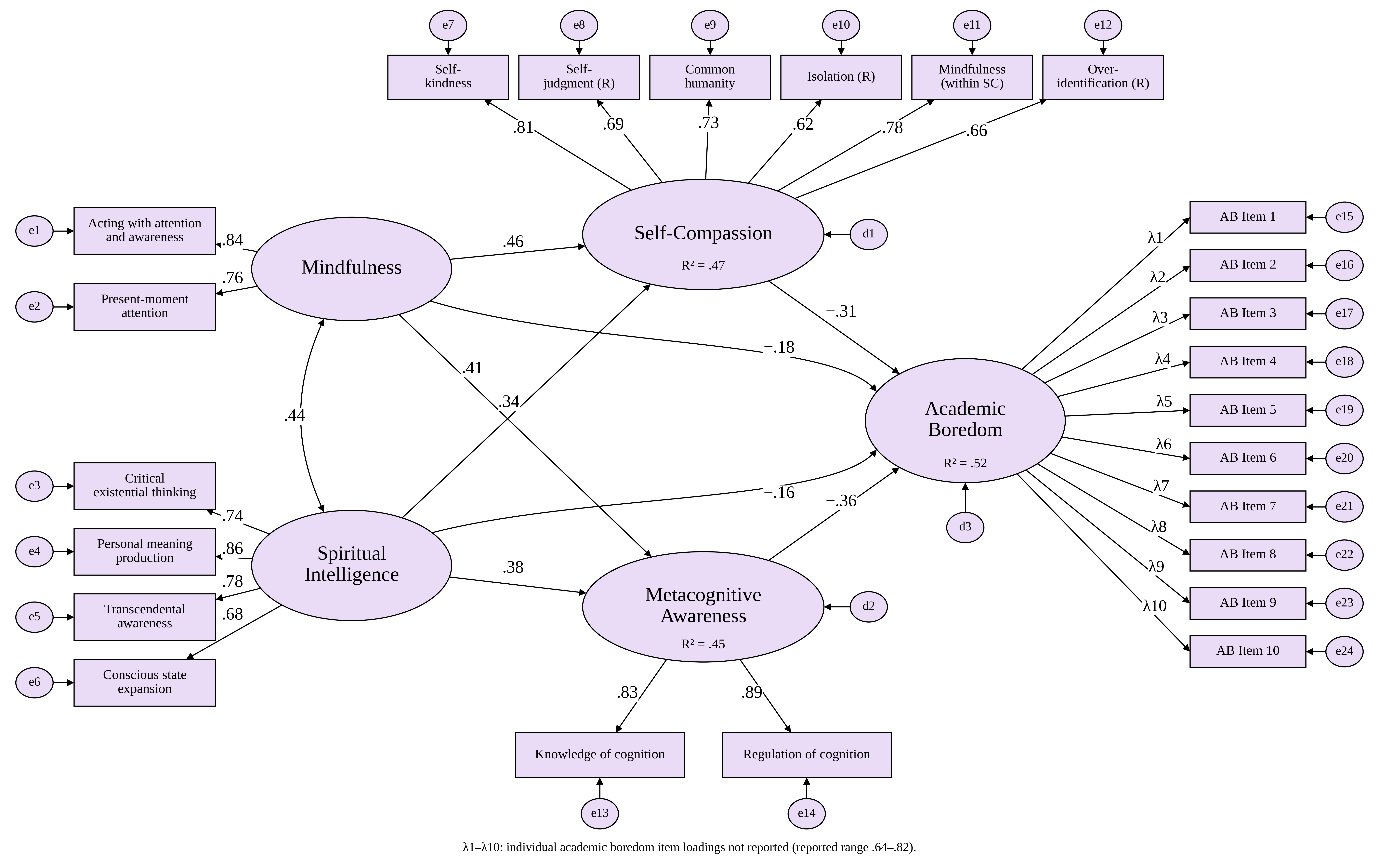
Mindfulness had a significant positive direct effect on self-compassion (β = .46, p < .001) and metacognitive awareness (β = .41, p < .001). Spiritual intelligence also significantly predicted greater self-compassion (β = .34, p < .001) and metacognitive awareness (β = .38, p < .001). Both mediating variables were significantly associated with lower academic boredom. Self-compassion had a significant negative effect on academic boredom (β = −.31, p < .001), and metacognitive awareness had an even stronger negative effect (β = −.36, p < .001).
After the two mediators were included in the model, mindfulness retained a significant direct negative effect on academic boredom (β = −.18, p < .001). Spiritual intelligence also retained a significant direct negative effect on academic boredom (β = −.16, p < .001). Thus, the findings were consistent with partial mediation for both predictors. Mindfulness and spiritual intelligence were moderately and positively correlated in the structural model (r = .44, p < .001). The model explained 47% of the variance in self-compassion, 45% of the variance in metacognitive awareness, and 52% of the variance in academic boredom. These findings indicate that the proposed psychological variables jointly accounted for more than half of the individual differences in students' academic boredom.
Table 5
Standardized Direct Effects in the Structural Model
Structural path | β | SE | CR | p |
Mindfulness → Self-compassion | .46 | .041 | 9.84 | < .001 |
Mindfulness → Metacognitive awareness | .41 | .044 | 8.61 | < .001 |
Spiritual intelligence → Self-compassion | .34 | .038 | 7.55 | < .001 |
Spiritual intelligence → Metacognitive awareness | .38 | .040 | 8.19 | < .001 |
Self-compassion → Academic boredom | −.31 | .046 | −6.74 | < .001 |
Metacognitive awareness → Academic boredom | −.36 | .044 | −7.92 | < .001 |
Mindfulness → Academic boredom | −.18 | .047 | −3.92 | < .001 |
Spiritual intelligence → Academic boredom | −.16 | .043 | −3.68 | < .001 |
The mediating effects of self-compassion and metacognitive awareness were examined using bias-corrected bootstrapping with 5,000 resamples. The indirect effect of mindfulness on academic boredom through self-compassion was significant (β = −.14, 95% CI [−.193, −.097], p < .001). The indirect effect of mindfulness through metacognitive awareness was also significant (β = −.15, 95% CI [−.201, −.103], p < .001). The combined indirect effect of mindfulness through both mediators was therefore β = −.29, 95% CI [−.357, −.230], p < .001.
Spiritual intelligence similarly demonstrated significant indirect effects through both mediators. The indirect pathway through self-compassion was β = −.11, 95% CI [−.151, −.072], p < .001, whereas the indirect pathway through metacognitive awareness was β = −.14, 95% CI [−.183, −.096], p < .001. The total indirect effect of spiritual intelligence on academic boredom was β = −.24, 95% CI [−.304, −.187], p < .001. Because the direct effects of both mindfulness and spiritual intelligence on academic boredom remained statistically significant after inclusion of the mediating variables, self-compassion and metacognitive awareness were interpreted as parallel partial mediators rather than complete mediators.
Table 6
Bootstrapped Indirect Effects on Academic Boredom
Indirect pathway | β | Bootstrap SE | 95% CI | p |
Mindfulness → Self-compassion → Academic boredom | −.14 | .024 | [−.193, −.097] | < .001 |
Mindfulness → Metacognitive awareness → Academic boredom | −.15 | .025 | [−.201, −.103] | < .001 |
Total indirect effect of mindfulness | −.29 | .032 | [−.357, −.230] | < .001 |
Spiritual intelligence → Self-compassion → Academic boredom | −.11 | .020 | [−.151, −.072] | < .001 |
Spiritual intelligence → Metacognitive awareness → Academic boredom | −.14 | .022 | [−.183, −.096] | < .001 |
Total indirect effect of spiritual intelligence | −.24 | .030 | [−.304, −.187] | < .001 |
The total standardized effect of mindfulness on academic boredom was β = −.47. Of this association, β = −.18 represented the residual direct effect and β = −.29 was transmitted indirectly through self-compassion and metacognitive awareness. The total standardized effect of spiritual intelligence on academic boredom was β = −.40, consisting of a direct effect of β = −.16 and a combined indirect effect of β = −.24.
Table 7
Direct, Indirect, and Total Effects on Academic Boredom
Predictor | Direct effect | Indirect effect | Total effect |
Mindfulness | −.18*** | −.29*** | −.47*** |
Spiritual intelligence | −.16*** | −.24*** | −.40*** |
Overall, the findings supported the proposed structural model. Greater mindfulness was associated with greater self-compassion and metacognitive awareness and was directly associated with lower academic boredom. Greater spiritual intelligence showed a similar pattern, predicting higher levels of both mediators and lower academic boredom. In turn, both self-compassion and metacognitive awareness significantly predicted lower academic boredom, with the association involving metacognitive awareness being somewhat stronger.
Bootstrap analyses confirmed that both mediators significantly transmitted the effects of mindfulness and spiritual intelligence to academic boredom. Because the direct paths from mindfulness and spiritual intelligence to academic boredom remained significant, the pattern supported parallel partial mediation. The final model accounted for 47% of the variance in self-compassion, 45% of the variance in metacognitive awareness, and 52% of the variance in academic boredom.
Figure 1
Final structural model of academic boredom
Discussion
The present study examined a structural model of academic boredom based on mindfulness and spiritual intelligence, with self-compassion and metacognitive awareness as parallel mediators among male upper-secondary students. The findings supported the proposed model and indicated that mindfulness and spiritual intelligence were directly and indirectly associated with academic boredom through self-compassion and metacognitive awareness. Specifically, mindfulness significantly predicted greater self-compassion (β = .46) and metacognitive awareness (β = .41) and had a significant direct negative effect on academic boredom (β = −.18). Spiritual intelligence also significantly predicted self-compassion (β = .34) and metacognitive awareness (β = .38), while directly predicting lower academic boredom (β = −.16). Both mediators were inversely related to academic boredom, with self-compassion showing a standardized effect of β = −.31 and metacognitive awareness an effect of β = −.36. Bootstrap analysis further confirmed significant indirect effects for both predictors through both mediators. The total effect of mindfulness on academic boredom was β = −.47, while the total effect of spiritual intelligence was β = −.40. Collectively, the model explained 52% of the variance in academic boredom, indicating that the combination of attentional, meaning-oriented, affective, and metacognitive resources provided substantial explanatory power for individual differences in students’ boredom.
The significant negative association between mindfulness and academic boredom is consistent with previous research suggesting that mindful awareness can reduce disengagement during tedious or repetitive academic activities. Mindfulness enables students to attend more consciously to present-moment experiences and to recognize fluctuations in attention, motivation, and emotional states without responding automatically. In academic situations, this capacity may allow students to notice boredom without immediately shifting toward avoidance, daydreaming, task abandonment, or procrastination. The findings align closely with Galla et al., who showed that mindfulness predicted greater academic diligence in situations characterized by boredom and that students with greater mindfulness were more capable of persisting despite low task stimulation (Galla et al., 2020). The present findings also correspond with intervention evidence demonstrating that mindfulness training can reduce academic boredom in students experiencing procrastination (Mahmoudi Mehr et al., 2026). Taken together, these studies suggest that mindfulness may not necessarily eliminate the occurrence of boredom, but may reduce the extent to which boredom controls attention, motivation, and academic behavior.
The negative relationship between mindfulness and academic boredom is also meaningful in light of the broader consequences of boredom for educational functioning. Academic boredom has consistently been associated with reduced motivation, weaker learning strategies, disengagement, and poorer performance. Meta-analytic evidence demonstrates that boredom has a substantial negative relationship with academic outcomes across educational contexts (Tze et al., 2016). Longitudinal research has additionally indicated a reciprocal relationship between boredom and academic achievement, such that boredom may undermine later performance while weaker performance can subsequently increase boredom (Pekrun et al., 2014). More recent evidence from upper-secondary students similarly suggests that boredom is negatively associated with academic achievement and that greater autonomy support may reduce boredom (Hahnsson Holen et al., 2026). Within this broader context, the present findings suggest that mindfulness may constitute an individual psychological resource capable of interrupting the cycle through which boredom contributes to disengagement and academic decline.
A particularly important finding was the strong positive association between mindfulness and self-compassion. Mindfulness predicted self-compassion with a standardized coefficient of β = .46, representing one of the strongest paths in the structural model. This relationship is conceptually understandable because mindfulness and self-compassion share a nonreactive orientation toward difficult internal experiences. Mindfulness may allow students to become aware of frustration, failure, comparison with peers, or academic disappointment without becoming excessively identified with negative thoughts and emotions. Self-compassion may then shape how students respond to those experiences by encouraging greater self-kindness and reducing harsh self-criticism. Within the Iranian context, the availability of a psychometrically validated self-compassion measure supports the meaningful assessment of these processes among Persian-speaking populations (Khanjani et al., 2016). The present findings therefore suggest that mindful awareness may contribute to academic adjustment partly by promoting a more accepting and supportive relationship with the self.
Self-compassion itself was significantly associated with lower academic boredom, with a standardized path coefficient of β = −.31. This finding is consistent with previous evidence demonstrating that self-compassion is negatively associated with boredom. Chan et al. found that both trait and state self-compassion predicted lower boredom and that meaning in life partly explained this relationship (Chan et al., 2022). This is particularly relevant to academic boredom because students are more likely to disengage from activities that they perceive as meaningless, frustrating, or disconnected from personally important goals. A self-compassionate student may be less likely to interpret temporary academic difficulty as evidence of personal inadequacy and may therefore remain more emotionally engaged with learning. Similarly, Abdellatif reported meaningful structural relationships between self-compassion and academic boredom in university students, supporting the role of compassionate self-regulation in students’ academic quality of life (Abdellatif, 2022).
The mediating role of self-compassion in the association between mindfulness and academic boredom further supports an affective self-regulation interpretation. The significant indirect effect of mindfulness through self-compassion indicates that part of the protective role of mindfulness may operate through students’ capacity to respond more constructively to academic frustration and difficulty. Rather than becoming self-critical when they fail to understand a lesson or struggle to maintain interest, mindful students may be more capable of acknowledging the experience without excessive judgment, thereby preserving emotional resources required for continued engagement. Evidence from adolescent populations supports the broader protective role of self-compassion under stressful educational conditions. Self-compassion has been associated with lower school burnout among high-school students (Ponkosonsirilert et al., 2022), while recent daily-diary research has shown that self-compassion helps explain the relationship between academic stress and state anxiety in high-achieving adolescents (Zhou et al., 2026). These findings reinforce the interpretation that self-compassion may buffer the emotional consequences of demanding academic environments and thereby reduce vulnerability to boredom.
Mindfulness also significantly predicted metacognitive awareness, with a standardized coefficient of β = .41. This finding is theoretically coherent because mindfulness and metacognition both involve awareness of cognitive processes, although they emphasize different functions. Mindfulness facilitates awareness of ongoing experience, including shifts in attention and emotional state, whereas metacognitive awareness involves knowledge about cognition and the deliberate monitoring and regulation of learning. A student who notices that attention has wandered during a repetitive lesson may, through metacognitive awareness, deliberately modify the learning strategy, establish an intermediate goal, monitor comprehension, or redirect attention to the task. The present findings therefore suggest that mindfulness may support not only emotional regulation but also cognitive self-regulation.
Metacognitive awareness demonstrated the strongest negative association with academic boredom among the mediators, with β = −.36. This finding indicates that students who are better able to understand, monitor, and regulate their cognitive processes may be less likely to remain passively disengaged when academic activities become monotonous or demanding. Previous research supports this interpretation. Metacognitive strategies have been associated with improved academic achievement among students (Salari et al., 2013), and longitudinal meta-analytic evidence indicates that initial metacognitive functioning predicts subsequent academic achievement across educational stages (He et al., 2024). A large meta-analysis focused specifically on mathematics achievement likewise demonstrated a meaningful positive association between metacognition and academic performance from preschool through university (Xie et al., 2024). These findings suggest that metacognitive students tend to adopt a more active role in learning, which may reduce the passivity and attentional disengagement characteristic of academic boredom.
More specifically, the present results accord with recent research directly linking metacognition to academic boredom. Nikookar et al. showed that metacognitive strategies contributed to a causal model of mathematics academic boredom in which academic procrastination also played an important role (Nikookar et al., 2025). Similarly, Mahmoudi Mehr et al. found that metacognitive training significantly reduced academic boredom among procrastinating students (Mahmoudi Mehr et al., 2026). These results support the view that students with stronger metacognitive awareness are better able to detect ineffective learning patterns and implement corrective strategies before cognitive disengagement develops into sustained boredom. The significant indirect pathway from mindfulness to academic boredom through metacognitive awareness in the present study therefore suggests that mindful awareness may reduce boredom partly because it facilitates more effective cognitive monitoring and self-regulated learning.
The findings regarding spiritual intelligence also supported the proposed model. Spiritual intelligence had a significant direct negative effect on academic boredom and positively predicted both self-compassion and metacognitive awareness. This pattern suggests that students who are more capable of generating meaning, reflecting on existential issues, and connecting personal experiences to broader goals may be less likely to experience academic activities as empty or purposeless. Meaning is especially important in understanding boredom because boredom frequently emerges when activities are perceived as lacking personal significance. Ma and Wang proposed that spiritual intelligence can enhance academic engagement by strengthening meaning, purpose, psychological resources, and active participation in learning (Ma & Wang, 2022). The present findings are consistent with this theoretical position and suggest that spiritual intelligence may function as a meaning-oriented protective resource against academic disengagement.
The direct relationship between spiritual intelligence and lower academic boredom is also consistent with evidence connecting spiritual intelligence to favorable academic outcomes. Zhou et al., in a systematic review and meta-analysis, found a significant positive relationship between spiritual intelligence and student academic achievement (Zhou et al., 2024). Although academic achievement and boredom represent distinct constructs, both are closely related to engagement, persistence, and students’ appraisal of academic experiences. Students who perceive learning as personally meaningful may be more likely to sustain effort despite temporary difficulty or low stimulation. In this sense, spiritual intelligence may reduce boredom by helping students integrate individual academic tasks within broader educational, personal, and future-oriented goals.
Spiritual intelligence also predicted greater self-compassion. This finding is consistent with previous Iranian research demonstrating a significant structural relationship between spiritual intelligence and self-compassion among university students (Zarrinabadi et al., 2020). The relationship may be explained by the meaning-making and perspective-taking qualities associated with spiritual intelligence. Students capable of interpreting difficulties within a broader personal framework may be less likely to react to mistakes or disappointing academic outcomes through severe self-criticism. Instead, they may view difficulties as part of a wider process of learning and personal development. The significant indirect effect of spiritual intelligence on academic boredom through self-compassion therefore suggests that meaning-oriented psychological capacities may contribute to lower boredom partly by fostering more accepting and compassionate responses to academic difficulty.
The positive relationship between spiritual intelligence and metacognitive awareness also represents an important finding. Although spiritual intelligence and metacognition are conceptually distinct, both involve reflective processes. Spiritual intelligence emphasizes meaning, existential reflection, and interpretation of experience, while metacognitive awareness involves reflection on learning, cognition, and strategy use. Students who habitually reflect on the significance of their experiences may also be more inclined to monitor their own thinking and evaluate whether their current approach to learning is effective. This interpretation is compatible with evidence emphasizing the importance of metacognition for academic achievement (He et al., 2024; Xie et al., 2024). The significant indirect pathway from spiritual intelligence to academic boredom through metacognitive awareness suggests that meaning-oriented reflection may ultimately contribute to lower boredom when it is translated into more active regulation of cognition.
The significant parallel mediation effects are among the most important contributions of the study. The findings showed that self-compassion and metacognitive awareness simultaneously transmitted part of the effects of both mindfulness and spiritual intelligence on academic boredom. For mindfulness, the indirect effect through self-compassion was β = −.14 and through metacognitive awareness β = −.15, while the total indirect effect was β = −.29. For spiritual intelligence, the corresponding indirect effects were β = −.11 and β = −.14, respectively, producing a combined indirect effect of β = −.24. This pattern suggests that academic boredom is influenced through at least two complementary regulatory pathways. Self-compassion represents an affective pathway concerned with how students respond to difficulty and negative self-evaluation, whereas metacognitive awareness represents a cognitive pathway involving monitoring and regulating learning processes. The persistence of significant direct effects for mindfulness and spiritual intelligence indicates partial rather than complete mediation, suggesting that additional processes such as attentional control, boredom tolerance, meaning in life, autonomy, perceived task value, and motivational regulation may also contribute.
The substantial proportion of explained variance in academic boredom further supports the value of integrating these constructs within a single model. The predictors and mediators collectively accounted for 52% of the variance in boredom, while the model explained 47% of the variance in self-compassion and 45% in metacognitive awareness.
Conclusion
These findings reinforce the view that academic boredom is not simply a response to monotonous teaching or insufficiently stimulating content. It also reflects differences in students’ attentional awareness, ability to construct meaning, emotional responses to difficulty, and capacity to regulate cognition. Nevertheless, the remaining unexplained variance indicates that classroom characteristics, instructional quality, autonomy support, task difficulty, achievement experiences, peer influences, and other motivational variables remain important. The documented reciprocal association between academic boredom and achievement (Pekrun et al., 2014) and the role of autonomy in upper-secondary students’ boredom (Hahnsson Holen et al., 2026) particularly underscore the need to understand boredom as a multidetermined phenomenon emerging from the interaction between individual and contextual factors.
Limitations & Suggestions
Several limitations should be considered when interpreting these findings. First, the cross-sectional correlational design does not establish temporal or causal relationships among mindfulness, spiritual intelligence, self-compassion, metacognitive awareness, and academic boredom, even though the proposed structural model was theoretically specified. Reverse or reciprocal relationships are possible. Second, all principal variables were assessed through self-report questionnaires, which may have increased associations because of shared method variance, social desirability, or individual differences in response tendencies. Third, the sample consisted exclusively of male upper-secondary students from Tehran, which limits generalization to female students, younger age groups, university students, and adolescents from other geographical, socioeconomic, or cultural settings. Fourth, although the model explained a substantial proportion of variance in academic boredom, potentially important contextual and motivational factors such as perceived autonomy, classroom climate, task value, teacher support, academic stress, and actual achievement were not incorporated into the structural model.
Future research should employ longitudinal, experimental, and prospective designs to clarify the temporal ordering of the variables and determine whether changes in mindfulness and spiritual intelligence precede changes in self-compassion, metacognitive awareness, and academic boredom. Intervention studies could directly compare mindfulness, self-compassion, metacognitive, and meaning-oriented programs and examine whether changes in the proposed mediators account for reductions in boredom. Future studies should also include female students and more geographically and socioeconomically diverse samples and use multi-group structural equation modeling to investigate gender, grade-level, and educational-field differences. Incorporating objective academic performance, teacher evaluations, behavioral indicators of persistence, classroom observations, and experience-sampling methods would reduce dependence on self-report data. More comprehensive models could additionally examine academic stress, procrastination, autonomy support, task value, achievement goals, meaning in life, emotion regulation, resilience, and classroom characteristics as additional mediating or moderating mechanisms.
From a practical perspective, the findings suggest that school-based approaches to academic boredom should extend beyond attempts to make every academic activity continuously interesting or entertaining. Schools and counselors may instead strengthen students’ capacity to remain engaged when learning is difficult, repetitive, or temporarily unstimulating. Mindfulness exercises can be incorporated into counseling or classroom programs to improve present-moment attention and recognition of emerging disengagement. Self-compassion training may help students respond more adaptively to mistakes, unfavorable comparisons, difficult examinations, and perceived academic inadequacy. Metacognitive instruction can teach students to plan learning activities, monitor comprehension, evaluate strategy effectiveness, and deliberately change ineffective approaches. Educational programs may also encourage students to connect learning with personally meaningful goals, future aspirations, and broader values in culturally appropriate ways. Integrating these approaches may be particularly valuable for students who demonstrate persistent boredom, procrastination, low engagement, or difficulty sustaining effort under demanding academic conditions.
Acknowledgments
We would like to express our appreciation and gratitude to all those who cooperated in carrying out this study.
Declaration of Interest
The authors of this article declared no conflict of interest.
Ethical Considerations
The study protocol adhered to the principles outlined in the Helsinki Declaration, which provides guidelines for ethical research involving human participants.
Transparency of Data
In accordance with the principles of transparency and open research, we declare that all data and materials used in this study are available upon request.
Funding
This research was carried out independently with personal funding and without the financial support of any governmental or private institution or organization.
Authors’ Contributions
All authors equally contributed to this article.
References
Abdellatif, M. S. (2022). Modeling the relationships between academic boredom, self-compassion, and quality of academic life among university students. Sage Open, 12(4). https://doi.org/10.1177/21582440221141703
Abed, M., Kadivar, P., & Khalatbari, J. (2023). Validation of students' academic boredom questionnaire. Rooyesh-e-Ravanshenasi Journal, 11(12), 67-74.
Chan, C. S., van Tilburg, W. A. P., Igou, E. R., Poon, C. Y. S., Tam, K. Y. Y., Wong, V. U. T., & Cheung, S. K. (2022). Self-compassion predicts less boredom: The role of meaning in life. Personality and individual differences, 186, 111360. https://doi.org/10.1016/j.paid.2021.111360
Galla, B. M., Esposito, M. V., & Fiore, H. M. (2020). Mindfulness predicts academic diligence in the face of boredom. Learning and Individual Differences, 81, 101864. https://doi.org/10.1016/j.lindif.2020.101864
Hahnsson Holen, H. C., Lande, G., Idsoe, T., & Tvedt, M. S. (2026). Academic boredom, autonomy granting and academic achievement in upper secondary school. Scandinavian Journal of Educational Research. https://doi.org/10.1080/00313831.2026.2662242
He, G., Chen, S., Lin, H., & Su, A. (2024). The association between initial metacognition and subsequent academic achievement: A meta-analysis of longitudinal studies. Educational psychology review, 36, 81. https://doi.org/10.1007/s10648-024-09922-w
Khanjani, S., Foroughi, A. A., Sadghi, K., & Bahrainian, S. A. (2016). Psychometric properties of Iranian version of Self-Compassion Scale (short form). Pajoohande, 21(5), 282-289.
Ma, Q., & Wang, F. (2022). The role of students' spiritual intelligence in enhancing their academic engagement: A theoretical review. Frontiers in psychology, 13, 857842. https://doi.org/10.3389/fpsyg.2022.857842
Mahmoudi Mehr, M., Dasht Bozorgi, Z., Jayervand, H., & Talebzadeh Shoushtari, M. (2026). Metacognitive and mindfulness training effects on academic boredom and rumination in procrastinating students. Iranian Journal of Practice in Clinical Psychology, 14(2), 185-196.
Mohsenabadi, H., Shabani, M. J., & Zanjani, Z. (2019). Factor structure and reliability of the Mindfulness Attention Awareness Scale for Adolescents and the relationship between mindfulness and anxiety in adolescents. Iranian journal of psychiatry and behavioral sciences, 13(1), e64097. https://doi.org/10.5812/ijpbs.64097
Nikookar, E., Farrokhi, N., Dortaj, F., & Ghaemi, F. (2025). Testing a causal model of mathematics academic boredom based on metacognitive strategies and achievement goal orientation with the mediating role of academic procrastination. Iranian Journal of Learning and Memory, 8(31), 1-16.
Pekrun, R., Hall, N. C., Goetz, T., & Perry, R. P. (2014). Boredom and academic achievement: Testing a model of reciprocal causation. Journal of Educational Psychology, 106(3), 696-710. https://doi.org/10.1037/a0036006
Ponkosonsirilert, T., Laemsak, O., Pisitsungkagarn, K., Jarukasemthawee, S., Audboon, S., & Leangsuksant, T. (2022). Stress, self-compassion, and school burnout in Thai high school students. International Journal of Adolescent Medicine and Health, 34(5), 343-349. https://doi.org/10.1515/ijamh-2020-0109
Salari, M., Hamzah, R., & Hambali, Z. (2013). Meta-cognitive strategies and nursing students' achievement. Journal of Education and Vocational Research, 4(6), 169-173. https://doi.org/10.22610/jevr.v4i6.116
Sharp, J. G., Zhu, X., Matos, M., & Sharp, J. C. (2021). The Academic Boredom Survey Instrument (ABSI): A measure of trait, state and other characteristic attributes for the exploratory study of student engagement. Journal of Further and Higher Education, 45(9), 1253-1280. https://doi.org/10.1080/0309877X.2021.1947998
Tze, V. M. C., Daniels, L. M., & Klassen, R. M. (2016). Evaluating the relationship between boredom and academic outcomes: A meta-analysis. Educational psychology review, 28(1), 119-144. https://doi.org/10.1007/s10648-015-9301-y
Xie, Y., Zeng, F., & Yang, Y. (2024). A meta-analysis of the relationship between metacognition and academic achievement in mathematics: From preschool to university. Acta Psychologica, 249, 104486. https://doi.org/10.1016/j.actpsy.2024.104486
Zarrinabadi, Z., Isfandyari-Moghaddam, A., Erfani, N., & Ahmadi Tahour Soltani, M. (2020). Formulating a structural model of self-compassion based on the spiritual intelligence of the students of medical library and information sciences in Iranian universities of medical sciences. Journal of education and health promotion, 9, 31. https://doi.org/10.4103/jehp.jehp_422_19
Zhou, J., Cao, Y., Deng, X., & Luo, P. (2026). Perceived academic stress predicts state anxiety via self-compassion in high-achieving junior school students: A daily diary study. Journal of adolescence, 98(5), 1780-1790. https://doi.org/10.1002/jad.70180
Zhou, Z., Tavan, H., Kavarizadeh, F., Sarokhani, M., & Sayehmiri, K. (2024). The relationship between emotional intelligence, spiritual intelligence, and student achievement: A systematic review and meta-analysis. BMC Medical Education, 24, 217. https://doi.org/10.1186/s12909-024-05208-5