The Effectiveness of Brain-Based Parenting Training on Parenting Adaptability and Parenting Orientation in Mothers of Children Aged 6 to 10 Years with Anxiety Symptoms
DOI:
https://doi.org/10.61838/kman.aftj.4484Keywords:
Brain-based parenting, Parenting adaptability, Parenting orientation, Anxious children, Parenting interventionAbstract
Objective: This study aimed to examine the effectiveness of brain-based parenting training on enhancing parenting adaptability and parenting orientation among mothers of children aged 6 to 10 years who exhibit anxiety symptoms.
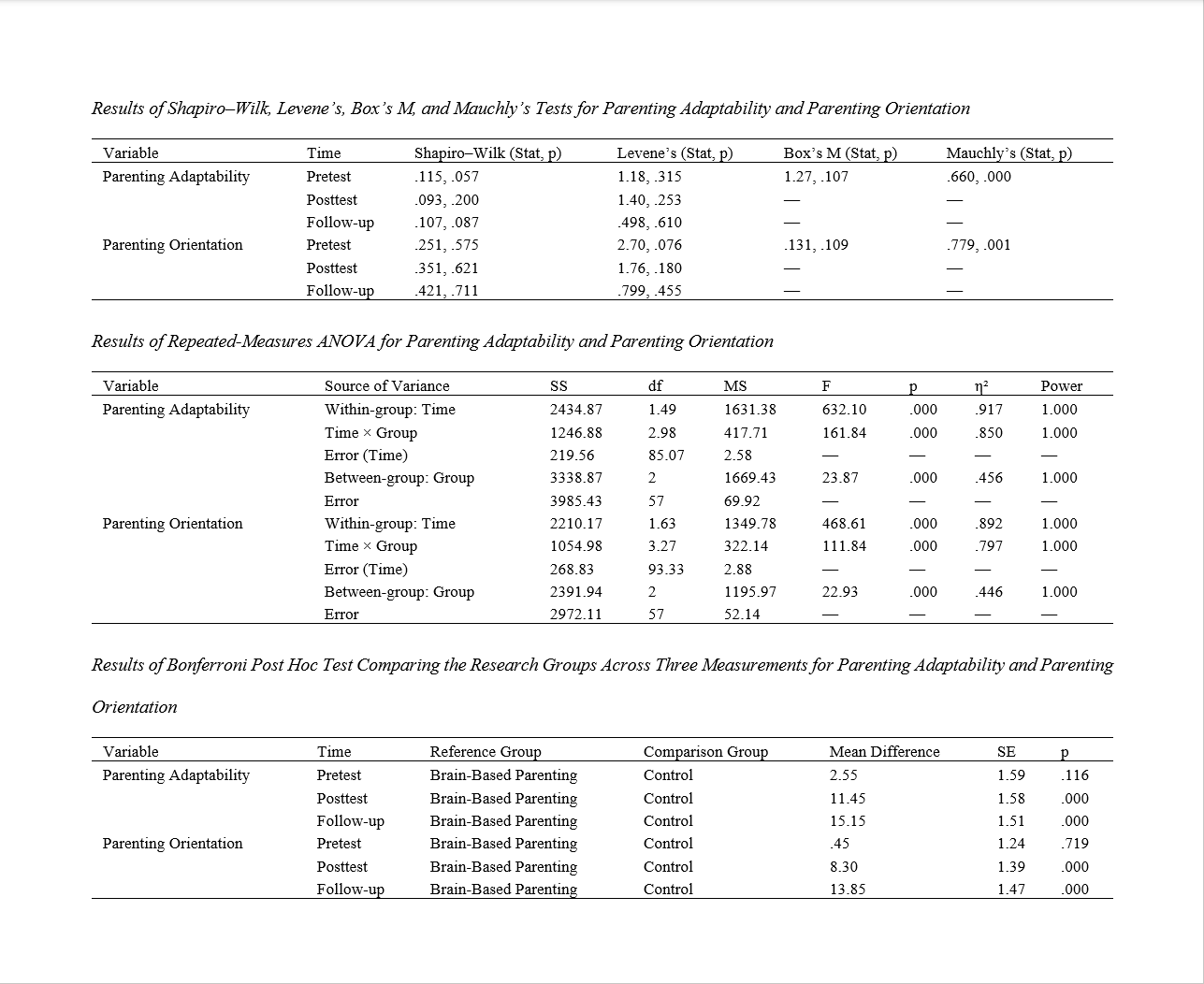
Methods and Materials: The study employed a quasi-experimental design with a pretest–posttest–follow-up structure and a non-equivalent control group. The statistical population consisted of all mothers of children with anxiety symptoms in Isfahan during the 2023–2024 academic year. Based on inclusion and exclusion criteria, 40 mothers were selected through purposive sampling and randomly assigned to an experimental group (n = 20) and a control group (n = 20). The experimental group received eight 90-minute sessions of brain-based parenting training, while the control group was placed on a waiting list. All participants completed the Parenting Adaptability Questionnaire (Yousefi, 2021) and the Parenting Orientation Questionnaire (Yousefi, 2021) at pretest, posttest, and a 45-day follow-up. Data were analyzed using repeated-measures ANOVA and Bonferroni post hoc test in SPSS 26, with significance set at p < .05.
Findings: The results revealed significant time × group interaction effects for both parenting adaptability (F = 161.84, p < .001, η² = .850) and parenting orientation (F = 111.84, p < .001, η² = .797). Post hoc comparisons showed that the experimental group had significantly higher posttest and follow-up scores than the control group on both variables (p < .001). These findings indicate that brain-based parenting training produced sustained improvements in mothers’ adaptability and orientation.
Conclusion: Brain-based parenting training is an effective intervention for improving mothers’ parenting adaptability and orientation, which may contribute to reducing anxiety risk and fostering healthier parent–child relationships.
Downloads
References
Abbaszadeh Arzoo, M., Moulavi, G., Pour Mohammadzadeh Tajrishi, M., & Vahidi, M. (2021). The effectiveness of parenting education on mental health and parent-child relationships in mothers of children with hearing impairments. Journal of Rehabilitation, 22(2), 210-227. https://doi.org/10.32598/RJ.22.2.3258.1
Aliakbari, M., & Aslezaker, M. (2022). The effectiveness of mindful parenting on self-efficacy of mothers and anxiety symptoms in preschool children with anxiety symptoms. Rooyesh, 11(3), 69-80. http://frooyesh.ir/article-1-3416-en.html
Ataran, N., Mozafari, M., Ghorban Jahromi, R., & Amini Manesh, S. (2024). The efficacy of positive parenting training and parenting based on mentalization on improving the mother-child relationship. Journal of Psychological Science, 23(143), 59-78. https://doi.org/10.52547/JPS.23.143.2629
Babaei Motlaq, F., & Tanha, Z. (2023). Comparing the effectiveness of mindfulness-based parenting with choice theory-based parenting in mothers of children diagnosed with oppositional defiant disorder. Research in Child and Adolescent Psychotherapy, 2(2), 21-36.
Babore, A., Trumello, C., Lombardi, L., Candelori, C., Chirumbolo, A., Cattelino, E., & Morelli, M. (2023). Mothers' and children's mental health during the COVID-19 pandemic lockdown: The mediating role of parenting stress. Child Psychiatry & Human Development, 54(1), 134-146. https://doi.org/10.1007/s10578-021-01230-6
Becker, S., Pfost, M., Schiefer, I. M., & Artelt, C. (2019). Relations between life-goal regulation, goal orientation, and education-related parenting: A person-centered perspective. Learning and Individual Differences, 76, 101786. https://doi.org/10.1016/j.lindif.2019.101786
Hossein Karimi, Z., Latifi, Z., & Yousefi, Z. (2024). The Effectiveness of Attachment-Based, Brain-Based, and Mindful Parenting Training on Parental Stress in Children with Symptoms of Social Anxiety. Applied Family Therapy Journal (AFTJ), 5(5), 24. https://doi.org/10.61838/kman.aftj.5.5.3
Jewell, C., Wittkowski, A., & Pratt, D. (2022). The impact of parent-only interventions on child anxiety: A Clinical Anxiety Symptoms. Journal of affective disorders, 309, 324-349. https://doi.org/10.1016/j.jad.2022.04.082
Karimi, H., Latifi, Z., & Yousefi, Z. (2024). The Effectiveness of Brain-Based, Mindful, and Attachment-Based Parenting Training on Parental Orientation of Students with Social Anxiety Symptoms. Journal of Assessment and Research in Applied Counseling (JARAC), 6(4), 116-125. https://doi.org/10.61838/kman.jarac.6.4.14
Khani, R., Abedi, M. R., & Javadzadeh Shahshahani, Z. (2024). The effectiveness of mindful parenting education on the psychological well-being of preschool children. Quarterly Journal of Child Mental Health, 11(3), 1-16. https://doi.org/10.61186/jcmh.11.3.2
Li, D., Li, W., & Zhu, X. (2023). Parenting style and children's emotion management skills among Chinese children aged 3-6: The chain mediation effect of self-control and peer interactions. Frontiers in psychology, 14, Article 1231920. https://doi.org/10.3389/fpsyg.2023.1231920
Lyle, R. (2013). Brain-Based Parenting: The Neuroscience of Caregiving for Healthy Attachment, by Daniel A. Hughes and Jonathan Baylin. Journal of Neurotherapy, 17(2), 140-141. https://doi.org/10.1080/10874208.2013.785843
Maleki Farab, N., Taher, M., & Saidi, M. (2024). Mindfulness-based parenting education for mothers and its effectiveness on social adjustment and emotional regulation of at-risk adolescent girls. Empowerment of Exceptional Children, 15(4), 27-39. https://www.ceciranj.ir/article_217722.html?lang=en
Meng, Z., Luen, L. C., & Abidin, N. H. Z. (2023). Parental role orientation's influence on children's personality formation. International Journal of Education & Technology (IJE-TECH), 1(3), 38-47. https://doi.org/10.59021/ijetech.v1i3.22
Mirzaei, M., Yousefi, Z., & Baratali, M. (2022). Development of an Anxiety Management Package for Mothers with Children Preparing for University Entrance Exams. International Journal of Education and Cognitive Sciences, 5(1), 108-116. https://doi.org/10.61838/kman.ijecs.5.1.13
Mirzaei, M., Yousefi, Z., & Baratali, M. (2024). Development of an Anxiety Management Package for Mothers with Children Preparing for University Entrance Exams. International Journal of Education and Cognitive Sciences, 5(1), 108-116. https://doi.org/10.61838/kman.ijecs.5.1.13
Nili Ahmad Abadi, Z., Bagheri, F., & Salimi Bajestani, H. (2019). The effectiveness of a parenting education program emphasizing choice theory on improving parent-child relationships and mothers' life satisfaction. Counseling and Psychotherapy Culture, 10(39), 99-122. https://qccpc.atu.ac.ir/article_10112_en.html
Rathore, S., Kumar, A., & Gautam, A. (2015). Life satisfaction and life orientation as predictors of psychological well-being. The International Journal of Indian Psychology, 3(1), 20-27. https://doi.org/10.25215/0301.113
Saadati, N., Yousefi, Z., & Golparvar, M. (2020). Effectiveness of Systematic Training of Effective Parenting (STEP) on Parenting Stress, Emotion Regulation, and Cognitive Flexibility on Mothers of Male Adolescents. Applied Psychology, 14(2), 100-177. https://doi.org/10.52547/apsy.14.2.77
Sadeghi Dehkordi, A., Yousefi, Z., & Torkan, H. (2023). Determining the effectiveness of Seligman's parenting style education package on mother-daughter conflicts. Applied Family Therapy Journal (AFTJ), 4(1), 638-648. https://doi.org/10.61838/kman.aftj.4.1.32
Taheri, M., Mansor, M., & Madon, Z. (2021). A Qualitative Study among Refugee Children with Anxiety in Kuala Lumpur, Malaysia: The Effect of Child-Centred Play Therapy on the Social-Emotional Development. International Journal of Academic Research in Business and Social Sciences, 11(12), 407-417. https://doi.org/10.6007/IJARBSS/v11-i12/11787
Downloads
Additional Files
Publication Timeline
- Submitted
- Revised
- Accepted
Issue
Section
License
Copyright (c) 2025 Elham Motovalibashi Naeini (Author); Zahra Yousefi (Corresponding Author); Mohsen Golparvar (Author)

This work is licensed under a Creative Commons Attribution-NonCommercial 4.0 International License.