Exploring the Psychological and Relational Consequences of Smartphone Overuse in Marital Relationships
DOI:
https://doi.org/10.61838/kman.aftj.4511Keywords:
Smartphone overuse, marital relationships, jealousy, intimacy, relational conflict, coping strategies, TaiwanAbstract
Objective: This study aimed to explore the psychological and relational consequences of smartphone overuse in marital relationships.
Methods and Materials: A qualitative research design was employed to gain in-depth insights into couples’ experiences. The study included 24 married participants residing in Taiwan, selected through purposive sampling to capture diverse marital backgrounds. Data were collected through semi-structured interviews, which allowed participants to articulate their perceptions and experiences regarding smartphone use within marriage. Interviews continued until theoretical saturation was reached, and each session lasted between 45 and 70 minutes. With participants’ consent, all interviews were audio-recorded, transcribed verbatim, and analyzed using NVivo 14 software. A thematic analysis approach was applied, with open coding followed by categorization and theme development, ensuring systematic identification of patterns and meanings in the data.
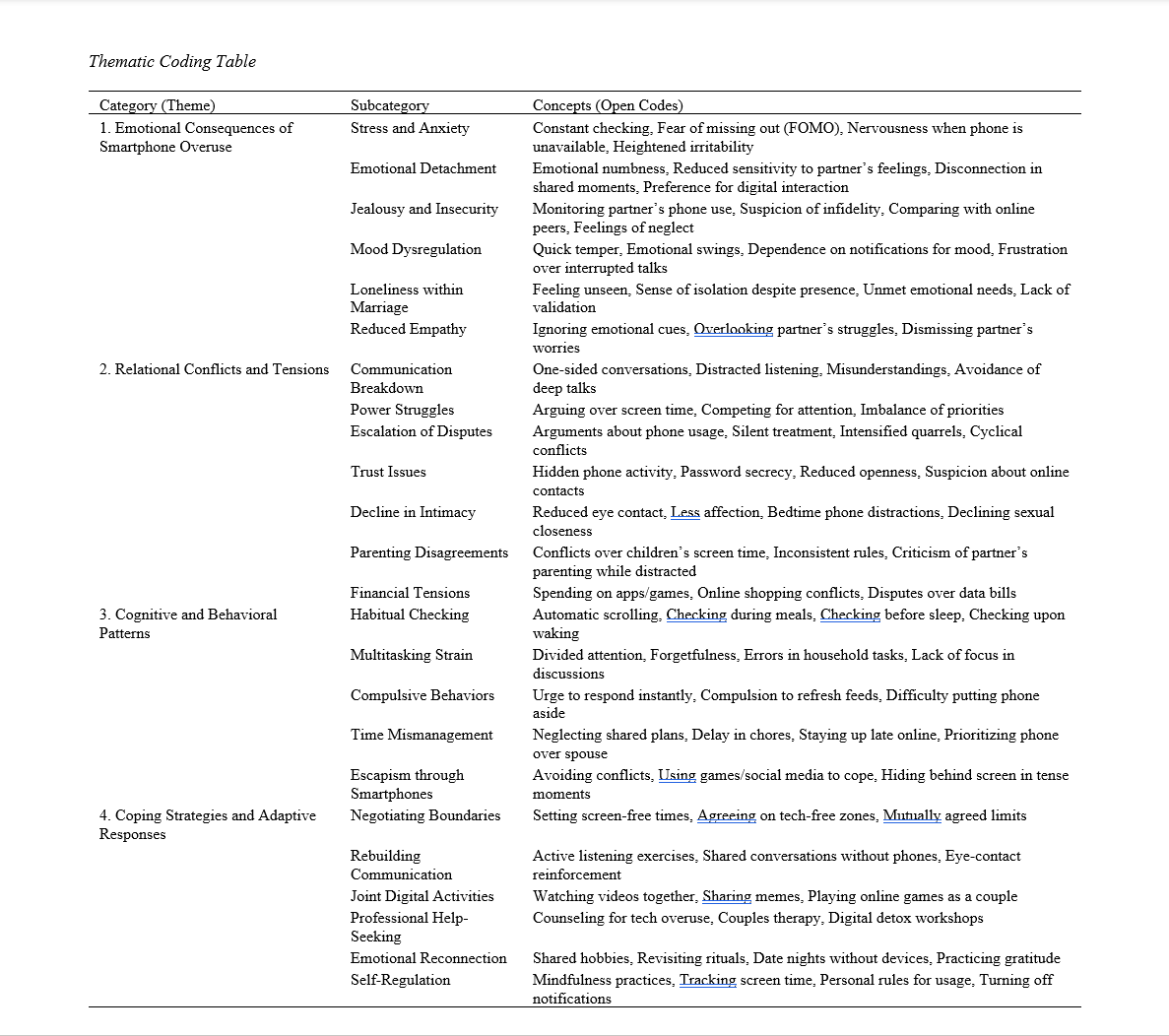
Findings: The analysis generated four overarching themes: (1) Emotional Consequences, including stress, jealousy, mood dysregulation, and loneliness; (2) Relational Conflicts and Tensions, involving communication breakdown, trust issues, intimacy decline, and parenting disagreements; (3) Cognitive and Behavioral Patterns, encompassing habitual checking, compulsive use, time mismanagement, and escapism; and (4) Coping Strategies and Adaptive Responses, which included negotiating boundaries, rebuilding communication, joint digital activities, professional help-seeking, and emotional reconnection. Participants emphasized how smartphone overuse fostered feelings of neglect, suspicion, and conflict while also demonstrating the potential for constructive adaptations when couples actively addressed the challenges.
Conclusion: Smartphone overuse significantly affects marital relationships by eroding intimacy, intensifying jealousy, and provoking conflict. At the same time, couples who implemented intentional strategies, such as setting boundaries and engaging in shared activities, demonstrated resilience and relational recovery. These findings underscore the dual role of smartphones as both relational stressors and potential tools for connection, highlighting the need for awareness, communication, and structured interventions in marital contexts.
Downloads
References
Arnocky, S., Kubinec, K., MacKinnon, M., & Mazmanian, D. (2024). An Experimental Test of Jealousy's Evolved Function: Imagined Partner Infidelity Induces Jealousy, Which Predicts Positive Attitude Towards Mate Retention. Evolutionary Psychology, 22(3). https://doi.org/10.1177/14747049241267226
Arnocky, S., Pearson, M., & Vaillancourt, T. (2015). Health, Anticipated Partner Infidelity, and Jealousy in Men and Women. Evolutionary Psychology, 13(3). https://doi.org/10.1177/1474704915593666
Barelds, D. P. H., & Dijkstra, P. (2021). Exploring the Link Between Bright and Dark Personality Traits and Different Types of Jealousy. Psihologijske teme, 30(1), 77-98. https://doi.org/10.31820/pt.30.1.4
Davis, A. C., Desrochers, J., DiFilippo, A., Vaillancourt, T., & Arnocky, S. (2018). Type of Jealousy Differentially Predicts Cost‐inflicting and Benefit‐provisioning Mate Retention. Personal Relationships, 25(4), 596-610. https://doi.org/10.1111/pere.12262
Dunn, M., & Billett, G. (2017). Jealousy Levels in Response to Infidelity-Revealing Facebook Messages Depend on Sex, Type of Message and Message Composer: Support for the Evolutionary Psychological Perspective. Evolutionary Psychological Science, 4(1), 17-23. https://doi.org/10.1007/s40806-017-0110-z
Edlund, J. E., Buller, D. J., Sagarin, B. J., Heider, J. D., Scherer, C. R., Farc, M.-M., & Ojedokun, O. (2018). Male Sexual Jealousy: Lost Paternity Opportunities? Psychological Reports, 122(2), 575-592. https://doi.org/10.1177/0033294118806556
Edlund, J. E., Kinner, K. M., & Seda, D. (2022). Sex Differences in Jealousy and Personality Differences: Comparing Consensually Non-Monogamous Participants to a Monogamous Cohort. Culture and Evolution, 19(1), 61-67. https://doi.org/10.1556/2055.2022.00015
Hakimov, K. (2023). Aspects of the Difference Between Premeditated Murder Committed Beyond the Limits of Necessary Defense and in a State of Strong Mental Excitement. Jurisprudence, 3(4), 112-121. https://doi.org/10.51788/tsul.jurisprudence.3.4./kcmh1815
Hatfield, E., Rapson, R. L., & Purvis, J. (2020). From Monogamy to Swingers and Polyamory. 151-168. https://doi.org/10.1093/oso/9780190647162.003.0008
Kato, T. (2014). A Reconsideration of Sex Differences in Response to Sexual and Emotional Infidelity. Archives of Sexual Behavior, 43(7), 1281-1288. https://doi.org/10.1007/s10508-014-0276-4
Kemer, G., Bulgan, G., & Yıldız, E. Ç. (2015). Gender Differences, Infidelity, Dyadic Trust, and Jealousy Among Married Turkish Individuals. Current Psychology, 35(3), 335-343. https://doi.org/10.1007/s12144-014-9298-2
Larsen, P. H. H., Bendixen, M., Grøntvedt, T. V., Kessler, A. M., & Kennair, L. E. O. (2021). Investigating the Emergence of Sex Differences in Jealousy Responses in a Large Community Sample From an Evolutionary Perspective. Scientific reports, 11(1). https://doi.org/10.1038/s41598-021-85997-7
Massar, K., & Buunk, A. P. (2019). Expecting and Competing? Jealous Responses Among Pregnant and Nonpregnant Women. Evolutionary Psychology, 17(1). https://doi.org/10.1177/1474704919833344
Naz, Z., & Usman, N. (2019). Infidelity and Its Impact in the Perspective of Women. International Journal of Women Empowerment, 5, 9-14. https://doi.org/10.29052/2413-4252.v5.i1.2019.9-14
Ostria, A., Addauto, L., Castillo, A. d., & Palencia, A. R. (2017). Interacción Por Sexo Y Consumo De Alcohol en El Nivel De Celos E Infidelidad De Estudiantes De Licenciatura De La UAEH. European Scientific Journal Esj, 13(26), 229. https://doi.org/10.19044/esj.2017.v13n26p229
Richter, M., Schlegel, K., Thomas, P., & Troche, S. J. (2022). Adult Attachment and Personality as Predictors of Jealousy in Romantic Relationships. Frontiers in psychology, 13. https://doi.org/10.3389/fpsyg.2022.861481
Scelza, B. A., Prall, S. P., Blumenfield, T., Crittenden, A. N., Gurven, M., Kline, M. A., Koster, J., Kushnick, G., Mattison, S. M., Pillsworth, E. G., Shenk, M. K., Starkweather, K., Stieglitz, J., Sum, C. Y., Yamaguchi, K., & McElreath, R. (2019). Patterns of Paternal Investment Predict Cross-Cultural Variation in Jealous Response. Nature Human Behaviour, 4(1), 20-26. https://doi.org/10.1038/s41562-019-0654-y
Shcherbata, V. G., & Borets, Y. V. (2021). Theoretical Analisis of the Causes of Jealousy. Scientific Herald of Sivershchyna Series Education Social and Behavioural Sciences, 1(6), 179-191. https://doi.org/10.32755/sjeducation.2021.01.179
Shchukina, O. G. (2024). Transformation of Jealousy in Romantic Relationships and Its Catalysts in Digital Age. Vestnik Universiteta(6), 229-236. https://doi.org/10.26425/1816-4277-2024-6-229-236
Sheikhmoonesi, F., Zarghami, M., Faal, A. A., & Parkoohi, P. I. (2020). Study of Subtypes of Non-Delusional Jealousy and Its Association With Personality Aspects and Psychopathological Dimensions in a Young Adult Sample in Iran. Iranian journal of psychiatry and behavioral sciences, 14(4). https://doi.org/10.5812/ijpbs.104176
Toplu‐Demirtaş, E., Kayabol, N. B. A., Aracı‐İyiaydın, A., & Fincham, F. D. (2020). Unraveling the Roles of Distrust, Suspicion of Infidelity, and Jealousy in Cyber Dating Abuse Perpetration: An Attachment Theory Perspective. Journal of interpersonal violence, 37(3-4), NP1432-NP1462. https://doi.org/10.1177/0886260520927505
Valentová, J. V., Fernández, A. M., & Varella, M. A. C. (2020). Jealousy Is Influenced by Sex of the Individual, Their Partner, and Their Rival. https://doi.org/10.31234/osf.io/hypkz
Walum, H., Larsson, H., Westberg, L., Lichtenstein, P., & Magnusson, P. K. E. (2013). Sex Differences in Jealousy: A Population-Based Twin Study in Sweden. Twin Research and Human Genetics, 16(5), 941-947. https://doi.org/10.1017/thg.2013.57
Zheng, X., Xu, X., Xu, L., Kou, J., Luo, L., Ma, X., & Kendrick, K. M. (2021). Intranasal Oxytocin May Help Maintain Romantic Bonds by Decreasing Jealousy Evoked by Either Imagined or Real Partner Infidelity. Journal of Psychopharmacology, 35(6), 668-680. https://doi.org/10.1177/0269881121991576
Downloads
Additional Files
Publication Timeline
- Submitted
- Revised
- Accepted
Issue
Section
License

This work is licensed under a Creative Commons Attribution-NonCommercial 4.0 International License.