Causes of Escalation in High-Arousal Conflicts Among Newlyweds: A Qualitative Exploration
DOI:
https://doi.org/10.61838/kman.aftj.6.3.13Keywords:
newlyweds, high-arousal conflict, emotional triggers, communication patterns, qualitative research, marital stress, conflict escalationAbstract
Objective: This study aimed to explore the underlying emotional, relational, and contextual causes of escalation in high-arousal conflicts among newly married couples to better understand early marital vulnerability and inform preventive interventions.
Methods and Materials: This qualitative research employed an exploratory–descriptive design using semi-structured, in-depth interviews with 24 newlywed individuals (married one to three years) residing in Mexico. Participants were recruited purposively to include variation in gender, socioeconomic status, and educational background. Interviews lasting 60–90 minutes were conducted in Spanish, audio-recorded with consent, and transcribed verbatim. Data analysis followed an inductive thematic approach supported by NVivo 14 software. Coding progressed from open codes to axial categories through constant comparison until theoretical saturation was reached. Trustworthiness was ensured via peer debriefing, audit trails, and reflective journaling.
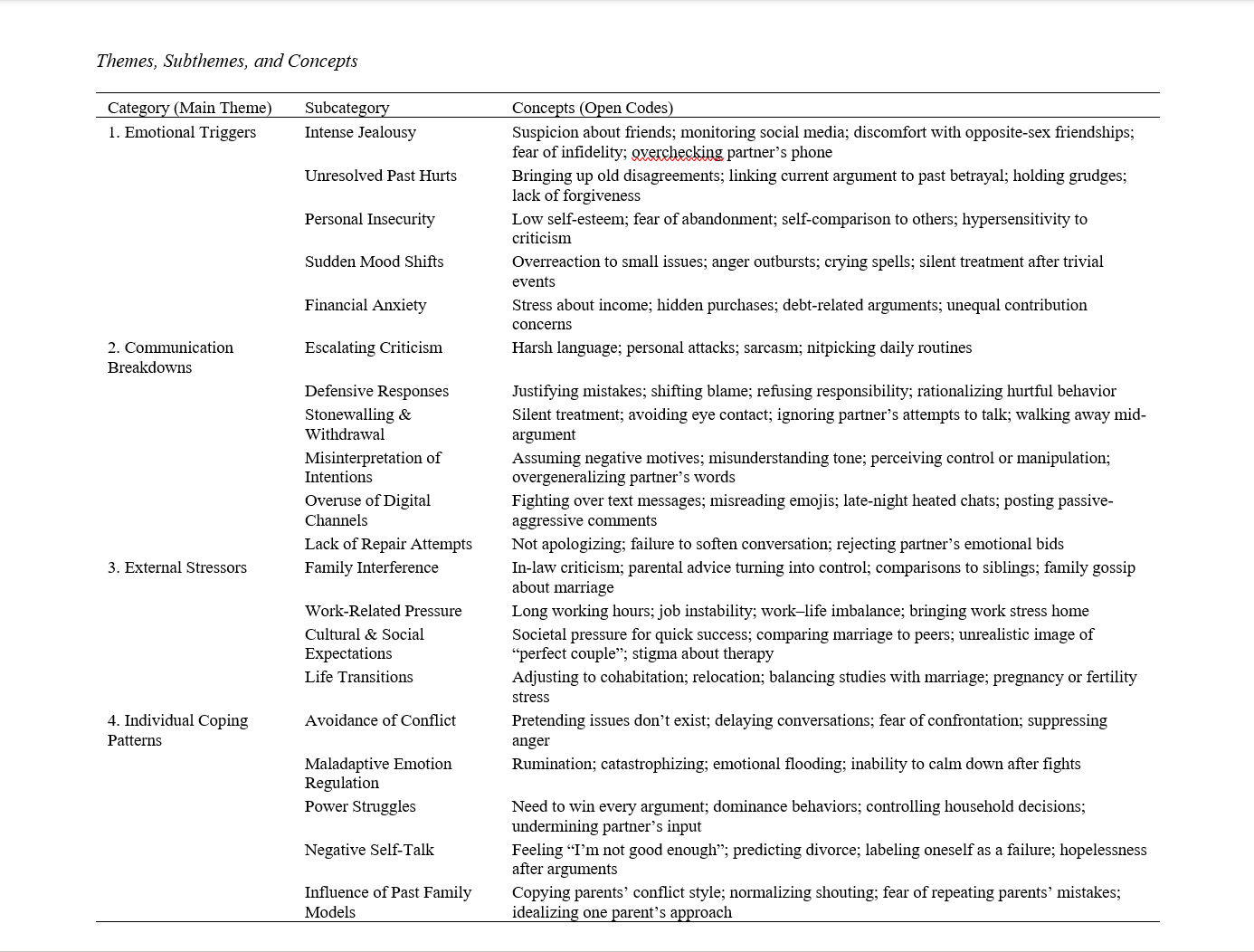
Findings: Four overarching themes explained conflict escalation: emotional triggers (e.g., jealousy, unresolved past hurts, insecurity, sudden mood shifts, financial anxiety), communication breakdowns (e.g., escalating criticism, defensiveness, stonewalling, misinterpretation of intent, digital miscommunication, failed repair), external stressors (e.g., family interference, work pressure, cultural perfectionism, major life transitions, socioeconomic strain), and individual coping patterns (e.g., avoidance of conflict, rumination, catastrophic thinking, power struggles, negative self-talk, inherited conflict scripts). Participants described how intense arousal impaired self-regulation and fueled reactive cycles, while contextual adversity drained emotional resources and exacerbated miscommunication.
Conclusion: High-arousal conflict escalation among newlyweds arises from the interplay of heightened emotional vulnerability, ineffective communication strategies, external pressures, and maladaptive coping. Findings highlight the importance of addressing physiological arousal and emotion regulation, integrating cultural and contextual realities, and equipping couples with early skills to interrupt destructive cycles before they consolidate.
Downloads
References
Adelson, M. J., Nelson, J. A., & Hafiz, M. (2021). Longitudinal Associations Between Household Labor Division Inequity and Conflict Among Newlywed Couples. Journal of Family Issues, 42(12), 2861-2880. https://doi.org/10.1177/0192513x21993185
Alameda, C., Avancini, C., Sanabria, D., Bekinschtein, T. A., Canales‐Johnson, A., & Ciria, L. F. (2023). Staying in Control: Characterising the Mechanisms Underlying Cognitive Control in High and Low Arousal States. https://doi.org/10.1101/2023.04.17.536548
Alameda, C., Avancini, C., Sanabria, D., Bekinschtein, T. A., Canales‐Johnson, A., & Ciria, L. F. (2024). Staying in Control: Characterizing the Mechanisms Underlying Cognitive Control in High and Low Arousal States. British Journal of Psychology, 115(4), 665-682. https://doi.org/10.1111/bjop.12715
Amemori, K. i., Amemori, S., Gibson, D. J., & Graybiel, A. M. (2020). Striatal Beta Oscillation and Neuronal Activity in the Primate Caudate Nucleus Differentially Represent Valence and Arousal Under Approach-Avoidance Conflict. Frontiers in Neuroscience, 14. https://doi.org/10.3389/fnins.2020.00089
Avancini, C., Ciria, L. F., Alameda, C., Palenciano, A. F., Canales‐Johnson, A., Bekinschtein, T. A., & Sanabria, D. (2023). High-Intensity Physiological Activation Disrupts the Neural Signatures of Conflict Processing. https://doi.org/10.1101/2023.07.31.550835
Baucom, B., Sheng, E., Christensen, A., Georgiou, P., Narayanan, S., & Atkins, D. C. (2015). Behaviorally-Based Couple Therapies Reduce Emotional Arousal During Couple Conflict. Behaviour Research and Therapy, 72, 49-55. https://doi.org/10.1016/j.brat.2015.06.015
Beck, L. A., Pietromonaco, P. R., DeVito, C. C., Powers, S. I., & Boyle, A. M. (2013). Congruence Between Spouses’ Perceptions and Observers’ Ratings of Responsiveness. Personality and Social Psychology Bulletin, 40(2), 164-174. https://doi.org/10.1177/0146167213507779
Chang, S.-C., Chang, J. H., Low, M.-Y., Chen, T.-C., & Kuo, S. H. (2020). Self-Regulation of the Newlyweds in Taiwan: Goals and Strategies. Journal of Social and Personal Relationships, 37(8-9), 2674-2690. https://doi.org/10.1177/0265407520929762
Citron, F., Abugaber, D., & Herbert, C. (2016). Approach and Withdrawal Tendencies During Written Word Processing: Effects of Task, Emotional Valence, and Emotional Arousal. Frontiers in psychology, 6. https://doi.org/10.3389/fpsyg.2015.01935
DeBuse, C. J., Pietromonaco, P. R., & Powers, S. I. (2011). A Threat vs. Challenge View of Conflict in Romantic Relationships. https://doi.org/10.1037/e634112013-684
Fehring, D. J., Samandra, R., Rosa, M. G. P., & Mansouri, F. A. (2019). Negative Emotional Stimuli Enhance Conflict Resolution Without Altering Arousal. Frontiers in human neuroscience, 13. https://doi.org/10.3389/fnhum.2019.00282
Gan, H., Li, M., Wang, X., Yang, Q., Tang, Y., Wang, B., Liu, K., Zhu, P., Shao, S., & Tao, F. (2023). Low and Mismatched Socioeconomic Status Between Newlyweds Increased Their Risk of Depressive Symptoms: A Multi-Center Study. Frontiers in Psychiatry, 13. https://doi.org/10.3389/fpsyt.2022.1038061
Ha, H. J., & Yang, H. C. (2025). The Effects of Internalized Shame on Marital Intimacy Among Newlyweds: The Sequential Mediation Effect of Relationship Authenticity and Perceived Marital Support. Korean Academy Welfare Counseling, 14(1), 75-101. https://doi.org/10.20497/jwce.2025.14.1.75
Hall, S. S., & Adams, R. (2020). “Not Just Me Anymore.” a Qualitative Study of Transitioning to Marriage After Cohabitation. Journal of Family Issues, 41(12), 2275-2296. https://doi.org/10.1177/0192513x20943915
Jo, M., & Lee, S. (2025). The Effects of Self-Differentiation on Newly-Wedded Couples' Marital Satisfaction: The Moderated Mediating Effect of Conflict Management Style According to Gender. Korean Assoc Learner-Centered Curric Instr, 25(12), 573-590. https://doi.org/10.22251/jlcci.2025.25.12.573
Landman, L. L., & Steenbergen, H. v. (2020). Emotion and Conflict Adaptation: The Role of Phasic Arousal and Self-Relevance. Cognition & Emotion, 34(6), 1083-1096. https://doi.org/10.1080/02699931.2020.1722615
Lavner, J. A., Karney, B. R., & Bradbury, T. N. (2014). Relationship Problems Over the Early Years of Marriage: Stability or Change? Journal of Family Psychology, 28(6), 979-985. https://doi.org/10.1037/a0037752
Liao, T., Tang, Y., Yang, X., Gao, Y., Liu, Y., Zhu, P., Tao, F., & Shao, S. (2022). Physical Activity Moderates the Association Between Negative Life Events and Depression Symptom in Newlyweds: A Large Multicenter Cross-Sectional Study. https://doi.org/10.21203/rs.3.rs-2112901/v1
Masón, L., Zaccoletti, S., Scrimin, S., Tornatora, M. C., Florit, E., & Goetz, T. (2019). Reading With the Eyes and Under the Skin: Comprehending Conflicting Digital Texts. Journal of Computer Assisted Learning, 36(1), 89-101. https://doi.org/10.1111/jcal.12399
McKone, K. M., Woody, M. L., Ladouceur, C. D., & Silk, J. S. (2021). Mother-Daughter Mutual Arousal Escalation and Emotion Regulation in Adolescence. Research on Child and Adolescent Psychopathology, 49(5), 615-628. https://doi.org/10.1007/s10802-020-00763-z
Mhs, M. F. Y., & Amirullah, B. (2025). The Role of Marriage Counseling Services in Efforts to Improve Household Harmony for Newly Married Couples (Case Study at Al-Amien Applied Psychology Institute Al-Amien Islamic Boarding School Prenduan Sumenep). Maklumat, 3(1), 34-46. https://doi.org/10.61166/maklumat.v3i1.48
Monk, J. K., Ogolsky, B. G., Rice, T. M., Dennison, R. P., & Ogan, M. A. (2020). The Role of Family-of-Origin Environment and Discrepancy in Conflict Behavior on Newlywed Marital Quality. Journal of Social and Personal Relationships, 38(1), 124-147. https://doi.org/10.1177/0265407520958473
Nadeem, U., & Mohamad, Z. S. (2025). Exploring Emotional Availability and Psychological Adjustment in Newlywed Men in Malaysia: A Qualitative Study. International Journal of Innovative Research and Scientific Studies, 8(5), 507-515. https://doi.org/10.53894/ijirss.v8i5.8761
Park, S.-S. (2013). The Evaluation of an Education Program for the Marital Relationship Enhancement of a Newlywed Couple : With a Focus on an Education Program for Newlywed Couples at a Healthy Family Support Center. Journal of Korean Home Management Association, 31(1), 85-98. https://doi.org/10.7466/jkhma.2013.31.1.085
Wang, Y. M., Li, T., & Li, L. (2017). Valence Evaluation With Approaching or Withdrawing Cues: Directly Testing Valence–arousal Conflict Theory. Cognition & Emotion, 32(4), 904-912. https://doi.org/10.1080/02699931.2017.1353483
Williamson, H. C., & Lavner, J. A. (2019). Trajectories of Marital Satisfaction in Diverse Newlywed Couples. Social Psychological and Personality Science, 11(5), 597-604. https://doi.org/10.1177/1948550619865056
Xu, H. (2022). The Development and Effect Evaluation of the Newlyweds' Relationship Education Program in China. Advances in Social Sciences Research Journal, 9(4), 55-63. https://doi.org/10.14738/assrj.94.12131
Zeng, Q., Qi, S., Li, M., Yao, S., Ding, C., & Yang, D. (2016). Enhanced Conflict-Driven Cognitive Control by Emotional Arousal, Not by Valence. Cognition & Emotion, 31(6), 1083-1096. https://doi.org/10.1080/02699931.2016.1189882
Downloads
Additional Files
Publication Timeline
- Submitted
- Revised
- Accepted
Issue
Section
License

This work is licensed under a Creative Commons Attribution-NonCommercial 4.0 International License.