Exploring the Role of Humor as a Coping Component in Marital Satisfaction
DOI:
https://doi.org/10.61838/kman.aftj.4408Keywords:
Humor, Coping strategies, Marital satisfaction, Intimacy, Communication, Resilience, Qualitative researchAbstract
Objective: This study aimed to explore how humor functions as a coping mechanism that contributes to marital satisfaction among couples in Slovenia.
Methods and Materials: A qualitative design was employed, relying on semi-structured interviews to capture couples’ lived experiences of humor in marriage. Twenty-four participants (12 couples) from Slovenia, married for at least three years, were recruited using purposive sampling. Interviews were conducted until theoretical saturation was achieved, with each session lasting between 60 and 90 minutes. Data were transcribed verbatim and analyzed thematically using NVivo 14 software. Trustworthiness was enhanced through peer debriefing, member checking, and triangulation with field notes.
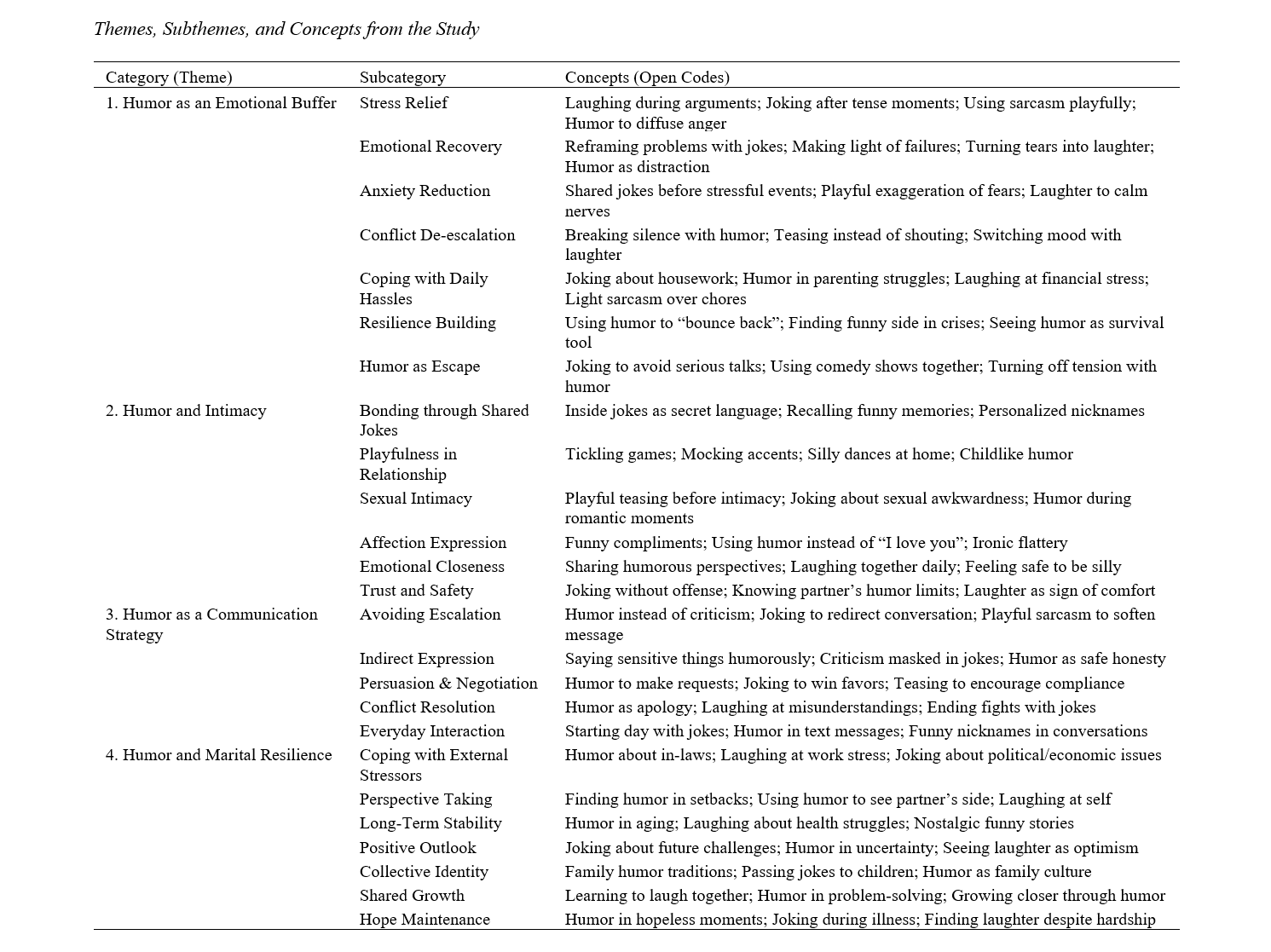
Findings: Four major themes emerged from the data: (1) Humor as an Emotional Buffer, where couples described humor as a strategy for stress relief, emotional recovery, and conflict de-escalation; (2) Humor and Intimacy, highlighting the role of shared jokes, playful teasing, and affectionate humor in strengthening closeness and trust; (3) Humor as a Communication Strategy, with participants explaining how humor allowed them to soften criticism, indirectly express sensitive issues, and repair conflicts; and (4) Humor and Marital Resilience, where humor facilitated coping with external stressors, fostered perspective-taking, and sustained hope during challenges such as illness or financial strain. Couples reported that affiliative and self-enhancing humor styles were most beneficial, while aggressive humor could undermine satisfaction. Humor was also noted as increasingly expressed through digital interactions, including memes and messaging.
Conclusion: The findings suggest that humor is a multidimensional coping resource in marriage, functioning simultaneously as an emotional, relational, communicative, and resilience-enhancing tool. While humor generally promotes marital satisfaction, its effects depend on style and context. These insights highlight the importance of constructive humor in maintaining healthy, satisfying, and enduring marital relationships.
Downloads
References
Brody, N., & Cullen, S. P. (2023). Meme Sharing in Relationships: The Role of Humor Styles and Functions. First Monday. https://doi.org/10.5210/fm.v28i5.12789
Chuang, S. P., Wu, J. Y. W., & Wang, C. S. (2021). Humor Styles Moderate the Relationship Between Rumination and Mental Health in Community Residents. Sage Open, 11(4). https://doi.org/10.1177/21582440211054477
Crowe, J., Yoerger, M., Harms, M., Lehmann‐Willenbrock, N., & Allen, J. A. (2019). Meeting Mirth: The Critical Role of Impression Management and Humor Style in Meetings. Humor - International Journal of Humor Research, 32(1), 23-48. https://doi.org/10.1515/humor-2017-0103
Fritz, H. L. (2021). Caregiving in Quarantine: Humor Styles, Reframing, and Psychological Well-Being Among Parents of Children With Disabilities. Journal of Social and Personal Relationships, 39(3), 615-639. https://doi.org/10.1177/02654075211043515
Gheorghe, A., Curşeu, P. L., & Fodor, O. C. (2024). Personality and Humor in Groups: Implications for Collective Emotional Intelligence, Psychological Safety and Satisfaction. Team Performance Management, 30(1/2), 1-22. https://doi.org/10.1108/tpm-07-2023-0054
Idrees, A., & Batool, S. (2020). Styles of Humor and Interpersonal Relationships in University Students. Fwu Journal of Social Sciences, 14(4), 57-67. https://doi.org/10.51709/fw12725
James, R. (2024). Supervisor’s Styles of Humour and Employee’s Satisfaction: Is Gender a Matter of Influence? Journal of Business Studies, 11(1), 25-43. https://doi.org/10.4038/jbs.v11i1.101
Kucharski, A., & Rutkowska, E. (2019). Humor Styles and Communication in Relationships. Socialization & Human Development International Scientific Journal, 13-24. https://doi.org/10.37096/shdisj-19-1.1-0002
Lazzaro, A., Bolton, M. J., & Kieffer, K. (2022). A Brief Report on Amusement in College Students: The Positive Effects of Affiliative and Self-Enhancing Humor Styles on Romantic Relationship Satisfaction and Psychological Wellbeing. https://doi.org/10.31234/osf.io/cu5yh
Love, Z. M., Bowler, J. L., & Bowler, M. C. (2020). The Influence of Humor on Workplace Mentoring and Employee Attitudes. Social Behavior and Personality an International Journal, 48(9), 1-12. https://doi.org/10.2224/sbp.8459
Ostovar, S., Griffiths, M. D., Raeisi, T., & Hashim, I. H. M. (2020). Path Analysis of the Relationship Between Optimism, Humor, Affectivity, and Marital Satisfaction Among Infertile Couples. International journal of mental health and addiction, 21(1), 200-214. https://doi.org/10.1007/s11469-020-00341-w
Purol, M. F., & Chopik, W. J. (2022). Partner Accuracy in Humor Perception and Associations With Relationship Satisfaction. Personality and Social Psychology Bulletin, 49(5), 791-805. https://doi.org/10.1177/01461672221080950
Rüzgar, N. (2018). The Effect of the Perceptıon of Employees About Theır Managers’ Humor Styles on Job Satısfactıon. Archives of Business Research, 6(4). https://doi.org/10.14738/abr.64.4399
Salavera, C., & Supervía, P. U. (2017). Relationship Between the Use of Humor and Life Satisfaction in Secondary School Students. European Journal of Investigation in Health Psychology and Education, 7(2), 87-97. https://doi.org/10.3390/ejihpe7020007
Salavera, C., & Supervía, P. U. (2018). Relación Entre Los Estilos Del Humor Y La Satisfacción Con La Vida en Estudiantes De Secundaria. European Journal of Investigation in Health Psychology and Education, 7(2), 87. https://doi.org/10.30552/ejihpe.v7i2.198
Sobral, F., Furtado, L., & Islam, G. (2019). Humor as Catalyst and Neutralizer of Leadership Effectiveness. Revista De Administração De Empresas, 59(5), 313-327. https://doi.org/10.1590/s0034-759020190502
Souza, A. M. d., Félix, B., Andrade, A. M. d., & Cerqueira, A. d. S. (2019). Humor No Trabalho: Um Estudo Sobre a Relação Entre Estilos De Humor, Satisfação Com a Chefia E Desempenho Individual No Trabalho. Revista De Administração Da Ufsm, 12(4), 803-820. https://doi.org/10.5902/1983465919382
Staton, T. A. (2025). Assessing the Relationship Between Resilience, Humor Styles, and Retention Across Semesters. Advances in Social Sciences Research Journal, 12(3), 163-173. https://doi.org/10.14738/assrj.123.18522
Sunil, N. T., Jegathesan, A. J., & Prihadi, K. D. (2024). Nice Couple, Funny Couple, Happy Couple: Emotional Intelligence, Humor Style, and Relationship Satisfaction. International Journal of Public Health Science (Ijphs), 13(4), 1769. https://doi.org/10.11591/ijphs.v13i4.24030
Theisen, J. C., Ogolsky, B. G., Simpson, J. A., & Rholes, W. S. (2019). Dyad to Triad: A Longitudinal Analysis of Humor and Pregnancy Intention During the Transition to Parenthood. Journal of Social and Personal Relationships, 36(11-12), 3611-3630. https://doi.org/10.1177/0265407519831076
Tsai, M.-N., Cheng, Y.-C., & Chen, H. C. (2023). Humor Styles and Marital Satisfaction: Cluster Analysis of the Relationship. Psychological Reports, 127(5), 2405-2426. https://doi.org/10.1177/00332941221149151
Wang, M., Zou, H., Zhang, W., & Hou, K. P. (2018). Emotional Intelligence and Subjective Well-Being in Chinese University Students: The Role of Humor Styles. Journal of Happiness Studies, 20(4), 1163-1178. https://doi.org/10.1007/s10902-018-9982-2
Yue, X. (2017). How Humor Styles Affect Self-Compassion and Life Satisfaction: A Study in Hong Kong. Acta Psychopathologica, 03(04). https://doi.org/10.4172/2469-6676.100113
Downloads
Additional Files
Publication Timeline
- Submitted
- Revised
- Accepted
Issue
Section
License

This work is licensed under a Creative Commons Attribution-NonCommercial 4.0 International License.