Thematic Analysis of the Concept of Marital Jealousy among High-Conflict Couples
DOI:
https://doi.org/10.61838/kman.aftj.4925Keywords:
Marital jealousy, jealousy reduction, couple relationships, family systems, qualitative research, thematic analysisAbstract
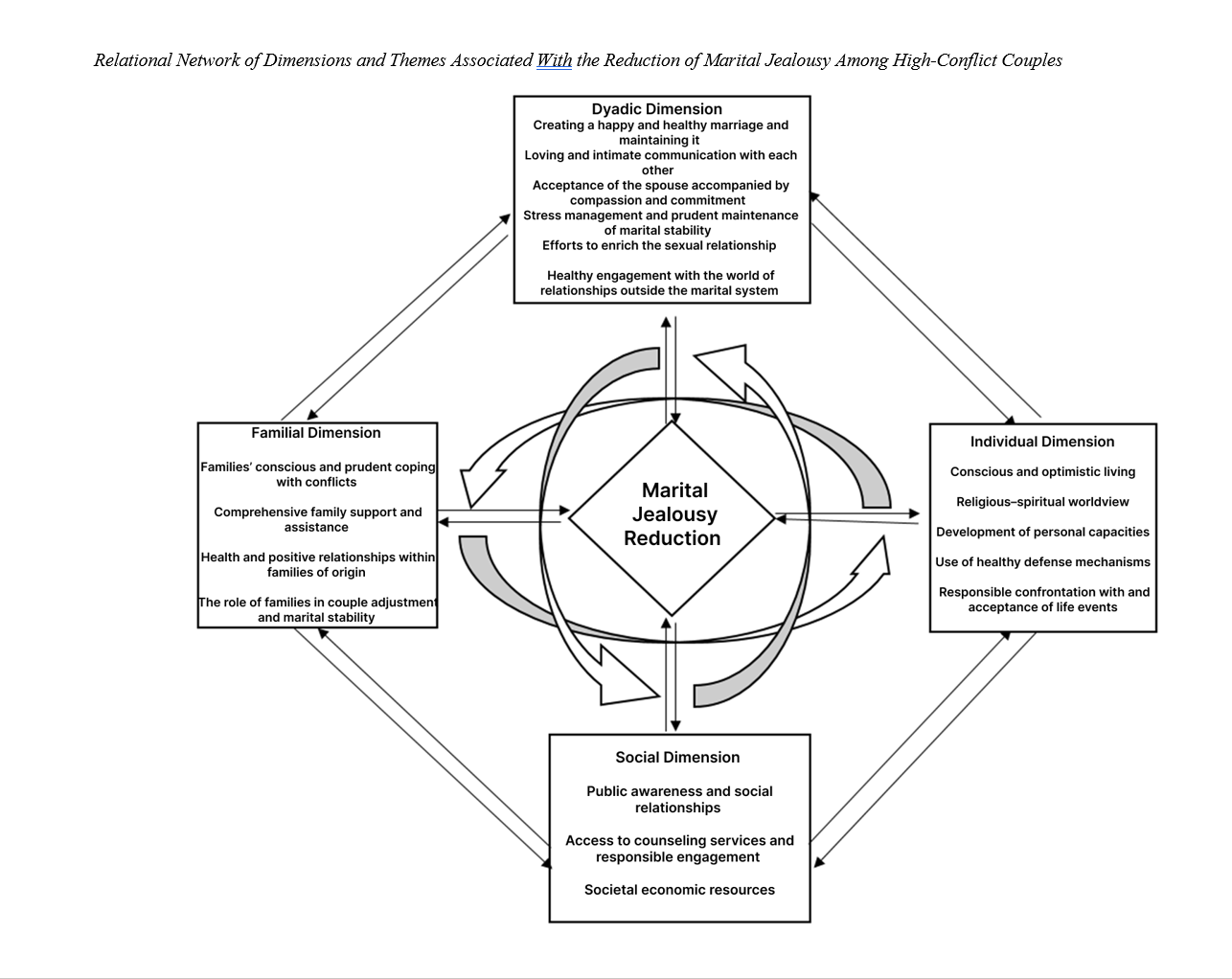
Objective: The objective of this study was to develop a model of marital jealousy reduction dimensions underlying jealousy regulation among couples.
Methods and Materials: This qualitative study employed a thematic analysis approach to explore the lived experiences of high-conflict couples who reported successful jealousy reduction. Participants were selected through purposive sampling from family counseling centers, and data were collected using semi-structured in-depth interviews conducted until theoretical saturation was achieved. Interviews were transcribed verbatim and analyzed using an inductive–deductive coding strategy following Attride-Stirling’s thematic network model. MAXQDA software was used to manage and organize data. Trustworthiness was ensured through triangulation, negative case analysis, peer debriefing, member checking, and intercoder reliability assessment using Cohen’s kappa coefficient.
Findings: The analysis yielded a four-dimensional model of marital jealousy reduction consisting of individual, dyadic, familial, and social dimensions. Each dimension comprised several principal themes that interacted in a dynamic, circular pattern. Individual factors included emotional self-regulation, optimistic meaning-making, spiritual orientation, personal growth, and mature defense mechanisms. Dyadic processes involved marital satisfaction, intimate communication, compassionate commitment, adaptive stress management, sexual enrichment, and constructive engagement with external relationships. Familial influences encompassed supportive conflict management, emotional and material backing, healthy family-of-origin functioning, and strong endorsement of marital stability. Social determinants included public awareness, access to professional counseling services, and broader socioeconomic conditions.
Conclusion: Marital jealousy reduction emerges as a complex systemic process shaped by reciprocal interactions across personal, relational, familial, and societal levels, underscoring the necessity of integrated, multilevel interventions in both clinical practice and social policy.
Downloads
References
Aloyce, D., Mshana, G., Peter, E., Malibwa, D., Buller, A. M., McHome, Z., Kapiga, S., & Stöckl, H. (2023). Pathways of Romantic Jealousy to Intimate Partner Violence in Mwanza, Northern Tanzania. Family Relations, 73(2), 843-857. https://doi.org/10.1111/fare.12880
Arbinaga, F., Mendoza-Sierra, M. I., Caraballo-Aguilar, B. M., Buiza-Calzadilla, I., Torres-Rosado, L., Bernal-López, M., & Fernández-Ozcorta, E. J. (2021). Jealousy, violence, and sexual ambivalence in adolescent students according to emotional dependency in the couple relationship. Children, 8(11), 993. https://doi.org/10.3390/children8110993
Arnocky, S., Kubinec, K., MacKinnon, M., & Mazmanian, D. (2024). An Experimental Test of Jealousy's Evolved Function: Imagined Partner Infidelity Induces Jealousy, Which Predicts Positive Attitude Towards Mate Retention. Evolutionary Psychology, 22(3). https://doi.org/10.1177/14747049241267226
Chursina, A. (2023). The Impact of Romantic Attachment Styles on Jealousy in Young Adults. Psychology in Russia State of Art, 16(3), 222-232. https://doi.org/10.11621/pir.2023.0315
David, M. E., & Roberts, J. A. (2021). Investigating the Impact of Partner Phubbing on Romantic Jealousy and Relationship Satisfaction: The Moderating Role of Attachment Anxiety. Journal of Social and Personal Relationships, 38(12), 3590-3609. https://doi.org/10.1177/0265407521996454
De Cristofaro, V., Pellegrini, V., Salvati, M., & Giacomantonio, M. (2023). Examining and understanding patterns of cognitive, emotional, and behavioral jealousy: Dispositional Mindfulness as a protective factor in romantic relationships. Journal of Social and Personal Relationships. https://doi.org/10.1177/02654075221139631
Deng, M., Tadesse, E., Khalid, S., Zhang, W., Song, J., & Gao, C. (2023). The Influence of Insecure Attachment on Undergraduates’ Jealousy: The Mediating Effect of Self-Differentiation. Frontiers in psychology, 14. https://doi.org/10.3389/fpsyg.2023.1153866
Edlund, J. E., Kinner, K. M., & Seda, D. (2022). Sex Differences in Jealousy and Personality Differences: Comparing Consensually Non-Monogamous Participants to a Monogamous Cohort. Culture and Evolution, 19(1), 61-67. https://doi.org/10.1556/2055.2022.00015
Fallahzadeh, H., Asadi, M., Mostafa, V., & Hamidi, O. (2022). Predicting marital jealousy based on self-differentiation components and attachment styles. Family Research, 18(3), 535-550. https://jfr.sbu.ac.ir/article_102939.html?lang=en
Khazaei, S., Salimi, H., Namjoo, S., & Abedini Chamgordani, S. (2022). The Structural Relationships between Romantic Jealousy, Marital Stability and Marital Satisfaction Mediated by Marital Control and Emotional Expression: An Evolutionary Perspective. Iranian Evolutionary Educational Psychology Journal, 4(3), 554-563. https://doi.org/10.52547/ieepj.4.3.554
Kovan, A. (2023). Social Media Jealousy and Life Satisfaction in Romantic Relationships: Mediation Role of Communication Skills. Actualidades en Psicología, 37(135), 111-127. https://doi.org/10.15517/ap.v37i135.51265
Kyegombe, N., Stern, E., & Buller, A. M. (2022). “We saw that jealousy can also bring violence”: A qualitative exploration of the intersections between jealousy, infidelity and intimate partner violence in Rwanda and Uganda. Social Science & Medicine, 292, 114593. https://doi.org/j.socscimed.2021.114593
Nesterova, A. A., & Shchukina, O. G. (2024a). Features of the Manifestation of Romantic Jealousy and Building Relationships in Men and Women. Bulletin of the State University of Education. Series: Psycholo(1), 87-104. https://doi.org/10.18384/2949-5105-2024-1-87-104
Nesterova, A. A., & Shchukina, O. G. (2024b). Social-Psychological Predictors of Jealousy Destroying Couple Relationships. Bulletin of the Moscow State Regional University(4). https://doi.org/10.18384/2224-0209-2024-4-1518
Rahimi, E., Rafiei-Honar, H., & Kheirollahi, M. (2021). The Relationship between Wisdom and Jealousy Mediated by Self-Esteem: A Path Analysis. Revelatory Ethics, 11(1), 291-322. https://ethics.isramags.ir/article_134658_en.html?lang=en
Richter, M., Schlegel, K., Thomas, P., & Troche, S. J. (2022). Adult Attachment and Personality as Predictors of Jealousy in Romantic Relationships. Frontiers in psychology, 13. https://doi.org/10.3389/fpsyg.2022.861481
Shcherbata, V. G., & Borets, Y. V. (2021). Theoretical Analisis of the Causes of Jealousy. Scientific Herald of Sivershchyna Series Education Social and Behavioural Sciences, 1(6), 179-191. https://doi.org/10.32755/sjeducation.2021.01.179
Shchukina, O. G. (2024). Transformation of Jealousy in Romantic Relationships and Its Catalysts in Digital Age. Vestnik Universiteta(6), 229-236. https://doi.org/10.26425/1816-4277-2024-6-229-236
Sheikhmoonesi, F., Zarghami, M., Faal, A. A., & Parkoohi, P. I. (2020). Study of Subtypes of Non-Delusional Jealousy and Its Association With Personality Aspects and Psychopathological Dimensions in a Young Adult Sample in Iran. Iranian journal of psychiatry and behavioral sciences, 14(4). https://doi.org/10.5812/ijpbs.104176
Toplu‐Demirtaş, E., Kayabol, N. B. A., Aracı‐İyiaydın, A., & Fincham, F. D. (2020). Unraveling the Roles of Distrust, Suspicion of Infidelity, and Jealousy in Cyber Dating Abuse Perpetration: An Attachment Theory Perspective. Journal of interpersonal violence, 37(3-4), NP1432-NP1462. https://doi.org/10.1177/0886260520927505
Valentova, J. V., de Moraes, A. C., & Varella, M. A. C. (2020). Gender, sexual orientation and type of relationship influence individual differences in jealousy: A large Brazilian sample. Personality and individual differences, 157(4), 109805. https://doi.org/10.1016/j.paid.2019.109805
Valentová, J. V., Fernández, A. M., & Varella, M. A. C. (2020). Jealousy Is Influenced by Sex of the Individual, Their Partner, and Their Rival. https://doi.org/10.31234/osf.io/hypkz
Ventura‐León, J., Tocto‐Muñoz, S., Lino‐Cruz, C., Sánchez‐Villena, A. R., Martinez‐Munive, R., Talledo‐Sánchez, K., & Casiano‐Valdivieso, K. (2025). Myths of Romantic Love, Negative Interactions, Relationship Involvement, Satisfaction, Infidelity, and Jealousy in Peruvian Individuals With Couples: Directed and Undirected Network Analysis. Journal of marital and family therapy, 51(2). https://doi.org/10.1111/jmft.70014
Downloads
Additional Files
Publication Timeline
- Submitted
- Revised
- Accepted