Factors Affecting Extramarital Relationships in Iran: A Meta-Synthesis Study
Keywords:
Extramarital Relationships, Married Couples, Meta-Synthesis, Model Development, Marital Commitment, Family CounselingAbstract
Objective: The present study aimed to develop a comprehensive model of the factors influencing extramarital relationships in Iran through a meta-synthesis of Iranian research conducted between 2012 and 2022.
Methods and Materials: This study employed a qualitative meta-synthesis approach to integrate and analyze findings from previous Iranian studies on extramarital relationships. The statistical population consisted of all domestic research published between 2012 and 2022 that addressed factors associated with extramarital relationships among married couples. A purposive sampling strategy was used, and a systematic search was conducted across major scientific databases, including Google Scholar, Noormags, IranDoc, Magiran, the Scientific Information Database (SID), and the Comprehensive Portal of Humanities. Following screening and eligibility assessment, 37 relevant studies were selected for analysis. Data were extracted, coded, categorized, and synthesized using qualitative content analysis procedures. To ensure the trustworthiness and validity of the findings, expert evaluation was conducted, and the resulting model was assessed using Cohen’s Kappa coefficient.
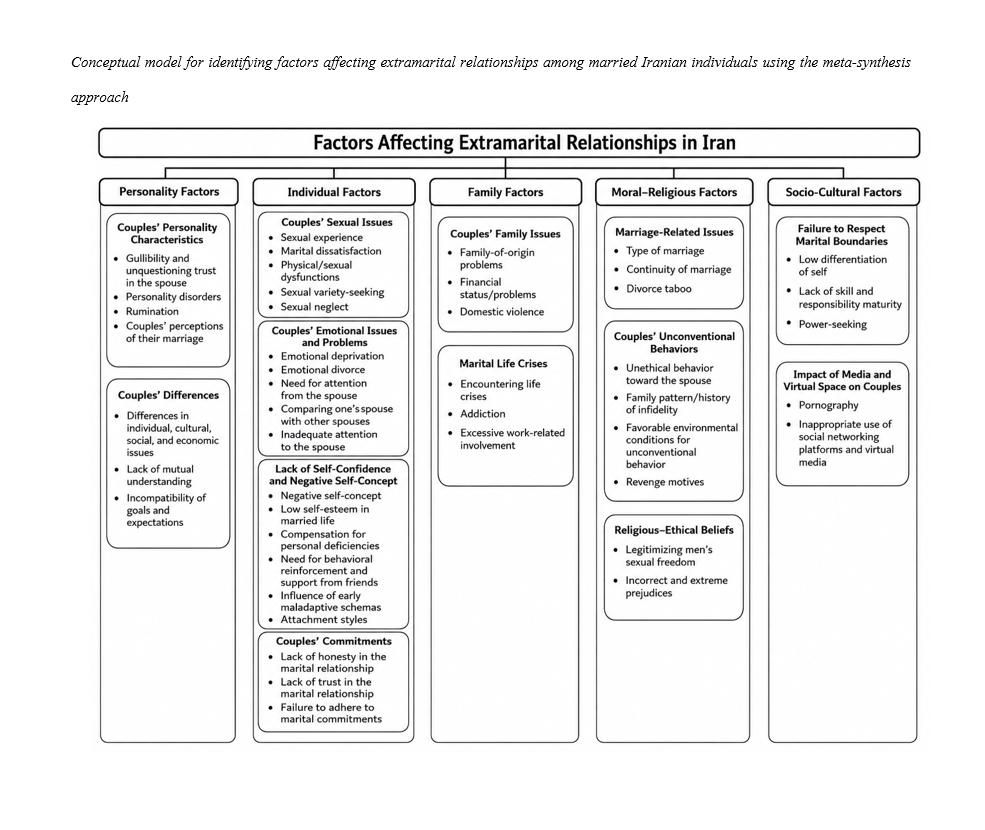
Findings: The meta-synthesis identified five major categories of factors affecting extramarital relationships in Iran, comprising 13 dimensions and 46 underlying concepts. The first category, personality factors, included the dimensions of spouses’ personality traits and interpersonal differences. The second category, individual factors, encompassed sexual and physical issues, emotional difficulties, low self-esteem and negative self-concept, and marital commitment. The third category, family factors, consisted of family-related problems and marital life crises. The fourth category, moral-religious factors, included marriage-related issues, unconventional behaviors, and religious and ethical beliefs. Finally, cultural-social factors comprised inadequate boundary maintenance and the influence of media and virtual social spaces. The proposed conceptual model demonstrated acceptable validity, with an expert agreement coefficient (Kappa) of 0.71, confirming the reliability and coherence of the framework.
Conclusion: The findings indicate that extramarital relationships in Iran are influenced by a complex interaction of personality, individual, familial, moral-religious, and socio-cultural factors. The multidimensional nature of these relationships suggests that prevention and intervention efforts should address both intrapersonal and contextual determinants.
Downloads
References
Abuzari, H., Rashidpour, P., & Barzegari, A. (2018). The Effect of Infidelity in Marital Relationships, Its Influencing Factors, and Comparison of Causes of Infidelity. Second International Conference on Innovation and Research in Educational Sciences, Management and Psychology, Tehran.
Afrasiabi, H., & Razavi, A. (2021). Suspension of Life: Representation of Marital Infidelity in Iranian Cinema Films of the 2000s and 2010s. Strategic Research on Social Problems in Iran, 10(32), 1-22. https://doi.org/10.22108/srspi.2021.127119.1673
Afshari Kashanian, O., Zahrakar, K., Mohsenzadeh, F., & Tajik Esmaeili, A. (2018). Identifying Contextual Factors of Marital Infidelity in Women. Counseling Research, 18(71), 122-156. https://doi.org/10.29252/jcr.18.71.121
Afshari Kermani, M. H. (2020). Causal Layered Analysis (CLA) of Extramarital Relationships among Couples in Tehran and Presentation of a Desirable Policy Baqir al-Olum University, Faculty of Culture, Social and Behavioral Sciences].
Ahmadi Ardakani, Z., Zarei Mahmoudabadi, H., & Kalateh Sadati, A. (2021). Qualitative Analysis of Contextual Factors of Extramarital Relationships among Women with Experience of Extramarital Relationships. Quarterly Journal of Counseling Research, Iranian Counseling Association, 20(80). https://doi.org/10.18502/qjcr.v20i80.8496
Ahmadi, K., Samadzadeh, M., & Kiamanesh, A. (2024). Identifying the Cycle of Aggression among Iranian Couples: A Qualitative Study. Cultural-Educational Quarterly of Women and Family, 19(69), 246-271. https://dor.isc.ac/dor/20.1001.1.26454955.1403.19.69.10.5
Alibakhshi, Z. (2024). The Mediating Effect of Moral Foundations on the Relationship between Power Structure and Marital Satisfaction in Tehran. Cultural-Educational Quarterly of Women and Family. https://cwfs.ihu.ac.ir/article_209504.html
Amani, A., Khaleghpanah, K., & Mohammadi, A. (2019). Lived Experience of Women Harmed by Spouses' Extramarital Relationships in Sanandaj. Family Counseling and Psychotherapy, 9(2). https://doi.org/10.34785/J015.2019.011
Avani, M., & Zarei Mahmoudabadi, H. (2020). Revealing the Why and Contexts of Women's Extramarital Bonds from the Perspective of Harmed Men: A Grounded Theory Study. Family Counseling and Psychotherapy, 10(1). https://dor.isc.ac/dor/20.1001.1.22516654.1399.10.1.6.7
Bahmanesh, F., & Rezaei, M. (2020). Explaining Married Women's Understanding and Experience of Extramarital Relationships: A Qualitative Study. Islamic Lifestyle Centered on Health, 4(2), 16-27. https://www.magiran.com/p2209070
Basharpour, S., & Miri, M. (2018). The Mediating Role of Moral Disengagement in the Relationship between Dark Personality Traits and Marital Infidelity Readiness. Iranian Journal of Psychology, 22(3), 271-286. http://www.iranapsy.ir/en/Article/13970905165797
Beltrán-Morillas, A. M., Alonso-Ferres, M., Garrido-Macías, M., Villanueva-Moya, L., Sánchez-Hernández, M. D., & Expósito, F. (2022). The Relationship Between the Motivation to Commit Infidelity and Negative Affect and Self-Esteem: How Cheating in Romance Might Signal Positive Well-Being in Adolescents. Psychological Reports, 125(1), 517-544. https://doi.org/10.1177/0033294120973947
Choupani, M., Sohrabifard, M. M., Mohammadi, F., Esmaili, N., & Samadi, A. F. (2019). Unfaithful Men's Perception of Causes and Deterrents of Extramarital Relationships: A Qualitative Study. Counseling Research, 18(69), 79-105. https://doi.org/10.29252/jcr.18.69.79
Ejtehadi, M., & Vahedi, G. (2017). A Sociological Study of the Potential for Infidelity in Marital Relationships and Its Influencing Factors. Iranian Journal of Sociology, 17(4), 105-138. https://dor.isc.ac/dor/20.1001.1.17351901.1395.17.4.5.2
Eslamzadeh, M. (2019). Meta-Analysis of Factors Affecting the Formation of Infidelity from 2007 to 2017 Islamic Azad University, Marvdasht Branch].
Firouzjaeian, A. A., & Ghadiri, H. (2017). A Phenomenological Study of the Reasons for Marital Infidelity. Iranian Journal of Social Studies, 11(1), 123-147. http://noo.rs/kvVg7
Ghaem Mohammadi, M. R., Rezapour Mirsaleh, Y., & Aryanpour, H. R. (2023). Understanding Lived Experiences of Marital Infidelity with an Emphasis on Consequences and Strategies in Yazd. Journal of Disability Studies, 13(63), 1-7. http://jdisabilstud.org/article-1-3082-fa.html
Ghafourian Norouzi, P., Asghari Ebrahimabad, M. J., Abdkhodaei, M. S., & Kimiaei, S. A. (2018). Factors Affecting Extramarital Relationships among Married Women: A Qualitative Study. Applied Psychological Research, 9(3), 55-75. https://doi.org/10.22059/japr.2018.69568
Gholami, N., Salehzadeh, M., Bakhshayesh, A., & Karimian, M. (2024). The Mediating Role of Shame in the Relationship between Self-Concept and Marital Conflicts among Married People. Cultural-Educational Quarterly of Women and Family, 19(69), 133-158. https://dor.isc.ac/dor/20.1001.1.26454955.1403.19.69.5.0
Gholamikia, M., Karami, J., & Goodarzi, M. (2023). Effectiveness of Emotion Regulation on Family Functioning and Marital Commitment in Couples with Low Resilience. Applied Family Therapy Quarterly, 4(4), 553-565. https://www.magiran.com/p2647990
Golbarian, M., Arefi, M., Goodarzi, M., & Sharaf Bayani, M. (2025). Designing an Iranian-Islamic Efficient Family Model and Its Effectiveness on Marital Conflicts of Divorce-Seeking Couples. Cultural-Educational Quarterly of Women and Family, 20(72), 180-203. https://dor.isc.ac/dor/20.1001.1.26454955.1404.20.72.8.6
Goodarzi, M., & Ghobaadi, S. (2022). Comparison of the Effectiveness of Choice Theory-Based Couple Therapy and EIS Model Couple Therapy Training on Marital Conflicts, Functional Flexibility, and Marital Burnout among Infertile Women during COVID-19 Quarantine. Journal of Clinical Psychology, 14(2), 89-106. http://noo.rs/yAgNn
Habibi Asgarabad, M., & Haji Heydari, Z. (2015). Causes of Marital Infidelity from the Perspective of Couples Referring to Family Court: A Qualitative Study. Family Research Quarterly, 11(42), 1-66. https://jfr.sbu.ac.ir/article_96356.html?lang=en
Hackathorn, J., & Ashdown, B. K. (2021). The Webs We Weave: Predicting Infidelity Motivations and Extradyadic Relationship Satisfaction. The Journal of Sex Research, 58(2), 170-182. https://doi.org/10.1080/00224499.2020.1746954
Harris, C. (2018). Characteristics of Emotional and Physical Marital Infidelity That Predict Divorce Alliant International University]. USA.
Heydari Mamadi, T., Vaziri Yazdi, S., & Ebadi, S. H. (2019). Exploring the Process of Marital Betrayal among Clients of Noor Hospital Social Psychiatry Center. Behavioral Sciences Research, 17(2), 336-347. https://doi.org/10.52547/rbs.17.2.336
Hosseini, S. M., Aslani, K., & Attari, Y. A. (2019). Identifying Conditions Affecting Marital Infidelity among Married Men: A Grounded Theory Study. Journal of Qualitative Research in Health Sciences, 8, 44-55. https://www.magiran.com/p2529123
Jamali, M., Shakeri, T., Ahmadi, F., & Azadfallah, P. (2020). Contextual Factors of Men's Extramarital Relationships: A Qualitative Study of Women's Experiences. Journal of Nursing Rehabilitation Research, 6(3), 85-93. http://ijrn.ir/article-1-518-fa.html
Kanaani, M. A., & Alijani, M. (2021). Extramarital Relationships and Their Contexts: A Qualitative Study in Rasht. Sociology of Social Institutions Quarterly, 8, 273-286. https://doi.org/10.22080/ssi.2022.22927.1960
Khaledian, M., Shahmoradi, S., & Madani, Y. (2023). Explaining the Process of Marital Infidelity Formation among Women with Substance-Dependent Husbands. Addiction Research Quarterly, 17(67), 197-228. https://doi.org/10.52547/etiadpajohi.17.67.197
Khodadadi Sangdeh, J., & Farjad Tehrani, T. (2020). Identifying Contextual Factors of Men's Marital Betrayal from Women's Perspectives. Journal of Mashhad University of Medical Sciences, 63, 101-110. https://doi.org/10.22038/mjms.2020.18108
Khorramabadi, R., Sepehri Shamloo, Z., Salehi Fadardi, J., & Bigdeli, I. (2018). Structural Model of Executive Functions and Extramarital Relationships with the Mediating Role of Self-Control. Cognitive Psychology Quarterly, 6(1), 46-57. https://dor.isc.ac/dor/20.1001.1.23455780.1397.6.1.6.7
Khorramdel, K., & Hajjar, A. (2019). Identification and Ranking of Factors Affecting Marital Infidelity: A Delphi Study. Sixth International Conference on New Research Achievements in Social Sciences, Educational Sciences and Psychology, Isfahan.
Lashgari, M. (2018). A Review of Factors Affecting the Occurrence of Extramarital Relationships among Married Individuals. Third Conference on Community Empowerment in Humanities and Psychological Studies, Tehran.
Malek Asgar, S., Mazaheri, M. A., Fati, L., Motabi, F., & Heidari, M. (2020). Schema Therapists' Views on the Role of Schema Components in the Etiology of Marital Infidelity: A Qualitative Study. Family Research Quarterly, 16(62), 199-216.
Masaeli, H. (2022). Qualitative Analysis of the Views of Women with Extramarital Relationships toward the Phenomenon of Infidelity Feiz al-Islam Institute of Higher Education]. https://jfr.sbu.ac.ir/article_97816.html?lang=fa
Mohammadi, H., Goodarzi, M., & Rezaei, S. (2020). Structural Model of Marital Commitment Based on Communication Beliefs and Early Maladaptive Schemas with the Mediating Role of Couple Communication Patterns, Sexual Satisfaction, and Conflict Resolution Styles among Married Students of Payame Noor University of Kermanshah. New Approaches in Islamic Studies, 2(5), 377-405. https://civilica.com/doc/1595161
Mohammadmirzaei, M., Tajbakhsh, G. R., Hosseini, M. R., & Mohammadmirzaei, Z. (2018). Contextual Factors of Marital Infidelity in Borujerd City. Second Scientific Research Conference on New Approaches in Humanities in Iran, Ilam.
Nargesi, A., Jadiri, J., & Hadi, M. (2019). Contextual Factors of Extramarital Relationships Based on Islamic Sources. Islamic Psychology Research Journal, 5(10). https://psychology.riqh.ac.ir/article_13245.html?lang=fa
Nasiri, Z., Honarparvaran, N., Javadzadeh Shahshahani, F., & Samani, S. (2022). Identifying Contextual and Revealing Factors in Marital Infidelity: A Qualitative Study. Applied Family Therapy Journal, 3(1), 110-135. https://doi.org/10.22034/aftj.2022.305871.1208
Negash, S., Veldorale-Brogan, A., Kimber, S. B., & Fincham, F. D. (2016). Predictors of Extradyadic Sex among Young Adults in Heterosexual Dating Relationships: A Multivariate Approach. Sexual and Relationship Therapy, 1-20. https://doi.org/10.1080/14681994.2016.1219334
Nikbakhsh, H., Hashemzehi, N., & Malekian, N. (2021). Why Married Men Have Extramarital Relationships in Tehran. Strategic Studies on Sport and Youth(55). https://doi.org/10.22034/ssys.2022.2202.2574
Roustaei, M., Badihi Zeraati, F., & Pourakbaran, E. (2016). The Effect of Emerging Media (Internet, Satellite and Mobile Phone) on Couples' Emotional Infidelity and Its Influencing Factors. Journal of Fundamentals of Mental Health, 18(1), 419-423. https://civilica.com/doc/1798703/
Sabbaghi, F., Salehi, K., & Moghaddamzadeh, A. (2016). Couples' Perception and Lived Experience of the Causes of Emotional Divorce: A Phenomenological Study. Counseling Research, 16(2), 4-31. http://irancounseling.ir/journal/article-1-196-fa.html
Sadeghi, A., Goodarzi, M., & Karimi Sani, P. (2024). Design and Validation of an Online Post-Divorce Adjustment Intervention Protocol. Journal of Psychological Science, 23(143), 160-176. https://doi.org/10.52547/JPS.23.142.2571
Salari Zare, Z., Goodarzi, M., Zandi, F., & Karimi Sani, P. (2022). Effectiveness of a Training Program Based on Indigenous Qualitative Research Related to Successful Marriage on Marital Conflicts. Knowledge and research in applied psychology, 23(2), 123-133. https://doi.org/10.30486/jsrp.2020.1892866.2302
Salehnia, M., Khodadadi Sangdeh, J., & Dehdast, K. (2025). The Role of Family Emotional Support in Marital Quality of Life from Women's Perspective. Cultural-Educational Quarterly of Women and Family, 20(71), 85-109. https://dor.isc.ac/dor/20.1001.1.26454955.1404.20.71.2.8
Samadi Kashan, S., Pourqannad, M., & Zamani Zarchi, M. S. (2019). Marital Infidelity: An Exploration of Perspectives, Factors, and Consequences. Rooyesh-e-Ravanshenasi Journal, 8(4), 165-176. https://dor.isc.ac/dor/20.1001.1.2383353.1398.8.4.22.4
Sarabi, P., Imanizad, A., Elahiyari, V., & Parvizi, F. (2022). Analyzing the Causes and Consequences of Extramarital Relationships (Marital Infidelity) from the Viewpoint of Married Youth in Kermanshah: A Grounded Theory Study. Rooyesh-e-Ravanshenasi Journal, 11(6). https://dor.isc.ac/dor/20.1001.1.2383353.1401.11.6.9.6
Seydi Avandi, S. (2022). Examining the Effect of Social Factors on Tendency toward Extramarital Relationships: Case Study of Married Individuals in Izeh County Payame Noor University of Khuzestan Province, Abadan Center].
Shalchian Pourkhaljan, N., Asadi, J., Hassanzadeh, R., & Khajavand Khoshli, A. (2022). Relationship of Sexual Self-Concept with Tendency toward Extramarital Relationships with the Mediating Role of Emotion Regulation. Rooyesh-e-Ravanshenasi Journal, 11(80), 156-164. https://dor.isc.ac/dor/20.1001.1.2383353.1401.11.11.15.2
Sharafoddin, S. H., & Salehizadeh, A. (2016). Contexts of Extramarital Relationships in Iran: Case Study of Tehran. Social-Cultural Knowledge, 7(3), 117-138. https://marefatefarhangi.nashriyat.ir/en/node/275
Sharifi Saei, M. H., & Azadarmaki, T. (2021). Factors in the Formation of Marital Infidelity in Iran: A Meta-Synthesis Study. Iranian Journal of Social Problems, 12(2), 34-73. https://doi.org/10.22059/ijsp.2022.87903
Shrout, M. R., & Weigel, D. J. (2020). Coping with Infidelity: The Moderating Role of Self-Esteem. Personality and individual differences, 154, 109631. https://doi.org/10.1016/j.paid.2019.109631
Tajbakhsh, G. R. (2021). Analysis of Contextual Factors of Extramarital Relationships. Women in Development and Politics, 19(4), 595-641. https://doi.org/10.22059/jwdp.2021.328053.1008055
Tamarchi, F., Asadpour, E., & Zahrakar, K. (2021). Presenting a Paradigmatic Model of Contextual Factors of Marital Infidelity: A Grounded Theory Study. Journal of Psychological Science, 20(107), 1-14. https://doi.org/10.52547/JPS.20.107.2027
Vossler, A., & Moller, N. P. (2020). Internet Affairs: Partners' Perceptions and Experiences of Internet Infidelity. Journal of sex & marital therapy, 46(1), 67-77. https://doi.org/10.1080/0092623x.2019.1654577
Yuan, S., & Weiser, D. A. (2019). Relationship Dissolution Following Marital Infidelity: Comparing European Americans and Asian Americans. Marriage & Family Review, 55(7), 631-650. https://doi.org/10.1080/01494929.2019.1589614
Zhianpour, M., & Baharlooei, M. (2020). Escape from the Weak Orbit of Marital Life: An Exploration of the Meaning and Process of Infidelity Formation. Iranian Journal of Social Problems, 10(2). https://doi.org/10.22059/ijsp.2020.77487
Downloads
Additional Files
Publication Timeline
- Submitted
- Revised
- Accepted