Development and Evaluation of a Family-Centered Psychological Intervention Program on Self-Worth in Women with Substance Use Disorder
DOI:
https://doi.org/10.61838/kman.aftj.4928Keywords:
Family-centered intervention, self-worth, women’s addiction.Abstract
Objective: The present study aimed to develop and evaluate the effectiveness of a culturally adapted family-centered psychological intervention program in improving self-worth and its components among women with substance use disorders.
Methods and Materials: This research employed a mixed-methods design. In the qualitative phase, a descriptive phenomenological approach was used, and data were collected through semi-structured interviews with 10 addiction specialists and therapists in Tehran, which were analyzed using Colaizzi’s thematic analysis method. The extracted themes informed the development of a 12-session family-centered psychological intervention program whose content validity was confirmed using CVR and CVI indices. In the quantitative phase, a quasi-experimental pretest–posttest design with a control group was implemented. Thirty women with substance use disorders were selected from addiction treatment centers in Tehran and randomly assigned to an experimental group (n = 15) and a control group (n = 15). The Self-Worth Scale was administered before and after the intervention. Data were analyzed using multivariate and univariate analyses of covariance in SPSS.
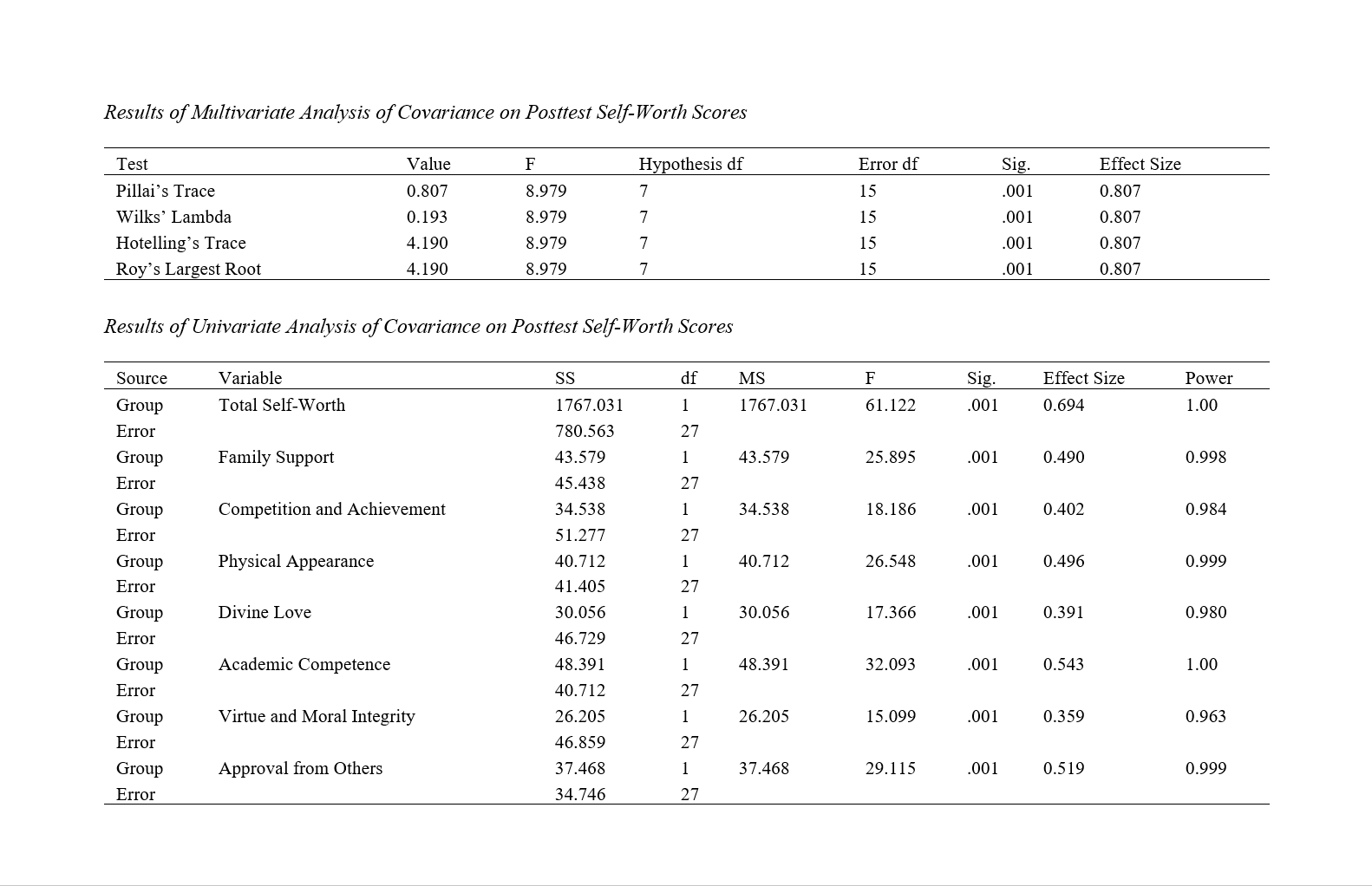
Findings: Multivariate analysis of covariance revealed a significant overall effect of the intervention on posttest self-worth and its components (p < .001). Univariate ANCOVA indicated significant improvements in total self-worth, family support, competition and achievement, physical appearance, divine love, academic competence, virtue and moral integrity, and approval from others in the experimental group compared with the control group (all p < .01), with large effect sizes.
Conclusion: The family-centered psychological intervention was highly effective in enhancing self-worth and multiple dimensions of psychological functioning in women with substance use disorders, highlighting the central role of family processes in addiction recovery and psychosocial rehabilitation.
Downloads
References
Assalin, A. C. B., Zerbetto, S. R., Ruiz, B. O., Cugler, P. S., & Pereira, S. S. (2021). Facilities of family adherence in treatment of chemical dependence: families' perception. Rev Eletrônica Saúde Mental Álcool Drog, 17(1), 17-25. https://doi.org/10.11606/issn.1806-6976.smad.2021.150251
Baqeri Nia, E., Safara, M., Karami, A., & Makoundeh Hosseini, S. (2022). Determining the effectiveness of problem-solving therapy (solution-focused) on the spiritual, cognitive, behavioral, and emotional dimensions of psychological health in addicts. Research in Religion and Health, 8(2), 140-149. https://ensani.ir/fa/article/509225/
Bessa, F. B., Bandeira, M., Pollo, T. C., & Oliveira, D. C. R. (2020). Sobrecarga e sintomatologia depressiva em familiares cuidadores de pessoas dependentes de álcool e outras drogas. Gerais Rev Interinst Psicol, 13(2). https://doi.org/10.36298/gerais202013e14705
Campeny, E., López-Pelayo, H., Nutt, D., Blithikioti, C., Oliveras, C., Nuño, L., Maldonado, R., Florez, G., Arias, F., Fernández-Artamendi, S., Villalbí, J. R., Sellarès, J., Ballbè, M., Rehm, J., Balcells-Olivero, M. M., & Gual, A. (2020). The blind men and the elephant: Systematic review of systematic reviews of cannabis use related health harms. Eur Neuropsychopharmacol, 33, 1-35. https://doi.org/10.1016/j.euroneuro.2020.02.003
Casey, J. L., & Cservenka, A. (2020). Effects of frequent marijuana use on risky decision-making in young adult college students. Addict Behav Rep, 11, 100253. https://doi.org/10.1016/j.abrep.2020.100253
Coffey, J. K., & Warren, M. T. (2020). Comparing adolescent positive affect and self-esteem as precursors to adult self-esteem and life satisfaction. Motivation and Emotion, 44(5), 707-718. https://doi.org/10.1007/s11031-020-09825-7
Das, J. K., Salam, R. A., Arshad, A., Finkelstein, Y., & Bhutta, Z. A. (2016). Interventions for adolescent substance abuse: An overview of systematic reviews. Journal of Adolescent Health, 59(4), S61-S75. https://doi.org/10.1016/j.jadohealth.2016.06.021
Erdvik, I. B., Haugen, T., Ivarsson, A., & Säfvenbom, R. (2020). Global self-worth among adolescents: The role of basic psychological need satisfaction in physical education. Scandinavian Journal of Educational Research, 64(5), 768-781. https://doi.org/10.1080/00313831.2019.1600578
Farnam, A. (2018). Effectiveness of problem solving and anger management on decrease of parent-adolescent conflicts among boy students. J Educ Psychol, 15(29), 149-176. https://doi.org/10.22111/JEPS.2018.3605
Hogue, A., Schumm, J. A., MacLean, A., & Bobek, M. (2022). Couple and family therapy for substance use disorders: Evidence‐based update 2010-2019. Journal of marital and family therapy, 48(1), 178-203. https://doi.org/10.1111/jmft.12546
Hosseini Lou, A., Rostami, R., & Khorshidi Sa, A. (2020). The etiology and family-centered treatment of addiction: A review study. Scientific Journal of Psychology Emergence, 9(11), 149-158. https://frooyesh.ir/browse.php?a_id=2373&slc_lang=fa&sid=1&printcase=1&hbnr=1&hmb=1
Kian Arthi, S., Abbas Pour, Z., & Aslani, K. (2022). The effectiveness of behavioral family therapy on substance use temptation in adolescents recovering from substance abuse. Scientific Quarterly Journal of Addiction Research, 16(64), 61-80. https://doi.org/10.52547/etiadpajohi.16.64.61
Lorenzetti, V., Hoch, E., & Hall, W. (2020). Adolescent cannabis use, cognition, brain health and educational outcomes: A review of the evidence. Eur Neuropsychopharmacol, 36, 169-180. https://doi.org/10.1016/j.euroneuro.2020.03.012
Namani, E., Mohammadi Hosseini, S. A., Namani, R., & Arzandehfar, A. (2025). Investigating the mediating role of psychological security in the relationship between family cohesion and self-esteem with marital satisfaction among female teachers. Journal of Applied Psychological Research, 16(1), 199-221. https://doi.org/10.22059/japr.2023.348899.644385
Przepiórka, A., Błachnio, A., Kot, P., & Cudo, A. (2025). Family Satisfaction That Matters. The Relationship Between Problematic Instagram Use, Self-Esteem and Life Satisfaction. Interciencia. https://doi.org/10.59671/h3j5f
Rhodes, R. E., Hollman, H., & Sui, W. (2024). Family-based physical activity interventions and family functioning: A systematic review. Family Process, 63(1), 392-413. https://doi.org/10.1111/famp.12921
Rojas, L. M., Brincks, A., Brown, E. C., Bahamon, M., Estrada, Y., Lee, T. K., & Pantin, H. (2023). Family Functioning in Hispanic Parents of Adolescents: Who Benefits Most from a Family-Based HIV and Substance Use Preventive Intervention? Prevention Science, 24(2), 249-258. https://doi.org/10.1007/s11121-022-01489-8
Sabik, N. J., Falat, J., & Magagnos, J. (2020). When self-worth depends on social media feedback: Associations with psychological well-being. Sex Roles, 82, 411-421. https://doi.org/10.1007/s11199-019-01062-8
Sandler, I., Ingram, A., Wolchik, S., Tein, J. Y., & Winslow, E. (2015). Long-term effects of parenting-focused preventive interventions to promote resilience of children and adolescents. Child Development Perspectives, 9(3), 164-171. https://doi.org/10.1111/cdep.12126
Silva, F. M. D., Camatta, M. W., Lachini, A. J. B., & Nasi, C. (2023). Family motivations and expectations in the care for psychoactive substance users. Revista Gaúcha De Enfermagem, 44, e20220141. https://doi.org/10.1590/1983-1447.2023.20220141.en
Small, S., & Huser, M. (2016). Family-Based Prevention Programs. Switzerland: Springer International Publishing. https://doi.org/10.1007/978-3-319-32132-5_161-2
United Nations. (2023). Haiti's criminal markets: mapping trends in firearms and drug trafficking. https://www.unodc.org/documents/data-and-analysis/toc/Haiti_assessment_UNODC.pdf
United Nations Office on Drugs, C. (2019). Annual Report 2019: together making the region safer from drugs, crime and terrorism. https://www.unodc.org/roca/uploads/documents/ROCA_Annual_Reports/ROCA_AR_2019_EN_web.pdf
Volkow, N. D., Baler, R. D., Compton, W. M., & Weiss, S. R. (2014). Adverse health effects of marijuana use.
Xia, M., Weymouth, B. B., Bray, B. C., & et al. (2020). Exploring Triadic Family Relationship Profiles and Their Implications for Adolescents' Early Substance Initiation. Prev Sci, 21, 519-529. https://doi.org/10.1007/s11121-019-01081-7
You, Y. H., Lu, S. F., Tsai, C. P., & et al. (2020). Predictors of five-year relapse rates of youths with substance abuse who underwent a family-oriented therapy program. Ann Gen Psychiatry, 19, 17. https://doi.org/10.1186/s12991-020-00269-4
Yousofi, F., Arazadeh, M., & Nazemi, B. (2015). The impact of combined therapy-family therapy, group therapy, and methadone therapy-on patients with substance abuse disorders. Family Counseling and Psychotherapy, 5(1), 24-41. https://fcp.uok.ac.ir/mobile/article_11239.html
Downloads
Additional Files
Publication Timeline
- Submitted
- Revised
- Accepted