Support Vector Machine Classification of Dysfunctional Family Systems Based on Psychological Assessment Data
DOI:
https://doi.org/10.61838/kman.aftj.4950Keywords:
Dysfunctional family systems, support vector machine, machine learning, psychological assessment, family functioning, adolescent mental health, predictive modelingAbstract
Objective: The objective of this study was to develop and validate a Support Vector Machine (SVM) model for the accurate classification of dysfunctional family systems using multidimensional psychological assessment data.
Methods and Materials: This quantitative cross-sectional study was conducted among 376 families in Armenia, including adolescents and their primary caregivers. Participants completed standardized psychological instruments assessing family functioning, parenting practices, parental stress, adolescent emotional and behavioral adjustment, and relational quality. A composite family dysfunction index was generated and used as the classification target. Data were preprocessed through normalization, imputation, and feature selection. The dataset was divided into training, validation, and test sets using stratified sampling. An SVM model with radial basis function kernel was trained and optimized through grid search and cross-validation. Model performance was evaluated using accuracy, precision, recall, F1-score, and area under the receiver operating characteristic curve. Feature contributions were interpreted using SHAP analysis.
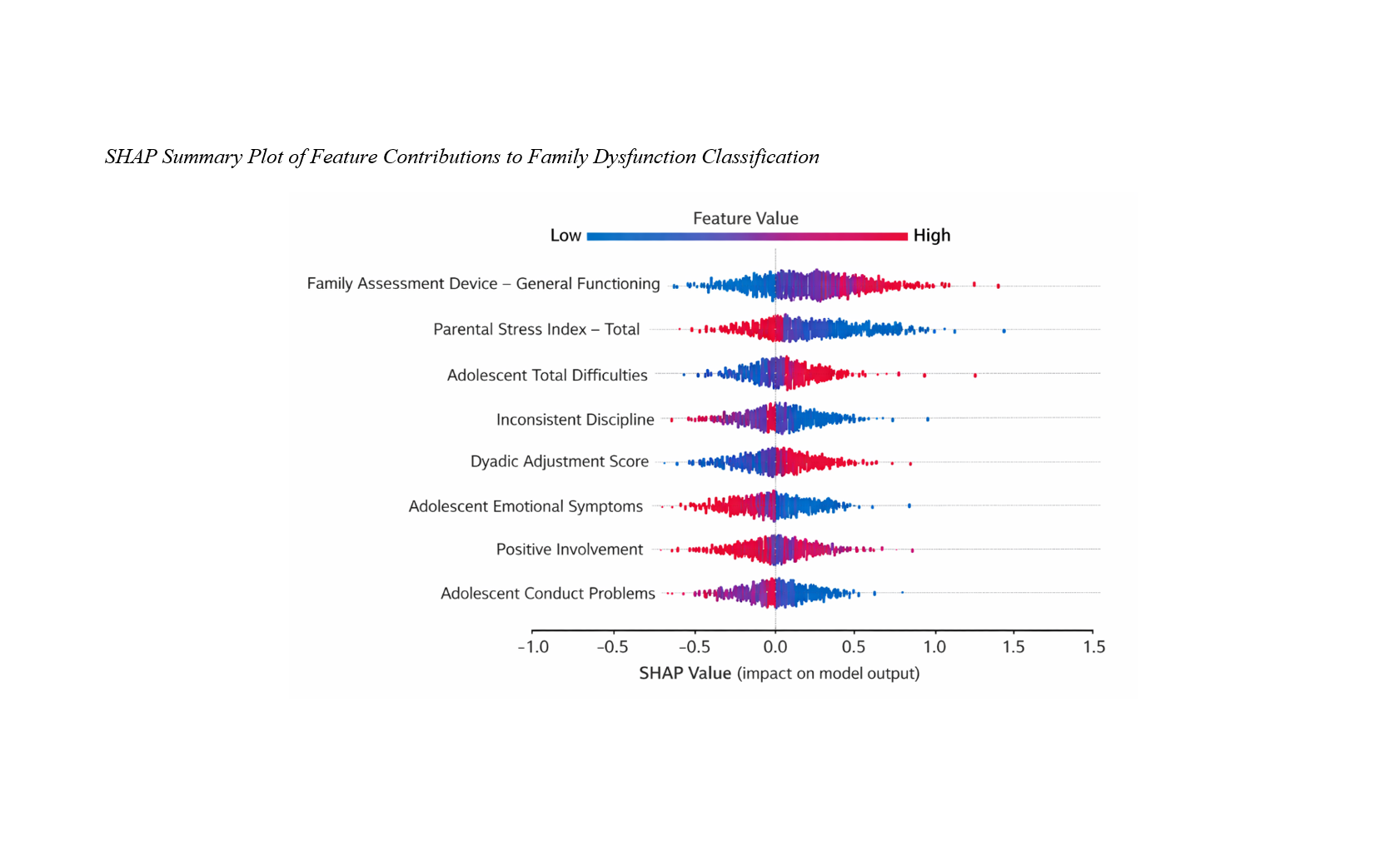
Findings: The SVM model achieved an accuracy of 0.913, precision of 0.904, recall of 0.921, F1-score of 0.912, and AUC of 0.948 on the test dataset. Comparative analysis indicated that the SVM significantly outperformed logistic regression, k-nearest neighbors, and random forest classifiers (p < .05). Feature importance analysis revealed that family functioning, parental stress, adolescent behavioral difficulties, parenting inconsistency, and marital adjustment were the strongest predictors of family dysfunction classification.
Conclusion: The findings demonstrate that SVM-based machine learning provides a highly accurate and robust framework for identifying dysfunctional family systems, offering substantial potential for early detection, targeted intervention, and data-driven mental health decision-making in family psychology and public health practice.
Downloads
References
Al-Hablawi, A.-H. B. A., & Azeez, R. A. (2025). Familial Disintegration and Its Psychological Impact in Sam Shepard’s Buried Child. Journal of the College of Languages, 0(51), 125-162. https://doi.org/10.36586/jcl.2.2025.0.51.0125
Arsenyan, M. (2025). Shattered Dreams: Dysfunctional Families and Suicidal Behaviour Among Armenian Adolescents. European Psychiatry, 68(S1), S339-S339. https://doi.org/10.1192/j.eurpsy.2025.721
Badamas, O. L., Uyanne, E. O., & Ifinju, I. O. (2023). Impact of Family Dysfunction on the Psychological Wellbeing of Pupils in Inclusive Schools in Lagos State, Nigeria. Journal of Educational Sciences, 7(3), 369. https://doi.org/10.31258/jes.7.3.p.369-381
Bochantseva, L. I. (2024). Formation of Emotional Well-Being in Adolescents From Dysfunctional Families. Pedagogical Image, 395-409. https://doi.org/10.32343/2409-5052-2024-18-3-395-409
Čepukienė, V., & Neophytou, K. (2024). Intergenerational Transmission of Familial Relational Dysfunction: A Test of a Complex Mediation Model Based on Bowen Family Systems Theory. Journal of Social and Personal Relationships, 41(11), 3385-3408. https://doi.org/10.1177/02654075241265472
Huang, X., Zhang, X., Chen, Q., Hu, Y., Zhao, X., & Zhao, L. (2025). Associations Between Family Functioning, Psychological Resilience, and Emotional Competence Among Primary and Secondary School Students in Chengdu, Sichuan Province: An Exploratory Study Using Structural Equation Modeling. BMC public health, 25(1). https://doi.org/10.1186/s12889-025-24539-6
Hudson, M., & Johnson, M. I. (2023). Hidden Family Rules: Perspective on a Dysfunctional Paternalistic System and the Persistence of Pain. Frontiers in Pain Research, 4. https://doi.org/10.3389/fpain.2023.1303853
Lifintseva, A. A., & Eremeitsev, D. V. (2025). Some Aspects of Psychological and Pedagogical Support for Dysfunctional Families. The Tidings of the Baltic State Fishing Fleet Academy Psychological and Pedagogical Sciences (Theory and Methods of Professional Education)(4(70)), 169-172. https://doi.org/10.46845/2071-5331-2024-4-70-169-172
Mahama, I., Ammah, C., Kwartemaa, E., Kwaw, R., & Klutsey, D. A. (2025). Psychological Resilience as Emotional Armour in Family Dysfunction and Food Addiction Among Ghanaian Tertiary Students. Eating and Weight Disorders - Studies on Anorexia Bulimia and Obesity, 30(1). https://doi.org/10.1007/s40519-025-01775-8
Muhlisin, M., & Sudewi, N. K. N. (2023). The Dysfunctional Family in Toni Morrison's the Bluest Eye. Rainbow Journal of Literature Linguistics and Cultural Studies, 12(1), 20-28. https://doi.org/10.15294/rainbow.v12i1.67064
Osman, A., Hafez, S. H., Mohamed, I., Ahmed, M. M., Balola, H. A., Ahmed, K. M., Gomaa, S. M., Alwadei, H. A., & Elrefaey, S. R. (2024). Unraveling the Nexus: Dysfunctional Family Dynamics, Mental Health Struggles, and Coping Strategies Among University Students. Minia Scientific Nursing Journal, 015(2), 8-13. https://doi.org/10.21608/msnj.2024.283171.1119
Rahimi, V. A., Babapour, J., Khanjani, Z., Hashemi, T., & Rudsari, A. B. (2024). The Structural Relationships Between Family Functioning, Positive Development, Psychological Distress and Social Media Addiction With the Mediating of Cognitive Emotion Regulation Strategies in Adolescents. Depiction of Health, 15(3), 341-357. https://doi.org/10.34172/doh.2024.26
Rasool, A. (2023). The Role of Family in Fostering Mental Health: Nurturing Practices and Their Long-Term Effects. Bits, 2(1), 1-3. https://doi.org/10.51470/bits.2022.01.01.01
Rizky, A. A., Suparto, D., & Florina, I. D. (2025). Analisis Pola Komunikasi Dalam Disfungsional Family &Amp; Resiliensi Pada Anak Kota Tegal. Jurnal Studi Ilmu Sosial Dan Politik, 5(1), 69-84. https://doi.org/10.35912/jasispol.v5i1.4616
Romanenko, T. V. (2024). The Impact of Family Education on Socialization and the Professional Success of a College Student. Professional Education in Russia and Abroad, 3(1), 196-202. https://doi.org/10.54509/22203036_2024_3_196
Romanova, N. M. (2025). The Relationship Between Psychological Sovereignty and the Peculiarities of Dysfunctional Relationships in the Parental Family in Youth-Aged Individuals. Izvestiya of Saratov University Philosophy Psychology Pedagogy, 25(3), 212-216. https://doi.org/10.18500/1819-7671-2025-25-3-212-216
Silva, D. F. d., Souza‐Talarico, J. N. d., Santos, J. L. F., & Duarte, Y. A. O. (2023). Family Dysfunction and Cognitive Decline in Aging: The “Health, Wellbeing, and Aging” (SABE) Longitudinal Population-Based Study. Dementia & Neuropsychologia, 17. https://doi.org/10.1590/1980-5764-dn-2022-0109
Spivak, V., & Levitsky, V. (2023). Peculiarities of the Work of Special Secondary Education Institutions With Students' Families. Actual Problems of the Correctional Education (Pedagogical Sciences), 22, 123-134. https://doi.org/10.32626/2413-2578.2023-22.123-134
Sudrajat, Z. K. (2025). Hubungan Disfungsional Family Dan Triangular of Love Pada Remaja Yang Sedang Menjalin Hubungan Romantis. Yasin, 5(6), 6674-6685. https://doi.org/10.58578/yasin.v5i6.8243
Zayniddinovna, R. D. (2025). Psychological Characteristics of Preventing Deviant Behavior Among Minors. Psychohealth: Scientific Journal of Psychology and Mental Healt, 1(2), 75-85. https://doi.org/10.35912/psychohealth.v1i2.3648
Султанова, Н., Lemko, H., & Ворощук, О. (2023). Prevention of Violence Against Women in Disadvantaged Families. Mountain School of Ukrainian Carpaty(29), 31-35. https://doi.org/10.15330/msuc.2023.29.31-35
Downloads
Additional Files
Publication Timeline
- Submitted
- Revised
- Accepted