Bayesian Network Modeling of Family Stress, Economic Pressure, and Child Adjustment Outcomes
DOI:
https://doi.org/10.61838/kman.aftj.4951Keywords:
Family stress, economic pressure, child adjustment, Bayesian network, family systems, TunisiaAbstract
Objective: The objective of this study was to identify and quantify the probabilistic pathways through which economic pressure and family stress influence multiple domains of child adjustment within Tunisian families using Bayesian network modeling.
Methods and Materials: This cross-sectional study was conducted with 416 families recruited from urban and semi-urban regions of Tunisia, each consisting of one primary caregiver and one child aged 9–14 years. Data were collected using standardized, culturally adapted measures assessing economic pressure, family stress, and child emotional, behavioral, social, and prosocial adjustment. A multi-informant protocol was implemented, combining caregiver reports, child self-reports, and demographic questionnaires. Bayesian network analysis was applied to model conditional dependencies among study variables. Structure learning employed a hybrid constraint-based and score-based algorithm, and parameter estimation was performed using Bayesian inference. Model stability was examined through bootstrap resampling, and predictive validity was evaluated using k-fold cross-validation and classification accuracy indices.
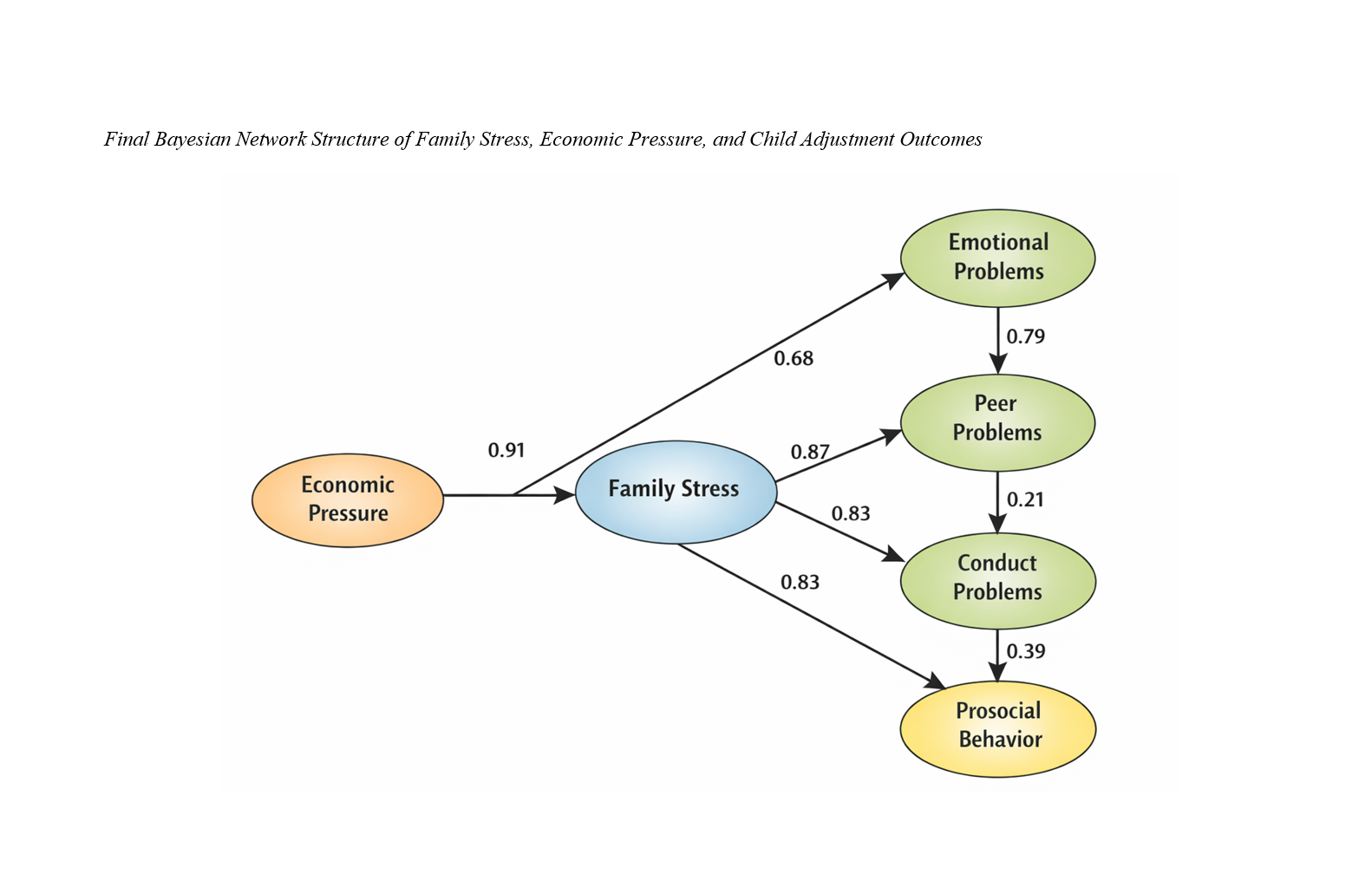
Findings: The Bayesian network revealed a dominant pathway from economic pressure to family stress with high posterior probability, followed by strong conditional effects of family stress on child emotional problems, conduct problems, peer difficulties, and prosocial behavior. Family stress emerged as the central mediating construct linking economic conditions to child outcomes. Emotional problems functioned as a key transmission node predicting peer difficulties. The model demonstrated high predictive accuracy across all child adjustment domains, with excellent discrimination between high-risk and low-risk profiles.
Conclusion: The findings confirm that economic pressure exerts pervasive influence on child development primarily through its impact on family stress processes.
Downloads
References
Andersen, K., Redman, J., Stewart, K., & Patrick, R. (2024). ‘It's the Kids That Suffer’: Exploring How the UK's Benefit Cap and Two‐child Limit Harm Children. Social Policy and Administration, 59(1), 57-72. https://doi.org/10.1111/spol.13034
Bao, J., & Greder, K. A. (2022). Economic Pressure and Parent Acculturative Stress: Effects on Rural Midwestern Low-Income Latinx Child Behaviors. Journal of Family and Economic Issues, 44(2), 490-501. https://doi.org/10.1007/s10834-022-09841-4
Carneiro, P., Cattan, S., & Neves, H. (2025). Theoretical and Empirical Perspectives on the Link Between Poverty, Parenting and Children's Outcomes. Fiscal Studies, 46(1), 9-35. https://doi.org/10.1111/1475-5890.12404
Chen, J. H., Huang, C.-H., Wu, C. F., Jonson‐Reid, M., & Drake, B. (2023). The Application of Family Stress Model to Investigating Adolescent Problematic Behaviors: The Moderating Role of Assets. Journal of Family and Economic Issues, 45(1), 174-183. https://doi.org/10.1007/s10834-023-09902-2
Cooper, D. K., Bayly, B. L., Tennie, B., Lupini, F., & Wadsworth, M. E. (2025). Family Risk Classes Predict Longitudinal Parent and Child Outcomes: Understanding the Implications of Poverty-Related Adversity. Journal of Family Psychology, 39(4), 526-536. https://doi.org/10.1037/fam0001325
Cusick, G. R., Gaul-Stout, J., Kakuyama-Villaber, R., Wilks, O., Grewal-Kök, Y., & Anderson, C. (2024). A Systematic Review of Economic and Concrete Support to Prevent Child Maltreatment. Societies, 14(9), 173. https://doi.org/10.3390/soc14090173
Fanta, A., Kim, S. E., Huang, C. J., Tsai, W., & Huang, C. Y. (2025). Economic Stress and Child Outcomes: The Family Stress Model Among Asian American Families During COVID-19. Frontiers in psychology, 16. https://doi.org/10.3389/fpsyg.2025.1591730
Lam, C. B., Lam, A., Li, X., & Chung, K. K. H. (2025). Mindful Parenting Mediates the Association of Family Economic Pressure With Child Adjustment: A Longitudinal Study. Journal of Family Psychology, 39(4), 515-525. https://doi.org/10.1037/fam0001337
Lee, J., Yoo, J., Chin, M., Son, S., Sung, M., & Chang, Y. E. (2022). Pathways From Economic Hardship to Couple Conflict by Socioeconomic Status During COVID‐19 in Korea. Family Relations, 72(1), 60-76. https://doi.org/10.1111/fare.12771
Lee, J. Y., Lee, S. J., Oh, S., Xu, A. J., Radney, A., & Rodriguez, C. M. (2024). Family Stress Processes Underlying COVID‐19–Related Economic Insecurity for Mothers and Fathers and Children's Internalizing Behaviour Problems. Child & Family Social Work, 30(3), 510-523. https://doi.org/10.1111/cfs.13188
Marcil, L. E. (2025). Maternal Social Health – A Prerequisite to Improving Child Health. Current opinion in pediatrics, 38(1), 1-8. https://doi.org/10.1097/mop.0000000000001532
Martins, P. C., & Oliveira, V. H. P. (2024). Child Well-Being, Family Functioning, and Contextual Strain: A Study of Multi-Assisted Low-Income Families. Children, 11(12), 1533. https://doi.org/10.3390/children11121533
Narciso, I. (2025). Supporting At‐Risk Families: The Role of Intervention in Family Recovery and Reunification. Child & Family Social Work. https://doi.org/10.1111/cfs.70072
Oftedal, A., Larsen, L., & Helland, M. S. (2025). Economic Hardship During the Covid‐19 Pandemic and Trajectories of Parent–Child Relationships: A Prospective Longitudinal Study Among Norwegian Families. Family Process, 64(2). https://doi.org/10.1111/famp.70031
Partington, L. C., Mashash, M., & Hastings, P. D. (2022). Family Thriving During COVID-19 and the Benefits for Children’s Well-Being. Frontiers in psychology, 13. https://doi.org/10.3389/fpsyg.2022.879195
Perez‐Brena, N. J., Duncan, J. C., Bámaca‐Colbert, M. Y., & Perez, R. (2022). Progress and Gaps: A Systematic Review of the Family Demographics and Family Subsystems Represented in Top Family Science Journals 2008–2018. Journal of Family Theory & Review, 14(1), 59-78. https://doi.org/10.1111/jftr.12446
Perez‐Brena, N. J., Duran, J. G., Son, D., Updegraff, K. A., & Umaña‐Taylor, A. J. (2025). Navigating Family Bonds in the Great Recession: Insights From Parents and Young Adults. Journal of Family Psychology. https://doi.org/10.1037/fam0001363
Peverill, M., Dirks, M. A., Narvaja, T., Herts, K. L., Comer, J. S., & McLaughlin, K. A. (2021). Socioeconomic Status and Child Psychopathology in the United States: A Meta-Analysis of Population-Based Studies. Clinical psychology review, 83, 101933. https://doi.org/10.1016/j.cpr.2020.101933
Rose, J. R., Martin, M. J., Trejos‐Castillo, E., & Mastergeorge, A. M. (2024). Longitudinal Pathways of Maltreated Young Children: Family Stress Processes and Adverse Childhood Experiences. Journal of Family Psychology, 38(2), 309-319. https://doi.org/10.1037/fam0001163
Scheibner, H., Xu, W., Walsh, S. J., & Condon, E. M. (2024). 0123 Family Economic Strain Is Associated With Parent-Child Sleep Interactions. Sleep, 47(Supplement_1), A54-A54. https://doi.org/10.1093/sleep/zsae067.0123
Schmeer, K. K., Singletary, B., Purtell, K. M., & Justice, L. M. (2021). Family Disruption and Parenting During the COVID-19 Pandemic. Journal of Family Issues, 44(1), 112-138. https://doi.org/10.1177/0192513x211042852
Smyth, E., & Murray, A. (2022). The Effect of Pandemic-Related Economic Disruption on Young Adolescents in Ireland. Children, 9(7), 1037. https://doi.org/10.3390/children9071037
Thibodeau‐Nielsen, R. B., Palermo, F., White, R. E., Dooley, A. W., & Dier, S. (2021). Child Adjustment During COVID-19: The Role of Economic Hardship, Caregiver Stress, and Pandemic Play. Frontiers in psychology, 12. https://doi.org/10.3389/fpsyg.2021.716651
Varga, E. T. (2023). What Is the Economically and Socially Optimised Child Support? Central European Journal of Operations Research, 32(1), 131-154. https://doi.org/10.1007/s10100-023-00865-1
Vrabic, S. C., Herbers, J. E., Davis, M., & Thomas, C. A. (2022). Perceptions of Support in Shelter Environments for Caregivers and Young Children Experiencing Family Homelessness. Child Care Health and Development, 48(4), 588-594. https://doi.org/10.1111/cch.12963
Downloads
Additional Files
Publication Timeline
- Submitted
- Revised
- Accepted