
Early Detection of Family Violence Risk Using Ensemble Machine Learning on Psychosocial and Demographic Indicators
DOI:
https://doi.org/10.61838/kman.aftj.4952Keywords:
Family violence, intimate partner violence, early detection, ensemble machine learning, psychosocial risk, demographic indicators, predictive modeling, South AfricaAbstract
Objective: The objective of this study was to develop and validate an ensemble machine learning framework for the early detection of family violence risk based on psychosocial and demographic indicators among South African households.
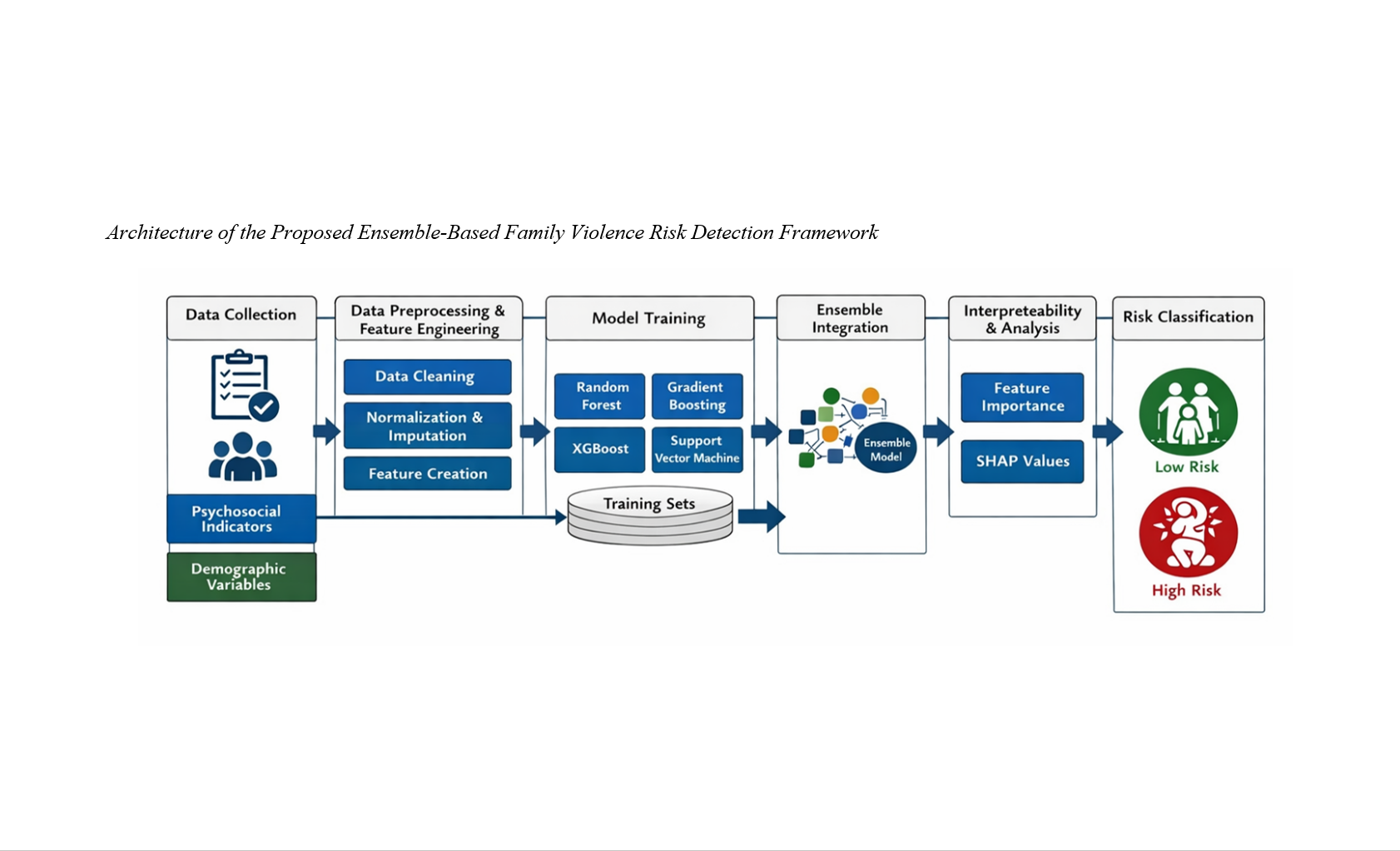
Methods and Materials: This cross-sectional predictive study recruited 1,198 adults from urban, peri-urban, and rural regions of South Africa using stratified multistage sampling. Participants completed a comprehensive assessment battery measuring demographic characteristics, socioeconomic conditions, psychosocial functioning, relational dynamics, and behavioral risk indicators. Data preprocessing included cleaning, normalization, multiple imputation, and feature engineering. The dataset was partitioned into training and test sets, and class imbalance was addressed using synthetic oversampling. Four supervised machine learning models—random forest, gradient boosting, extreme gradient boosting, and support vector machine—were trained using five-fold cross-validation and Bayesian hyperparameter optimization. An ensemble model integrating these classifiers was constructed and evaluated using accuracy, precision, recall, F1-score, and area under the receiver operating characteristic curve.
Findings: The ensemble model significantly outperformed all individual classifiers, achieving an accuracy of 0.917, precision of 0.904, recall of 0.896, F1-score of 0.900, and AUC of 0.958. Inferential comparisons indicated statistically meaningful improvements in sensitivity and discrimination over the strongest single model. Feature importance analysis revealed that family conflict frequency, emotional regulation difficulty, perceived stress, substance use severity, depression symptoms, and parenting stress were the most influential predictors of violence risk.
Conclusion: The findings demonstrate that ensemble machine learning provides a highly effective and interpretable framework for early identification of family violence risk, offering substantial potential for proactive prevention and targeted intervention in high-vulnerability populations.
Downloads
References
Abdel-Salam, D. M., Alruwaili, B. F., Osman, D., Alazmi, M., Alghayyadh, S., Al-sharari, R., & Mohamed, R. (2022). Prevalence and Correlates of Intimate Partner Violence Among Women Attending Different Primary Health Centers in Aljouf Region, Saudi Arabia. International journal of environmental research and public health, 19(1), 598. https://doi.org/10.3390/ijerph19010598
Agyemang‐Duah, W., Asare, B. Y., Adu, C., Agyekum, A. K., & Peprah, P. (2023). Intimate Partner Violence as a Determinant of Pregnancy Termination Among Women in Unions: Evidence From the 2016–2018 Papua New Guinea Demographic and Health Survey. Journal of Biosocial Science, 56(1), 141-154. https://doi.org/10.1017/s002193202300007x
Ahmad, Y., & Razali, S. (2025). Cyber-Intimate Partner Violence (C-Ipv) and Its Risk Factors Among Women in Malaysia. PLoS One, 20(7), e0327978. https://doi.org/10.1371/journal.pone.0327978
Ani, J. I. (2025). Predictors of Intimate Partner Violence and Associated Marital Disruption Among Ever-Married Women in Sub-Saharan Africa: A Multi-Country Analysis for Policy and Intervention Priorities. Frontiers in Sociology, 10. https://doi.org/10.3389/fsoc.2025.1658603
Atta, G. P., Newton, P., & Shah, T. (2025). Insights Into Intimate Partner Violence: Exploring Predictive Factors in Ghana Multiple Indicator Cluster Surveys 2018. Societies, 15(4), 100. https://doi.org/10.3390/soc15040100
Brunton, R., & Dryer, R. (2024). Intimate Partner Violence Risk Factors: A Vulnerability-Adaptation Stress Model Approach. Journal of interpersonal violence, 39(15-16), 3738-3763. https://doi.org/10.1177/08862605241234352
Cénat, J. M., Amédée, L. M., Onesi, O., Darius, W. P., Barara, R., Villarreal, D. G., Seyed Mohammad Mahdi Moshirian, F., Labelle, P., & Hébert, M. (2024). Prevalence and Correlates of Intimate Partner Violence Among Women and Men in Mexico: A Systematic Review and Meta-Analysis. Trauma Violence & Abuse, 26(1), 20-40. https://doi.org/10.1177/15248380241271345
Firdaush, S., & Das, P. (2023). Intimate Partner Violence and Its Associated Factors: A Multidimensional Analysis in the Context of India. Journal of Asian and African Studies, 60(2), 661-676. https://doi.org/10.1177/00219096231176748
Gilbar, O., Charak, R., Trujillo, O., Cantu, J. I., Cavazos, V., & Lavi, I. (2022). Meta-Analysis of Cyber Intimate Partner Violence Perpetration and Victimization: Different Types and Their Associations With Face-to-Face IPV Among Men and Women. Trauma Violence & Abuse, 24(3), 1948-1965. https://doi.org/10.1177/15248380221082087
Gunarathne, L., Bhowmik, J., Apputhurai, P., & Nedeljkovic, M. (2023). Factors and Consequences Associated With Intimate Partner Violence Against Women in Low- And Middle-Income Countries: A Systematic Review. PLoS One, 18(11), e0293295. https://doi.org/10.1371/journal.pone.0293295
Metheny, N., Mkhize, S. P., Scott, D., & Hatcher, A. M. (2024). Violence Victimization and Depressive Symptoms Among a Sub-Sample of Sexual and Gender Minority Adults in a Population-Based South African Study. Journal of interpersonal violence, 39(23-24), 4699-4721. https://doi.org/10.1177/08862605241243348
Mosha, I. H., Akyoo, W. O., & Ezekiel, M. J. (2023). Perpetrators’ Characteristics and Intimate Partner Violence in Informal Settlements at Iringa Municipality Tanzania. Journal of Asian and African Studies, 60(4), 2308-2323. https://doi.org/10.1177/00219096231215699
Petersen, Z., Jaca, A., Ginindza, T. G., Maseko, G., Takatshana, S., Ndlovu, P., Zondi, N., Zungu, N., Varghese, C., Hunting, G., Parham, G. P., Simelela, P. N., & Moyo, S. (2022). Barriers to Uptake of Cervical Cancer Screening Services in Low-and-Middle-Income Countries: A Systematic Review. BMC Women S Health, 22(1). https://doi.org/10.1186/s12905-022-02043-y
Pradhan, M. R., & De, P. (2024). Men’s Attitude Towards Wife-Beating: Understanding the Pattern and Trend in India. BMC public health, 24(1). https://doi.org/10.1186/s12889-024-17782-w
Sarno, E. L., Newcomb, M. E., & Whitton, S. W. (2023). Minority Stress and Intimate Partner Violence Among Sexual and Gender Minorities Assigned Female at Birth. Psychology of violence, 13(3), 239-247. https://doi.org/10.1037/vio0000466
Seifu, B. L., Asebe, H. A., Legesse, B. T., Mulaw, G. F., Tebeje, T. M., & Mare, K. U. (2024). Prognostic Factors of First Intimate Partner Violence Among Ever-Married Women in Sub-Saharan Africa: Gompertz Gamma Shared Frailty Modeling. PLoS One, 19(5), e0303187. https://doi.org/10.1371/journal.pone.0303187
Stubbs, A., & Szoeke, C. (2021). The Effect of Intimate Partner Violence on the Physical Health and Health-Related Behaviors of Women: A Systematic Review of the Literature. Trauma Violence & Abuse, 23(4), 1157-1172. https://doi.org/10.1177/1524838020985541
Wessells, M., & Kostelny, K. (2022). The Psychosocial Impacts of Intimate Partner Violence Against Women in LMIC Contexts: Toward a Holistic Approach. International journal of environmental research and public health, 19(21), 14488. https://doi.org/10.3390/ijerph192114488
White, S., Sin, J., Sweeney, A., Salisbury, T. T., Wahlich, C., Guevara, C. M. M., Gillard, S., Brett, E., Allwright, L., Iqbal, N., Khan, A., Perôt, C., Marks, J., & Mantovani, N. (2023). Global Prevalence and Mental Health Outcomes of Intimate Partner Violence Among Women: A Systematic Review and Meta-Analysis. Trauma Violence & Abuse, 25(1), 494-511. https://doi.org/10.1177/15248380231155529
Whitton, S. W., Lawlace, M., Dyar, C., & Newcomb, M. E. (2021). Exploring Mechanisms of Racial Disparities in Intimate Partner Violence Among Sexual and Gender Minorities Assigned Female at Birth. Cultural diversity & ethnic minority psychology, 27(4), 602-612. https://doi.org/10.1037/cdp0000463
Whitton, S. W., Welge, J. A., & Newcomb, M. E. (2023). Evaluation of Traditional Risk Factors for Intimate Partner Violence Among Sexual and Gender Minority Youth. Psychology of violence, 13(6), 456-467. https://doi.org/10.1037/vio0000486
Zamora-Ramírez, C. M., Caira‐Chuquineyra, B., Fernandez-Guzmán, D., Martinez‐Rivera, R. N., Llamo-Vilcherrez, A. P., Gálvez-Arévalo, R. A., Urrunaga‐Pastor, D., & Toro‐Huamanchumo, C. J. (2024). Association Between History of Interparental Violence and Alcohol Abuse Among Reproductive-Age Women: Evidence From the Peruvian Demographic and Health Survey. Women S Health, 20. https://doi.org/10.1177/17455057241277533
Downloads
Additional Files
Publication Timeline
- Submitted
- Revised
- Accepted