Explainable AI Prediction of Parenting Self-Efficacy from Socio-Emotional Family Dynamics
DOI:
https://doi.org/10.61838/kman.aftj.4953Keywords:
Parenting self-efficacy, socio-emotional family dynamics, explainable artificial intelligence, ensemble learning, emotion regulation, parenting stress, family cohesionAbstract
Objective: The objective of this study was to develop and interpret an explainable artificial intelligence model for predicting parenting self-efficacy from socio-emotional family dynamics among parents in Greece.
Methods and Materials: This cross-sectional study was conducted with 438 parents of children aged 6–16 years recruited from multiple urban and semi-urban regions of Greece using multi-stage cluster sampling. Participants completed standardized measures assessing parenting self-efficacy, parenting stress, emotion regulation, family emotional cohesion, parent–child attachment, coparenting quality, family conflict, family expressiveness, and perceived social support. Data preprocessing included normalization, multiple imputation, and feature selection. Predictive modeling was performed using an ensemble learning architecture integrating gradient boosting, random forest, and elastic net regression. Model training employed nested cross-validation with an 80/20 train–test split. Model interpretability was ensured through the application of explainable AI techniques, including SHAP and LIME.
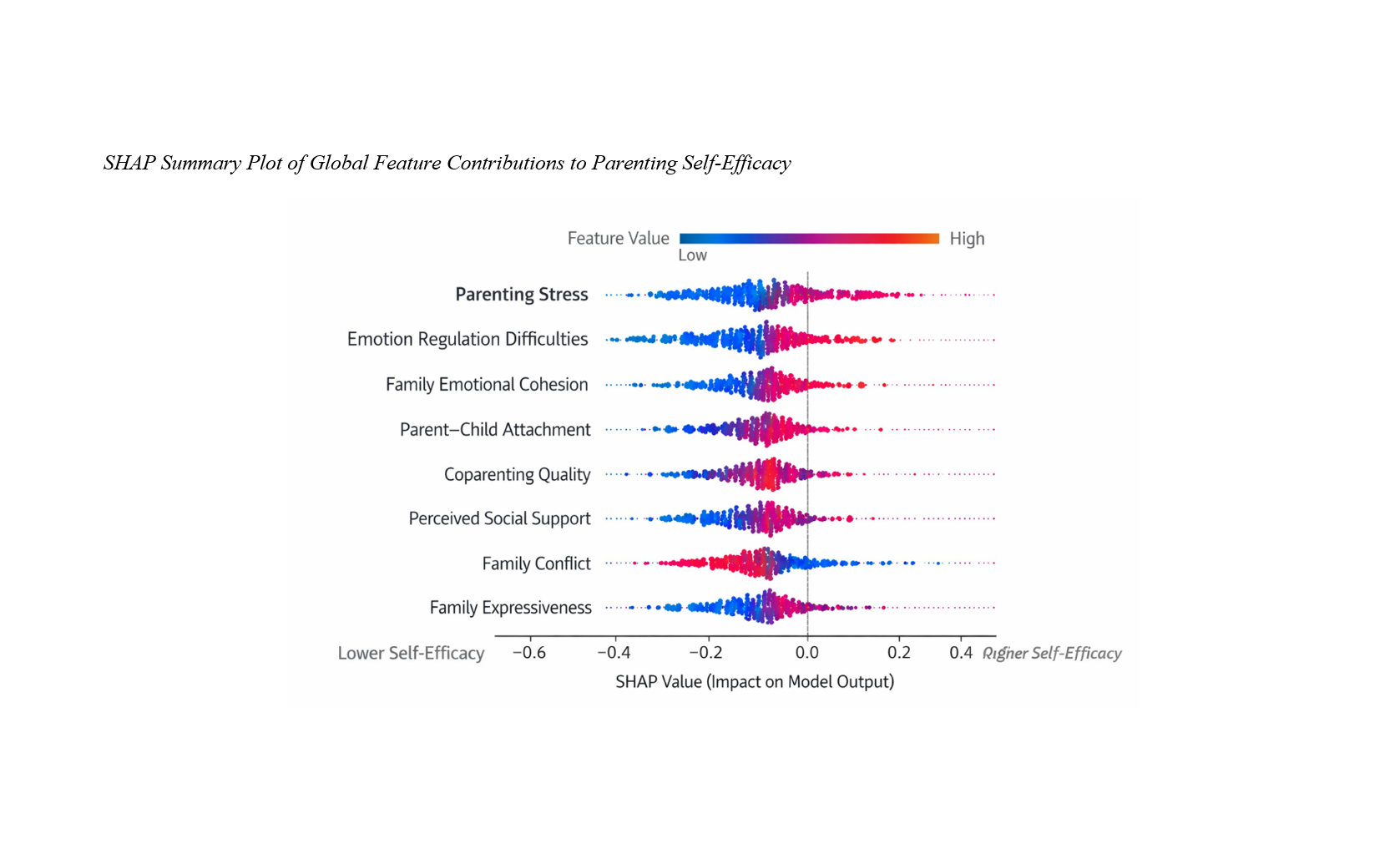
Findings: The ensemble model demonstrated strong predictive performance (R² = 0.79, RMSE = 0.24, MAE = 0.18). Parenting stress and emotion regulation difficulties emerged as the most influential negative predictors of parenting self-efficacy, while family emotional cohesion, parent–child attachment security, and coparenting quality were the strongest positive predictors. Significant interaction effects were observed, particularly between parenting stress and emotion regulation (ΔR² = 0.061), indicating that effective emotional regulation substantially buffers the adverse impact of stress on parental confidence.
Conclusion: The findings highlight the central role of emotional and relational processes in shaping parenting self-efficacy and demonstrate the value of explainable artificial intelligence for modeling complex family systems with both high predictive accuracy and theoretical transparency.
Downloads
References
Carbone, A., Pestell, C., Nevill, T., & Mancini, V. O. (2024). The Indirect Effects of Fathers’ Parenting Style and Parent Emotion Regulation on the Relationship Between Father Self-Efficacy and Children’s Mental Health Difficulties. International journal of environmental research and public health, 22(1), 11. https://doi.org/10.3390/ijerph22010011
Fidan, N. K., & Olur, B. (2023). Examining the Relationship Between Parents’ Digital Parenting Self-Efficacy and Digital Parenting Attitudes. Education and Information Technologies, 28(11), 15189-15204. https://doi.org/10.1007/s10639-023-11841-2
Filanowski, P. M., Steeves, J. A., & Slade, E. (2025). Step by Step: Investigating Children’s Physical Activity and Enjoyment in Outdoor Walking With Their Parents. Healthcare, 13(14), 1721. https://doi.org/10.3390/healthcare13141721
Fitriani, O., Khairudin, R., & Sulaiman, W. S. W. (2023). The Effectiveness of Enlightening Parenting Training Module in Improving Parenting Self-Efficacy and Reducing the Potential for Child Maltreatment. International Journal of Academic Research in Business and Social Sciences, 13(10). https://doi.org/10.6007/ijarbss/v13-i10/18973
Gessulat, J., Oppermann, E., Cohen, F., & Anders, Y. (2023). Parental Self-Efficacy in Relation to Family Characteristics. Journal of Early Childhood Research, 21(2), 224-240. https://doi.org/10.1177/1476718x231164133
He, T., Wu, D., Jiang, Y., Tang, Y., Zhou, Q., Wu, Q., & Lin, X. (2023). Coparenting Relationship, Parenting Self‐efficacy, and Child Adjustment in Chinese Mother–grandmother Coparenting Families: Grandmother Role Difference. Family Relations, 73(2), 1086-1106. https://doi.org/10.1111/fare.12928
Kohlhoff, J., & Traynor, N. M. (2024). Prospective Evaluation of Parent and Child Outcomes Following Admission to a ‘Virtual’ Early Parenting Residential Programme. BMJ open, 14(2), e077024. https://doi.org/10.1136/bmjopen-2023-077024
Laçin, E., & LaÇİN, B. G. D. (2023). Parenting Behaviors and Parental Self-Efficacy: A Comparative Study of Parents of Children With Intellectual Disabilities and Typically Developing Children. Journal of Intellectual Disabilities, 28(4), 885-897. https://doi.org/10.1177/17446295231215414
Landsem, I. P., & Handegård, B. H. (2024). Parental Reports of Hospital- And Community-Based Follow-Up Services, Self-Efficacy, and Symptoms of Depression a Few Months After Discharge of a Prematurely Born Child. BMC public health, 24(1). https://doi.org/10.1186/s12889-024-19079-4
Lo, H. K. Y., Fong, T. K. H., Cheng, C. P., Lui, W. Y. V., Wong, Y. P., & Chan, P. C. (2025). The Effectiveness of a New Parent Education Intervention Program for Primary School-Age Children and Parents in Hong Kong. PLoS One, 20(9), e0331308. https://doi.org/10.1371/journal.pone.0331308
Morawska, A., Etel, E., & Mitchell, A. E. (2023). Relationships Between Parenting and Illness Factors and Child Behaviour Difficulties in Children With Asthma and/or Eczema. Journal of Child Health Care, 28(4), 829-848. https://doi.org/10.1177/13674935231155964
Opie, J. E., Hooker, L., Gibson, T., & McIntosh, J. (2023). My Early Relational Trust-Informed Learning (MERTIL) for Parents: A Study Protocol for a Brief, Universal, Online, Preventative Parenting Program to Enhance Relational Health. PLoS One, 18(3), e0272101. https://doi.org/10.1371/journal.pone.0272101
Pachiti, I., Milienos, F. S., & Dimitropoulou, P. (2023). Child ViReal Support Program: A Randomized Controlled Trial Study for Effective Support of Parents Raising Children With Attention Deficits. Behavioral Sciences, 13(8), 691. https://doi.org/10.3390/bs13080691
Robb, S. L., Stegenga, K., Perkins, S. M., Stump, T. E., Moody, K., Henley, A. K., MacLean, J., Jacob, S. A., Delgado, D., & Haut, P. R. (2023). Mediators and Moderators of Active Music Engagement to Reduce Traumatic Stress Symptoms and Improve Well-Being in Parents of Young Children With Cancer. Integrative Cancer Therapies, 22. https://doi.org/10.1177/15347354231218266
Skowron, E. A., Nekkanti, A., Skoranski, A., Scholtes, C. M., Lyons, E. R., Mills, K. L., Bard, D., Rock, A., Berkman, E. T., Bard, E., & Funderburk, B. W. (2024). Randomized Trial of Parent–child Interaction Therapy Improves Child-Welfare Parents’ Behavior, Self-Regulation, and Self-Perceptions. Journal of consulting and clinical psychology, 92(2), 75-92. https://doi.org/10.1037/ccp0000859
So, W. C., Song, X. K., Lam, H. W., Chan, S. I., & Lau, K. L. (2025). Relationship Between Parental Self‐efficacy and Parent–child Relationships: Moderating Roles of Problem Behaviors and Autism Stigma. Family Relations, 74(4), 1616-1634. https://doi.org/10.1111/fare.13155
Xie, R., Wang, X., Ding, Y., Chen, Y. R., & Ding, W. (2024). The Impact of Parental Autonomy Support on Family Adaptation in the Context of “Double Reduction”: The Mediating Role of Parent–Child Communication and Cohesion. Behavioral Sciences, 14(7), 534. https://doi.org/10.3390/bs14070534
Younge, T., Jacobs, M., Soghier, L., & Fratantoni, K. (2025). Unmet Health and Childcare Needs After Neonatal Intensive Care Unit Discharge. American Journal of Perinatology. https://doi.org/10.1055/a-2593-8807
Zhu, H., Shu, L. H., Wang, X., & Xu, Z. (2025). Household Chaos and Preschool Migrant Children’s Self-Regulation: The Mediating Role of Parent–child Conflict and the Moderating Role of Mindful Parenting. Frontiers in psychology, 16. https://doi.org/10.3389/fpsyg.2025.1416040
Downloads
Additional Files
Publication Timeline
- Submitted
- Revised
- Accepted