Hybrid Machine Learning Framework for Predicting Family Adaptation to Chronic Illness
DOI:
https://doi.org/10.61838/kman.aftj.4954Keywords:
Family adaptation, family resilience, chronic illness, hybrid machine learning, predictive modeling, caregiver burden, psychosocial assessmentAbstract
Objective: The objective of this study was to develop and validate a hybrid machine learning framework for accurately predicting family adaptation to chronic illness using integrated psychosocial, relational, and clinical indicators.
Methods and Materials: This cross-sectional study recruited 812 family caregivers of patients with chronic illnesses from major healthcare centers in Chile using multistage cluster sampling. Data were collected through standardized measures assessing family functioning, caregiver burden, psychological distress, social support, and illness characteristics. A hybrid machine learning architecture integrating gradient boosting, random forest, support vector machine, and a meta-learning classifier was developed. Data were preprocessed using normalization, multiple imputation, and feature selection. The dataset was partitioned into training, validation, and testing subsets. Model training employed five-fold cross-validation with Bayesian hyperparameter optimization. Model interpretability was enhanced through explainable artificial intelligence techniques including SHAP analysis.
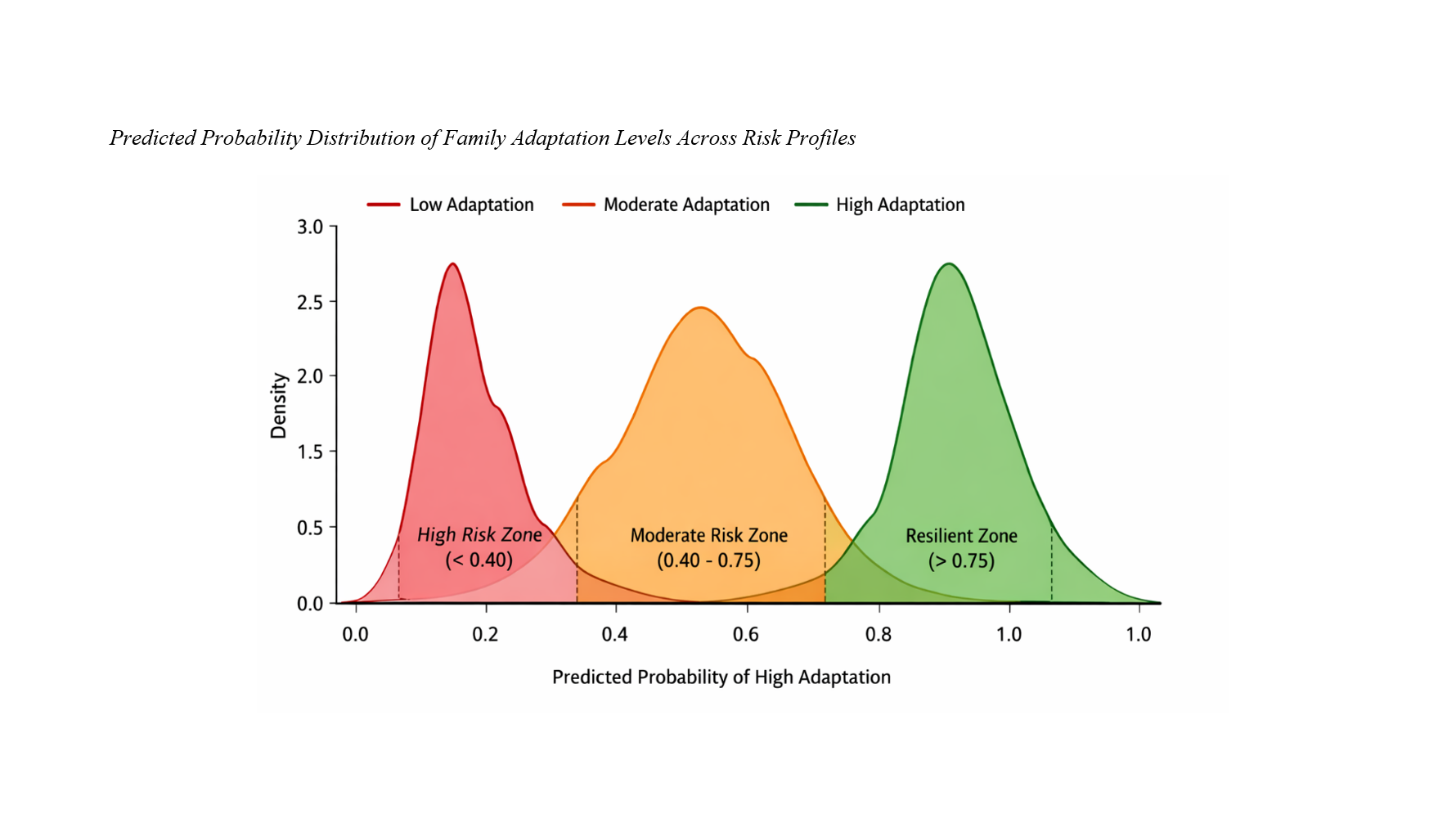
Findings: The hybrid model achieved high predictive performance on the independent test set, with an accuracy of 0.893, F1-score of 0.884, and AUC of 0.921, significantly outperforming individual machine learning models. Family functioning, caregiver burden, psychological distress, symptom severity, and social support emerged as the most influential predictors. The model demonstrated strong discriminative capacity between low, moderate, and high family adaptation levels and exhibited excellent calibration.
Conclusion: The proposed hybrid machine learning framework provides a robust, interpretable, and clinically valuable tool for early identification of families at risk of maladaptation to chronic illness, offering significant potential for improving family-centered care and psychosocial intervention planning.
Downloads
References
Arvin, N., Namjoo, A., Mousavikhoo, S. L., Namjoo, F., & Keshavarz, S. (2024). Exploring the Role of Family Resilience in Predicting Marital Functioning: A Cross-Sectional Study. JPRFC, 10-15. https://doi.org/10.61838/kman.jprfc.2.1.3
Chen, M., Chen, X., Jiang, H., Wang, Y., Ren, L., Zhang, L., & Dong, C. (2024). Parent–adolescent Family Resilience and Psychological Adjustment in Chronically Ill Adolescents: An Actor–partner Interdependence Mediation Model. Journal of Advanced Nursing, 81(4), 1864-1874. https://doi.org/10.1111/jan.16377
Chen, Y., Zhang, L., Jiang, W., Yu, H., Zhang, J., Li, Q., Ren, J., & Zhou, Y. (2024). Family Resilience in Patients With Schizophrenia: Potential Influencing Factors and Mediating Effect. Journal of Advanced Nursing, 81(8), 4600-4612. https://doi.org/10.1111/jan.16589
Cypress, B. S., & Allred, S. (2023). Building Family Resilience: Qualitative Perspectives From a Multisite Experimental Study in Intensive Care Units. Family Relations, 73(1), 154-170. https://doi.org/10.1111/fare.12893
García-Marín, E., Valero‐Moreno, S., Schoeps, K., Postigo-Zegarra, S., & Pérez‐Marín, M. (2023). Overburden in Caregivers of Chronically Ill Adolescents: A Comparative Study Between Pulmonological and Endocrinological Diseases. Children, 10(12), 1840. https://doi.org/10.3390/children10121840
Heuser, C., Schneider, J. N., Heier, L., Ernstmann, N., Nakata, H., Petermann‐Meyer, A., Bremen, R., Karger, A., Icks, A., Brümmendorf, T. H., & Geiser, F. (2024). Family Resilience of Families With Parental Cancer and Minor Children: A Qualitative Analysis. Frontiers in psychology, 14. https://doi.org/10.3389/fpsyg.2023.1251049
Huang, Y., Chen, M., Wang, Y., Qi, Y., Zhang, L., & Dong, C. (2024). Resiliency Process in the Family After Childhood Leukaemia Diagnosis: A Longitudinal Qualitative Study. Journal of clinical nursing, 34(3), 932-947. https://doi.org/10.1111/jocn.17224
Knezevic, E., Nenic, K., Milanovic, V., & Knežević, N. N. (2023). The Role of Cortisol in Chronic Stress, Neurodegenerative Diseases, and Psychological Disorders. Cells, 12(23), 2726. https://doi.org/10.3390/cells12232726
Laporte, G., Sergerie-Richard, S., Genest, C., & Aita, M. (2023). Family Resilience as an Emerging Concept in Neonatology. The Journal of Perinatal & Neonatal Nursing. https://doi.org/10.1097/jpn.0000000000000761
Li, Y., Li, N., Wang, J., Qiongqiong, S., Zhang, B., & Cao, M. (2023). Effects of Social Support, Family Resilience, and Individual Resilience on Fear of Cancer Recurrence Among Persons With Breast Cancer: A Cross-Sectional Study. Western Journal of Nursing Research, 45(11), 993-1000. https://doi.org/10.1177/01939459231200772
Najafi, A., & Belil, F. E. (2023). Investigating the Predictability of Social Support and Self-Esteem on the Resilience of Students With Chronic Illness in the Family. Journal of education and health promotion, 12(1). https://doi.org/10.4103/jehp.jehp_420_22
Safi, F., Areshtanab, H. N., Ghafourifard, M., & Ebrahimi, H. (2024). The Association Between Self-Efficacy, Perceived Social Support, and Family Resilience in Patients Undergoing Hemodialysis: A Cross-Sectional Study. BMC Nephrology, 25(1). https://doi.org/10.1186/s12882-024-03629-4
Sarı, A., & Duman, Z. Ç. (2024). Family Resilience Experiences of Individuals With Schizophrenia‐family Caregivers Dyads: Qualitative Study. Journal of Psychiatric and Mental Health Nursing, 32(1), 125-137. https://doi.org/10.1111/jpm.13091
Sequeira, J., Lino, C., Fonseca, G., & Vicente, H. T. (2025). Validation Study of the Portuguese Version of the Walsh Family Resilience Questionnaire. Family Process, 64(3). https://doi.org/10.1111/famp.70060
Sriyono, S., Zulkarnain, H., Proboningsih, J., & Kurnia, K. A. (2024). COVID-19 Slightly Reduced Family Resilience, Coping, and Disaster Preparedness in ISTIFAR’s Lombok Study. Jàmbá Journal of Disaster Risk Studies, 16(1). https://doi.org/10.4102/jamba.v16i1.1696
Suparit, S., Sakunpong, N., & Junprasert, T. (2023). Family Resilience Processes Among Guardians Caring for Children and Youths With Leukemia. Heliyon, 9(6), e17205. https://doi.org/10.1016/j.heliyon.2023.e17205
Susmarini, D., Ninh, D. T., & Shin, H. (2024). Family Resilience and Caregiver’s Well-Being Across Different Age Groups of Children With ADHD in the United States: A Cross-Sectional Study. Child Health Nursing Research, 30(2), 97-107. https://doi.org/10.4094/chnr.2024.003
Wei, W., Dong, L., Ye, J., & Xiao, Z. (2024). Current Status and Influencing Factors of Family Resilience in Families of Children With Epilepsy: A Cross-Sectional Study. Frontiers in Psychiatry, 15. https://doi.org/10.3389/fpsyt.2024.1354380
Zhang, N., Liu, Y., Yu, X., Tian, Z., Liu, Y., Li, Y., Liu, X., Zhu, H., & Wang, L. (2024). Positive Coping Style and Family Resilience of Caregivers of COPD Patients: The Chain Mediating Roles of Caregiver Burden and Resilience. Journal of clinical nursing, 34(2), 554-564. https://doi.org/10.1111/jocn.17587
Zhang, W., Gao, Y. J., Ye, M. M., & Zhou, L. (2024). Post‐stroke Family Resilience Is Correlated With Family Functioning Among Stroke Survivors: The Mediating Role of Patient's Coping and Self‐efficacy. Nursing Open, 11(7). https://doi.org/10.1002/nop2.2230
Zhang, Y., Hu, Y., & Yang, M. (2024). The Relationship Between Family Communication and Family Resilience in Chinese Parents of Depressed Adolescents: A Serial Multiple Mediation of Social Support and Psychological Resilience. BMC psychology, 12(1). https://doi.org/10.1186/s40359-023-01514-7
Zhang, Y., Huang, C., & Yang, M. (2023). Family Resilience Progress From the Perspective of Parents of Adolescents With Depression: An Interpretative Phenomenological Analysis. International journal of environmental research and public health, 20(3), 2564. https://doi.org/10.3390/ijerph20032564
Zhang, Y. H., Wang, L., Cao, R., Chen, L., Yuan, H., Li, R., Jiang, X. S., Cheng, Y., Zou, H., Yang, B. X., & Liu, Q. (2025). Family Resilience in Adolescent and Young Adult Patients With Hematological Malignancies: A Qualitative Study of Patients and Family Caregivers. Psycho-Oncology, 34(7). https://doi.org/10.1002/pon.70224
Downloads
Additional Files
Publication Timeline
- Submitted
- Revised
- Accepted