Machine Learning Modeling of Family Communication Structures and Emotional Influences
DOI:
https://doi.org/10.61838/kman.aftj.4955Keywords:
Family communication, emotional climate, adolescent mental health, machine learning, predictive modeling, family systems, emotional regulationAbstract
Objective: The objective of this study was to develop and validate a machine learning–based predictive model of how family communication structures influence family emotional climate and adolescent emotional outcomes.
Methods and Materials: This cross-sectional correlational study was conducted with 548 family dyads from urban and suburban regions of Taiwan. Adolescents and their primary caregivers completed validated measures assessing family communication patterns, emotional climate, parental stress, and adolescent emotional outcomes. Data were analyzed using multiple supervised machine learning algorithms, including random forest, gradient boosting, support vector regression, elastic net regression, and neural networks. Model training employed nested cross-validation with an 80/20 train–test split. Feature importance and interpretability were examined using permutation importance, SHAP values, and partial dependence analysis. Structural equation modeling was used to validate theoretically derived emotional pathways identified by machine learning models.
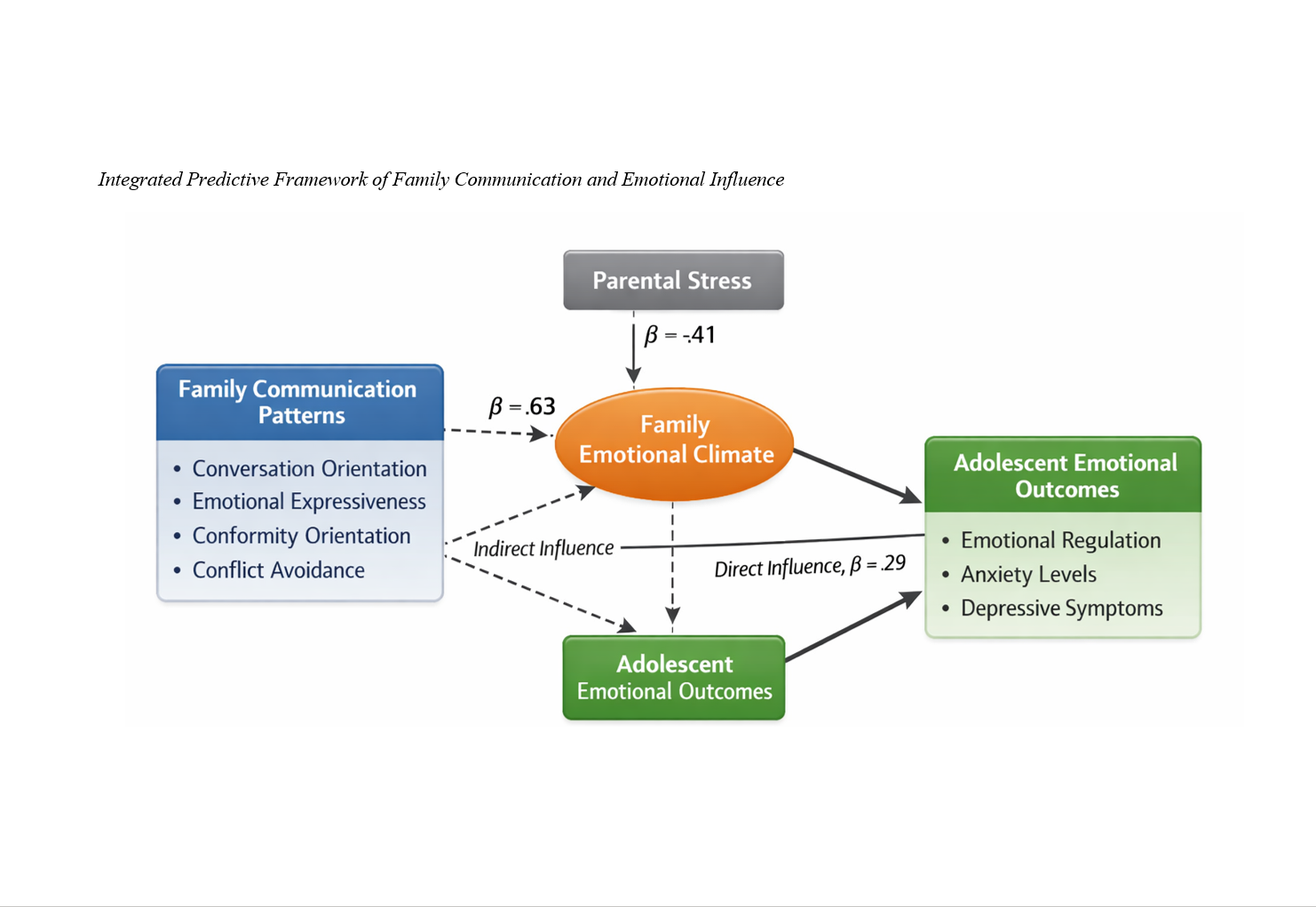
Findings: Neural network and gradient boosting models achieved the highest predictive accuracy for family emotional climate and adolescent emotional outcomes, explaining up to 76% of outcome variance. Emotional warmth and conversation orientation emerged as the strongest predictors of adolescent emotional regulation, while parental stress exerted a significant negative effect on family emotional climate. Structural equation modeling confirmed both direct and indirect effects of communication structures on adolescent outcomes mediated by family emotional climate, with all primary pathways reaching high statistical significance.
Conclusion: The findings demonstrate that family communication structures operate as a complex emotional regulatory system shaping adolescent development, and that machine learning provides a powerful methodological framework for modeling these dynamic processes and informing early intervention strategies.
Downloads
References
Al-Taie, Z. (2025). Identifying Patterns of Role Negotiation in Blended Families and Their Effects on Cohesion and Identity. Aftj, 6(5), 1-9. https://doi.org/10.61838/kman.aftj.4510
Ar, B., & Nurainiah, N. (2024). The Influence of Communication in Creating Household Harmony in Aceh Barat District. Jurnal Al-Ijtimaiyyah, 10(1), 122. https://doi.org/10.22373/al-ijtimaiyyah.v10i1.24154
Avitasari, I., & Sulistyarin, D. (2024). The Role of Family Communication and Parenting on Children’s Social Behavior. International Journal of Research and Innovation in Social Science, VIII(X), 1180-1185. https://doi.org/10.47772/ijriss.2024.8100099
Creuzé, C., Lestienne, L., Vieux, M., Chalancon, B., Poulet, E., & Leaune, É. (2022). Lived Experiences of Suicide Bereavement Within Families: A Qualitative Study. International journal of environmental research and public health, 19(20), 13070. https://doi.org/10.3390/ijerph192013070
Dang, Q., Lin, W., & Li, Y. (2025). Information and Authority: Research on the Mechanism of Offspring's Health Information Avoidance Behavior. Frontiers in Public Health, 13. https://doi.org/10.3389/fpubh.2025.1516225
DemİRcİ, Z. A. (2024). The Relationship Between Family Interaction Quality and Adolescent Mental Health With a Focus on Parental Roles in Reconstituted Families. Studies in Social Science & Humanities, 3(11), 34-38. https://doi.org/10.56397/sssh.2024.11.07
Doni Prasetyo Tri Sumara, H., Sunarto, S., & Nilamsari, N. (2025). Interpersonal Communication Strategies of Military Parents in Encouraging Openness in Their Children. Moestopo International Review on Social Humanities and Sciences, 5(1), 131-140. https://doi.org/10.32509/mirshus.v5i1.123
Fasihi, M., & Rostami, M. (2023). The Relationship of Mobile-Based Social Network Addiction and Family Communication Patterns, With Behavioral Problems in Secondary School Students: The Mediating Role of Emotional Self-Regulation. Psychology in Russia State of Art, 16(4), 55-71. https://doi.org/10.11621/pir.2023.0404
Gong, W., Jiang, L., Guo, Q., & Shen, F. (2023). The Role of Family Communication Patterns in Intergenerational COVID-19 Discussions and Preventive Behaviors: A Social Cognitive Approach. BMC psychology, 11(1). https://doi.org/10.1186/s40359-023-01331-y
Hurst, J. L., Widman, L., Maheux, A. J., Evans-Paulson, R., Brasileiro, J., & Lipsey, N. P. (2022). Parent–child Communication and Adolescent Sexual Decision Making: An Application of Family Communication Patterns Theory. Journal of Family Psychology, 36(3), 449-457. https://doi.org/10.1037/fam0000916
Iqbal, N., Emran, A., & Dar, K. A. (2025). Family Communication Patterns and Depression in Indian Women: Examining the Effects of Self-Silencing. International Journal of Social Psychiatry. https://doi.org/10.1177/00207640251348046
Jusnawati, J., Salwia, S., & Rawali, S. (2025). Gender Communication Patterns in Broken Home Families. Metacommunication Journal of Communication Studies, 10(1), 77. https://doi.org/10.20527/mc.v10i1.22090
Kim, J., & Hwang, J. (2025). Can Video Gaming as a Family Improve Communication Skills and Promote Social-Emotional Growth in Preteens?: Lessons From “Co-Play” in Korean Parent-Child Relationships. https://doi.org/10.20944/preprints202505.2366.v1
Liang, Z., Delvecchio, E., Cheng, Y., & Mazzeschi, C. (2021). Parent and Child’s Negative Emotions During COVID-19: The Moderating Role of Parental Attachment Style. Frontiers in psychology, 12. https://doi.org/10.3389/fpsyg.2021.567483
Marek, F. (2025). Family Support After a Family Member’s Suicide: A Qualitative Exploration. PLoS One, 20(10), e0334964. https://doi.org/10.1371/journal.pone.0334964
Maulina, Y., Fitriani, W., Yeni, P., & Maharjan, K. (2024). Analysis Dynamics of Adolescents' Lack of Openness to Parents: A Qualitative Study. Agenda Jurnal Analisis Gender Dan Agama, 6(2), 103. https://doi.org/10.31958/agenda.v6i2.12823
Naibaho, C. N., Tampubolon, F. A., Siburian, Y., & Surip, M. (2025). Pengaruh Lingkungan Keluarga Terhadap Perkembangan Kemampuan Berbahasa Anak. Morfologi, 3(2), 150-161. https://doi.org/10.61132/morfologi.v3i2.1528
Patrisia, D., Abror, A., Dastgir, S., & Rahayu, R. (2023). Generation Z’s Financial Behaviour: The Role of Islamic Financial Literacy. Isra International Journal of Islamic Finance, 15(2), 20-37. https://doi.org/10.55188/ijif.v15i2.540
Phillips, F., Prezio, E. A., Currin‐McCulloch, J., & Jones, B. L. (2022). Wonders &Amp; Worries: A Randomized Clinical Trial of a Psychosocial Intervention for Children Who Have a Parent With Cancer. Psycho-Oncology, 31(8), 1399-1411. https://doi.org/10.1002/pon.5943
Rebicova, M. L., Veselská, Z. D., Husárová, D., Klein, D., Gecková, A. M., Dijk, J. P. v., & Reijneveld, S. A. (2020). Does Family Communication Moderate the Association Between Adverse Childhood Experiences and Emotional and Behavioural Problems? BMC public health, 20(1). https://doi.org/10.1186/s12889-020-09350-9
Rogers, A. A., Ha, T., & Ockey, S. (2021). Adolescents' Perceived Socio-Emotional Impact of COVID-19 and Implications for Mental Health: Results From a U.S.-Based Mixed-Methods Study. Journal of Adolescent Health, 68(1), 43-52. https://doi.org/10.1016/j.jadohealth.2020.09.039
Sivakumar, S., & Choudhary, V. L. (2024). Social Networks of Children and Parents in Single-Parent Families. Ijemmasss, 06(03(II)), 66-72. https://doi.org/10.62823/ijemmasss/6.3(ii).6900
Strasser, K., Arias, P., Alessandri, F., Turner, P., Villarroel, T. E. E., Aldunate, C. P., & Montt, M. E. (2023). Adolescents’ Academic Self-Efficacy and Emotions During the COVID-19 Pandemic: A Latent Profile Analysis of Family and School Risk Factors. School Psychology, 38(2), 88-99. https://doi.org/10.1037/spq0000523
Tariq, A. (2025). Impact of Digital Parenting Practices on Adolescent Mental Health and Family Well-Being: A Case Study of Urban Households. Health Education, 1-23. https://doi.org/10.1108/he-07-2025-0120
Utan, Y. B. L. (2024). Dinamika Keluarga Kristen Di Era Gaya Hidup Modern: Kajian Pastoral Konseling Di Jemaat GKII Efata Bonet Engkabang Sungai Tebelian. Jurnal Riset Rumpun Agama Dan Filsafat, 3(2), 191-203. https://doi.org/10.55606/jurrafi.v3i2.7508
Wulandari, M. P., & Amanda, F. (2023). The Association Between Aspect of Family Communication Dimentions Beforehand, To, and Throughout the COVID-19 Pandemic. Jurnal Ilmu Komunikasi, 21(2), 316. https://doi.org/10.31315/jik.v21i2.5120
Xie, Q., Chen, R., Wang, K., Lu, J., Wang, F., & Zhou, X. (2024). Associations of Latent Patterns of Parent‒child Communication With Communication Quality and Mental Health Outcomes Among Chinese Left-Behind Children. BMC public health, 24(1). https://doi.org/10.1186/s12889-024-17793-7
Downloads
Additional Files
Publication Timeline
- Submitted
- Revised
- Accepted