Recurrent Neural Network Forecasting of Marital Satisfaction Under Economic Stress Conditions
DOI:
https://doi.org/10.61838/kman.aftj.4956Keywords:
Marital satisfaction, economic stress, recurrent neural network, longitudinal forecasting, couple relationships, psychological distressAbstract
Objective: The objective of this study was to develop and evaluate a recurrent neural network model for forecasting longitudinal changes in marital satisfaction among couples experiencing economic stress.
Methods and Materials: This longitudinal predictive study examined 540 married couples from major urban regions of Argentina over a twelve-month period. Participants completed four waves of assessment measuring marital satisfaction, economic stress, perceived stress, depressive and anxiety symptoms, social support, and objective financial indicators. Data were preprocessed and structured into temporal sequences for each couple. A long short-term memory recurrent neural network was trained to predict future marital satisfaction based on prior economic and psychological states. Model performance was evaluated using root mean squared error, mean absolute error, and explained variance, and compared with linear regression, random forest, and support vector regression baselines.
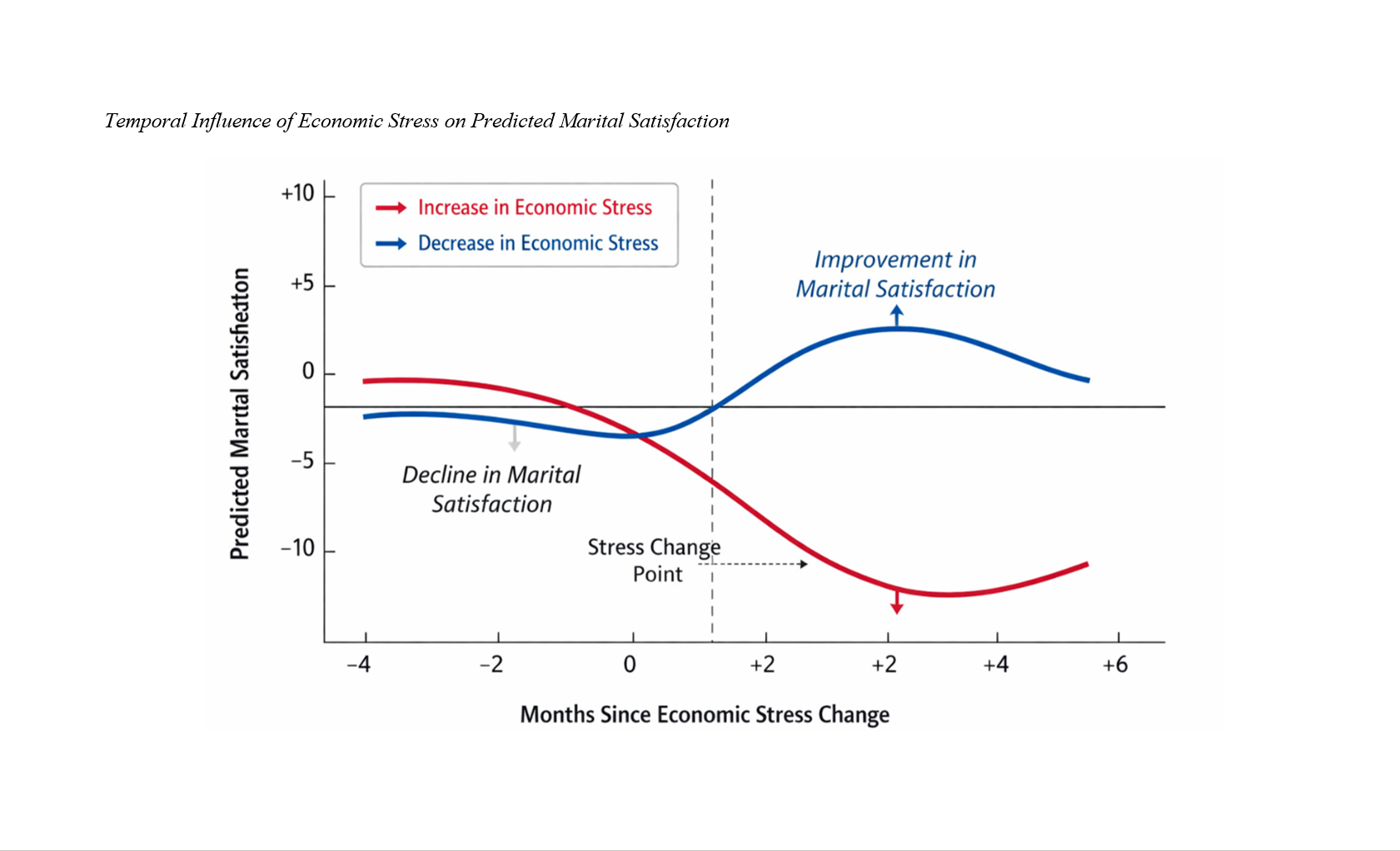
Findings: The recurrent neural network significantly outperformed all baseline models, achieving an R² of 0.81 and reducing prediction error by more than 30%. Economic stress was the strongest predictor of marital satisfaction trajectories, followed by perceived stress and social support. The model revealed delayed and cumulative effects of financial strain on marital satisfaction, with peak relational impact occurring two to three months after major stress changes. High predictive accuracy was maintained across socioeconomic groups.
Conclusion: The findings demonstrate that marital satisfaction under economic stress follows complex nonlinear temporal patterns that can be accurately forecasted using recurrent neural networks, providing a powerful framework for early identification of couples at risk and informing targeted interventions.
Downloads
References
Balzarini, R. N., Muise, A., Zoppolat, G., Gesselman, A. N., Lehmiller, J. J., Garcia, J. R., Slatcher, R. B., & Mark, K. P. (2022). Sexual Desire in the Time of COVID-19: How COVID-Related Stressors Are Associated With Sexual Desire in Romantic Relationships. Archives of Sexual Behavior, 51(8), 3823-3838. https://doi.org/10.1007/s10508-022-02365-w
Baryła‐Matejczuk, M., Skvarciany, V., Cwynar, A., Poleszak, W., & Cwynar, W. (2020). Link Between Financial Management Behaviours and Quality of Relationship and Overall Life Satisfaction Among Married and Cohabiting Couples: Insights From Application of Artificial Neural Networks. International journal of environmental research and public health, 17(4), 1190. https://doi.org/10.3390/ijerph17041190
Bather, J. R., McSorley, A.-M. M., Rhodes-Bratton, B., Cuevas, A. G., Rouhani, S., Nafiu, R. T., Harris, A., & Goodman, M. S. (2024). Love After Lockup: Examining the Role of Marriage, Social Status, and Financial Stress Among Formerly Incarcerated Individuals. Health & Justice, 12(1). https://doi.org/10.1186/s40352-024-00264-x
Brooks, S. K., Webster, R., Smith, L., Woodland, L., Wessely, S., Greenberg, N., & Rubin, G. J. (2020). The Psychological Impact of Quarantine and How to Reduce It: Rapid Review of the Evidence. The lancet, 395(10227), 912-920. https://doi.org/10.1016/s0140-6736(20)30460-8
Camisasca, E., Covelli, V., Cafagna, D., Manzoni, G. M., Cantoia, M. E. A., Bavagnoli, A., Crescenzo, P., Marsicovetere, V., Pesce, M., & Visco, M. A. (2023). From Economic Difficulties to Psychological Maladjustment in Italian Women During the Covid-19 Pandemic: Does Marital Dissatisfaction Moderate or Mediate This Association? Frontiers in psychology, 14. https://doi.org/10.3389/fpsyg.2023.1166049
Curtis, K., Nagase, A., Kim, S., & Holloway, S. D. (2022). Raising Children in the Context of Rapid Social Change: Parenting Self-Efficacy of South Korean Mothers. Journal of Child and Family Studies, 31(10), 2676-2687. https://doi.org/10.1007/s10826-021-02211-y
Dew, J. (2020). Ten Years of Marriage and Cohabitation Research in the Journal of Family and Economic Issues. Journal of Family and Economic Issues, 42(S1), 52-61. https://doi.org/10.1007/s10834-020-09723-7
Dew, J., Barham, C. C., & Hill, E. J. (2020). The Longitudinal Associations of Sound Financial Management Behaviors and Marital Quality. Journal of Family and Economic Issues, 42(1), 1-12. https://doi.org/10.1007/s10834-020-09701-z
Dijk, W. v., Minou, M. B. v. d. W., & Dillen, L. F. v. (2022). The Psychological Inventory of Financial Scarcity (PIFS): A Psychometric Evaluation. Journal of Behavioral and Experimental Economics, 101, 101939. https://doi.org/10.1016/j.socec.2022.101939
Falconier, M. K., & Jackson, J. B. (2020). Economic Strain and Couple Relationship Functioning: A Meta-Analysis. International Journal of Stress Management, 27(4), 311-325. https://doi.org/10.1037/str0000157
Fleming, C. J. E., & Franzese, A. T. (2021). Should I Stay or Should I Go? Evaluating Intimate Relationship Outcomes During the 2020 Pandemic Shutdown. Couple and Family Psychology Research and Practice, 10(3), 158-167. https://doi.org/10.1037/cfp0000169
Gunawan, I. l. F. N. A., & Krisnatuti, D. (2022). The Relationship Between Economic Pressure, Husband-Wife Interaction, and Husband’s Marital Satisfaction. Journal of Child Family and Consumer Studies, 1(3), 175-184. https://doi.org/10.29244/jcfcs.1.3.175-184
Gutin, S. A., Mulauzi, N., Jere, J., Sungani, C., Tebbetts, S., Ruark, A., Mkandawire, J., & Conroy, A. A. (2025). “After Reducing Alcohol, Things Now Work Well at Home”: Perceived Impacts of the Mlambe Intervention on Alcohol Use, Relationship Dynamics, Household Economics, and HIV Treatment Adherence in Malawian Couples. PLoS One, 20(8), e0331202. https://doi.org/10.1371/journal.pone.0331202
Hong, X., Liu, Q., & Zhang, M. (2021). Dual Stressors and Female Pre-School Teachers' Job Satisfaction During the COVID-19: The Mediation of Work-Family Conflict. Frontiers in psychology, 12. https://doi.org/10.3389/fpsyg.2021.691498
Jachimowicz, J., Frey, E., Matz, S., Jeronimus, B. F., & Galinsky, A. D. (2022). The Sharp Spikes of Poverty: Financial Scarcity Is Related to Higher Levels of Distress Intensity in Daily Life. Social Psychological and Personality Science, 13(8), 1187-1198. https://doi.org/10.1177/19485506211060115
Jackson, J. B., Carrese, D. H., & Willoughby, B. J. (2023). The Indirect Effects of Financial Conflict on Economic Strain and Marital Outcomes Among Remarried Couples. International Journal of Stress Management, 30(1), 69-83. https://doi.org/10.1037/str0000277
Kanter, J. B., & Proulx, C. M. (2020). Understanding the Early Years of Socioeconomically Disadvantaged Couples’ Marriages. Family Process, 60(3), 806-822. https://doi.org/10.1111/famp.12602
Kaur, M., & Singh, M. (2025). Money in Couples: A Systematic Literature Review on Intrahousehold Financial Management. International Journal of Consumer Studies, 49(4). https://doi.org/10.1111/ijcs.70100
LeBaron‐Black, A. B., Li, X., Wilmarth, M. J., Suxo-Sanchez, S. C., Archuleta, K. L., Yorgason, J. B., & Kong, D. (2025). Happily Ever Affluence: Dyadic Analysis of Money Scripts, Financial Communication, and Relationship Satisfaction. Journal of Social and Personal Relationships, 42(7), 1415-1438. https://doi.org/10.1177/02654075251327316
LeBaron‐Black, A. B., Saxey, M. T., Totenhagen, C. J., Wheeler, B., Archuleta, K. L., Yorgason, J. B., & James, S. (2022). Financial Communication as a Mediator Between Financial Values and Marital Outcomes. Family Relations, 72(4), 1974-1992. https://doi.org/10.1111/fare.12786
Li, X., Curran, M. A., LeBaron‐Black, A. B., Jorgensen, B. L., Yorgason, J. B., & Wilmarth, M. J. (2021). Couple-Level Attachment Styles, Finances, and Marital Satisfaction: Mediational Analyses Among Young Adult Newlywed Couples. Journal of Family and Economic Issues, 44(1), 125-142. https://doi.org/10.1007/s10834-021-09808-x
Mbozi, P., Ratcliff, C., & Roberts, D. (2020). Challenges Facing Women Caring for a Spouse Having Cancer Treatment: A Critical Literature Review. Open Journal of Nursing, 10(01), 34-68. https://doi.org/10.4236/ojn.2020.101003
Mishra, N., Garbinsky, E. N., & Shu, S. B. (2024). Discussing Money With the One You Love: How Financial Stress Influences Couples' Financial Communication. Journal of Consumer Psychology, 35(2), 288-296. https://doi.org/10.1002/jcpy.1430
Novianti, L. E., Purba, F. D., Karremans, J. C., & Agustiani, H. (2024). Financial Strain Among West-Javanese Parents: Its Association With Marital Satisfaction and Quality of Life, and the Role of Dyadic Coping. Frontiers in psychology, 15. https://doi.org/10.3389/fpsyg.2024.1434426
Park, A., Kim, K. H., & Hwang, H. (2025). The Impact of Economic Issues Across Different Life Stages and Marital Life Evaluation on Marital Satisfaction and Quality of Life. Korean Data Anal Soc, 27(3), 965-980. https://doi.org/10.37727/jkdas.2025.27.3.965
Peetz, J., & Joseph, M. (2024). How Couples Think About Money: Types of Money Motives and Relationship Satisfaction. Personal Relationships, 31(2), 516-537. https://doi.org/10.1111/pere.12539
Peetz, J., Meloff, Z., & Royle, C. (2023). When Couples Fight About Money, What Do They Fight About? Journal of Social and Personal Relationships, 40(11), 3723-3751. https://doi.org/10.1177/02654075231187897
Peterson, C., O’Neal, C. W., & Lucier‐Greer, M. (2025). Service Members’ Couple Finances: An Examination of Financial Anxiety, Financial Decision-Making, and Agreement on Spending and Relationship Outcomes. Journal of Family and Economic Issues, 46(2), 545-557. https://doi.org/10.1007/s10834-025-10043-x
Rettie, H., & Daniels, J. (2021). Coping and Tolerance of Uncertainty: Predictors and Mediators of Mental Health During the COVID-19 Pandemic. American psychologist, 76(3), 427-437. https://doi.org/10.1037/amp0000710
Rumondor, P. C. B., Randall, A. K., Purwono, U., Muttaqin, D., & Ginanjar, A. S. (2022). Factor Structure and Validity of the Dyadic Coping Inventory–Bahasa Indonesia. Personal Relationships, 29(4), 751-777. https://doi.org/10.1111/pere.12459
Saxey, M. T., Dew, J., & Yorgason, J. B. (2022). Bedtime and the Budget: Longitudinal, Actor–Partner Connections Between Sleep Quality and Financial Management Behaviors in Newlywed Couples. International journal of environmental research and public health, 20(1), 55. https://doi.org/10.3390/ijerph20010055
Sesini, G., Manzi, C., & Lozza, E. (2023). Is Psychology of Money a Gendered Affair? A Scoping Review and Research Agenda. International Journal of Consumer Studies, 47(6), 2701-2723. https://doi.org/10.1111/ijcs.12975
Ward, D. E., Park, L. E., Walsh, C., Naragon‐Gainey, K., Paravati, E., & Whillans, A. V. (2021). For the Love of Money: The Role of Financially Contingent Self-Worth in Romantic Relationships. Journal of Social and Personal Relationships, 38(4), 1303-1328. https://doi.org/10.1177/0265407521991663
Weber, D. M., Lavner, J. A., & Beach, S. R. H. (2023). Couples’ Communication Quality Differs by Topic. Journal of Family Psychology, 37(6), 909-919. https://doi.org/10.1037/fam0001111
Wendołowska, A., & Czyżowska, D. (2021). Centrality of Religiosity and Dyadic Coping in Close Romantic Relationships: Actor Partner Interdependence Model. Religions, 12(11), 978. https://doi.org/10.3390/rel12110978
Zacher, H., & Rudolph, C. W. (2021). Individual Differences and Changes in Subjective Wellbeing During the Early Stages of the COVID-19 Pandemic. American psychologist, 76(1), 50-62. https://doi.org/10.1037/amp0000702
Żelaźniewicz, A. (2025). Is Family Size Related to Love? Data From 25 Countries. Human Nature. https://doi.org/10.1007/s12110-025-09505-w
Downloads
Additional Files
Publication Timeline
- Submitted
- Revised
- Accepted