Comparison of the Effectiveness of Cognitive Behavioral Couple Therapy (CBT) and Intensive Short-Term Dynamic Psychotherapy for Couples (ISTDP) in Reducing Relationship Obsessive–Compulsive Disorder (ROCD) Symptoms and Improving Relationship Quality in Young Couples
DOI:
https://doi.org/10.61838/kman.aftj.4998Keywords:
cognitive–behavioral couple therapy, Intensive short-term dynamic psychotherapy, relationship obsessive–compulsive disorder, relationship quality, young couplesAbstract
Objective: This study aimed to compare the effectiveness of cognitive–behavioral couple therapy (CBT) and intensive short-term dynamic psychotherapy (ISTDP) in reducing relationship obsessive–compulsive disorder (ROCD) symptoms and improving relationship satisfaction among young couples.
Methods and Materials: The study was conducted as a randomized controlled clinical trial with a pretest–posttest design, a control group, and a three-month follow-up. The statistical population consisted of young couples seeking psychological services due to relationship difficulties. A total of 52 couples (104 individuals) who met the inclusion criteria were selected and randomly assigned to three groups: CBT (18 couples), ISTDP (17 couples), and a wait-list control group (17 couples). The interventions were delivered in ten weekly 90-minute couple-based sessions following standardized protocols. Data were collected using the Relationship Obsessive–Compulsive Inventory (ROCI) and the Couples Satisfaction Index (CSI), with general obsessive–compulsive symptoms (OCI-R) and negative emotional states (DASS-21) included as covariates. Data were analyzed using multivariate analysis of variance (MANOVA) and multivariate analysis of covariance (MANCOVA) in SPSS version 27.
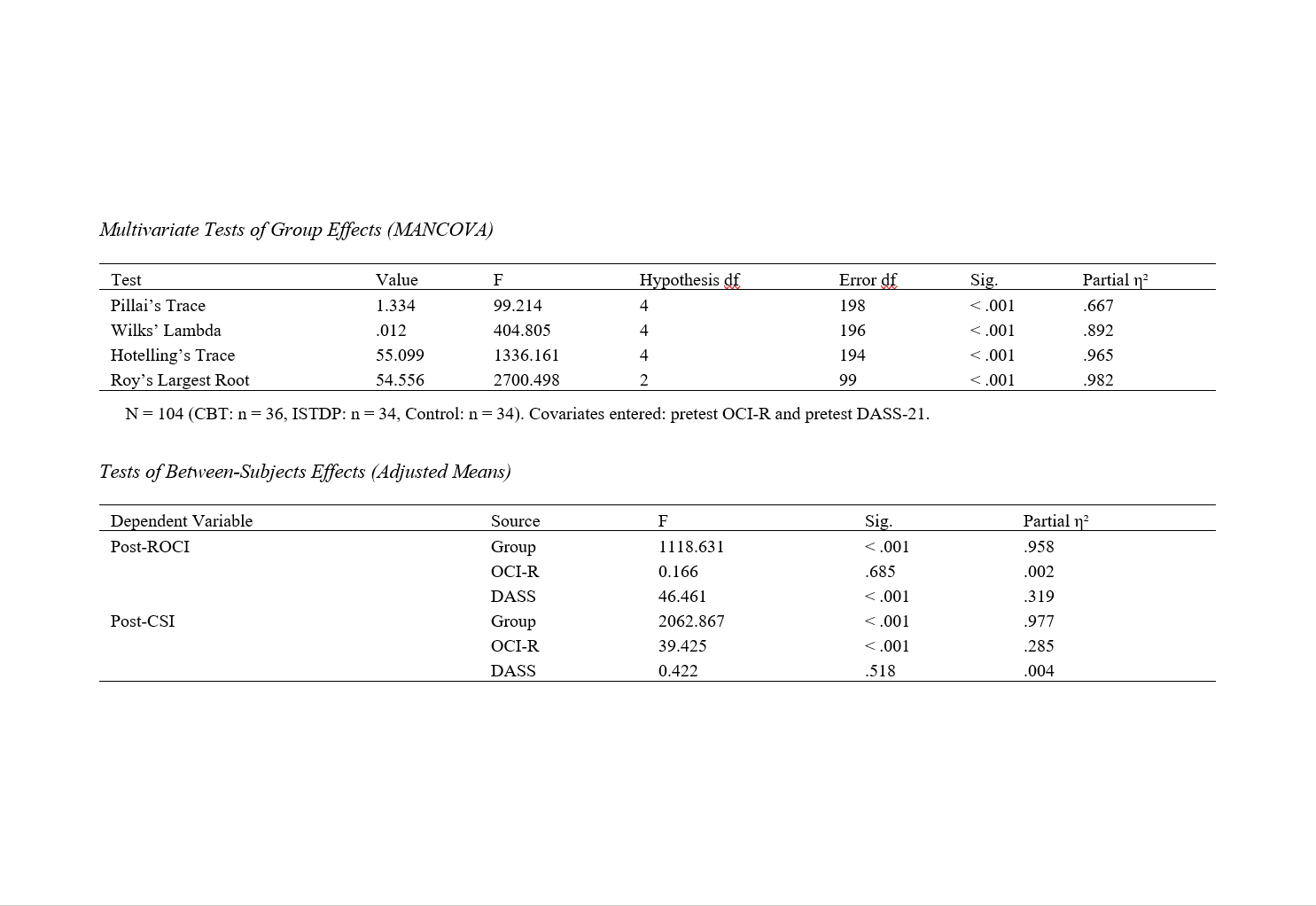
Findings: MANOVA results indicated a significant multivariate effect of group on posttest ROCD symptoms and relationship satisfaction (p < .001), with large effect sizes. Univariate analyses showed significant between-group differences for both ROCD symptoms (F(2,101) = 139.75, p < .001) and relationship satisfaction (F(2,101) = 282.32, p < .001). Post hoc comparisons revealed that both CBT and ISTDP significantly outperformed the control group on both outcomes, while no substantial difference was observed between the two treatment groups in relationship satisfaction; ISTDP showed a marginally greater reduction in ROCD symptoms. MANCOVA results confirmed that these effects remained robust after controlling for OCI-R and DASS-21 (p < .001).
Conclusion: Both CBT and ISTDP are highly effective couple-based interventions for reducing ROCD symptoms and enhancing relationship satisfaction, with comparable overall efficacy and strong clinical significance.
Downloads
References
Abbass, A., Town, J., & Driessen, E. (2012). Intensive short-term dynamic psychotherapy: A systematic review and meta-analysis of outcome research. Harvard Review of Psychiatry, 20(2), 97-108. https://doi.org/10.3109/10673229.2012.677347
Abramowitz, J. S., Baucom, D. H., Boeding, S., Wheaton, M. G., Pukay-Martin, N. D., Fabricant, L. E., Paprocki, C., & Fischer, M. S. (2013). Treating obsessive-compulsive disorder in intimate relationships: A pilot study of couple-based cognitive-behavior therapy. Behavior therapy, 44(3), 395-407. https://doi.org/10.1016/j.beth.2013.02.005
Andersson, E., Enander, J., Andrén, P., Hedman, E., Ljótsson, B., Hursti, T., Bergström, J., Kaldo, V., Lindefors, N., Andersson, G., & Rück, C. (2012). Internet-based cognitive behaviour therapy for obsessive-compulsive disorder: A randomized controlled trial. Psychological medicine, 42(10), 2193-2203. https://doi.org/10.1017/S0033291712000244
Asghari Moghaddam, M. A., Saed, F., Dibajnia, P., & Zare, J. (2008). Preliminary evaluation of reliability and validity of the Depression, Anxiety and Stress Scales (DASS) in non-clinical samples. Journal of Clinical Psychology and Personality, 15(21), 23-38.
Davanloo, H. (2014). Davanloo’s intensive short-term dynamic psychotherapy in a tertiary psychotherapy service: Overall effectiveness and association between unlocking the unconscious and outcome. Peerj, 2, e548.
Doss, B. D., Roddy, M. K., Wiebe, S. A., & Johnson, S. M. (2022). A review of the research during 2010-2019 on evidence-based treatments for couple relationship distress. Journal of marital and family therapy, 48(1), 283-306. https://doi.org/10.1111/jmft.12552
Epstein, N. B., & Zheng, L. (2017). Cognitive-behavioral couple therapy. Current opinion in psychology, 13, 142-147. https://doi.org/10.1016/j.copsyc.2016.09.004
First, M. B., Williams, J. B. W., Karg, R. S., & Spitzer, R. L. (2015). Structured Clinical Interview for DSM-5 Disorders—Clinician Version (SCID-5-CV). American Psychiatric Association.
Fischer, M. S., Baucom, D. H., & Cohen, M. J. (2016). Cognitive-behavioral couple therapies: Review of the evidence for the treatment of relationship distress, psychopathology, and chronic health conditions. Family Process, 55(3), 423-442. https://doi.org/10.1111/famp.12227
Foa, E. B., Kozak, M. J., Salkovskis, P. M., & Coles, M. E. (1998). The validation of a new obsessive-compulsive disorder scale: The Obsessive Compulsive Inventory. Psychological assessment, 10(3), 206-214.
Forouzani, S., Norbakhsh Amiri, M., Abbasi, F., Akbarzadeh, N., & Jafari, Z. (2024). Effectiveness of cognitive behavioral therapy on psychological hardiness and marital relationship quality in couples with marital conflicts. Journal of Assessment and Research in Applied Counseling, 6(2), 105-112. https://doi.org/10.61838/kman.jarac.6.2.13
Forouzesh Yekta, F., Yaghubi, H., Mootabi, F., Roshan, R., Gholami Fesharaki, M., & Omidi, A. (2017). Psychometric characteristics and factor analysis of the Persian version of the Couples Satisfaction Index. Avicenna Journal of Neuropsychophysiology, 4(2), 49-56. https://doi.org/10.32598/ajnpp.4.2.49
Ghomian, S., Shaeiri, M. R., & Farahani, H. (2021). Designing the Relationship Obsessive-Compulsive Inventory (ROCI) based on Iranian culture and evaluation of its psychometric properties. Iranian Journal of Psychiatry, 16(4), 418-429. https://doi.org/10.18502/ijps.v16i4.7229
Gorelik, M., Szepsenwol, O., & Doron, G. (2023). Promoting couples' resilience to relationship obsessive-compulsive disorder symptoms using a CBT-based mobile application: A randomized controlled trial. Heliyon, 9(11), e21673. https://doi.org/10.1016/j.heliyon.2023.e21673
Kashfi, F., Azkhosh, M., Khanjani, M. S., & Aghaei, H. (2024). The effectiveness of intensive short-term dynamic psychotherapy on sensation seeking and tendency toward marital infidelity in married women. Journal of Applied Psychological Research. https://doi.org/10.22059/japr.2024.360977.644655
Lovibond, P. F., & Lovibond, S. H. (1995). The structure of negative emotional states: Comparison of the Depression Anxiety Stress Scales (DASS) with the Beck Depression and Anxiety Inventories. Behaviour Research and Therapy, 33(3), 335-343.
Ranjbar Bahadari, S., Taklavi, S., & Kazemi, R. (2022). The effectiveness of short-term psychodynamic therapy on emotional manipulation and differentiation of self in betrayed women. Rooyesh-e Ravanshenāsi Quarterly, 11(1), 113-124. http://frooyesh.ir/article-1-3219-en.htm
Spencer, S. D., Stiede, J. T., Wiese, A. D., Guzick, A. G., Cervin, M., McKay, D., & Storch, E. A. (2023). Things that make you go Hmm: Myths and misconceptions within cognitive-behavioral treatment of obsessive-compulsive disorder. Journal of Obsessive-Compulsive and Related Disorders, 37, 100805. https://doi.org/10.1016/j.jocrd.2023.100805
Tinella, L., Lunardi, L., Rigobello, L., Bosco, A., & Mancini, F. (2023). Relationship obsessive-compulsive disorder (R-OCD): The role of relationship duration, fear of guilt, and personality traits. Journal of Obsessive-Compulsive and Related Disorders, 37, 100801. https://doi.org/10.1016/j.jocrd.2023.100801
Downloads
Additional Files
Publication Timeline
- Submitted
- Revised
- Accepted