Ranking Pathways to Forgiveness in Families After Abuse Disclosure
DOI:
https://doi.org/10.61838/kman.aftj.5022Keywords:
Forgiveness pathways, abuse disclosure, family systems, emotional acknowledgment, accountability, resilience, trauma recoveryAbstract
Objective: This study aimed to identify and rank the primary psychological, moral, and relational pathways to forgiveness in families following the disclosure of abuse, integrating qualitative and quantitative methods to construct a hierarchical model of post-trauma forgiveness.
Methods and Materials: The study employed a sequential exploratory mixed-methods design. In the first phase, a systematic qualitative content analysis was conducted using NVivo 14 based on an extensive literature review until theoretical saturation was reached. Seven major pathways to forgiveness were identified from conceptual and empirical sources. In the second phase, a quantitative ranking survey was administered to 223 participants in Tunisia, including family members, counselors, and social workers. Data were analyzed using SPSS 26, applying Friedman’s ranking test and Kendall’s W coefficient to determine the relative importance and consensus across the identified forgiveness pathways.
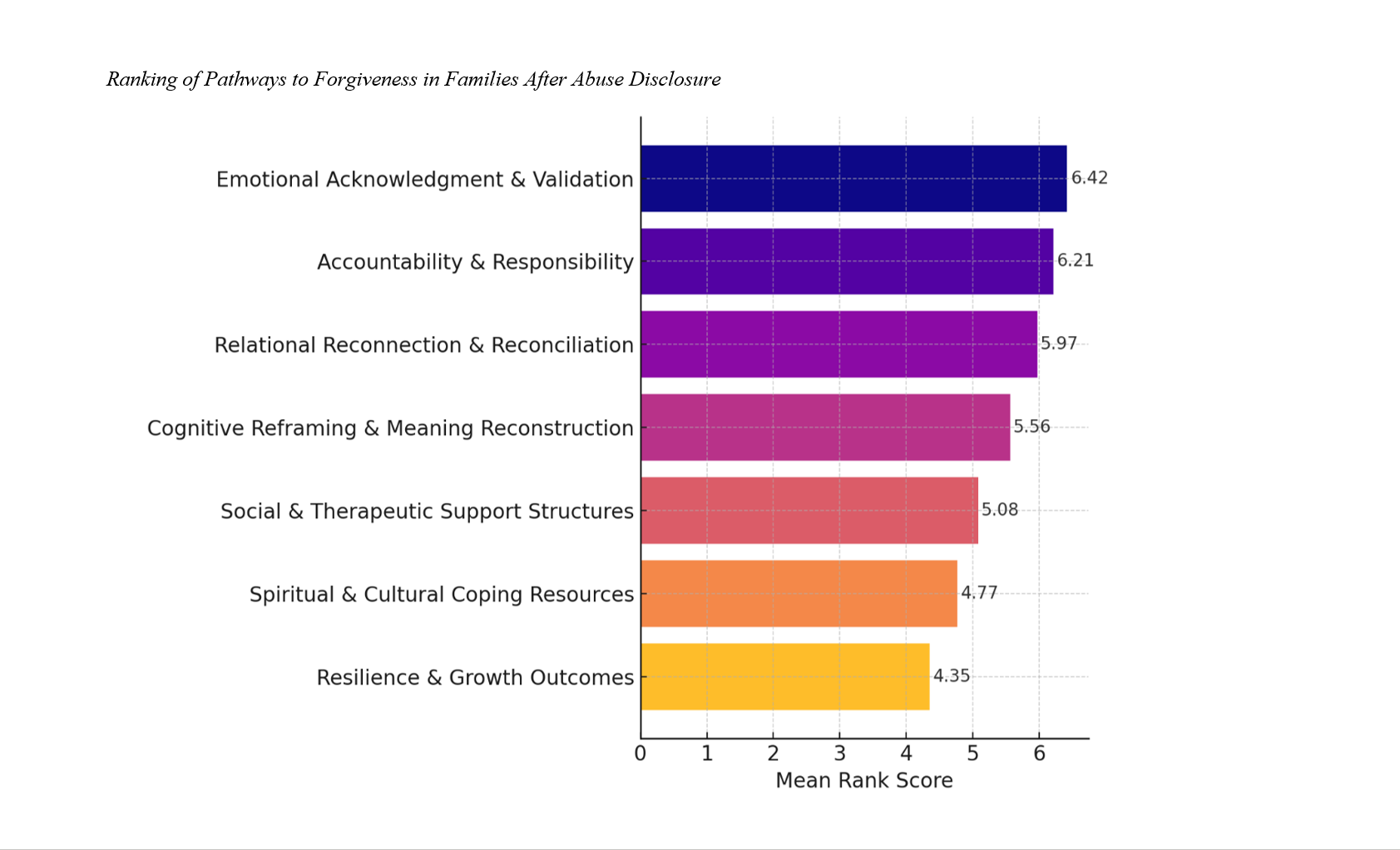
Findings: The inferential results indicated significant differences in the prioritization of forgiveness pathways (χ² = 108.72, p < 0.001, Kendall’s W = 0.67). Emotional acknowledgment and validation ranked highest (mean rank = 6.42), followed by accountability and responsibility (6.21) and relational reconnection and reconciliation (5.97), underscoring their foundational role in the forgiveness process. Cognitive reframing and meaning reconstruction (5.56) and social and therapeutic support structures (5.08) occupied mid-level ranks, while spiritual and cultural coping resources (4.77) and resilience and growth outcomes (4.35) were ranked lower, indicating their function as supplementary or long-term components. These results reveal a structured and process-oriented model of forgiveness emerging through emotional, moral, cognitive, and relational stages.
Conclusion: Forgiveness in families following abuse disclosure is a multidimensional and sequential process rooted in emotional recognition, moral accountability, and relational reconstruction, leading to eventual resilience and personal growth. The findings provide an empirical basis for developing culturally sensitive therapeutic interventions that prioritize safety, empathy, and justice in the post-abuse recovery process.
Downloads
References
Akhtar, S., & Barlow, J. (2016). Forgiveness Therapy for the Promotion of Mental Well-Being: A Systematic Review and Meta-Analysis. Trauma, Violence, & Abuse, 19(1), 107-122. https://doi.org/10.1177/1524838016637079
Ayaya, S., DeLong, A., Embleton, L., Ayuku, D., Sang, E., Hogan, J., Kamanda, A., Atwoli, L., Makori, D., Ott, M. A., Ombok, C., & Braitstein, P. (2023). Prevalence, incidence and chronicity of child abuse among orphaned, separated, and street-connected children and adolescents in western Kenya: What is the impact of care environment? Child abuse & neglect, 139, 104920. https://doi.org/10.1016/j.chiabu.2020.104920
Basting, E. J., Romero, G. J., Garner, A. R., Medenblik, A. M., Cornelius, T. L., & Stuart, G. L. (2023). Applying attachment theory to link family of origin violence history to cyber dating abuse among college students. Journal of family violence, 38(5), 953-963. https://doi.org/10.1007/s10896-022-00418-1
Edwards, C., Meier, L., Westerhold, K., Botset, K., Shaw, T. J., Mongan, L., & Brem, M. J. (2024). Examining the Role of Forgiveness in the Association Between Trait Mindfulness and Psychological Partner Aggression Among Dating College Students. Partner Abuse, 15(2). https://doi.org/10.1891/PA-2023-0014
Ha, N., Bae, S.-M., & Hyun, M.-H. (2019). The effect of forgiveness writing therapy on post-traumatic growth in survivors of sexual abuse. Sexual and Relationship Therapy, 34(1), 10-22. https://doi.org/10.1080/14681994.2017.1327712
McGaffin, B. J., Lyons, G., & Deane, F. P. (2013). Self-Forgiveness, Shame, and Guilt in Recovery From Drug and Alcohol Problems. Substance Abuse, 34(4), 396-404. https://doi.org/10.1080/08897077.2013.781564
Mukul, S., & Ajita, N. (2021). Aggresssion in School Children: Role of Gender, Family Factors and Exposure to Violence. medRxiv, 2021.2003.2025.21254374. https://doi.org/10.1101/2021.03.25.21254374
Petersson, C. C., & Plantin, L. (2023). Overcoming Challenges of Intimacy: Male Child Sexual Abuse Survivors’ Experiences of Achieving Healthy Romantic Relationships in Sweden. Journal of family violence, 39(6), 1107-1120. https://doi.org/10.1007/s10896-023-00576-w
Rahbari Ghazani, N., Hajloo, N., & Aghajan, S. (2022). The effectiveness of family -based empowerment based on short -term solution -oriented therapy on emotional expression and psychological distress of adolescents with substance -abuse parents. Rooyeshe Ravanshenasi Journal, 11(5), 111-124. https://frooyesh.ir/article-1-3578-fa.html
Rostami, M., Abdi, M., & Heidari, H. (2014). Childhood abuse and the amount of forgivenessin married individuals. Thoughts and Behavior in Clinical Psychology, 9(32), 77-89. https://jtbcp.roudehen.iau.ir/article_72_de6c6aa22e0e98abe9afeba9830ede6c.pdf
Spearman, K. J., Vaughan-Eden, V., Hardesty, J. L., & Campbell, J. (2023). Post-Separation Abuse: A Literature Review Connecting Tactics to Harm. Journal of Family Trauma, Child Custody & Child Development, 1-20. https://doi.org/10.1080/26904586.2023.2177233
Tariq, R., & Anjum, A. (2024). Childhood Abuse, Empathy, and Forgiveness in Young Adults. Journal of Research in Psychology (JRP), 2(1), 1-14. https://www.jrplcwu.pk/index.php/JRP/article/view/17
Webb, J. R., & Boye, C. M. (2024). Self-Forgiveness and Self-Condemnation in the Context of Addictive Behavior and Suicidal Behavior. Substance Abuse and Rehabilitation, 21-30. https://doi.org/10.2147/SAR.S396964
Downloads
Additional Files
Publication Timeline
- Submitted
- Revised
- Accepted