The Effectiveness of Reflective Parenting on Meta-Parenting and Time Perspective among Mothers of Children Aged 7 to 12 Years with Generalized Anxiety Symptoms in Isfahan
DOI:
https://doi.org/10.61838/kman.aftj.5093Keywords:
Reflective Parenting, Parental Overprotection, Temporal Perspective, Generalized Anxiety DisorderAbstract
Objective: Generalized anxiety in children can affect the mental health and emotional functioning of parents, particularly mothers. One effective approach in this domain is reflective parenting, which contributes to improving parent–child interactions. Accordingly, the present study was conducted in 2025 in the city of Isfahan.
Methods and Materials: This study employed a quasi-experimental design with a pretest–posttest control group. The statistical population consisted of all mothers of 7- to 12-year-old children with symptoms of generalized anxiety residing in Isfahan in 2025. From this population, 30 mothers were selected using purposive sampling and were randomly assigned to experimental and control groups. Participants in the experimental group received the reflective parenting program in ten 60-minute sessions, whereas participants in the control group did not receive this intervention. Research instruments included the standardized Meta-Parenting Questionnaire developed by Hawk and Holden (2006) and the Zimbardo Time Perspective Inventory (1999). The collected data were analyzed using multivariate analysis of covariance (MANCOVA) in SPSS version 27.
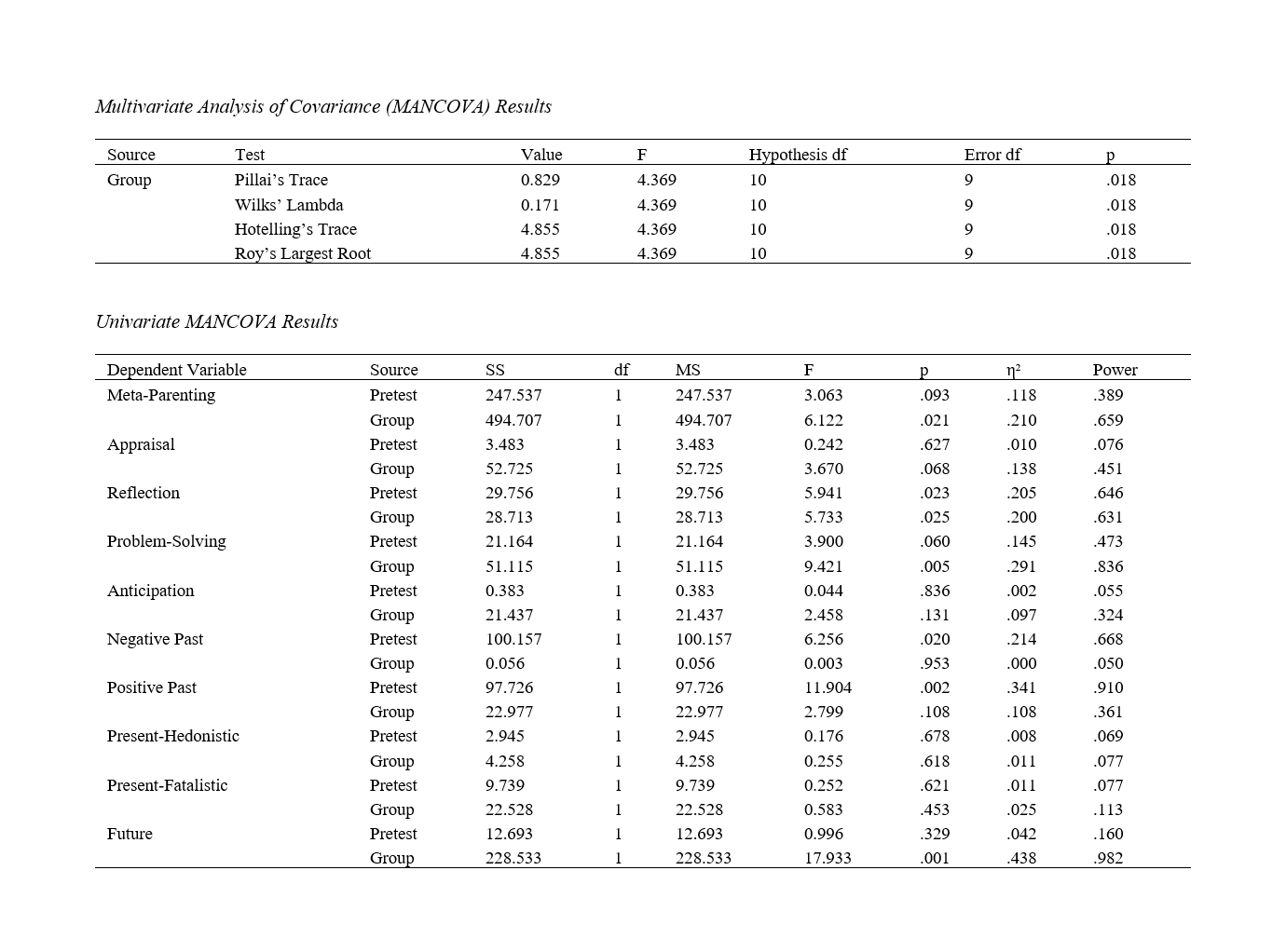
Findings: The findings indicated that the reflective parenting program had a significant effect on the total meta-parenting score and the problem-solving subscale (p < .05). Furthermore, the program led to a significant improvement in the future subscale (p < .05). However, there were no significant differences between the experimental and control groups with respect to the appraisal, reflection, and anticipation subscales, the total time perspective score, and the negative past, positive past, present-hedonistic, and present-fatalistic subscales (p > .05).
Conclusion: Therefore, it can be inferred that the reflective parenting program may be used as an effective approach to enhance meta-parenting among mothers of children with generalized anxiety symptoms and to modify their future-oriented time perspective.
Downloads
References
Abuhadra, B. D., Abohadra, R., Nawa, N., & Fujiwara, T. (2025). The impact of parental general anxiety disorder on parenting practices among Libyan parents: cross-sectional study. Discover Mental Health, 5(1), 41. https://doi.org/10.1007/s44192-025-00156-y
Aktar, E., Nikolić, M., & Bögels, S. M. (2017). Environmental transmission of generalized anxiety disorder from parents to children: Worries, experiential avoidance, and intolerance of uncertainty. Dialogues in clinical neuroscience, 19(2), 137-147. https://doi.org/10.31887/DCNS.2017.19.2/eaktar
Alipour Sabet Ray, B., & Jadidi, M. (2021). Determining the Role of Motivation Levels and Time Perspective on Purposefulness Mediated by Hope in Students. Quarterly Journal of New Ideas in Psychology, 11(15), 1-9. http://jnip.ir/article-1-652-fa.html
Alipour Sabetray, B., & Jadidi, M. (2022). Determining the role of motivation levels and time perspective on purposefulness mediated by hope in students. Journal of Psychology New Ideas, 11(15), 1-9. https://jnip.ir/article-1-652-en.html
Awiszus, A., Koenig, M., & Vaisarova, J. (2022). Parenting styles and their effect on child development and outcome. Journal of Student Research, 11(3), 3-12. https://doi.org/10.47611/jsrhs.v11i3.3679
Beesdo, K., Knappe, S., & Pine, D. S. (2009). Anxiety and anxiety disorders in children and adolescents: developmental issues and implications for DSM-V. The Psychiatric clinics of North America, 32(3), 483. https://doi.org/10.1016/j.psc.2009.06.002
Bucci, M., Marques, S. S., Oh, D., & Harris, N. B. (2016). Toxic stress in children and adolescents. Advances in Pediatrics, 63(1), 403-428. https://doi.org/10.1016/j.yapd.2016.04.002
Buchanan-Pascall, S., Melvin, G. A., Gordon, M. S., & Gray, K. M. (2023). Evaluating the effect of parent-child interactive groups in a school-based parent training program: Parenting behavior, parenting stress and sense of competence. Child Psychiatry & Human Development, 54(3), 692-710. https://doi.org/10.1007/s10578-021-01276-6
Camoirano, A. (2017). Mentalizing makes parenting work: A review about parental reflective functioning and clinical interventions to improve it. Frontiers in psychology, 8, 14. https://doi.org/10.3389/fpsyg.2017.00014
Cui, M., Hong, P., & Jiao, C. (2022). Overparenting and emerging adult development: A systematic review. Emerging Adulthood, 10(5), 1076-1094. https://doi.org/10.1177/21676968221108828
Dempsey, A. G., & Keller‐Margulis, M. A. (2020). Developmental and medical factors associated with parenting stress in mothers of toddlers born very preterm in a neonatal follow‐up clinic. Infant Mental Health Journal, 41(5), 651-661. https://doi.org/10.1002/imhj.21890
Dexter, C. A., & Wong, K. (2024). Circle of security-parenting randomized waitlist control study: Change in reflective functioning explains positive caregiver behavior. Journal of Child and Family Studies, 33(2), 504-514. https://doi.org/10.1007/s10826-023-02710-0
Fonseca, A., Moreira, H., & Canavarro, M. C. (2020). Uncovering the links between parenting stress and parenting styles: The role of psychological flexibility within parenting and global psychological flexibility. Journal of Contextual Behavioral Science, 18, 59-67. https://doi.org/10.1016/j.jcbs.2020.08.004
Gordo, L., Iriarte Elejalde, L., & Martínez-Pampliega, A. (2022). Parental perception of child vulnerability in parents of young children. Journal of Pediatric Psychology, 47(7), 850-857. https://doi.org/10.1093/jpepsy/jsac013
Hawk, C. K., & Holden, G. W. (2006). Meta-Parenting: An Initial Investigation into a New Parental Social Cognition Construct. Parenting, 6(4), 321-342. https://doi.org/10.1207/s15327922par0604_3
Huynh, T., Kerr, M. L., Kim, C. N., Fourianalistyawati, E., Chang, V. Y. R., & Duncan, L. G. (2024). Parental reflective capacities: A scoping review of mindful parenting and parental reflective functioning. Mindfulness, 15(7), 1531-1602. https://doi.org/10.1007/s12671-024-02379-6
Hwang, W., Jung, E., Kim, S., & Hadi, N. (2023). Can helicopter parenting be beneficial for parent-child relationships? A person-centered approach in the United States and South Korea. Frontiers in psychology, 14, 1097348. https://doi.org/10.3389/fpsyg.2023.1097348
Jolaeeha, S., Zare, H., & Mousavi, S. (2017). Evaluation of the Psychometric Properties of the Meta-Parenting Questionnaire. Scientific Journal of Pajouhan, 16(1), 42-48. http://psj.umsha.ac.ir/article-1-298-fa.html
Julaieha, S., Zare, H., & Mousavi, S. (2017). Evaluation of Psychometric Properties of the Meta- Parenting Questionnaire. Pajouhan Scientific Journal, 16(1), 42-48. http://psj.umsha.ac.ir/article-1-298-en.html;
Karimnejad Isfahani, R., Ansari Shahidi, M., & Dehghani, A. (2025). Examining the Effectiveness of Reflective Parenting Training on Emotion Regulation and Parent-Child Relationship in Mothers with Children Under 6 Years. Applied Family Therapy Journal (AFTJ), 6(3), 1-10. https://doi.org/10.61838/kman.aftj.6.3.9
Lin, X., Yang, W., Xie, W., & Li, H. (2023). The integrative role of parenting styles and parental involvement in young children's science problem-solving skills. Frontiers in psychology, 14, 1096846. https://doi.org/10.3389/fpsyg.2023.1096846
Lo, C. K., & Wong, S. Y. (2022). The effectiveness of parenting programs in regard to improving parental reflective functioning: a meta-analysis. Attachment & Human Development, 24(1), 76-92. https://doi.org/10.1080/14616734.2020.1844247
Luyten, P., Mayes, L. C., Nijssens, L., & Fonagy, P. (2017). The parental questionnaire: Development and preliminary validation. PLoS One, 12(5), e0176218. https://doi.org/10.1371/journal.pone.0176218
McKay, M. T., & Cole, J. C. (2020). The relationship between balanced and negative time perspectives, and symptoms of anxiety and depression. Psychiatry research, 293, 113383. https://doi.org/10.1016/j.psychres.2020.113383
Meng, X., & D'Arcy, C. (2016). Coping strategies and distress reduction in psychological well-being? A structural equation modelling analysis using a national population sample. Epidemiology and Psychiatric Sciences, 25(4), 370-383. https://doi.org/10.1017/S2045796015000505
Mesbahi, M., Hosseinian, S., & Rasouli, R. (2021a). The Effectiveness of Reflective Parenting Education on Attachment and Parenting Stress Mothers of Children 3 to 6 Years. The Journal of New Thoughts on Education, 17(1), 29-52. https://doi.org/10.22051/jontoe.2020.29774.2939
Mesbahi, M., Hosseinian, S., & Rasouli, R. (2021b). The Effectiveness of Reflective Parenting Training on Attachment and Parental Stress of Mothers with Children Aged 3 to 6 Years. New Educational Thoughts, 17(1), 29-52. https://doi.org/10.22051/jontoe.2020.29774.2939
Oyanadel, C., Worrell, F. C., Pinto-Vigueras, J., Betancur, S., Véliz Tapia, T., Au-Castro, M., & Peñate, W. (2023). Time balance and family functioning: the role of time perspective in the cohesion and adaptability of families with adolescents. European Journal of Investigation in Health, Psychology and Education, 14(1), 117-132. https://doi.org/10.3390/ejihpe14010008
Pan, W., Gao, B., Long, Y., Teng, Y., & Yue, T. (2021). Effect of caregivers' parenting styles on the emotional and behavioral problems of left-behind children: The parallel mediating role of self-control. International journal of environmental research and public health, 18(23), 12714. https://doi.org/10.3390/ijerph182312714
Sadoughi, M. (2024). Overparenting and adolescent's trait anxiety: Unraveling the roles of basic psychological needs frustration and emotion dysregulation. Acta Psychologica, 251, 104579. https://doi.org/10.1016/j.actpsy.2024.104579
Salo, S. J., Pajulo, M., Vinzce, L., Raittila, S., Sourander, J., & Kalland, M. (2021). Parent relationship satisfaction and reflective functioning as predictors of emotional availability and infant behavior. Journal of Child and Family Studies, 30(5), 1214-1228. https://doi.org/10.1007/s10826-021-01934-2
Sanders, M. R., & Mazzucchelli, T. G. (2017). The power of positive parenting: Transforming the lives of children, parents, and communities using the Triple P system. Oxford University Press. https://doi.org/10.1093/med-psych/9780190629069.001.0001
Segrin, C., Givertz, M., Swaitkowski, P., & Montgomery, N. (2015). Overparenting is associated with child problems and a critical family environment. Journal of Child and Family Studies, 24(2), 470-479. https://doi.org/10.1007/s10826-013-9858-3
Siegel, D. J., & Hartzell, M. (2013). Parenting from the inside out: How a deeper self-understanding can help you raise children who thrive. Penguin. https://www.amazon.com/Parenting-Inside-Out-Self-Understanding-Anniversary/dp/039916510X
Slade, A. (2005). Parental reflective functioning: An introduction. Attachment & Human Development, 7(3), 269-281. https://doi.org/10.1080/14616730500245906
Slade, A. (2023). Enhancing attachment and reflective parenting in clinical practice. Guilford Publications. https://books.google.com/books?hl=en&lr=&id=J6S9EAAAQBAJ&oi=fnd&pg=PP1&dq=Slade,+A.+(2023).+Enhancing+attachment+and+reflective+parenting+in+clinical+practice,+Guilford+Publications.+%09&ots=w8m8MFXJdn&sig=rXVQbD_hDEpr2wQjSXRIQowhpes
Smith, S. W., Splett, J. W., Poling, D. V., & Graham, J. W. (2020). Cognitive-behavioral prevention and intervention approaches to student emotional and behavioral functioning In - Handbook of Research on Emotional and Behavioral Disorders (pp. 386-399). In. Routledge. https://doi.org/10.4324/9780429453106-26
Spruijt, A. M., Ziermans, T. B., Dekker, M. C., & Swaab, H. (2020). Educating parents to enhance children's reasoning abilities: A focus on questioning style. Journal of Applied Developmental Psychology, 66, 101102. https://doi.org/10.1016/j.appdev.2019.101102
Stuhrmann, L. Y., Göbel, A., Bindt, C., & Mudra, S. (2022). Parental reflective functioning and its association with parenting behaviors in infancy and early childhood: A systematic review. Frontiers in psychology, 13, 765312. https://doi.org/10.3389/fpsyg.2022.765312
Wynter, E., Meade, T., & Perich, T. (2021). Parental and partner role functioning and personal recovery in bipolar disorder. Journal of Clinical Psychology, 77(9), 1985-1996. https://doi.org/10.1002/jclp.23127
Zeegers, M. A., Colonnesi, C., Stams, G. J. J., & Meins, E. (2017). Mind matters: a meta-analysis on parental mentalization and sensitivity as predictors of infant-parent attachment. Psychological bulletin, 143(12), 1245. https://doi.org/10.1037/bul0000114
Zeng, L., Peng, X., Zeng, X., Wang, H., Xiao, S., & Chen, Y. (2022). Parental autonomy support and future-oriented coping among high school students: Serial mediation of future time perspective and meaning in life. Frontiers in psychology, 13, 895003. https://doi.org/10.3389/fpsyg.2022.895003
Zhang, S., Hassan, N. B. C., & Sulong, R. M. B. (2023). Time perspective predicts parents' education involution perception via education anxiety, expectations for children might not as incomprehensible as it seems. Development, 12(1), 1227-1240. https://doi.org/10.6007/IJARPED/v12-i1/16321
Zimbardo, P. G., & Boyd, J. N. (1999). Putting time in perspective: A valid, reliable individual-differences metric. Journal of personality and social psychology, 77(6), 1271-1288. https://doi.org/10.1037/0022-3514.77.6.1271
Zimmer-Gembeck, M. J., Rudolph, J., Kerin, J., & Bohadana-Brown, G. (2022). Parent emotional regulation: A meta-analytic review of its association with parenting and child adjustment. International Journal of Behavioral Development, 46(1), 63-82. https://doi.org/10.1177/01650254211051086
Downloads
Additional Files
Publication Timeline
- Submitted
- Revised
- Accepted