Comparison of the Effectiveness of Acceptance and Commitment Therapy and Emotion-Focused Therapy on Hope and Family Cohesion in Incompatible Couples
Keywords:
Acceptance and Commitment Therapy, Emotion-Focused Therapy, Hope, Family Cohesion, Incompatible CouplesAbstract
Objective: The objective of this study was to investigate and compare the effectiveness of Acceptance and Commitment Therapy (ACT) and emotion-focused therapy on hope and family cohesion among incompatible couples attending counseling centers in Tehran.
Methods and Materials: This applied research utilized a quasi-experimental pretest-posttest design with a three-month follow-up phase and a control group. The statistical population comprised incompatible couples visiting Tehran counseling centers in 1403. A sample of 45 couples was selected via convenience sampling and randomly assigned to three equal groups: ACT, emotion-focused therapy, and a control group. The experimental groups received 12 structured therapeutic sessions based on their respective approaches, while the control group received no intervention. Data were collected using standard hope and family cohesion questionnaires across the three assessment phases.
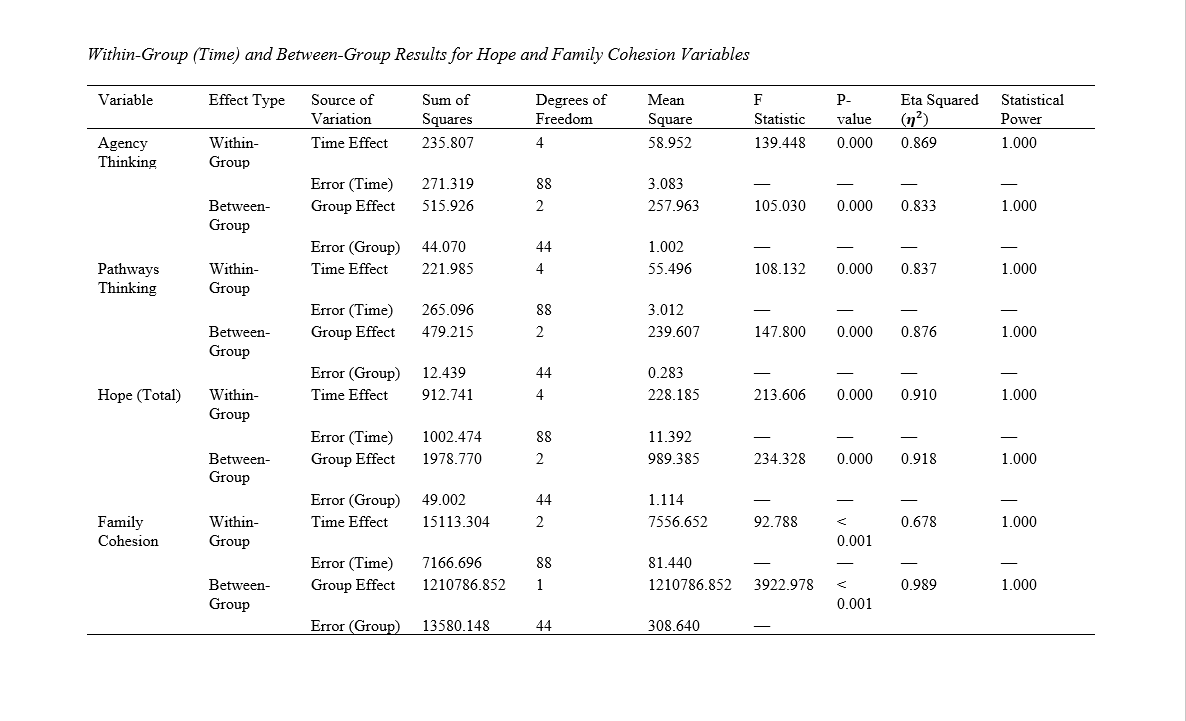
Findings: Data were analyzed using multivariate analysis of covariance (MANCOVA) and post-hoc follow-up tests. Statistical results revealed significant time and group effects with strong effect sizes. Both ACT and emotion-focused interventions significantly increased hope and family cohesion in incompatible couples compared to the control group ( ). Between-group comparisons indicated that ACT was significantly more effective than emotion-focused therapy in enhancing hope. Furthermore, while emotion-focused therapy successfully improved family cohesion, its overall impact was statistically weaker than that of the ACT intervention.
Conclusion: Both Acceptance and Commitment Therapy and emotion-focused therapy are highly effective evidence-based interventions for mitigating psychological challenges, enhancing hope, and strengthening family cohesion in incompatible couples. The therapeutic improvements, particularly the superior impact of ACT on the cognitive components of hope, remained stable throughout the three-month follow-up.
Downloads
References
Ahmadi, Z. (2025). The Effectiveness of Acceptance and Commitment Couple Therapy on Spousal Cognitive Empathy, Attachment-Detachment, and Sexual Satisfaction in Infertile Couples. Emotional and Behavioral Disorders, 2(2), 19-34. https://ebd.shirazu.ac.ir/article_8227.html?lang=en
Barraca, J., Polanski, T., Duarte-Díaz, A., & Perestelo-Pérez, L. (2025). Acceptance and commitment therapy for couples: A systematic review and meta-analysisJO - Journal of Contextual Behavioral Science. 35, 100867. https://doi.org/10.1016/j.jcbs.2024.100867
Cross, S. P., Staples, L. G., Bisby, M. A., Nielssen, O., Fisher, A., Titov, N., & Dear, B. F. (2023). An open trial of the feasibility of brief internet-delivered acceptance and commitment therapy (iACT) for chronic anxiety and depression. Internet Interventions, 33, 100655.
Demby, K. P., Riggs, S. A., & Kaminski, P. L. (2017). Attachment and family processes in children's psychological adjustment in middle childhood. Family Process, 56(1), 234-249.
Ferreira, M. G., Mariano, L. I., de Rezende, J. V., Caramelli, P., & Kishita, N. (2022). Effects of group Acceptance and Commitment Therapy (ACT) on anxiety and depressive symptoms in adults: A meta-analysis. Journal of affective disorders, 309, 297-308.
Fitzgerald, M., & Morgan, A. A. (2023). Marital quality and depression as mediators linking childhood maltreatment to adult physical health. Child abuse & neglect, 141, 106189.
Fledderus, M., Bohlmeijer, E. T., Fox, J. P., Schreurs, K. M., & Spinhoven, P. (2013). The role of psychological flexibility in a self-help acceptance and commitment therapy intervention for psychological distress in a randomized controlled trial. Behaviour Research and Therapy, 51(3), 142-151.
Fontaine, S. (2017). Parent and Youth Discrepancy Ratings of Mental Health Symptoms in Adolescents: The Moderating Role of Family Functioning University of Ottawa].
Goldfarb, M. R., & Trudel, G. (2019). Marital quality and depression: A review. Marriage & Family Review, 55(8), 737-763.
Hashemi, Z., Afshari, A., & Aini, S. (2020). Effectiveness of Acceptance and Commitment-Based Training on Mental Health and Quality of Life in Elderly Patients with Cancer. Health Education and Health Promotion, 8(2), 160-171.
Iordachescu, D. A., Gica, C., Vladislav, E. O., Panaitescu, A. M., Peltecu, G., Furtuna, M. E., & Gica, N. (2021). Emotional disorders, marital adaptation and the moderating role of social support for couples under treatment for infertility. Ginekologia Polska, 92(2), 98-104.
Jafari, S., & Sepehi, S. (2023). Investigating the Effectiveness of Acceptance and Commitment Therapy on Marital Adjustment and Family Cohesion in Men with High-Risk Occupations in Shiraz. First National Conference on Psychological and Behavioral Sciences Studies with a Focus on Lifestyle and Mental Health in Post-Corona, Shiraz.
Johnson, S. M. (2012). The Practice of Emotionally Focused Couple Therapy: Creating Connection. Routledge.
Julazadeh Esmaeili, A. A., Karimi, J., Goodarzi, K., & Asgari, M. (2021). Comparison of the Effectiveness of Acceptance and Commitment Couple Therapy and Emotionally Focused Couple Therapy on Depression in Maladjusted Couples. Clinical Psychology, 13(1), 47-64.
Landolt, S. A., Weitkamp, K., Roth, M., Sisson, N. M., & Bodenmann, G. (2023). Dyadic coping and mental health in couples: A systematic review. Clinical psychology review, 102344.
Manyam, S. B., & Junior, V. Y. (2014). Marital adjustment trend in Asian Indian families. Journal of Couple & Relationship Therapy, 13(2), 114-132.
Marshall, S. L., Parker, P. D., Ciarrochi, J., Sahdra, B., Jackson, C. J., & Heaven, P. C. (2015). Self-compassion protects against the negative effects of low self-esteem: A longitudinal study in a large adolescent sample. Personality and individual differences, 74, 116-121.
Najarnasab, S., Dasht Bozorgi, Z., Safarzadeh, S., & Talebzadeh Shoushtari, M. (2024). The Efficacy of Acceptance and Commitment Therapy (ACT)-Based Couples Therapy on Marital Quality of Life and Emotion Regulation in Distressed Couples. Avicenna Journal of Neuro Psycho Physiology. https://ajnpp.umsha.ac.ir/article-1-500-fa.html
Navroodi, S. O. S., Tavana, S. E., Roodbardeh, F. P., & Farokhi, N. (2025). The Effectiveness of Emotion-Focused Couple Therapy on Marital Harmony and Communication Patterns in Incompatible Couples. Journal of Behavior Modification Studies (JBMS), 1(2). https://jbms.guilan.ac.ir/article_8585_49755ea73d3e8caa290dd3de657fa11c.pdf
Palmer-Olsen, L., Gold, L. L., & Woolley, S. R. (2011). Supervising emotionally focused therapists: A systematic research-based model. Journal of marital and family therapy, 37(4), 411-426.
Peng, Y., & Wang, Z. (2020). Marital quality and children's prospective internalizing problems: A moderated mediation model. Children and Youth Services Review, 119, 105656.
Rezapour Mirsaleh, Y., Shafizadeh, R., & Amin, F. (2021). Effectiveness of Integrated Emotion-Focused Therapy and Forgiveness in Increasing Family Cohesion and Reducing Divorce Tendency in Women Affected by Marital Infidelity. Cultural-Educational Quarterly of Women and Family, 16(56).
Sachser, C., Olaru, G., Pfeiffer, E., Braehler, E., Clemens, V., Rassenhofer, M., & Fegert, J. M. (2021). The immediate impact of lockdown measures on mental health and couples’ relationships during the COVID-19 pandemic: Results of a representative population survey in Germany. Social Science & Medicine, 278, 113954.
SalehiT, S., & Davarani, F. F. (2025). Investigating the Effectiveness of Emotionally-Focused Approach Training on Improving Interpersonal Sensitivity in Couples on the Verge of Divorce. Journal of counseling research. https://doi.org/10.18502/qjcr.v23i92.17848
Shams Yousefi, L., Soodagar, S., Maschi, F., Rafiee, Z., & Seyrafi, M. (2023). The Mediating Role of Self-Compassion in the Relationship Between Family Cohesion, Stress, and Quality of Life with Body Image Satisfaction in Adolescent Girls. Journal of Psychological Science, 22(124), 723-742.
Sunmonu, H. O., Tiamiyu, K. A., Yusuf, J., & Ahmed, M. (2025). Emotionally-Focused Therapy and Marital Bonding: Counselling Implications for Nigerian Couples. Coution Journal of Counseling and Education, 6(2), 83-97. https://doi.org/10.47453/coution.v6i2.3533
Timulak, L., Dailey, J., Lunn, J., & McKnight, J. (2025). Transdiagnostic emotion-focused therapy for couples with co-morbid relational and mood, anxiety, and related difficulties. Journal of Contemporary Psychotherapy, 55(1), 1–10. https://doi.org/10.1007/s10879-024-09645-7
Whisman, M. A., & Collazos, T. (2023). A longitudinal investigation of marital dissolution, marital quality, and generalized anxiety disorder in a national probability sample. Journal of anxiety disorders, 96, 102713.
Yousefpouri, M., Zomorodi, S., & Bazzāziān, S. (2024). Effectiveness of Acceptance and Commitment-Based Couples Therapy on Attitudes Towards Marital Infidelity and Emotional Regulation in Married Women. Aftj, 5(2), 103-111. https://doi.org/10.61838/kman.aftj.5.2.12
Yu, Y., Wu, D., Wang, J. M., & Wang, Y. C. (2020). Dark personality, marital quality, and marital instability of Chinese couples: An actor-partner interdependence mediation model. Personality and individual differences, 154, 109689.
Zanganeh Motlagh, F., Binejamali, S., Ahadi, H., & Hatami, H. (2017). Effectiveness of Acceptance and Commitment Couple Therapy and Emotion-Focused Therapy on Improving Marital Adjustment and Commitment. Cultural-Educational Quarterly of Women and Family, 12(38), 49-70.
Zuccarini, D., Johnson, S. M., Dalgleish, T. L., & Makinen, J. A. (2013). Forgiveness and reconciliation in emotionally focused therapy for couples: The client change process and therapist interventions. Journal of marital and family therapy, 39(2), 148-162.
Downloads
Additional Files
Publication Timeline
- Submitted
- Revised
- Accepted