The Effectiveness of Acceptance and Commitment Therapy on Marital Inhibition and Emotional Intimacy among Women in Second Marriages
Keywords:
Acceptance and Commitment Therapy, marital inhibition, emotional intimacy, second marriageAbstract
Objective: The present study aimed to determine the effectiveness of Acceptance and Commitment Therapy (ACT) on marital inhibition and emotional intimacy among women in second marriages.
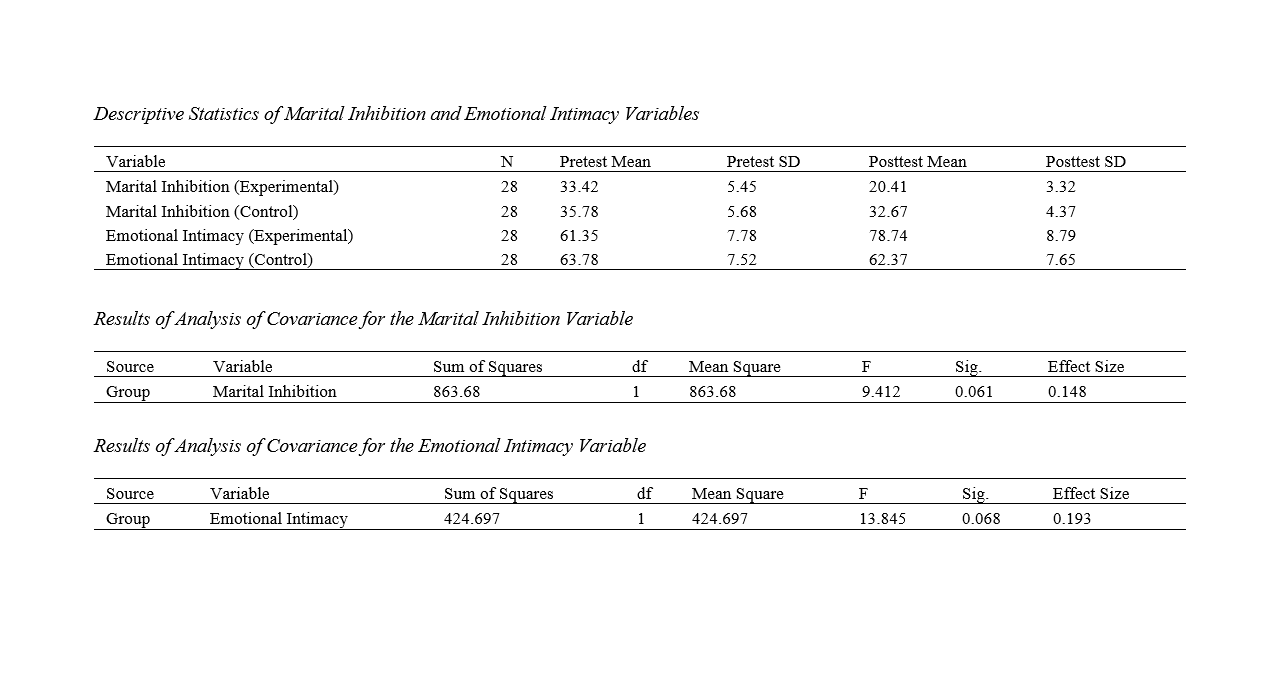
Methods and Materials: This study employed a quasi-experimental method using a pretest-posttest design with a control group. The statistical population consisted of women in second marriages who referred to counseling centers in Tehran in 2026. Using convenience sampling, 28 participants were selected and randomly assigned into experimental (n = 14) and control (n = 14) groups. Data were collected using the Marital Inhibition Questionnaire and the Emotional Intimacy Questionnaire. The experimental group participated in eight weekly 90-minute sessions of Acceptance and Commitment Therapy, whereas the control group received no intervention. Data were analyzed using analysis of covariance (ANCOVA) in IBM SPSS Statistics version 27 at a significance level of 0.05.
Findings: The findings indicated that Acceptance and Commitment Therapy significantly reduced marital inhibition and increased emotional intimacy among women in second marriages. The results of covariance analysis for marital inhibition demonstrated a significant difference between the experimental and control groups in the posttest phase (F = 9.412, effect size = 0.148). In addition, the covariance analysis results for emotional intimacy revealed a significant difference between the two groups following the intervention (F = 13.845, effect size = 0.193). The posttest mean scores showed that marital inhibition decreased and emotional intimacy increased in the experimental group compared with the control group.
Conclusion: Based on the findings, Acceptance and Commitment Therapy was effective in improving emotional intimacy and reducing marital inhibition among women in second marriages. By increasing psychological flexibility, emotional acceptance, and adaptive interpersonal functioning, ACT may help remarried women establish healthier emotional relationships and reduce maladaptive controlling behaviors within marital interactions.
Downloads
References
Abaie, S. M., & Bagheri, N. (2024). Predicting the Desire for Remarriage Based on Self-Differentiation and Ego Strength Mediated by Irrational Beliefs in Divorced Youth. Jarac, 6(3), 81-89. https://doi.org/10.61838/kman.jarac.6.3.9
Abid, H., & Stanikzai, I. U. (2024). Financial Rights of a Divorced Woman: From the Perspective of Islamic Jurisprudence and Afghan Civil Law. International Journal of Latest Engineering Research and Applications (Ijlera), 9(9), 40-48. https://doi.org/10.56581/ijlera.9.9.40-48
Güngör, A. (2025). Remarriage After Divorce: Insights From the Turkish Context. https://doi.org/10.21203/rs.3.rs-7186587/v1
Heath, F., Ockerman, K., Wiesemann, G., Safeek, R., Heath, M., Momeni, A., Spiguel, L. R., Kovach, S. J., & Sorice‐Virk, S. (2025). Changes in Relationship Dynamics in Men and Women After Receiving the Diagnosis of Breast Versus Prostate Cancer: A Population-Based Study. Plastic and Reconstructive Surgery Global Open, 13(2), e6494. https://doi.org/10.1097/gox.0000000000006494
Hernández, A. C., Lee, S., Xvii, B., Mitchell, S., Landor, A. M., Zeiders, K. H., Murillo, N., Turner, J. J., Kopystynska, O., Bradford, K., Higginbotham, B. J., Schramm, D. G., Stykes, J. B., Guzzo, K. B., Ogubuike, C., Omobowale, M. O., Index, O. A., Amodu, O. K., Illanes, J. C., . . . Bui, T. (2023). Conjugal Trajectories: Relationship Beginnings, Change, and Dissolutions. https://doi.org/10.1108/s1530-3535202322
Jackson, J. B., Carrese, D. H., & Willoughby, B. J. (2023). The Indirect Effects of Financial Conflict on Economic Strain and Marital Outcomes Among Remarried Couples. International Journal of Stress Management, 30(1), 69-83. https://doi.org/10.1037/str0000277
Karimi, Z., Mirhashemi, M., & Kord, B. (2023). Effectiveness of Acceptance and Commitment Therapy on Alexithymia in Women Experiencing Infidelity. PWJ, 4(4), 48-54. https://doi.org/10.61838/kman.pwj.4.4.6
Kumar, L. M., Stephen, J. J., George, R. J., & Babu, L. (2022). He Hit Me; But It’s Okay! Female Submissiveness in Marital Abuse: A Review in Indian Context. Journal of Family Medicine and Primary Care, 11(2), 447-452. https://doi.org/10.4103/jfmpc.jfmpc_1870_21
Lakshmanan, R., Anbu, M., & Noguchi, M. (2023). Analysis of Design Agents for Mediation of Gender Inclusivity in Domestic Space: A Case Study of Chettinad Vernacular Architecture. Sustainability, 15(4), 3643. https://doi.org/10.3390/su15043643
Masaeli, Z., Farajkhoda, T., Khanabadi, M., & Khorasani, A. (2024). A Brief Package of Tele-Sexual Counseling Based on Islamic Emotion-Focused Therapy Versus Tele-Sexual Health Education on Sexual Intimacy in Pregnant Women: A Randomized Clinical Trial. Journal of education and health promotion, 13(1). https://doi.org/10.4103/jehp.jehp_1094_23
Najibzadegan, A., Bahrainian, S. A., & Shahabizadeh, F. (2024). Efficacy of Acceptance and Commitment Therapy on Intimacy, Marital Forgiveness, and Marital Burnout in Women Affected by Extramarital Relationships. Aftj, 5(3), 102-112. https://doi.org/10.61838/kman.aftj.5.3.11
Nezamalmolki, M., Bahrainian, S. A., & Shahabizadeh, F. (2023). Effectiveness of Emotion-Focused Couples Therapy on Sexual Function, Marital Intimacy, and Impulsivity in Women Affected by Marital Infidelity. PWJ, 4(4), 39-47. https://doi.org/10.61838/kman.pwj.4.4.5
Nezamalmolki, M., Bahrainian, S. A., & Shahabizadeh, F. (2024). Effectiveness of Integrative Couple Therapy on Sexual Function, Marital Intimacy, and Impulsivity in Women Affected by Marital Infidelity. Jarac, 6(2), 19-26. https://doi.org/10.61838/kman.jarac.6.2.3
Nyarko, E. (2023). Jesus on Marriage, Divorce and Remarriage: A Reflection on Matthew 19:3-12 and Mark 10:2-12 From an Akan Perspective. Journal of Mother-Tongue Biblical Hermeneutics and Theology, 137-149. https://doi.org/10.38159/motbit.2023591
Ossai, M. O., & Chujor, C. J. (2023). Some Social Predictors of Gamophobia Among Unmarried Postgraduate Students in Tertiary Institutions in Rivers State. British Journal of Education, 11(1), 13-24. https://doi.org/10.37745/bje.2023/vol11n11324
Poorhejazi, M., Khalatbari, J., Shiroudi, S. G., & Khodabakhshi‐Koolaee, A. (2021). The Effectiveness of a Unified Protocol for the Family Therapy on Emotional Divorce and Marital Boredom in Women With Marital Conflict. Practice in Clinical Psychology, 9(1), 71-80. https://doi.org/10.32598/jpcp.9.1.747.1
Sobhani, F. F., Shiroudi, S. G., & Khodabakhshi‐Koolaee, A. (2021). Effect of Two Couple Therapies, Acceptance and Commitment Therapy and Schema Therapy, on Forgiveness and Fear of Intimacy in Conflicting Couples. Practice in Clinical Psychology, 9(4), 271-282. https://doi.org/10.32598/jpcp.9.4.746.3
Tavaloli, T., Kimiaee, S. A., & Mohammadian, H. A. (2022). The Effectiveness of Marriage Enrichment Training of TIME Plan on Improving Marital Intimacy and Women’s Psychological Security. Practice in Clinical Psychology, 10(3), 259-274. https://doi.org/10.32598/jpcp.10.3.857.1
Torani, R. A., & Fard, M. S. (2024). Efficacy of Emotion-Focused Couple Therapy on Intimacy, Marital Adjustment, and Forgiveness Among Couples With a History of Extramarital Affairs. Aftj, 5(2), 95-102. https://doi.org/10.61838/kman.aftj.5.2.11
Turner, J. J., Crapo, J. S., Kopystynska, O., Bradford, K., & Higginbotham, B. J. (2023). Economic Distress and Perceptions of Sexual Intimacy in Remarriage. Frontiers in psychology, 13. https://doi.org/10.3389/fpsyg.2022.1056180
Vakilian, K., Ebrahimi, S., Fouladvand, M., Moslemi, A., & Najdi, N. (2024). Predicting Commitment of Married Women Based on Emotional Intimacy, Cognitive Flexibility, and Irrational Beliefs of Infertile Couples in Arak City in the 2021:A Cross-Sectional Study. The Open Public Health Journal, 17(1). https://doi.org/10.2174/0118749445267020240209073345
Yousefpouri, M., Zomorodi, S., & Bazzāziān, S. (2024). Effectiveness of Acceptance and Commitment-Based Couples Therapy on Attitudes Towards Marital Infidelity and Emotional Regulation in Married Women. Aftj, 5(2), 103-111. https://doi.org/10.61838/kman.aftj.5.2.12
Downloads
Additional Files
Publication Timeline
- Submitted
- Revised
- Accepted