The Effectiveness of Metacognitive Training on Distress Tolerance and Cognitive Dysregulation in Mothers of Children with Intellectual Disabilities
Keywords:
metacognitive therapy, cognitive dysregulation, distress tolerance, mothers of children with intellectual disabilitiesAbstract
Objective: The present study aimed to investigate the effectiveness of metacognitive training on distress tolerance and cognitive dysregulation in mothers of children with intellectual disabilities.
Methods and Materials: This study was an applied quasi-experimental research with a pretest–posttest design and a two-month follow-up including a control group. The statistical population consisted of all mothers of children with intellectual disabilities in Tabriz in 2025, from whom 30 participants were selected using purposive and convenience sampling methods. After meeting the inclusion criteria and providing informed consent, participants were randomly assigned to an experimental group (n = 15) and a control group (n = 15). The experimental group received 12 weekly sessions of metacognitive training based on Wells’ protocol (2017), each lasting 60 minutes, while the control group received no intervention. Data were collected using the Distress Tolerance Questionnaire (Simons & Gaher, 2005) and the Cognitive Dysregulation Questionnaire (Mason et al., 1995), administered at pretest, posttest, and follow-up stages. Data were analyzed using repeated measures analysis of variance (ANOVA) in SPSS version 27.
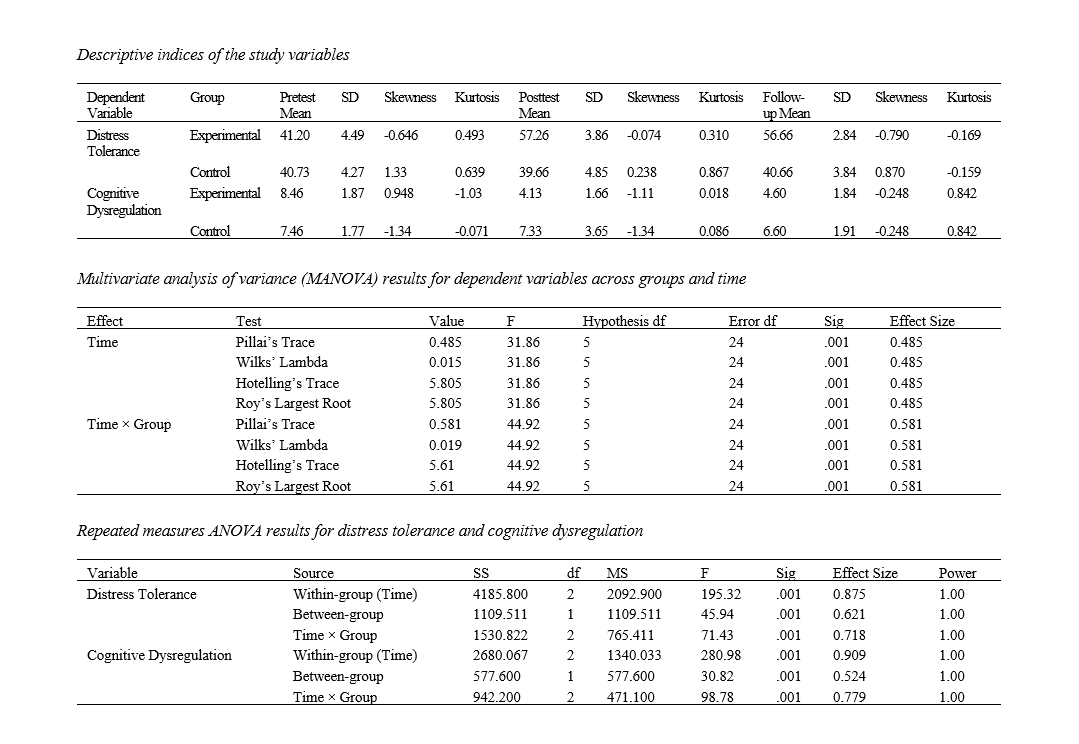
Findings: The results of repeated measures ANOVA indicated significant effects of time, group, and time × group interaction on distress tolerance (F = 195.32, p < .001, η² = 0.875; F = 45.94, p < .001, η² = 0.621; F = 71.43, p < .001, η² = 0.718) and cognitive dysregulation (F = 280.98, p < .001, η² = 0.909; F = 30.82, p < .001, η² = 0.524; F = 98.78, p < .001, η² = 0.779). Multivariate analysis of variance also confirmed a significant main effect of time (F = 31.86, p < .001, η² = 0.485) and a significant time × group interaction (F = 44.92, p < .001, η² = 0.581). Bonferroni post hoc tests showed significant differences between pretest and posttest and between pretest and follow-up (p < .001), while no significant differences were observed between posttest and follow-up (p = 1.00), indicating stability of effects.
Conclusion: Metacognitive training is an effective and stable intervention for increasing distress tolerance and reducing cognitive dysregulation in mothers of children with intellectual disabilities, and its effects remain sustained over time.
Downloads
References
Asgari, M., Ali Mohammadmalayeri, E., & Sharifi Daramadi, P. (2021). The Effectiveness of Acceptance and Commitment Therapy on Distress Tolerance and Time Perspective in Mothers of Children with Intellectual Disability. Journal of Clinical Psychology Studies(42), 51-76.
Azizi, A., Mirzaei, A., & Shams, J. (2010). Correlation between Distress Tolerance and Emotional Regulation with Students Smoking Dependence. Hakim Research Journal, 13(1), 8-11.
Cesur, E. (2026). Emotion Regulation Training for Children with Specific Learning Disorders: Metacognitive and Emotional Effects. Current Psychology, 45, 210. https://doi.org/10.1007/s12144-025-08910-9
Chan, R. C. H., Suen, Y. T., & Wong, E. M. Y. (2026). Minority Stress as a Risk Factor for Depression Symptoms and Sleep Disturbance among Sexual Minority Individuals: The Role of Cognitive and Emotional Dysregulation. Sexuality Research and Social Policy. https://doi.org/10.1007/s13178-026-01333-6
Dukmak, S. J., Mousa, A., & Algharaibeh, M. (2023). Child Behavior Problems as Predictors of Stress in Parents of Children with Developmental and Intellectual Disabilities in Four Emirates of the United Arab Emirates. Journal of Mental Health Research in Intellectual Disabilities, 16(2), 114-141. https://doi.org/10.1080/19315864.2022.2098434
Homayounfar, N., Taghipour, B., Seraj Mohammadi, P., Dida, L., Abdi, F., & Ahadi, E. (2022). The Effectiveness of Compassion-Based Mindfulness Training on Worry and Distress Tolerance in Mothers of Children with Intellectual Disability. Journal of Research in Psychological Health, 16(4), 16-30.
Hosseini, M., & Ashouri, M. (2024). The Effectiveness of Forgiveness Therapy on Distress Tolerance and Perceived Stress in Mothers of Children with Visual Impairment. Journal of Psychological Studies, 20(3), 91-105.
Hosseini, S. J., Ramezani, M., Ashrafzadeh, F., & Jamali, J. (2024). Motivation in Caregiving among Mothers of Children with Intellectual and Developmental Disabilities in Iran: A Qualitative Study. BMC pediatrics, 24, 472. https://doi.org/10.1186/s12887-024-04957-y
Khorrami, M., Atashpour, S. H., & Arefi, M. (2020). Comparing the Effectiveness of Mindfulness-Based Cognitive Therapy and Metacognitive Therapy on Mental Vitality, Psychological Well-Being, and Resilience in Mothers of Children with Cerebral Palsy. Journal of North Khorasan University of Medical Sciences, 12(1), 63-72.
Mazrouei, N., Alivandi Vafa, M., & Moheb, N. (2024). The Effectiveness of Group Training Based on an Islam-Oriented Spiritual-Religious Approach on Psychological Distress, Guilt, and Perceived Marital Relationship Quality among Mothers of Educable Students with Intellectual Disability. Women and Family Studies(66), 140-156.
Meinhart, A., Sauvé, G., Schmueser, A., Penney, D., Berna, F., Gawęda, Ł., Lamarca, M., Moritz, S., Ochoa, S., König, C., Acuña, V., & Fischer, R. (2025). Metacognitive Training for Psychosis (MCT): A Systematic Meta-Review of Its Effectiveness. Translational psychiatry, 15, 156. https://doi.org/10.1038/s41398-025-03344-0
Mohebbi Nobandegani, Z., Najafi Dolatabad, S., Rambod, M., & Mobaraki, A. (2010). Comparison of Attitudes of Parents with and without a Child with Intellectual Disability toward Intellectual Disability in Pasouj, 2007. Dena Journal, 5(1), 21.
Namjoo Abosaeidi, M., Asgari, M., & Yousefi, A. (2021). Comparing the Effectiveness of Positive Psychotherapy and Reality Therapy on Cognitive Distress and Anxiety about Returning to Substance Use among Addicted Individuals under Treatment. Behavioral Sciences Research, 19(4), 563-574.
Nouri Ghaleh Alikhani, F., Janadeleh, V., Emami, F., Gharibian, F., & Al-Kathir, F. (2025). Predicting Distress Tolerance in Mothers of Children with Physical-Motor Disabilities Based on Guilt, Self-Compassion, and Mindfulness. Rooyesh-e-Ravanshenasi, 14(8), 243-252.
Piro-Gambetti, B., Greenlee, J., Hickey, E. J., Putney, J. M., Lorang, E., & Hartley, S. L. (2023). Parental Depression Symptoms and Internalizing Mental Health Problems in Autistic Children. Journal of Autism and Developmental Disorders, 53(6), 2373-2383. https://doi.org/10.1007/s10803-022-05518-x
Wells, A. (2017). Metacognitive Therapy for Anxiety and Depression. The Guilford Press.
Yao, K., Huang, X., Kuang, J., & Xu, M. (2026). The Relationship between Irritability and Suicidal Ideation: The Chain Mediating Effects of Rumination and Distress Tolerance. BMC psychiatry, 26, 2. https://doi.org/10.1186/s12888-025-07598-2
Zeng, W., Heyman, M., Jerome, S. J., Davis, M. L., & Akobirshoev, I. (2025). Longitudinal Trajectories of Maternal Stress for Mothers with Intellectual Disabilities and Borderline Intellectual Functioning: Evidence from the Future of Families and Child Wellbeing Study. Journal of Autism and Developmental Disorders. https://doi.org/10.1007/s10803-025-06732-z
Downloads
Additional Files
Publication Timeline
- Submitted
- Revised
- Accepted