Comparison of the Effects of Reality Therapy and Cognitive Behavioral Therapy on the Resilience and Adjustment of Family Caregivers of Children with Autism
Keywords:
Reality Therapy, Cognitive Behavioral Therapy, Resilience, Adjustment, AutismAbstract
Objective: The present study aimed to compare the effectiveness of reality therapy and cognitive behavioral therapy on resilience and adjustment among family caregivers of children with autism spectrum disorder.
Methods and Materials: This study was conducted using a quasi-experimental design with a pretest–posttest format and a control group. The statistical population included all family caregivers of children with autism spectrum disorder who were members of the Tehran branch of the Iran Autism Association. A total of 45 participants were selected through purposive sampling and assigned into three groups, including a reality therapy group (n = 15), a cognitive behavioral therapy group (n = 15), and a control group (n = 15). The experimental groups participated in eight weekly group intervention sessions, while the control group received no intervention. Data were collected using the Connor–Davidson Resilience Scale and the Sinha and Singh Adjustment Questionnaire. The obtained data were analyzed using repeated measures multivariate analysis of variance in IBM SPSS Statistics.
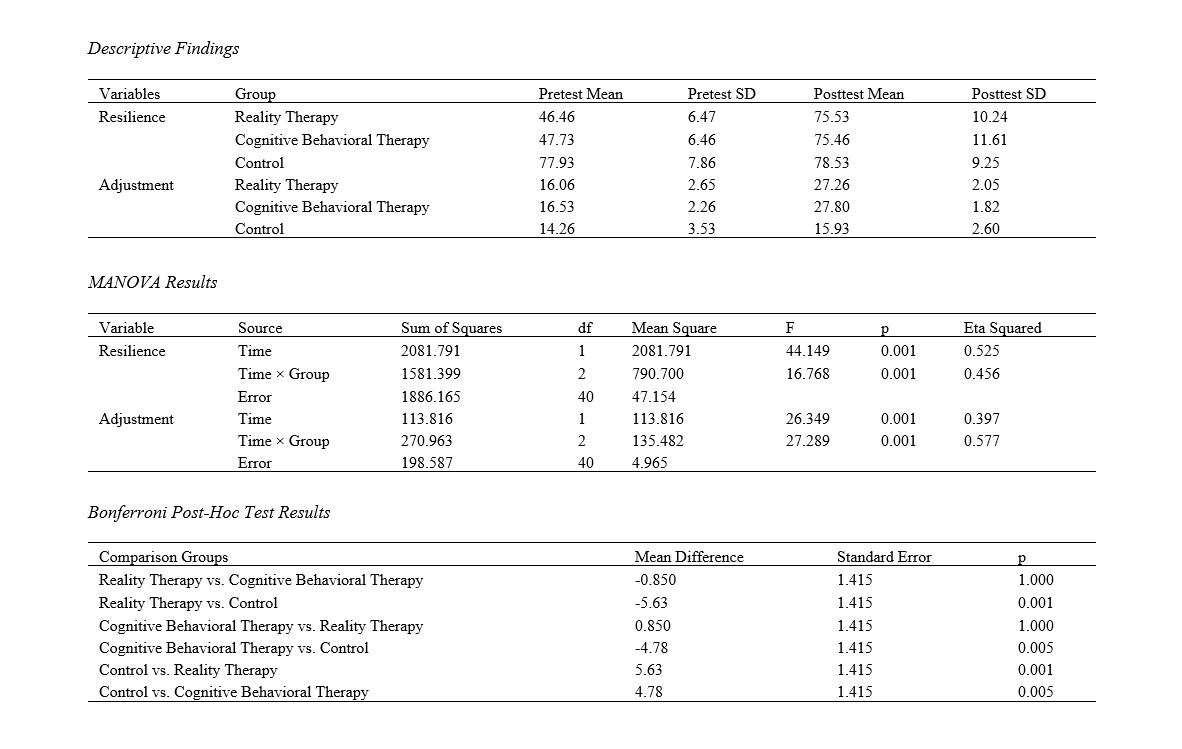
Findings: The results demonstrated that both reality therapy and cognitive behavioral therapy significantly improved resilience and adjustment among family caregivers of children with autism spectrum disorder compared with the control group. The repeated measures analysis of variance indicated significant effects of time and the interaction between time and group for resilience and adjustment (p < 0.001). Bonferroni post hoc comparisons further revealed significant differences between each experimental group and the control group in posttest scores. However, no statistically significant difference was observed between the reality therapy and cognitive behavioral therapy groups regarding resilience and adjustment outcomes (p > 0.05), indicating that both interventions were equally effective.
Conclusion: The findings suggest that both reality therapy and cognitive behavioral therapy are effective interventions for improving resilience and adjustment among family caregivers of children with autism spectrum disorder.
Downloads
References
Ahmadi, P. (2024). The Effectiveness of Cognitive-Behavioral Therapy on Increasing Resilience and Quality of Life in Mothers of Children with Autism Spectrum Disorder Islamic Azad University]. Shiraz.
Al-Kindi, S. G., Abualait, T. S., Qureshi, M. A., & Alyami, H. S. (2024). Effectiveness of Cognitive Behavioral Therapy (CBT) on Psychological Distress Among Mothers of Children with Autism Spectrum Disorder: The Role of Problem-Solving Appraisal. Brain Sciences, 14(1), 46. https://doi.org/10.3390/bs14010046
Bonati, M., Cartabia, M., & Clavenna, A. (2022). Still Too Much Delay in Recognition of Autism Spectrum Disorder. Epidemiology and Psychiatric Sciences, 11-23.
Dryden, W. (2021). Rational Emotive Behavior Therapy: A Practitioner's Guide. Springer. https://doi.org/10.4324/9781003081593
Fathi, A., Gharehbagh, Z. A., & Tabarsi, B. (2021). The Effect of Family Empowerment Training on Anxiety of Parents of Children with Autism Spectrum Disorder. Journal of Disability Studies, 11, 60.
Fathi, D., & Jamalabadi, M. (2017). The Mediating Role of Resilience in the Relationship Between Academic Support and Academic Buoyancy in Students. Educational Strategies in Medical Sciences, 10(4), 263-269.
Gegonani, F. (2023). The Mediating Role of Resilience in the Relationship Between Conflict with Parents and Social Anxiety in Adolescents Ivanaki University]. Ivanaki.
Ghorbani, A., & Zarei, F. (2021). The Effect of Reality Therapy Training on Adjustment Skills of Parents of Children with Autism. Autism Research Quarterly, 13(2), 50-62.
Hayes, S. A., Zablotsky, B., Maenner, M. J., & Cuevas, J. (2023). Community Support, Family Resilience and Mental Health Among Caregivers of Youth with Autism Spectrum Disorder. Child: Care, Health and Development, 49(1), 1-10. https://doi.org/10.1111/cch.13025
Hosseini, Z., & Falahati, F. (2022). The Effectiveness of Reality Therapy on Resilience and Mental Health of Mothers of Children with Autism Spectrum Disorder. Quarterly Journal of Modern Psychological Research, 17(3), 85-98.
Iadarola, S., Levato, L., Harrison, B., Smith, T., Lecavalier, L., Johnson, C., & Scahill, L. (2021). Resilience Intervention for Parents of Children with Autism: Findings from a Randomized Controlled Trial of the AMOR Method. Journal of Autism and Developmental Disorders, 51(4), 1264-1277.
Jaffar, A., Waqar, W., Hassan, S. M. U., Ahmed, A., Asim, M., & Zubair, M. (2025). Caregiver Burden and Psychological Distress in Parents of Children With Neurodevelopmental Disorders: The Mediating Roles of Rumination and Hopelessness. Journal of Autism and Developmental Disorders, 2(4), 1-12. https://doi.org/10.1007/s10803-025-07103-4
Kaplan, & Sadock. (2024). Diagnostic and Statistical Manual of Mental Disorders DSM-5. Arjmand Publications.
Karimi, S., & Esmaeili, M. (2020). The Relationship Between Emotion Regulation Strategies and Resilience with Marital Adjustment Among Female Teachers. Journal of Psychological Science, 19(87), 291-298.
Marsack‐Topolewski, C. N., Wang, F., & Samuel, P. S. (2025). Characteristics of Adult Children With Autism and Caregiver Burden. Family Relations, 74(2), 931-950. https://doi.org/10.1111/fare.13141
Nayar, K., Sealock, J. M., Maltman, N., Bush, L., Cook, E. H., Davis, L. K., & Losh, M. (2021). Elevated Polygenic Burden for Autism Spectrum Disorder Is Associated with the Broad Autism Phenotype in Mothers of Individuals with Autism Spectrum Disorder. Biological Psychiatry, 89(5), 476-485. https://doi.org/10.1016/j.biopsych.2020.08.029
Rast, J. E., Shui, A. M., Kerns, C. M., Masse, J. J., Smith, K. A., Johnson, C. R., & Kasari, C. (2024). Parent Outcomes Following Participation in Cognitive Behavior Therapy for Autistic Children in a Community Setting. Journal of Autism and Developmental Disorders, 54(3), 1089-1104.
Reaven, J., Blakeley-Smith, A., Leuthe, E., Moody, E., Hepburn, S., Connolly, C., & Amoss, R. T. (2021). Effectiveness of a Modified Group Cognitive Behavioral Therapy Program for Anxiety in Children with ASD Delivered in a Community Context. Molecular Autism, 12(1), 1-18.
Reed, G. M., First, M. B., Kogan, C. S., Hyman, S. E., Gureje, O., & Gaebel, W. (2019). Innovations and Changes in the ICD-11 Classification of Mental, Behavioural and Neurodevelopmental Disorders. World Psychiatry, 18(1), 3-19. https://doi.org/10.1002/wps.20611
Rosen, N. E., Lord, C., & Volkmar, F. R. (2021). The Diagnosis of Autism: From Kanner to DSM-III to DSM-5 and Beyond. Journal of Autism and Developmental Disorders, 51(12), 4253-4270. https://doi.org/10.1007/s10803-021-04904-1
Savadkouhi, A., Sharifi, M., & Shokri, O. (2020). The Effect of Emotional and Social Adjustment on Online Risky Behaviors of Lower Secondary School Students. Knowledge and research in applied psychology, 21(2), 64-74.
Singer, G. H. S. (2020). Meta-Analysis of Studies Addressing the Effects of Parenting Stress and Coping Strategies on the Behavior Problems of Children with Autism Spectrum Disorders. Journal of Autism and Developmental Disorders, 36(5), 629-641.
Swanson, A. (2019). Parental Stress and Coping in Families of Children with Autism Spectrum Disorders. Journal of Autism and Developmental Disorders, 39(8), 1181-1192.
Tavakoli, M. (2021). The Relationship Between Socio-Emotional Adjustment, Social Development, and Academic Achievement in Students Islamic Azad University]. Garmsar.
Wei, J., Liu, Y., Wang, J., & Zhang, L. (2024). Comparison of Effects of Interventions to Promote the Mental Health of Parents of Children with Autism: A Systematic Review and Network Meta-Analysis. Clinical psychology review, 101, 102346.
Downloads
Additional Files
Publication Timeline
- Submitted
- Revised
- Accepted