Comparing the Effectiveness of Emotion-Focused Couple Therapy and Systemic Couple Therapy on Affect Control and Hostile Attribution in Couples with Marital Conflicts
Keywords:
emotion-focused couple therapy, systemic couple therapy, affect control, hostile attribution, marital conflictsAbstract
Objective: The present study aimed to compare the effectiveness of emotion-focused couple therapy and systemic couple therapy on affect control and hostile attribution among couples experiencing marital conflicts.
Methods and Materials: The present study employed a quasi-experimental design with pretest, posttest, and three-month follow-up assessments using a control group. The statistical population included married couples experiencing marital conflict who referred to counseling centers in Tehran in 2025. Following initial screening and informed consent procedures, 45 couples were selected through purposive sampling and randomly assigned into three groups: emotion-focused couple therapy (15 couples), systemic couple therapy (15 couples), and control group (15 couples). The research instruments included the Marital Conflict Questionnaire developed by Barati and Sanaei (2000), the Affect Control Scale developed by Williams et al. (1997), and the Hostile Attribution Questionnaire developed by Arntz et al. (2003). The first experimental group received eight 90-minute sessions of emotion-focused couple therapy based on the protocol proposed by Greenberg et al. (2008), while the second experimental group received eight 90-minute sessions of systemic couple therapy based on Minuchin’s protocol (1974). The control group received no intervention during the study period. Data were analyzed using repeated-measures analysis of variance and Bonferroni post hoc tests in SPSS version 26.
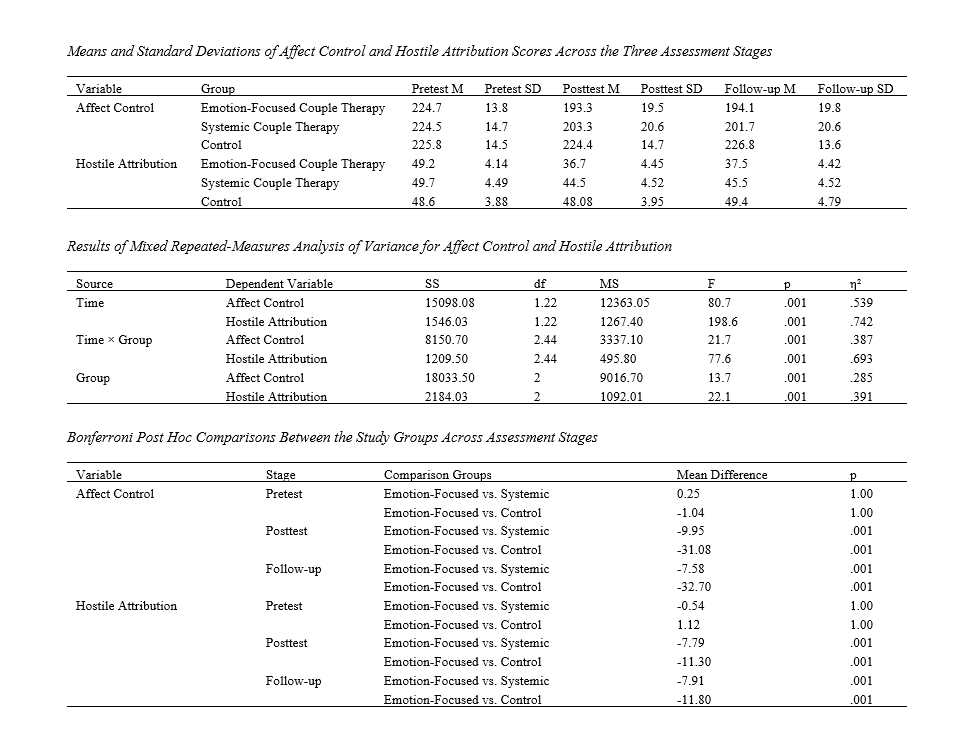
Findings: The results of repeated-measures analysis of variance indicated that the main effect of time, the interaction effect of time and group, and the between-group effect were statistically significant for both affect control and hostile attribution (p < .001). Both emotion-focused couple therapy and systemic couple therapy significantly improved affect control and reduced hostile attribution compared with the control group. Bonferroni post hoc comparisons demonstrated that the emotion-focused couple therapy group achieved significantly greater improvements in affect control and significantly greater reductions in hostile attribution compared with the systemic couple therapy group at the posttest and follow-up stages (p < .001). The therapeutic effects of both interventions remained stable during the three-month follow-up period.
Conclusion: The findings suggest that both emotion-focused couple therapy and systemic couple therapy are effective interventions for improving emotional functioning and reducing maladaptive interpersonal interpretations among couples experiencing marital conflicts. However, emotion-focused couple therapy demonstrated superior effectiveness in enhancing affect control and decreasing hostile attribution. These findings highlight the importance of emotional processing and attachment-based interventions in the treatment of marital conflicts and suggest that emotion-focused approaches may provide deeper and more enduring changes in couples’ emotional and cognitive-relational functioning.
Downloads
References
Acland, E., Peplak, J., Suri, A., & Malti, T. (2023). Emotion Recognition Links to Reactive and Proactive Aggression across Childhood: A Multi-Study Design. Development and Psychopathology, 1-12. https://doi.org/10.1017/S0954579423000342
Ansari, Z., Naderian, F., Abedini, F. G., & Miavari Kermani, M. (2023). Comparison of the Effectiveness of Emotion-Focused Couple Therapy and Structural Couple Therapy on Marital Justice and Relationship Maintenance Strategies in Conflicted Couples. Applied Family Therapy, 4(2), 1-28.
Azam, T., & Siddique, A. (2023). Perception of Females about Marital Conflicts and Its Role in Mental Health among the Women Living in Shelter Homes. Journal of Professional & Applied Psychology, 4(2), 281-287. https://doi.org/10.52053/jpap.v4i2.167
Babasafari, A., Atashpour, S. H., & Yousefi, Z. (2023). The Effectiveness of Integrative Systemic-Solution-Focused Couple Therapy on Marital Satisfaction and Family Relationships of Couples. Quarterly Journal of Modern Psychological Research, 18(69), 35-42.
Dinmohaamadpour, M., Tavanaei, S., Kabiri, E., Hajiyousefi, E., Beki Ardekani, E., & Mohebian, M. (2024). The Effectiveness of Systemic Family Therapy on Marital Conflicts and Marital Burnout of Couples. Iranian Evolutionary Educational Psychology Journal, 6(2), 157-169.
Ghaffari, H., Mikaeili, M. F., & Masoudi, S. (2022). The Effectiveness of Emotion-Focused Therapy on Feelings of Inferiority, Sensation Seeking, and Attachment Styles among Married Women with Experience of Extramarital Relationships. Journal of Rehabilitation Research in Nursing, 9(2), 62-76.
He, Y., Fisher, A., Swanson, S., & Lebow, J. (2022). Integrative Systemic Therapy: Integrating Individual, Couple, and Family Therapy. Australian and New Zealand Journal of Family Therapy, 43(1), 9-21. https://doi.org/10.1002/anzf.1473
Heaphy, B., & Hodgson, J. (2023). Reinvigorating Research on Divorce: Reflexivity, Agency and Regulation in Marriage and Civil Partnership Dissolution. Families, Relationships and Societies, 12(1), 75-90. https://doi.org/10.1332/204674321X16716131476134
Hoey, J., & Schröder, T. (2023). Disruption of Social Orders in Societal Transitions as Affective Control of Uncertainty. American behavioral scientist, 67(2), 311-331. https://doi.org/10.1177/00027642211066055
Hong, X., & Wang, M. (2023). The Challenge of Chinese Children's Emotion Regulation: Child Number, Parental Emotion Regulation, and Its Relationship with Reactions to Children's Negative Emotions. Sustainability, 15(4), 3812. https://doi.org/10.3390/su15043812
Imani-Imanloo, P., & Tofighi, B. (2023). Investigating the Effectiveness of Emotion-Focused Couple Therapy on Marital Satisfaction, Emotional Intimacy, and Communication Skills of Couples in Kuhchenar County. Strategic Research in Education and Training, 2(1), 443-461.
Jalalvand, D., Goudarzi, K., Karimi, J., & Yaghoubi, A. A. (2022). The Effectiveness of Integrative Behavioral Couple Therapy and Gottman Couple Therapy on Marital Burnout and Resilience in Conflicted Couples. Family Counseling and Psychotherapy, 12(2), 1-36.
Khajeh Hasani Raberi, F., Rezaei, F., Mirzaei, F., & Sedighi, F. (2024). The Effectiveness of Emotion-Based Therapy on Fear of Intimacy, Hostile Attributions, and Meta-Emotion in Women Harmed by Marital Infidelity. Rooyesh-e-Ravanshenasi, 13(1), 233-242.
Khoshbakht, N., Asayesh, K., Rezapour Mirsaleh, N., & Jahanbakhshi, H. (2025). Comparison of the Effectiveness of Wisdom-Based Couple Therapy and Emotion-Focused Couple Therapy on Sense of Coherence in Couples with Marital Conflicts. Clinical Psychology and Personality, 3(1), 13-30.
Kiss, B. (2024). The Role of Excitement and Enjoyment through Subjective Evaluation of Horror Film Scenes. Scientific reports, 14(1). https://doi.org/10.1038/s41598-024-53533-y
Larner, G. (2022). Integrative Dialogues in Family Therapy. Australian and New Zealand Journal of Family Therapy, 43(1), 54-69. https://doi.org/10.1002/anzf.1482
Lebni, J., Solhi, M., Azar, F., Farahani, F., & Irandoost, S. (2023). Exploring the Consequences of Early Marriage: A Conventional Content Analysis. INQUIRY: The Journal of Health Care Organization, Provision, and Financing, 60, 004695802311599. https://doi.org/10.1177/00469580231159963
Li, D., Coker, B., & Rowe, A. C. (2024). Validation of a New Assessment of Hostile Attribution Bias in Romantic Relationships: The Hostile Attributions in Romantic Relationships Test. Journal of marital and family therapy, 50(2), 328-347. https://doi.org/10.1111/jmft.12694
Mardani, F., Navabinejad, S., & Yousefi, E. (2023). The Effectiveness of Gottman Approach Intervention on Marital Burnout, Emotional Divorce and Emotional Regulation of Conflicted Couples. Journal of Assessment and Research in Applied Counseling, 5(3), 16-22. https://doi.org/10.61838/kman.jarac.5.3.3
Matejević, M., & Petrović, J. (2022). Family Functionality in Context of Systemic Family Therapy and Family Constellations Method. Anuario de Pedagogía, 7(1), 7-21. https://doi.org/10.46630/gped.1.2022.1
Mendelson, D. (2024). The Commitment of a Lifetime: The Role of Emotionally Focused Couple Therapy in Strengthening Attachment Bonds and Improving Relationship Health in Later-Life Couples: The Teletherapy Case of Alice and Steve. Pragmatic Case Studies in Psychotherapy, 20(1). https://doi.org/10.55818/pcsp.v20i1.2150
Neswiswa, K. (2024). Hearing the Voices of Black Africans: Essential Components for Culturally Relevant Marriage Enrichment Programs in South Africa. Journal of marital and family therapy, 50(2), 407-433. https://doi.org/10.1111/jmft.12696
Pasha, D. (2024). Effectiveness of Schema Therapy on Marital Relationship Quality and Emotion Regulation in Couples Affected by Infidelity. Journal of Assessment and Research in Applied Counseling, 6(2), 71-78. https://doi.org/10.61838/kman.jarac.6.2.9
Ren, F., Sun, Y., Ji, L., & Wei, X. (2022). The Relationship between Social Creativity and Aggressive Behavior among Chinese Junior High School Students: The Moderating Role of Hostile Attribution Bias. Frontiers in psychology, 13, 953361. https://doi.org/10.3389/fpsyg.2022.953361
Roy, R., Vranda, M., Jagannathan, A., Cicil, V., & Ranjith, P. (2023). Conjoint Couple Therapy with a Woman Survivor of Intimate Partner Violence: Strengths and Challenges. Indian Journal of Psychological Medicine, 45(6), 629-633. https://doi.org/10.1177/02537176231154820
Schweizer, S. (2023). Changes in Affective Control Covary with Changes in Mental Health Difficulties Following Affective Control Training (Affect) in Adolescents. Psychological medicine, 54(3), 539-547. https://doi.org/10.1017/S0033291723002167
Şenol, A., Gürbüz, F., & Dost, M. T. (2023). Emotion-Focused Couple Therapy: A Review of Theory and Practice. Psikiyatride Güncel Yaklaşımlar, 15(1), 146-160. https://doi.org/10.18863/pgy.1090793
Shita, N. (2024). Predictors of Divorce and Duration of Marriage among First Marriage Women in Dejne Administrative Town. Scientific reports, 14(1). https://doi.org/10.1038/s41598-024-59360-5
Soboroff, S., & Kelley, C. (2024). Modeling Status Interventions with Affect Control Theory. American behavioral scientist, 67(1), 60-76. https://doi.org/10.1177/00027642211066040
Tan, C., Song, H., Ma, S., Liu, X., & Zhao, Y. (2024). Autistic Traits and Aggressive Behavior in Chinese College Students: A Serial Mediation Model and the Gender Difference. Psychology research and behavior management, 1385-1397. https://doi.org/10.2147/PRBM.S451028
Timajchi, F., Rashidzadeh, S., Eshrati, M., Karamroudi, A., Riazi, N., & Janbaz, M. (2025). The Effectiveness of Emotion-Focused Couple Therapy on Marital Conflicts and Marital Adjustment among Couples Referred to Counseling Centers in Tehran. Quarterly Journal of Experimental and Cognitive Psychology, 2(2) 1-13.
Timulak, L., Dailey, J., Lunn, J., & McKnight, J. (2024). Transdiagnostic Emotion-Focused Therapy for Couples with Co-Morbid Relational and Mood, Anxiety and Related Difficulties. Journal of Contemporary Psychotherapy, 1-10. https://doi.org/10.1007/s10879-024-09645-7
Timulak, L., Keogh, D., Chigwedere, C., Wilson, C., Ward, F., Hevey, D., & Mahon, S. (2022). A Comparison of Emotion-Focused Therapy and Cognitive-Behavioral Therapy in the Treatment of Generalized Anxiety Disorder: Results of a Feasibility Randomized Controlled Trial. Psychotherapy. https://doi.org/10.1037/pst0000427
Warwar, S. (2023). The Use of Homework in Emotion-Focused Therapy for Depression. Journal of Clinical Psychology, 80(4), 744-761. https://doi.org/10.1002/jclp.23618
Yang, Y., Cheng, G., Shi, Y., Zhang, J., & Wu, L. (2024). Hostile Attribution Bias's Role in Perceived Stress among College Freshman Students: A Latent Growth Modelling Approach. International journal of psychology, 59(1), 30-38. https://doi.org/10.1002/ijop.12944
Zamanifar, M., Keshavarzi Arshadi, F., Hasani, F., & Emamipour, S. (2022). The Effectiveness of Systemic-Behavioral Couple Therapy on Sexual Satisfaction and Self-Differentiation in Each Partner among Couples with Marital Conflict. Health Promotion Management, 11(2), 45-58.
Downloads
Additional Files
Publication Timeline
- Submitted
- Revised
- Accepted