Factors Influencing the Decision to Have Children in Iranian Military Families: A Qualitative Study
Keywords:
Military families, childbearing, grounded theory, spiritual factors, psychological factorsAbstract
Objective: The present study was conducted to explain the dynamics of military families and the factors influencing childbearing within the context of Iranian society.
Methods and Materials: This study was conducted using a qualitative approach based on grounded theory, employing the Strauss and Corbin paradigmatic model. The participants were selected from military families residing in Tehran, Iran. Data were collected through semi-structured interviews using purposive sampling with 18 members of military families. The data were analyzed in three stages of coding (open, axial, and selective) and categorized into main themes.
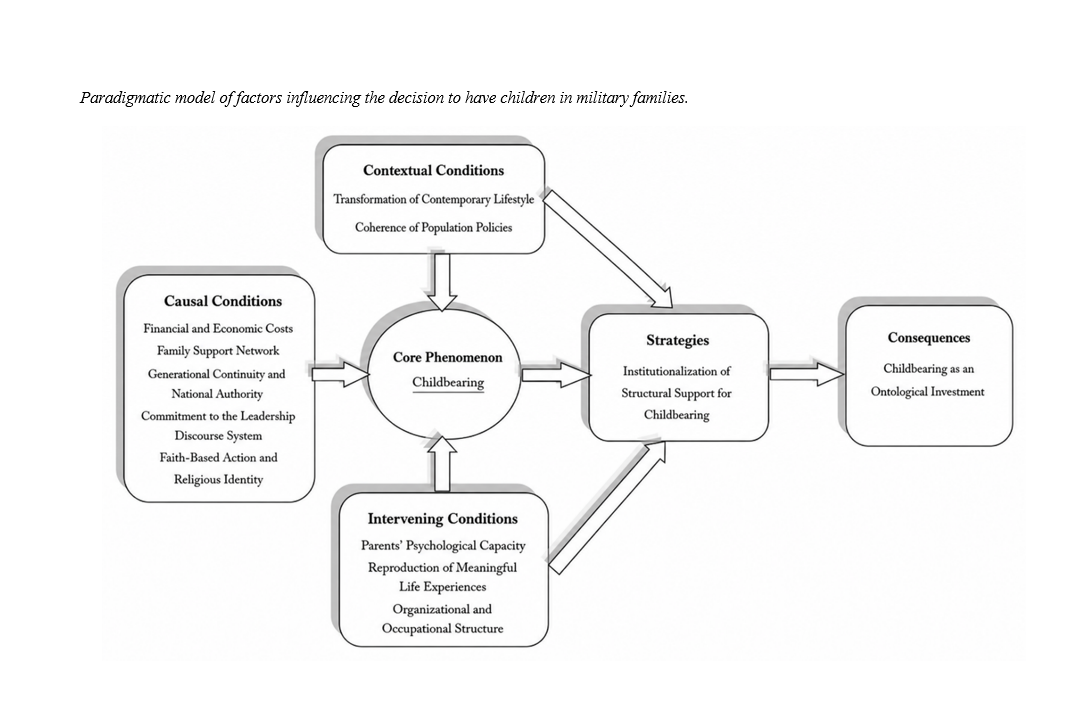
Findings: Analysis of the participants’ interviews led to the identification of 13 selective categories, 38 axial categories, and 156 subcategories. Childbearing among military families is influenced by numerous inhibiting and encouraging factors, including economic costs, family support networks, generational continuity and national authority, commitment to the leadership discourse system, faith-based action, parents’ psychological capacity, parenting experience, organizational and occupational structure, coherence of population policies, transformation of contemporary lifestyles, and institutionalization of structural support.
Conclusion: The findings of the study can assist policymakers and social planners in shifting their focus from general factors toward key and realistic components involved in the childbearing decision-making process and in designing supportive policies aimed at increasing family satisfaction and enhancing parents’ inclination and motivation toward childbearing.
Downloads
References
Akram, R., Sarker, A. R., Sheikh, N., Ali, N., Mozumder, M. G. N., & Sultana, M. (2020). Factors associated with unmet fertility desire and perceptions of ideal family size among women in Bangladesh: Insights from a nationwide Demographic and Health Survey. PLoS One, 15(5). https://doi.org/10.1371/journal.pone.0233634
Alidousti, E., Adhami, A. R., & Kazemipour, S. (2021). Socio-economic factors affecting attitudes towards childbearing: A study of ever married couples in Kermanshah, Iran. Journal of the Iranian Institute for Health Sciences Research, 20(4), 471-480. https://doi.org/10.52547/payesh.20.4.471
Brooks, S. K., & Greenberg, N. (2018). Non-deployment factors affecting psychological wellbeing in military personnel: Literature review. Journal of Mental Health, 27(1), 80-90. https://doi.org/10.1080/09638237.2016.1276536
Brough, M., & Sheppard, P. (2022). Fertility decision-making in the UK: Insights from a qualitative study among British men and women. Social Sciences, 11(9). https://doi.org/10.3390/socsci11090409
Burke, J., & Miller, A. R. (2018). The effects of job relocation on spousal careers: Evidence from military change of station moves. Economic Inquiry, 56(2), 1261-1277. https://doi.org/10.1111/ecin.12529
Cantor, J. H., & Tong, P. K. (2023). Geographical access to specialized behavioral health treatment programs for US active duty service members and military families from military installations. Preventive Medicine Reports, 34. https://doi.org/10.1016/j.pmedr.2023.102267
Creswell, J. W., & Poth, C. N. (2016). Qualitative inquiry and research design: Choosing among five approaches (4th ed.). SAGE Publications.
Englander, M., & Morley, J. (2023). Phenomenological psychology and qualitative research. Phenomenology and the Cognitive Sciences, 22(1), 25-53. https://doi.org/10.1007/s11097-021-09781-8
Farnsworth, M. L., & O'Neal, C. W. (2025). How military-related stress and family relationships are associated with perceptions of work-family impact for married male service members with adolescent children. Military Psychology, 37(3), 240-250. https://doi.org/10.1080/08995605.2024.2351750
Iobst, S. E., Smith, D. C., Best, N. I., Allard, R. J., & Trego, L. L. (2021). A scoping review of pregnancy, childbirth, and the postpartum period in active duty US military women. Women's Health Issues, 31, S81-S92. https://doi.org/10.1016/j.whi.2020.05.005
Kazemnejad, A., Gholami Fesharki, M., Samadi, S., & Gilani, N. (2015). Determining the factors affecting childbearing tendency in Tehran police personnel. Journal of Police Medicine, 4(3), 201-208.
Khojeh, Z., Naghibi, A., Khazaee-Pool, M., & Abdollahi, F. (2024). Investigating factors affecting childbearing: A review study. Journal of Mazandaran University of Medical Sciences, 34(238), 101-112.
Khoramshad, M. B., Aqa Mohammadi, M., & Babaiee, S. (2019). Population variables effective in the Islamic Republic of Iran's national security. Quarterly Journal of Interdisciplinary Studies on Strategic Knowledge, 9(36), 34-37.
Koulivand, K. (2024). Foresight demographic changes in the Islamic Republic of Iran with a defense-security approach in the horizon of 2042. The Women and Families Cultural-Educational, 19(69), 203-223.
Lee, E., Boedeker, D., Hunkler, K., Pacheco, M., Balzano, F., Larson, N., Saberski, E., & Kikuchi, J. Y. (2025). Family planning desires and barriers to fertility preservation for transgender and gender-diverse military service members in the United States. International Journal of Transgender Health, 27(2), 1115-1129. https://doi.org/10.1080/15532739.2025.2469279
McDonald, P., & Kippen, R. (2025). Applying Bourdieu's social theory to fertility behavior: The role of cultural and social resources in reproductive choices. Genus, 81. https://doi.org/10.1186/s41118-025-00260-5
Musilli, M. G., Fuller, S. M., Wyatt, B., Ryals, T. R., Haischer-Rollo, G., Drumm, C. M., Vereen, R. J., Plowden, T. C., Blevins, E. M., Spalding, C. N., Konopasky, A., & Lutgendorf, M. A. (2025). Qualitative analysis of the lived experience of reproductive and pediatric health care in the military health care system. Military medicine, 190(1-2), 333-341. https://doi.org/10.1093/milmed/usae238
Office of the Supreme Leader of, I. (2014). Leader announces general policies on population. https://english.khamenei.ir/news/1911/Leader-Announces-General-Policies-on-Population
Opie, J. E., Hameed, M., Vuong, A., Painter, F., Booth, A. T., Jiang, H., & McIntosh, J. E. (2024). Children's social, emotional, and behavioral outcomes in military families: A rapid review. Journal of Child and Family Studies, 33(6), 1949-1967. https://doi.org/10.1007/s10826-024-02850-3
Racila, A. M., Stewart Steffensmeier, K. R., Paez, M. B., Chasco, E. E., Sadler, A. G., Seaman, A. T., Ryan, G. L., & Mengeling, M. A. (2026). Assessing United States military veterans' fertility intentions before and after military service using a cognitive-social model. Military medicine. https://doi.org/10.1093/milmed/usaf547
Steenkamp, M. M., Corry, N. H., Qian, M., Li, M., McMaster, H. S., Fairbank, J. A., Stander, V. A., Hollahan, L., & Marmar, C. R. (2018). Prevalence of psychiatric morbidity in United States military spouses: The Millennium Cohort Family Study. Depression and Anxiety, 35(9), 815-829. https://doi.org/10.1002/da.22795
United Nations Department of, E., & Social Affairs, P. D. (2023). World Population Ageing 2023: Challenges and opportunities of population ageing in the least developed countries.
Zadeahmad, Z., Abdolahi, M., Tavakkoli Sani, S. B., & Charoghchian Khorasani, E. (2020). Tendency to childbearing and its relationship with spiritual health and health literacy in women referred to the healthcare centers of Torbat Heydarieh, Iran, in 2019. Razi Journal of Medical Sciences, 27(8), 32-41.
Downloads
Additional Files
Publication Timeline
- Submitted
- Revised
- Accepted