Predicting Tendency Toward Risky Behaviors Based on Emotion Regulation Difficulties and Mentalization in Children of Divorce: The Mediating Role of Post Traumatic Growth and the Moderating Role of Family Communication Patterns
Keywords:
risky behaviors, emotion regulation difficulties, mentalization, post traumatic growth, family communication patterns, children of divorceAbstract
Objective: The present study aimed to predict tendencies toward risky behaviors based on difficulties in emotion regulation and mentalization in children of divorce, with the mediating role of post traumatic growth and the moderating role of family communication patterns.
Methods and Materials: This descriptive–correlational study using path analysis was conducted in 2025. The statistical population consisted of children of divorce aged 15–18 years in Babol, from whom 300 participants were selected through purposive sampling. Data were collected using the Iranian Adolescents Risk Taking Scale (2011), Difficulties in Emotion Regulation Scale (2004), Mentalization Questionnaire (2018), Post Traumatic Growth Inventory (1996), and Family Communication Patterns Questionnaire (1990). Data were analyzed using Pearson correlation coefficients, path analysis, moderation analysis, and bootstrap procedures in SPSS and AMOS.
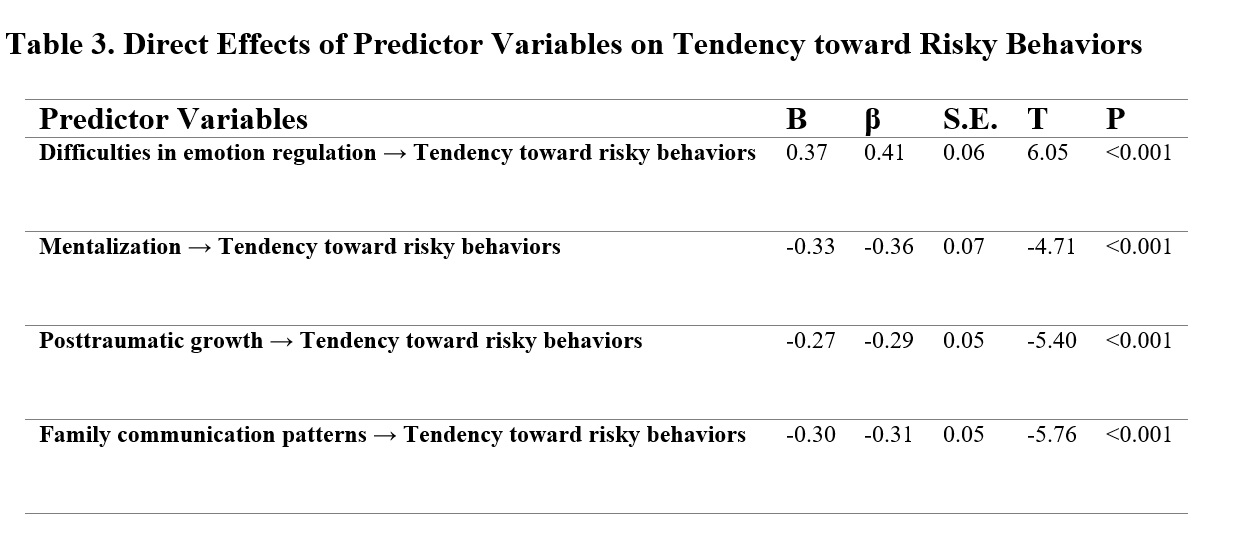
Findings: The results indicated that difficulties in emotion regulation had a significant positive direct effect on risky behavior tendencies (β = 0.41, p < .001), whereas mentalization (β = −0.36, p < .001), post traumatic growth (β = −0.29, p < .001), and family communication patterns (β = −0.31, p < .001) had significant negative direct effects. Furthermore, family communication patterns significantly moderated the relationship between difficulties in emotion regulation and risky behaviors (β = −0.18, p < .001), as well as the relationship between mentalization and risky behaviors (β = −0.15, p < .01). Bootstrap results also confirmed the mediating role of post traumatic growth in the relationship between difficulties in emotion regulation and risky behaviors (β = 0.12, 95% CI [0.06, 0.19]) and between mentalization and risky behaviors (β = −0.12, 95% CI [−0.18, −0.05]). The proposed model demonstrated good fit to the data (CFI = 0.95, TLI = 0.94, RMSEA = 0.054).
Conclusion: The findings suggest that children of divorce with greater difficulties in emotion regulation are more likely to engage in risky behaviors, whereas higher levels of mentalization, post traumatic growth, and constructive family communication patterns serve as protective factors.
Downloads
References
Abbasi-Rad, R., Rostami, F., Fasihi, S., Sarhangi, A., Ahmad Boukani, M., & Soleiman, S. (2024). The Relationship between Family Communication Patterns and Risky Behaviors in Adolescents: The Mediating Role of the Big Five Personality Traits. Journal of Applied Psychological Research, 15(3), 61-78.
Abebayehu, Y. (2025). Digital Risks and Family Dynamics: Adolescents' Perceptions of How Communication Styles Shape Risky Social Media Behavior.
Astolfi, R. C., Leite, M. A., Papa, C. H. G., Ryngelblum, M., Eisner, M., & Peres, M. F. T. (2021). Association between Self-Control and Health Risk Behaviors: A Cross-Sectional Study with 9th Grade Adolescents in Sao Paulo. BMC public health, 21(1), 1706. https://doi.org/10.1186/s12889-021-11718-4
Bahrani, F., Boland, H., & Sayadi, A. (2019). Post Traumatic Growth Model in Divorced Women. Middle Eastern Journal of Disability Studies, 9(1), 127.
Bazzi, M., Sadeghi, M., & Mohammadi, A. (2024). The Structural Relationship between Insecure Attachment Styles and Self-Harm: The Mediating Roles of Resilience and Mentalization. Research in cognitive and behavioral sciences, 13(2), 41-56.
Buyukkececi, Z., & Leopold, T. (2024). Parent-Child Relationships Following Gray Divorce: Stronger Ties with Mothers, Weaker Ties with Fathers. The Journals of Gerontology: Series B, 79(5), gbae004. https://doi.org/10.1093/geronb/gbae004
Davoodi, R., Alijani Renani, H., Moradi Kalboland, M., & Saki Malehi, A. (2024). Assessment of High-Risk Behaviors among Female Students at State Secondary Schools in Ahvaz City in 2021. Pajouhan Scientific Journal, 22(4), 247-254. https://doi.org/10.32592/psj.22.4.247
Daytalab Esmaeili, E., Ranandeh Kalankesh, L. Z., Ghaffari, A., & Dastgiri, S. (2025). Familial Aggregation of Sexual Risky Behaviors in Northwestern Iran: A Cross-Sectional Study. Depiction of Health, 16(1), 68-78. https://doi.org/10.34172/doh.2025.07
Dimitrijevic, A., Hanak, N., Altaras Dimitrijevic, A., & Jolic Marjanovic, Z. (2018). The Mentalization Scale (MentS): A Self-Report Measure for the Assessment of Mentalizing Capacity. Journal of Personality Assessment, 100(3), 268-280. https://doi.org/10.1080/00223891.2017.1310730
Doba, K., Debbane, M., Auger, E., & Nandrino, J. L. (2025). Suicide Risk, Mentalizing and Emotion Regulation in Adolescents: The Role of Maternal Maladaptive Emotion Regulation. Journal of affective disorders, 374, 342-349. https://doi.org/10.1016/j.jad.2025.01.052
Enayati, M., Khanzadeh, M., Raeisi, Z., & Dehghani, A. (2025). The Mediating Role of Authoritative Parenting Style in Predicting Risky Behaviors Based on the Dark Triad of Personality with the Mediation of Distress Tolerance in Adolescents. Journal of Psychological Science, 24(151), 223-244.
Farahani, H. S., Sadeghi, M. S., Mootabi, F., Ahmadi, F., & Bigham, Z. (2023). Coping with Divorce in Men: A Scoping Review. Iranian Journal of Health Psychology, 6(3).
Garces-Prettel, M., Barredo Ibanez, D., Vazquez-Miraz, P., & Santoya-Montes, Y. (2026). Mental Health in University Students: Exploring the Influence of Family Communication and Age on Youth Suicide Risk. Journal of Communication in Healthcare, 1-10. https://doi.org/10.1080/17538068.2026.2623322
Golvani, S., Karimi, H., & Hosseini, M. (2024). Investigating the Impact of Parental Divorce on Children's Education and Behavior. Proceedings of the Eighth National Conference on Modern Research in Educational Sciences and Psychology of Iran,
Haji Abolzadeh, N., Roshan Chesli, R., Farahani, H., & Mashayekh, M. (2025). The Relationship between Mentalization and Women's Sexual Satisfaction: The Mediating Role of Negative Mood. Journal of Psychological Science, 24(150), 165-183.
Hatami Varzaneh, A., & Imani, Z. (2025). Representation of the Lived Experiences of Children of Divorced Women in the Process of Mothers' Potential Remarriage: A Qualitative Study in a Cultural Context.
Heshmati, R., Niri, S. F., & Kehtary, L. (2020). Predictive Role of Emotional Repression, Anger, and Interpersonal Problems in High-Risk Behaviors of Tabriz University Students. Journal of Health Promotion Management, 9(1), 59-68.
Jahangir, T., Tajvedi, M., Mohammadi Shirmohalle, F., & Dehghan Neiri, N. (2023). Post-Traumatic Growth in Women's Lived Experiences: A Phenomenological Study. Iranian Journal of Culture and Health Promotion, 7(3), 480-486.
Kaleta, K., & Mroz, J. (2023). Posttraumatic Growth and Subjective Well-Being in Men and Women after Divorce: The Mediating and Moderating Roles of Self-Esteem. International journal of environmental research and public health, 20(5), 3864. https://doi.org/10.3390/ijerph20053864
Karagiannopoulou, E., Lianos, P., Andriopoulou, P., Rentzios, C., & Fonagy, P. (2025). Attachment and Epistemic Trust in Junior and Senior University Students: The Mediating Role of Affect Regulation and Mentalizing. Who Is at Risk? PLoS One, 20(8), e0304749. https://doi.org/10.1371/journal.pone.0304749
Larsson, K. H., Aspeqvist, E., Falkenstrom, F., Andersson, G., Svedin, C. G., & Zetterqvist, M. (2025). Assessing Emotion Regulation Difficulties in Adolescents: Validation and Clinical Utility of the Difficulties in Emotion Regulation Scale-16. BMC psychology, 13(1), 237. https://doi.org/10.1186/s40359-025-02540-3
Lin, I. F., Brown, S. L., & Mellencamp, K. A. (2024). Gray Divorce and Parent-Child Disconnectedness: Implications for Depressive Symptoms. Journal of marriage and family, 86(1), 95-110. https://doi.org/10.1111/jomf.12936
Majnounpour, M., & Javadi, S. (2024). Behavioral-Functional Damages and Risky Behaviors of Adolescents Resulting from Parental Divorce: Challenges and Solutions. Proceedings of the Sixth International Conference on Management, Psychology, and Social Sciences,
Maleki, S., Leilabadi, L., & Kooshki, S. (2025). Efficacy of Mentalization-Based Group Therapy on Object Relations and Difficulties in Emotion Regulation: Outcome for Individuals with Dependent Personality Syndrome. Journal of Applied Psychological Research, 16(2), 233-250.
Nasiri Nasab, Z., Tajdin, A. A., Aghajani Khotbehsara, E., Naderipour, M. R., & Aziminia, F. (2024). Investigating the Prevalence of Risky Behaviors and Their Relationship with the Components of Sensation Seeking in Patients Referred to Social Emergency. Razi Journal of Medical Sciences, 31(1), 1-9. https://doi.org/10.47176/rjms.31.175
Noroozi, Y., & Janjani, P. (2023). Investigating the Mediating Role of Difficulty in Emotion Regulation in the Relationship between Attachment Styles and Rumination in High-Risk Behaviors of Adolescent Girls. Journal of Arak University of Medical Sciences, 26(3), 41-46.
Piri, Z., Amiri Majd, M., Bazzazian, S., & Ghamari, M. (2019). The Mediating Role of Coping Strategies in the Relationship of Difficulties in Emotion Regulation with Internet Addiction among College Students. Internal Medicine Today, 26(1), 38-53. https://doi.org/10.32598/hms.26.1.3108
Ramazanzadeh, S., Etemadi, A., & Asenjarani, F. (2023). Effectiveness of the Intervention Program for Children of Divorce on Children's Perceptions of Parental Divorce: A Single-Case Study. Applied Psychology, 17(1), 127-149.
Ramzanzadeh, Z., & Ghazanfari, F. (2024). Prevention of Suicide in Iranian Teenagers: A Scoping Review. Social Welfare Quarterly, 24(95), 87-128. https://doi.org/10.32598/refahj.24.95.4448.1
Rizwan, J., & Gafoordeen, N. (2021). Divorce among the Kandyan Muslims in Sri Lanka. Muallim Journal of Social Sciences and Humanities, 12-21. https://doi.org/10.33306/mjssh/117
Saboohi Golkar, Z., & Afrasiabi, H. (2024). The Decision-Making Process of Men Applying for Divorce: A Narrative Perspective. Strategic Research on Social Problems, 13(2), 1-22.
Shafahirad, S., Gharibi, H., & Salahian, A. (2024). Prediction of Defense Mechanisms Based on Mentalizing Ability. Journal of Learning and Training Researches, 21(2), 113-128.
Singh, P., & Singh, A. (2023). Emotion Regulation Difficulties and Health-Risk Behaviours in Adolescents. Behaviour Change, 40(2), 86-102. https://doi.org/10.1017/bec.2022.5
Tariq, N., & Gupta, V. (2023). High-Risk Behaviors. StatPearls.
Tedeschi, R. G., & Moore, B. A. (2021). Posttraumatic Growth as an Integrative Therapeutic Philosophy. Journal of Psychotherapy Integration, 31(2), 180. https://doi.org/10.1037/int0000250
Vakili, M., Mirzadeh, M., Mirzaei, M., Modarresi, M., Raei, R., Karimi, R., Aghakoochak, A., & Imani, A. A. (2023). Sex Differences in High-Risk Health Behaviors among School-Going Adolescents in Yazd, Iran: A Cross-Sectional Study. Heliyon, 9(6). https://doi.org/10.1016/j.heliyon.2023.e16404
World Health, O. (2023). Global Accelerated Action for the Health of Adolescents (AA-HA!): Guidance to Support Country Implementation.
Yu, X., Zhou, Y., Fan, G., Yu, Y., & Peng, J. (2020). Collective and Individual Resilience Mediate the Effect of Self-Efficacy on Symptoms of Posttraumatic Stress Disorder and Posttraumatic Growth among Adolescents Following the Ya'an Earthquake. Personality and individual differences, 160, 109908.
Downloads
Additional Files
Publication Timeline
- Submitted
- Revised
- Accepted