Predicting Couple Relationship Quality from Adult Attachment and Emotional Intelligence: The Mediating Role of Empathic Communication
Keywords:
adult attachment, emotional intelligence, empathic communication, couple relationship quality, romantic relationships, mediation, structural equation modelingAbstract
Objective: This study aimed to predict couple relationship quality from adult attachment and emotional intelligence and to examine the mediating role of empathic communication in these associations.
Methods and Materials: The study employed a cross-sectional correlational design. The statistical population consisted of adults involved in committed romantic relationships and residing in Canada. A total of 384 participants were recruited using convenience sampling. Adult attachment was assessed using the Experiences in Close Relationships–Revised questionnaire, emotional intelligence using the Wong and Law Emotional Intelligence Scale, empathic communication using an empathic communication measure, and couple relationship quality using the Revised Dyadic Adjustment Scale. Data were analyzed using Pearson correlation coefficients, confirmatory factor analysis, and structural equation modeling. The significance of indirect effects was evaluated through bootstrapping with 5,000 resamples and 95% confidence intervals.
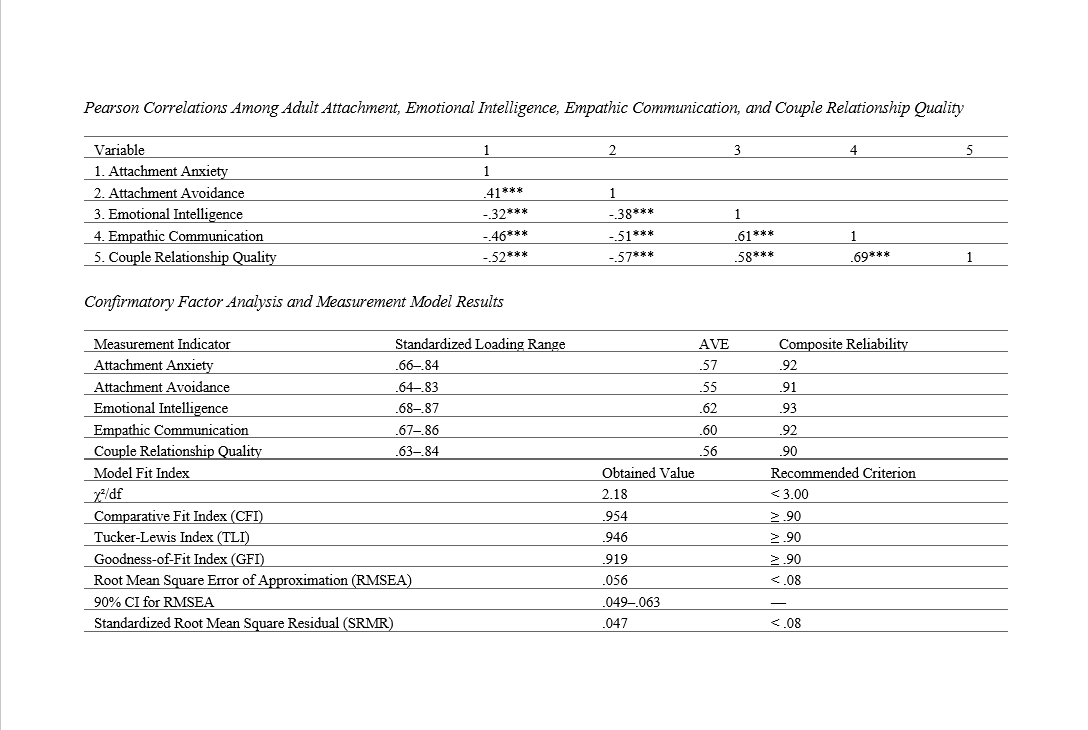
Findings: Attachment anxiety significantly predicted lower empathic communication (β = -.24, p < .001) and lower couple relationship quality (β = -.19, p < .001), while attachment avoidance also significantly predicted lower empathic communication (β = -.31, p < .001) and lower relationship quality (β = -.23, p < .001). Emotional intelligence positively predicted empathic communication (β = .43, p < .001) and couple relationship quality (β = .24, p < .001). Empathic communication positively predicted relationship quality (β = .45, p < .001). Significant indirect effects through empathic communication were observed for attachment anxiety (β = -.11, 95% CI [-.16, -.07]), attachment avoidance (β = -.14, 95% CI [-.20, -.09]), and emotional intelligence (β = .19, 95% CI [.14, .25]). The model explained 56.8% of the variance in empathic communication and 63.7% of the variance in couple relationship quality.
Conclusion: Adult attachment insecurity and emotional intelligence are important predictors of couple relationship quality, and empathic communication partially mediates these relationships, indicating that emotionally responsive communication is a key interpersonal mechanism linking individual emotional characteristics to romantic relationship functioning.
Downloads
References
Bell, D. C. (2023). Connection Abstract Theory: An Exercise in Abstract Theorizing After Bowlby. Journal of Family Theory & Review, 16(2), 191-215. https://doi.org/10.1111/jftr.12538
Buczel, K. A., Szyszka, P. D., & Mara, I. (2023). Exploring Compersion: A Study on Polish Consensually Non-Monogamous Individuals and Adaptation of the COMPERSe Questionnaire. https://doi.org/10.21203/rs.3.rs-2838247/v1
Eddy, C. M. (2021). Self-Serving Social Strategies: A Systematic Review of Social Cognition in Narcissism. Current Psychology. https://doi.org/10.1007/s12144-021-01661-3
Fogel‐Yaakobi, S., Golland, Y., Levit‐Binnun, N., Borelli, J. L., Mikulincer, M., & Shai, D. (2023). The Moderating Role of Attachment in the Association Between Physiological Synchrony in Married Couples and Supportive Behavior in the Transition to Parenthood. Psychophysiology, 60(7). https://doi.org/10.1111/psyp.14263
Gallistl, M., Hamann, J., Croy, I., Vrtička, P., & Engert, V. (2024). Relationship as Resource or Burden? Associations of Attachment Style, Relationship Quality and Dyadic Coping With Acute Psychosocial Stress in the Presence of the Romantic Partner. https://doi.org/10.1101/2024.10.21.618832
Gallistl, M., Handke, L., Kungl, M., Gabler, S., Croy, I., Vrtička, P., & Engert, V. (2025). Securely Stressed: Association Between Attachment and Empathic Stress in Romantic Couples. https://doi.org/10.21203/rs.3.rs-4582566/v2
Gauvin, S. E. M., Maxwell, J. A., Impett, E. A., & MacDonald, G. (2024). Love Lost in Translation: Avoidant Individuals Inaccurately Perceive Their Partners’ Positive Emotions During Love Conversations. Personality and Social Psychology Bulletin, 51(12), 2527-2541. https://doi.org/10.1177/01461672241258391
Gorla, L., Fusco, C., & Santona, A. (2023). A Retrospective Study on Adoptive Parenthood in the First Year After the Adoption: The Role of Parents’ Attachment and Empathy on Communicative Openness. Healthcare, 11(24), 3128. https://doi.org/10.3390/healthcare11243128
Hernández-Jorge, C. M., Rodríguez-Hernández, A. F., Kostiv, O., Rivero, F., & Domínguez-Medina, R. (2022). Psychometric Properties of an Emotional Communication Questionnaire for Education and Healthcare Professionals. Education Sciences, 12(7), 484. https://doi.org/10.3390/educsci12070484
Kaźmierczak, M., & Karasiewicz, K. (2021). Dyadic Empathy in Polish Samples: Validation of the Interpersonal Reactivity Index for Couples. Current Issues in Personality Psychology, 9(4), 354-365. https://doi.org/10.5114/cipp.2021.103541
Marmarosh, C. L. (2022). Attachments, Trauma, and COVID-19: Implications for Leaders, Groups, and Social Justice. Group Dynamics Theory Research and Practice, 26(2), 85-102. https://doi.org/10.1037/gdn0000187
Mora, P. M. (2021). Here for You: Attachment and the Growth of Empathic Support for Friends in Adolescence. Child development, 92(6), e1326-e1341. https://doi.org/10.1111/cdev.13630
Neu, C., & Bradford, A. B. (2025). Autism in Romantic Relationships: A Content Analysis of Challenges and Strengths (2013–2024). Journal of Family Theory & Review, 17(3), 600-635. https://doi.org/10.1111/jftr.70001
Sanctis, F. D., & Mesurado, B. (2022). Estilo De Apego Y Empatía en Infantes Tardíos, Adolescentes Y Adultos: Revisión Meta-Analítica. International Journal of Psychological Research, 15(2), 114-129. https://doi.org/10.21500/20112084.5409
Seedall, R. B., & Wampler, K. S. (2023). An Attachment Perspective on Couple Interaction: Helping Couples Signal Needs Clearly and Respond Appropriately. Journal of marital and family therapy, 50(2), 267-289. https://doi.org/10.1111/jmft.12684
Sels, L., Reis, H. T., Randall, A. K., & Verhofstadt, L. (2021). Emotion Dynamics in Intimate Relationships: The Roles of Interdependence and Perceived Partner Responsiveness. 155-179. https://doi.org/10.1007/978-3-030-82965-0_8
Sharma, N. S. (2021). Exploring the Empathy - Aggression Relationship, and Gender Related Differences in Greek College Students. Journal of Psychological Research, 3(2), 45-67. https://doi.org/10.30564/jpr.v3i2.3124
Suciu, N., Meliţ, L. E., & Mărginean, C. O. (2021). A Holistic Approach of Personality Traits in Medical Students: An Integrative Review. International journal of environmental research and public health, 18(23), 12822. https://doi.org/10.3390/ijerph182312822
Talib, M. A., Guo, J., Nordin, N. M., & Anne Noor Sri Juwaneeta, J. (2025). Integrative Behavioral Couple Therapy (IBCT) for Marital Reconciliation: A Systematic Review of Outcomes. The Family Journal, 34(1), 54-64. https://doi.org/10.1177/10664807251384198
Vaillancourt‐Morel, M. P., Bussières, È.-L., Nolin, M.-C., & Daspe, M. È. (2023). Partner Effects of Childhood Maltreatment: A Systematic Review and Meta-Analysis. Trauma Violence & Abuse, 25(2), 1150-1167. https://doi.org/10.1177/15248380231173427
Wiecha, J., Åbom, A. K., Śmieja, M., & Wójcik, M. E. (2026). The Fabric of Connection? Exploratory Studies on Being Moved in Committed Relationships. Scandinavian journal of psychology, 67(3), 923-939. https://doi.org/10.1111/sjop.70068
Wiseman, H., & Egozi, S. (2021). Attachment Theory as a Framework for Responsiveness in Psychotherapy. 59-82. https://doi.org/10.1037/0000240-004
Xiao, H., Double, K. S., Pinkus, R. T., & MacCann, C. (2025). Valuing Your Partner More: Linking Emotional Intelligence to Better Relationship Quality. Journal of Social and Personal Relationships, 43(4), 1244-1272. https://doi.org/10.1177/02654075251399696
Yao, R., & Nan, Y. (2025). Understanding Attachment to Social Chatbots: The Roles of Loneliness, Self‐Disclosure, and Empathy. Journal of Consumer Behaviour, 25(1), 425-443. https://doi.org/10.1002/cb.70077
Zamir, O. (2021). Childhood Maltreatment and Relationship Quality: A Review of Type of Abuse and Mediating and Protective Factors. Trauma Violence & Abuse, 23(4), 1344-1357. https://doi.org/10.1177/1524838021998319
Zhang, Y., & Liu, Y. (2026). User Needs and Preferences for Multimodal Interaction in Social Robots for Later-Life Support: An Exploratory Survey and Conceptual Five-Layer Architecture. Journal of Intelligence, 14(5), 85. https://doi.org/10.3390/jintelligence14050085
Downloads
Additional Files
Publication Timeline
- Submitted
- Revised
- Accepted