The Mediating Role of Guilt in the Relationship Between Dark Personality Traits and Tendency Toward Marital Infidelity Among Married Individuals
Keywords:
Guilt, dark personality traits, Machiavellianism, antisocial traits, narcissism, marital infidelity, married individualsAbstract
Objective: This study aimed to examine the mediating role of guilt in the relationship between dark personality traits and the tendency toward marital infidelity among married individuals.
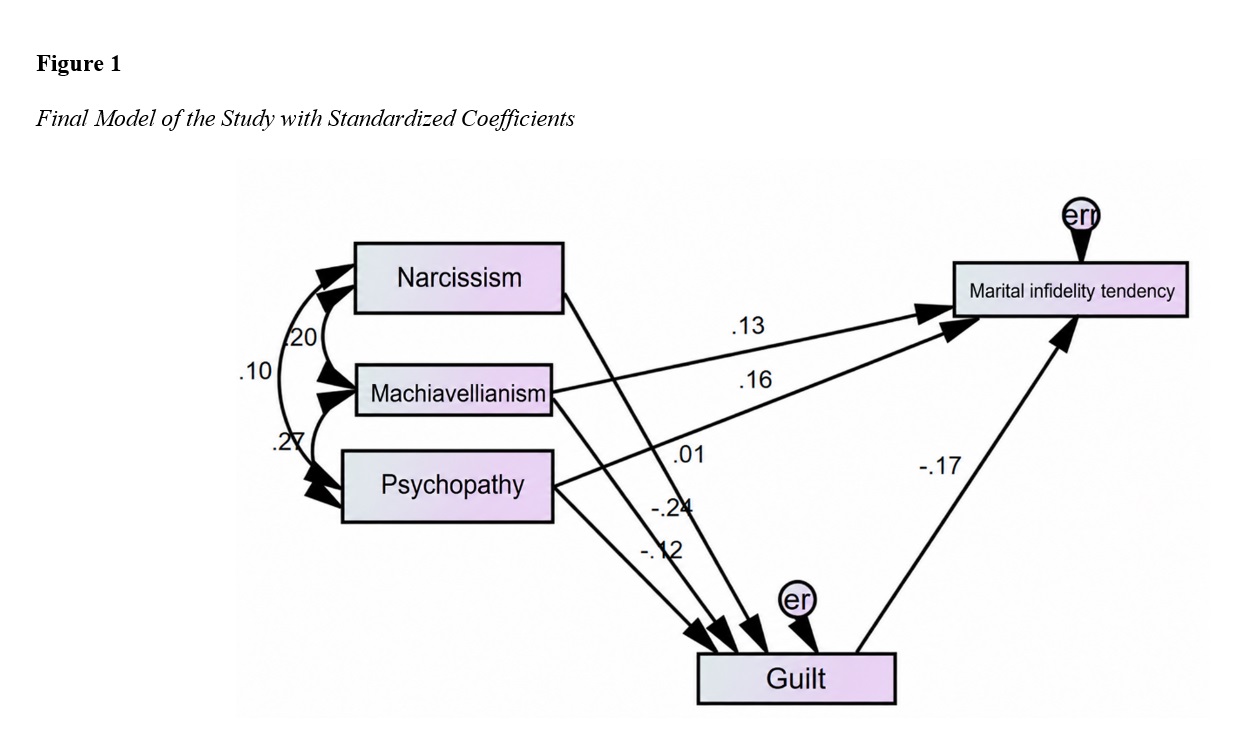
Methods and Materials: This quantitative study used a descriptive-correlational design based on path analysis. The statistical population included married individuals residing in Neyshabur, Iran, in 2024. A sample of 300 participants was selected through convenience sampling. Data were collected using the Dirty Dozen Dark Personality Traits Scale developed by Jonason and Webster, the Guilt Inventory developed by Kugler and Jones, and the Marital Infidelity Tendency Questionnaire developed by Whatley. The collected data were analyzed using SPSS version 27 and AMOS version 24. Pearson correlation coefficients and path analysis were applied to test the hypothesized direct and indirect relationships among narcissism, Machiavellianism, antisocial traits, guilt, and tendency toward marital infidelity.
Findings: The revised structural model showed acceptable fit to the data, with χ² = 1.41, df = 1, RMSEA = .038, GFI = .99, AGFI = .98, NFI = .97, IFI = 1.00, and CFI = 1.00. Machiavellianism had a significant negative effect on guilt (β = −.24, p = .001), and antisocial traits also had a significant negative effect on guilt (β = −.56, p = .044). Guilt had a significant negative effect on tendency toward marital infidelity (β = −.10, p = .005). Machiavellianism (β = .41, p = .029) and antisocial traits (β = .47, p = .006) had significant positive direct effects on tendency toward marital infidelity. The indirect effects of Machiavellianism (β = .04, p = .006) and antisocial traits (β = .02, p = .033) on infidelity tendency through guilt were significant, whereas the indirect effect of narcissism was not significant (p = .743).
Conclusion: The findings indicate that guilt partially mediates the relationship between dark personality traits and tendency toward marital infidelity. Higher Machiavellian and antisocial traits were associated with lower guilt and greater infidelity tendency. Therefore, assessing dark personality traits and strengthening guilt-related moral responsibility may be useful in marital counseling and preventive interventions.
Downloads
References
Arabi Divarzemi, S., Shaker, A., Esmaeili-Kouraneh, A., & Khademi, A. (2023). Structural relationships between dark personality construct, emotional inhibition, and extramarital relationships through the mediating role of attitude toward marital commitment among women and men with extramarital relationships. Rooyesh-e-Ravanshenasi Journal, 12(1).
Babakhani, V. (2020). The effectiveness of acceptance and commitment therapy (ACT) on distress tolerance and self-control in betrayed women. Journal of Family Psychology, 7(1), 121-132.
Bilal, A., Naqvi, G., & Mehmood, I. (2021). Impact of Dark Triad personality traits on attitude towards infidelity among married individuals in Punjab. Pakistan Journal of Applied Psychology, 1(1), 32-39. https://doi.org/10.52461/pjap.v1i1.821
Bjarehed, M., Thornberg, R., Wanstrom, L., & Gini, G. (2020). Mechanisms of moral disengagement and their associations with indirect bullying, direct bullying, and pro-aggressive bystander behavior. The Journal of Early Adolescence, 40(1), 28-55. https://doi.org/10.1177/0272431618824745
Chattardar, N., Taher, M., Vatan-khah Korandeh, H., & Hosseinkhan-zadeh Firouzjaei, A. (2020). Explaining personality disorders based on emotional self-awareness: The mediating role of defense mechanisms. Rooyesh-e-Ravanshenasi Journal, 9(54), 71-84.
Domanik, S. M. (2023). Religiosity as a moderator of infidelity in Dark Triad women.
Grigoropoulos, I. (2023). Unraveling the intrapersonal factors related to infidelity: The predictive value of light and dark personality traits in a convenient Greek women sample. Sexuality & Culture, 27, 1-25. https://doi.org/10.1007/s12119-023-10123-w
Hajihasani, M. (2026). Retaliatory Marital Infidelity After Betrayal. European Journal of Psychology Open, 85(1), 29-37. https://doi.org/10.1024/2673-8627/a000089
Hasheminejad, S. (2020). The role of early maladaptive schemas and dark personality traits in predicting tendency toward marital infidelity. New Achievements in Humanities Studies, 3(31), 97-104.
Isma, M. N. P., & Turnip, S. S. (2019). Personality traits and marital satisfaction in predicting couples' attitudes toward infidelity. Journal of Relationships Research, 10, e13. https://doi.org/10.1017/jrr.2019.10
Johnson, B. N., Clouthier, T. L., Rosenstein, L. K., & Levy, K. N. (2020). Psychotherapy for personality disorders. In V. Zeigler-Hill & T. K. Shackelford (Eds.), Encyclopedia of Personality and Individual Differences (pp. 4216-4234). Springer. https://doi.org/10.1007/978-3-319-24612-3_925
Kaplanova, A., & Gregor, A. (2019). Guilt- and shame-proneness and their relation to perceptions of dating infidelity. Studia psychologica, 61(3), 145-158. https://doi.org/10.21909/sp.2019.03.779
Khaksari, B. (2021). The relationship between dark personality traits and marital disturbances in nurse couples in Kermanshah during the COVID-19 crisis. Military Medical and Paramedical Sciences, 16(3), 30-37.
Khazraloo, E., Aghayousefi, A., & Ebrahimi Moghadam, H. (2026). A structural model for predicting attitudes toward marital infidelity based on attachment with the mediating role of coping strategies in married women and men in Tehran. Health Promotion Management, 14(1), 14-25.
Koay, K. Y., Lim, V. K., Soh, P. C. H., Ong, D. L. T., Ho, J. S. Y., & Lim, P. K. (2022). Abusive supervision and cyberloafing: A moderated moderation model of moral disengagement and negative reciprocity beliefs. Information & Management, 59(2), 103600. https://doi.org/10.1016/j.im.2022.103600
Lo Cricchio, M. G., Garcia-Poole, C., te Brinke, L. W., Bianchi, D., & Menesini, E. (2021). Moral disengagement and cyberbullying involvement: A systematic review. European Journal of Developmental Psychology, 18(2), 271-311. https://doi.org/10.1080/17405629.2020.1782186
Mohammadi Eini, Z., Sadeghi, J., Dortaj, F., & Homayouni, A. (2020). Structural modeling of the relationships between parent-child conflicts and aggression: The mediating role of moral disengagement. Journal of Military Psychology, 11(41), 41-49. https://doi.org/10.29252/jcmh.7.2.5
Moor, L., & Anderson, J. R. (2019). A systematic literature review of the relationship between dark personality traits and antisocial online behaviours. Personality and individual differences, 144, 40-55. https://doi.org/10.1016/j.paid.2019.02.027
Nasiri, Z., Honarparvaran, N., Javadzadeh Shahshahani, F., & Samani, S. (2022). Identifying background and revealing factors in marital infidelity: A qualitative study. Applied Family Therapy, 3(1), 110-135. https://doi.org/10.61838/kman.aftj.3.1.7
Palizgir, M. (2020). Investigating the relationship between guilt and extramarital relationships. 3rd International Conference on Psychology, Educational Sciences, Social Sciences and Humanities,
Paulhus, D. L., Buckels, E. E., Trapnell, P. D., & Jones, D. N. (2020). Screening for dark personalities. European Journal of Psychological Assessment. https://doi.org/10.1027/1015-5759/a000602
Sarmadi, Y., & Ahmadi, K. (2021). The extent of damages caused by marital infidelity in couples. Family Research, 7(1). https://doi.org/10.52547/jfr.17.1.81
Sharifi-Saei, M., & Azad-Armaki, T. (2021). Factors shaping marital infidelity in Iran: A meta-synthesis study. Iranian Journal of Social Issues, 12(2), 33-74.
Shoa Kazemi, M., Mohammadi, N., & Karimi, A. (2025). Predicting Marital Infidelity Based on Maladaptive Schema Modes and Emotional Divorce in Women Referring to Counseling Centers in Iran. Journal of Applied Psychological Research, 16(2), 1-18.
Shoaa Kazemi, M., Hamamra, B., Hosseini, S., Bdier, D., & Mahamid, F. (2026). Predicting Marital Infidelity Based on Incompatible Mental Schemas and Emotional Divorce in Women Referring to Counseling Centers in Iran. Journal of Ethnicity in Substance Abuse, 1-17. https://doi.org/10.1080/15332640.2026.2631710
Sutton, G. (2019). The Dark Triad in personnel selection: An exploration of narcissism, psychopathy, and Machiavellianism in candidates involved in an organisational selection process. Personality and individual differences, 139, 117-121.
Yasaran, M. L. (2023). How the Dark Tetrad predicts responses to infidelity threats?
Yousefi Moridani, M., Fallahian, H., & Mikaeli, M. (2020). The role of relational beliefs, dark personality dimensions, and social trust in couples' attitudes toward infidelity. Journal of New Advances in Psychology, Educational Sciences, and Education, 3(26), 1-15.
Yu, Y., Wu, D., Wang, J. M., & Wang, Y. C. (2020). Dark personality, marital quality, and marital instability of Chinese couples: An actor-partner interdependence mediation model. Personality and individual differences, 154, 109701. https://doi.org/10.1016/j.paid.2019.109689
Downloads
Additional Files
Publication Timeline
- Submitted
- Revised
- Accepted