Comparing the Effectiveness of Cognitive Behavioral Therapy and Reality Therapy on Family Boundaries and Differentiation of Self
Keywords:
Cognitive behavioral therapy, reality therapy, family boundaries, differentiation of self, family functioning, marital counselingAbstract
Objective: The present study aimed to compare the effectiveness of cognitive behavioral therapy and reality therapy on family boundaries and differentiation of self among married individuals in Tehran.
Methods and Materials: This quasi-experimental study was conducted using a pretest–posttest design with a control group and follow-up phase. The statistical population included married individuals living in Tehran who had referred to counseling and psychological service centers because of marital or family-related difficulties. A total of 45 eligible participants were selected through purposive sampling and randomly assigned to three equal groups: cognitive behavioral therapy, reality therapy, and control, with 15 participants in each group. The cognitive behavioral therapy and reality therapy groups each received eight weekly 90-minute group intervention sessions, while the control group remained on the waiting list and received no intervention during the study period. Data were collected using the Family Relational Boundaries Questionnaire and the Differentiation of Self Inventory-Revised. Data were analyzed using repeated-measures analysis of variance and Bonferroni post hoc tests.
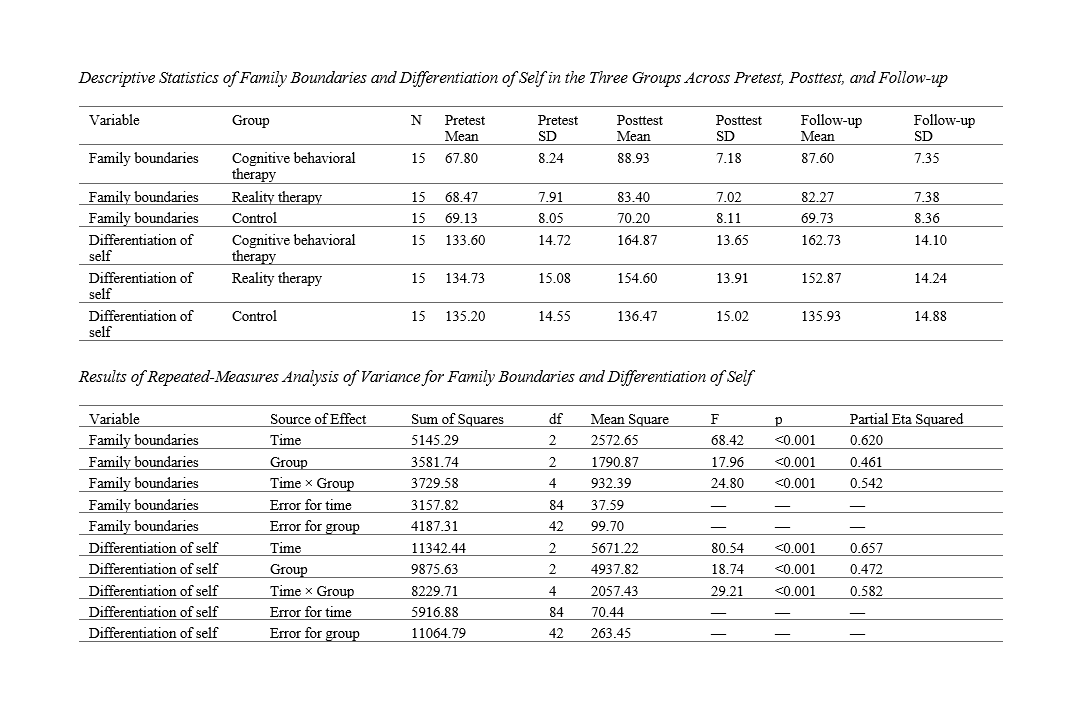
Findings: The results showed that the main effect of time was significant for family boundaries, F(2, 84) = 68.42, p < 0.001, η² = 0.620, and differentiation of self, F(2, 84) = 80.54, p < 0.001, η² = 0.657. The group effect was also significant for family boundaries, F(2, 42) = 17.96, p < 0.001, η² = 0.461, and differentiation of self, F(2, 42) = 18.74, p < 0.001, η² = 0.472. The time × group interaction was significant for family boundaries, F(4, 84) = 24.80, p < 0.001, η² = 0.542, and differentiation of self, F(4, 84) = 29.21, p < 0.001, η² = 0.582. Bonferroni comparisons indicated that both interventions were significantly more effective than the control condition, and cognitive behavioral therapy was significantly more effective than reality therapy.
Conclusion: The findings indicated that both cognitive behavioral therapy and reality therapy improved family boundaries and differentiation of self, but cognitive behavioral therapy produced stronger and more stable effects.
Downloads
References
Apicella, M., Pontillo, M., Maglio, G., Vincenzo, C. D., Santa, G. D., Andracchio, E., & Vicari, S. (2025). Non-Suicidal Self-Injury in Adolescents: A Clinician’s Guide to Understanding the Phenomenon, Diagnostic Challenges, and Evidence-Based Treatments. Frontiers in Psychiatry, 16. https://doi.org/10.3389/fpsyt.2025.1605508
Banerjee, D. (2025). Shared Psychotic Disorder in the Digital Age: A Case Series of Virtual “Folie À Trois”. Consortium Psychiatricum, 6(3), 78-84. https://doi.org/10.17816/cp15689
Besharat Qaramaleki, R., Panahali, A., & Hosseini Nasab, D. (2024). Investigating the Impacts and Continuity of Effects of Group-Based Reality Therapy on Marital Adjustment, Emotion Differentiation, and Intimacy in Couples with Emotional Divorce. Journal of Modern Psychological Researches, 18(72), 61-70.
Bhuvaneswari, S., & Kaur, J. (2024). Exploring reality therapy: A case study on adolescent emotional recovery amidst family conflict. IAPS Journal of Practice in Mental Health, 2(2), 43-47. https://doi.org/10.4103/IJPMH.IJPMH_14_24
Burmykina, O. N. (2024). Family boundaries: identification and dynamics. Semiotic studies, 4(3), 74-83.
Castellini, G., Cassioli, E., Rossi, E., Mancini, M., Ricca, V., & Stanghellini, G. (2022). Bridging Cognitive, Phenomenological and Psychodynamic Approaches to Eating Disorders. Eating and Weight Disorders - Studies on Anorexia Bulimia and Obesity, 27(7), 2273-2289. https://doi.org/10.1007/s40519-022-01379-6
Castonguay, L. G., Boswell, J. F., Caspar, F., Friedlander, M. L., Gómez, B., Hayes, A. M., Holtforth, M. G., Messer, S. B., Newman, M. G., & Strauß, B. (2023). What Competencies Should Therapists Acquire and How Should They Acquire Them? , 13-29. https://doi.org/10.1037/0000364-002
Chadha, Y., Patil, R., Toshniwal, S., & Sinha, N. (2024). Internet Addiction Management: A Comprehensive Review of Clinical Interventions and Modalities. Cureus. https://doi.org/10.7759/cureus.55466
Csirmaz, L., Nagy, T., Vikor, F., & Kasos, K. (2023). Cognitive Behavioral Digital Interventions Are Effective in Reducing Anxiety in Children and Adolescents: A Systematic Review and Meta-Analysis. Journal of Prevention, 45(2), 237-267. https://doi.org/10.1007/s10935-023-00760-0
DeGrush, E., & LaFrance, W. C. (2022). Psychotherapeutic Tools to Enhance the Neurologist-Patient Interaction. Seminars in Neurology, 42(02), 107-113. https://doi.org/10.1055/s-0042-1742288
Fang, S., Chen, F., Bian, J., Zhang, L., & Wang, Y. (2025). Interventions for Adolescent Depression Comorbid With Non-Suicidal Self-Injury: A Scoping Review. Frontiers in Psychiatry, 16. https://doi.org/10.3389/fpsyt.2025.1601073
Foe, A. D. (2023). Considerations in the Application of Psychedelic-Augmented Psychotherapy: A Commentary on Clinical Mechanisms. Psychoactives, 2(2), 162-173. https://doi.org/10.3390/psychoactives2020011
Fung, W. L. A., Yip, P., Stevens, S. K., Wong, T.-Y., Yoo, Y.-H. N., Ross, N., Noh, H.-L., & Tang, T. N. (2023). Christian-Based Spiritually Integrated Psychotherapy for East Asian Canadians and Findings From the CSPEARIT Study. 301-324. https://doi.org/10.1037/0000338-016
Guadagnoli, L., Washburn, J. J., & Butt, Z. (2022). Supervising the Delivery of Cognitive Behavior Therapy in Medical Settings. 189-205. https://doi.org/10.1037/0000314-014
Hadian, S., Havasi soomar, N., Hosseinzadeh Taghvaei, M., Ebrahimi, M. I., & Ranjbaripour, T. (2023). Comparing the effectiveness of acceptance and commitment therapy and reality therapy on the responsibility and self-efficacy of divorced women [Research]. Advances in Cognitive Sciences, 25(3), 47-63. https://doi.org/10.30514/icss.25.3.47
Hesapcioglu, S. T., Dabak, S., Aburşu, H., & Ceylan, M. F. (2026). Intensive Inpatient Trauma-Focused Cognitive Behavioral Therapy (II-TF-CBT) for Child and Adolescent Survivors of Sexual Trauma in Psychiatric Inpatient Care. Annals of Clinical Psychiatry, 37(3), 113-126. https://doi.org/10.1177/10401237261453591
Horovitz, O., & Argyrides, M. (2023). Orthorexia and Orthorexia Nervosa: A Comprehensive Examination of Prevalence, Risk Factors, Diagnosis, and Treatment. Nutrients, 15(17), 3851. https://doi.org/10.3390/nu15173851
Kamboj, J. (2024). Hypothesized the relationship between work–family boundaries, work–life balance, workload, and employees’ well-being: Moderated mediation analysis. Human Systems Management, 01672533251331490.
Kress, V. E., McAllister, C. A., Hall, A. K., & Forner, E. H. (2024). Sibling Sexual Abuse: Youth Counseling Considerations. The Family Journal, 33(1), 51-60. https://doi.org/10.1177/10664807241268440
Lebow, J. L., Fisher, A. R., & Swanson, S. E. (2024). Couple Theory in Psychotherapy. 191-206. https://doi.org/10.1037/0000353-012
Lee, A. T., Chin, P., Nambiar, A., & Haskins, N. (2023). Addressing Intergenerational Trauma in Black Families: Trauma‐informed socioculturally Attuned Family Therapy. Journal of marital and family therapy, 49(2), 447-462. https://doi.org/10.1111/jmft.12632
Magnavita, J. J., & Ingram, B. L. (2024). Personality Disorders. 375-394. https://doi.org/10.1037/0000353-022
Manfredi, P., & Taglietti, C. (2022). A Psychodynamic Contribution to the Understanding of Anger - The Importance of Diagnosis Before Treatment. Research in Psychotherapy Psychopathology Process and Outcome. https://doi.org/10.4081/ripppo.2022.587
Mazaheri Tehrani, F., Kokali, M., Savabi Niri, V., & Bikas Yekani, M. (2022). The Effectiveness of Reality Therapy on Cognitive Flexibility and Self-Differentiation in Mothers With Children With Special Learning Disorders. Journal of Child Mental Health, 9(1), 6-29. https://doi.org/10.52547/jcmh.9.1.7
Ottingerová, L., Halamová, J., & Szitás, D. (2026). Experiential Therapies Including Chairwork: A Systematic Review of Randomized Controlled Trials. Frontiers in psychology, 16. https://doi.org/10.3389/fpsyg.2025.1692630
Owens, A., & Mascarenas, A. (2025). From Digital Distress to Wellness: Counseling Implications of Social Media Use in Adolescents and Emerging Adults. The Family Journal. https://doi.org/10.1177/10664807251403538
Özçelik, H. N., & Toprak, T. B. (2025). “In Search of Truth?” Integrating Religious Consultation Into CBT to Address Ambivalence: A Case Study. Clinical Case Studies, 24(5), 315-332. https://doi.org/10.1177/15346501251369115
Park, J. J., Stryjewski, A., Chen, B., & Potenza, M. N. (2025). Treatment of Gaming Disorder in Children and Adolescents: A Systematic Review. Journal of Korean Academy of Child and Adolescent Psychiatry, 36(3), 106-121. https://doi.org/10.5765/jkacap.250014
Parsakia, K., Farzad, V., & Rostami, M. (2023). The Mediating Role of Attachment Styles in the Relationship Between Marital Intimacy and Self-Differentiation in Couples. Aftj, 4(1), 589-607. https://doi.org/10.61838/kman.aftj.4.1.29
Rezapour Chours, F., Nokani, M., & Mayeli, M. (2025). A Comparison of Disengaged Family Boundaries in Individuals With and Without Early Maladaptive Schemas. Clinical Psychology, 17(1), 79-92. https://jcp.semnan.ac.ir/article_9058.html
Sakdalan, J. A., & Mitchell, B. (2023). Development of an Evidence-Based Violence Rehabilitation Program for Offenders With Intellectual Disability. International journal of offender therapy and comparative criminology, 69(5), 572-593. https://doi.org/10.1177/0306624x231176005
Samadi, M., Pourshahriari, P. D., & Hosseinian, P. D. (2023). The Impact of Reality Therapy Training on Family Communication Patterns and Alexithymia in Elementary School Students. Quarterly Journal Of Family and Research, 20(3), 7-24. http://qjfr.ir/article-1-1725-fa.html
Satyanarayana, V. A., Das, A., & Shah, A. (2024). Psychotherapy for Families With Adolescent Children: Clinical Practice Guidelines. Journal of Indian Association for Child and Adolescent Mental Health, 20(2), 127-135. https://doi.org/10.1177/09731342241237074
Sookman, D., Phillips, K. A., Anholt, G. E., Bhar, S., Bream, V., Challacombe, F., Coughtrey, A., Craske, M. G., Foa, E. B., Gagné, J.-P., Huppert, J. D., Jacobi, D. M., Lovell, K., McLean, C. P., Neziroglu, F., Pedley, R., Perrin, S., Pinto, A., Pollard, C. A., . . . Veale, D. (2021). Knowledge and Competency Standards for Specialized Cognitive Behavior Therapy for Adult Obsessive-Compulsive Disorder. Psychiatry research, 303, 113752. https://doi.org/10.1016/j.psychres.2021.113752
Tolin, D. F., Grasso, D. J., Boness, C. L., Beck, J. G., Keane, T. M., Leichsenring, F., Olatunji, B. O., Otto, M. W., & Weinand, J. (2025). A Proposed Definition of Psychological Treatment and Its Relation to Empirically Supported Treatments. Clinical Psychology Science and Practice, 32(3), 213-225. https://doi.org/10.1037/cps0000220
Tretter, F., & Löffler‐Stastka, H. (2021). How Does the ‘Environment’ Come to the Person? The ‘Ecology of the Person’ and Addiction. World journal of psychiatry, 11(11), 915-936. https://doi.org/10.5498/wjp.v11.i11.915
Tsamalidou, A., & Tragantzopoulou, P. (2025). From Doubt to Development: Professional Journeys of Novice CBT Therapists. Behavioral Sciences, 15(11), 1504. https://doi.org/10.3390/bs15111504
West, M. L., Guest, R. M., & Carmel, A. (2021). Comorbid Early Psychosis and Borderline Personality Disorder: Conceptualizing Clinical Overlap, Etiology, and Treatment. Personality and Mental Health, 15(3), 208-222. https://doi.org/10.1002/pmh.1509
Wood, K. (2017). Families Beyond Boundaries: Conceptualising Kinship in Gay and Lesbian Adoption and Fostering. Child & Family Social Work, 23(2), 155-162. https://doi.org/10.1111/cfs.12394
Xu, M., Rodríguez‐González, M., Calatrava, M., Sambuceti‐Lewis, A., & Martínez‐Díaz, M. P. (2025). Differentiation of Self, Attachment Experiences, and Dyadic Adjustment: An APIM Approach With Spanish‐Speaking Couples. Family Process, 65(1). https://doi.org/10.1111/famp.70105
Xue, Y. (2023). Family System and Depression: Theoretical Perspectives and Intervention. Journal of Education Humanities and Social Sciences, 22, 523-530. https://doi.org/10.54097/ehss.v22i.12518
Zarean, M., Ahadi, H., Jomehri, F., & Sohrabi, F. (2023). Comparison of the Effectiveness of Reality Therapy and Cognitive Behavioral Therapy on Depression and Adjustment in Post-Abortion Women. Journal of Applied Family Therapy, 4(1), 396-419. https://doi.org/10.22034/aftj.2022.329891.1408
Zhang, F., Lei, J., Hei, H., & Wang, L. (2025). Effects and Mechanisms of Family-Based Cognitive Behavioral Therapy for Pediatric Obsessive–compulsive Disorder: A Systematic Review and Meta-Analysis. Clinical Psychology Science and Practice. https://doi.org/10.1037/cps0000308
Zhu, Y. (2023). Literature Review: Dissociative Identity Disorder (DID). Journal of Education Humanities and Social Sciences, 22, 195-201. https://doi.org/10.54097/ehss.v22i.12419
Волкова, О. О. (2021). Theoretical Analysis Rehabilitation Potential and Features Care of Combatants. https://doi.org/10.31435/rsglobal_conf/25012021/7359
Downloads
Additional Files
Publication Timeline
- Submitted
- Revised
- Accepted