Exploring the Lived Experiences of Couples Experiencing Emotional Divorce: A Phenomenological Study
Keywords:
Emotional Divorce, Lived Experience, Couples, Phenomenology, Marital Relationships, Emotional IntimacyAbstract
Objective: This study aimed to explore and describe the lived experiences of couples experiencing emotional divorce and to identify the principal dimensions through which this phenomenon is perceived and experienced.
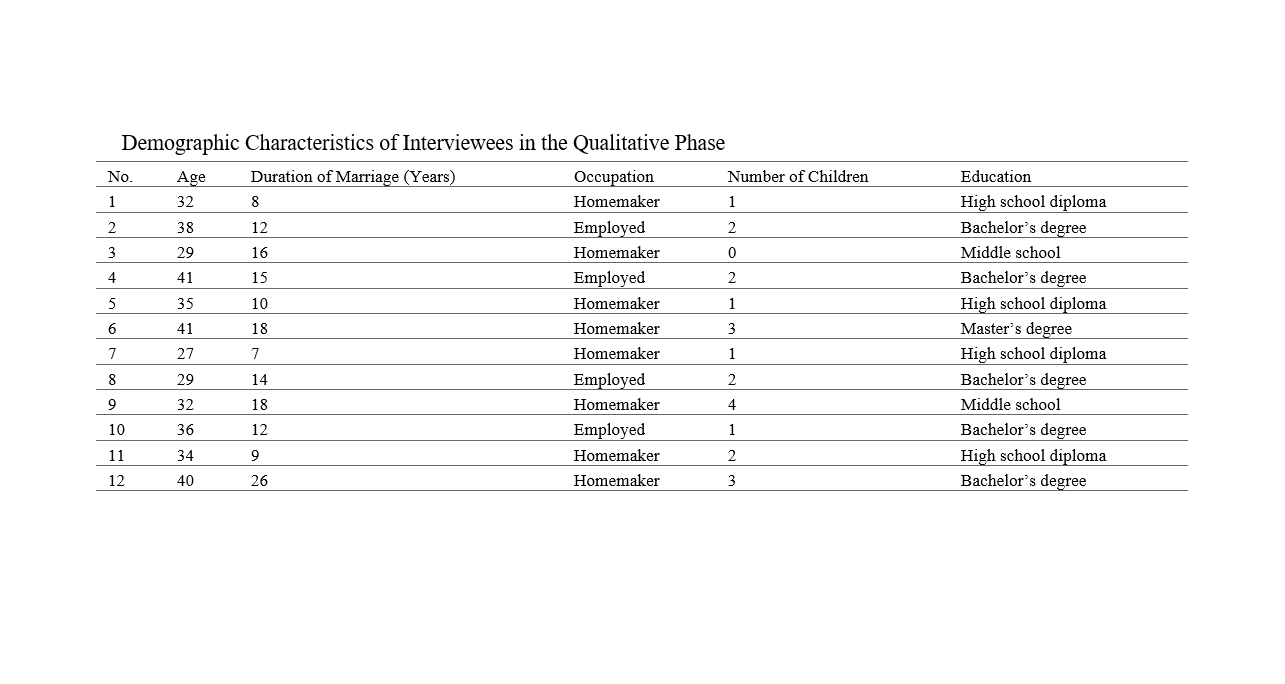
Methods and Materials: This qualitative study employed a descriptive phenomenological design based on Colaizzi’s approach. Twelve participants with lived experience of emotional divorce were selected through purposive sampling and participated in in-depth semi-structured interviews. Following verbatim transcription, the interview data were systematically coded and analyzed according to Colaizzi’s seven-step phenomenological method to identify significant statements, formulated meanings, thematic clusters, and overarching themes. MAXQDA 2020 software was used for data management and coding. To enhance the credibility and dependability of the findings, several rigor-enhancing strategies were applied, including member checking with 10 participants, review and evaluation of the findings by three experts, and the involvement of 24 individuals in different stages of the data analysis and validation process.
Findings: The phenomenological analysis yielded five overarching themes representing the core dimensions of emotional divorce: cognitive factors, emotional-regulatory factors, affective factors, communicational factors, and sexual factors. The participants’ accounts indicated that emotional divorce was experienced not as an abrupt relational rupture but as a progressive and multidimensional process involving the gradual erosion of cognitive engagement, emotional connection, affection, constructive communication, and sexual intimacy. These dimensions appeared to interact dynamically, generating a self-reinforcing cycle characterized by increasing emotional coldness, psychological distancing, relational disengagement, and declining hope for restoration of the marital relationship.
Conclusion: The findings highlight the importance of developing multidimensional couple-centered interventions and integrating communication skills training, emotion regulation, and emotional-sexual literacy into culturally sensitive preventive and therapeutic programs for Iranian couples.
Downloads
References
Afkhami Poustchi, M., & Alidousti, F. (2022). The Moderating Role of Conflict Resolution Styles in the Relationship Between Marital Conflict and Emotional Divorce. Iranian-Islamic Family Studies, 4(2), 1-18.
Aghajani, Z., Rahmani Firouzjah, A., & Heydarabadi, A. (2025). Examining Social and Cultural Factors Affecting the Tendency Toward Emotional Divorce: A Study of Couples Referring to Counseling Centers in Qaemshahr. Approaches in Sociology and Development, 1(2), 25-43. https://doi.org/10.22034/jasd.2025.223978
Al-Shahrani, H. F., & Hammad, M. A. (2023). Impact of Emotional Divorce on the Mental Health of Married Women in Saudi Arabia. PLoS One, 18(11), e0293285. https://doi.org/10.1371/journal.pone.0293285
Beyazit, U., Yurdakul, Y., & Ayhan, A. B. (2024). The Mediating Role of Trait Emotional Intelligence in the Relationship Between Parental Neglect and Cognitive Emotion Regulation Strategies. BMC psychology, 12(1), 314. https://doi.org/10.1186/s40359-024-01817-3
Damo, D. D., & Cenci, C. M. B. (2021). Emotional Divorce: Similarities and Differences According to the Position Occupied. Trends in Psychology, 29(3), 505-518. https://doi.org/10.1007/s43076-021-00088-w
Faraji, Z., Ghavamnia, Z., & Kalantari, J. (2024). Predicting Emotional Divorce Based on Family Communication Patterns with the Mediating Role of Marital Burnout in Married Female Teachers in Darab. Modern Psychology, 4(3), 65-78.
Gordeeva, T. O., Sychev, O. A., Kornienko, D. S., Rudnova, N. A., & Dedyukina, M. I. (2024). To Stay or to Leave: The Role of School, Family, and Prosocial Goals in Migration Intentions of Russian High School Students. Psychology in Russia: State of the art, 17(1), 84-99. https://doi.org/10.11621/pir.2024.0105
Gottman, J. (2023). What Predicts Divorce?: The Relationship Between Marital Processes and Marital Outcomes. Routledge. https://doi.org/10.4324/9781003429807
Gregory, E. M., & Maddern, R. (2025). The Psychosocial Experience of Traumatic Birth in Couples: An Interpretative Phenomenological Study. Journal of Reproductive and Infant Psychology, 43(1), 121-135. https://doi.org/10.1080/02646838.2023.2225073
Habibi, B., Shirmardi, S., Shiralinia, K., & Fathi, K. (2022). The Mediating Role of Marital Expectations in the Relationship Between Basic Psychological Needs and Emotional Divorce Among Health-Care Network Employees. Journal of Jiroft University of Medical Sciences, 9(3), 1039-1048.
Kamau, K. P., Ngari, P. S. M., Gichure, P. P., Ndung'u, D. E. M., & Esiu, E. O. (2021). The Effect of Emotional Intelligence on Marital Quality in Kenya: A Case of the Catholic Archdiocese of Nairobi, Kenya.
Kavosh Melli, A., & Moheb, N. (2022). Effectiveness of Schema Therapy on Quality of Life and Marital Satisfaction in Men Experiencing Emotional Divorce in Tabriz. Quarterly Journal of New Psychological Research, 17(65), 239-249.
Mohammadi Araghi, M., & Kazemi Najafabadi, A. (2024). The Interaction of Social Sciences and Family Law Based on Expediency: A Study of Emotional Divorce. Iranian Social Issues Review, 15(1), 241-258.
Mousavikia, E., Karimi Asl, R., & Fallahnejad, R. (2024). A Qualitative Study of Reconstructing Emotional Bonds in Couples with a History of Unsuccessful Mutual-Consent Divorce. Assessment, Evaluation, and Interventions in Couple Therapy, 1(1), 1-12.
Mulyati, S., Sulistiana, D., & Isti'adah, F. N. (2026). Emotional Regulation among High School Students Affected by Parental Divorce: A Qualitative Case Study. QUANTA: Kajian Bimbingan dan Konseling dalam Pendidikan, 10(2), 152-162.
Najafi, M., Rezaeian Bilandi, H., & Ahmadi, M. (2025). A Systematic Review of the Consequences of Emotional Divorce in the Family Based on Islamic Sources: A Qualitative Study. Islamic Studies of Women and Family, 12(23), 223-242.
Navidian, A., Navabi Rigi, S., Imani, M., & Soltani, P. (2016). The Effect of Sexual Education on the Quality of Marital Relationships in Pregnant Women. Hayat, 22(2), 115-127.
Niedenthal, P. M., & Ric, F. (2017). Psychology of Emotion. Psychology Press. https://doi.org/10.4324/9781315276229
Pourabbas Vafa, H., Babapour Kheireddin, J., Livarjani, S., & Moheb, N. (2022). Comparison of the Effectiveness of Emotional Schema Therapy and Emotion-Focused Therapy on Marital Burnout in Women Experiencing Emotional Divorce. Quarterly Journal of New Psychological Research, 17(66), 35-43.
Rahiman, R., Ghamari, M., Babakhani, V., & Jafari, A. (2023). Modeling the Structural Relationship of Personality Dimensions and Attachment Styles with Communication Skills and Marital Conflicts Through the Mediation of Early Maladaptive Schemas in Couples at Risk of Divorce. Applied Family Therapy, 4(5), 251-265.
Rashid, K., Hassanvand, F., Nabizadeh, S., & Rashti, A. (2019). Examining Interpersonal Factors Affecting Emotional Divorce Among Women. Women and Family Studies, 7(1), 117-137.
Sadeghkhani, M., Emamipour, S., & Mirhashemi, M. (2023). Developing a Structural Model of Emotional Divorce Based on the Dark Triad Personality Traits and Conflict Resolution Styles with Marital Burnout as a Mediator. Applied Family Therapy, 4(2), 444-471.
Stedje, K., Sæther Kvamme, T., Odell-Miller, H., Stensaeth, K. A., Bukowska, A. A., Tamplin, J., & Baker, F. A. (2026). Music Therapy Approaches to Support Relationship Quality in Couples Living with Dementia: A Hermeneutic-Phenomenological Study of Music Therapists' Reflections. Nordic Journal of Music Therapy, 35(2), 142-159. https://doi.org/10.1080/08098131.2025.2497805
Yuan, Q., Fan, Z., & Leng, J. (2022). The Effect of Emotional Reactivity on Marital Quality in Chinese Couples: The Mediating Role of Perceived Partner Responsiveness. Frontiers in psychology, 12, 787899. https://doi.org/10.3389/fpsyg.2021.787899
Zhang, L., Gu, W., Zhang, L., Miao, R., Jing, X., Zhi, S., & Wang, W. (2022). The Effects of a Nurse-Led Couples Intervention on Marital Quality of Couples with Gynecological Cancer: A Clinical Randomized Controlled Trial. Gynecologic Oncology, 165(3), 629-636. https://doi.org/10.1016/j.ygyno.2022.03.010
Zou, X., Lv, Y., Wang, S., Zhang, L., Ma, Z., Liu, G., & Tao, Y. (2026). The Impact of Parental Divorce on the Comorbidity of Depression and Social Anxiety Symptoms in Adolescents and Young Adults: Evidence from Symptom and Bayesian Network Analysis. BMC public health, 26(1), 1126. https://doi.org/10.1186/s12889-026-26776-9
Downloads
Additional Files
Publication Timeline
- Submitted
- Revised
- Accepted