A Comparison of the Effectiveness of Cognitive-Behavioral Therapy and Acceptance and Commitment Therapy on Cognitive Emotion Regulation and Marital Satisfaction among Discordant Couples Referred to Psychological Counseling Centers in East Tehran
Keywords:
Cognitive-Behavioral Therapy, Acceptance and Commitment Therapy, Cognitive Emotion Regulation, Marital Satisfaction, Discordant CouplesAbstract
Objective: This study aimed to compare the effectiveness of Cognitive-Behavioral Therapy (CBT) and Acceptance and Commitment Therapy (ACT) on cognitive emotion regulation and marital satisfaction among discordant couples referred to psychological counseling centers in East Tehran.
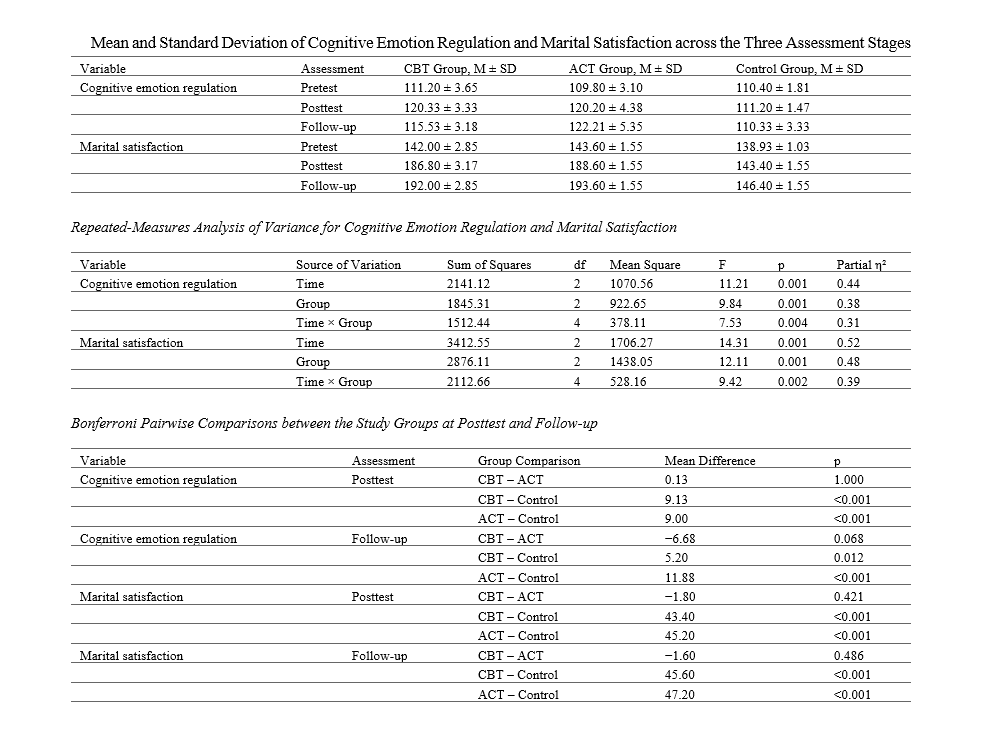
Methods and Materials: This applied study used a quasi-experimental pretest–posttest design with a control group and a one-month follow-up. The statistical population consisted of discordant couples referred to psychological counseling centers in East Tehran during 2024–2025. From 80 eligible individuals, 45 participants were selected through random sampling and randomly assigned to three groups of 15: CBT, ACT, and control. The experimental groups received eight 90-minute couple-therapy sessions, while the control group received no intervention during the study period. Data were collected using the Cognitive Emotion Regulation Questionnaire and the ENRICH Marital Satisfaction Scale at pretest, posttest, and follow-up. Data were analyzed using repeated-measures analysis of variance and Bonferroni post-hoc comparisons in SPSS version 26.
Findings: Repeated-measures ANOVA showed significant effects of time, group, and time × group interaction for cognitive emotion regulation, with F = 11.21, p = 0.001, partial η² = 0.44; F = 9.84, p = 0.001, partial η² = 0.38; and F = 7.53, p = 0.004, partial η² = 0.31, respectively. Significant effects were also found for marital satisfaction, with F = 14.31, p = 0.001, partial η² = 0.52; F = 12.11, p = 0.001, partial η² = 0.48; and F = 9.42, p = 0.002, partial η² = 0.39, respectively. Bonferroni comparisons indicated that both CBT and ACT significantly outperformed the control group at posttest and follow-up, while no significant differences were observed between CBT and ACT.
Conclusion: Both CBT and ACT were effective in improving cognitive emotion regulation and marital satisfaction among discordant couples, with no clear overall superiority of either intervention.
Downloads
References
Abbasi, M., & Abbasi, Z. (2025). The effectiveness of group couples therapy based on cognitive behavioral therapy (CBT) on couples' marital satisfaction and adjustment. The Journal of Tolooebehdasht, 24(1), Article 18926.
Amini, R., & Eshghi Nogoorani, R. (2024). The Effectiveness of Cognitive-Behavioral Couple Therapy on Marital Satisfaction, Interpersonal Cognitive Distortions, and Emotional Orientation towards Sex in Married Women with Marital Burnout. The Second National Conference on Healthy Family, Healthy Society, Qayenat,
Bayrami, M., Hashemi, T., & Azhdeh, L. (2024). Comparing the effectiveness of cognitive-behavioral couple therapy and integrative therapy on improving marital satisfaction and intimacy in incompatible couples. Iranian Journal of Psychiatry and Clinical Psychology, 30([issue not provided]). https://doi.org/10.32598/ijpcp.30.4942.1
Beyrami, M., Hashemi Nosratabad, T., & Ajideh, L. (2024). Comparison of the effectiveness of cognitive-behavioral couple therapy and integrative couple therapy on improving marital satisfaction and intimacy in maladjusted couples. Iranian Journal of Psychiatry and Clinical Psychology, 30(1), 1-15.
Borjali, Z., Mollazadeh, J., Mohammadi, N., & Aflakseir, A. (2024). Effectiveness of Combined Couple Therapy Based on Acceptance and Commitment with Schema Formulation (ACT/SF) on Flexibility, Satisfaction, and Marital Burnout Shiraz University, Faculty of Education and Psychology].
Farajkhah, F. M., Abedi Noghondar, M., & Moshtaghi, E. (2025). Comparison of the effectiveness of emotionally-focused therapy and cognitive-behavioral therapy on improving emotion regulation and marital satisfaction in couples with conflicts with alertness-inhibition early maladaptive schema. Razavi International Journal of Medicine, 13(1), e1329.
Foruzani, S., Hasanzadeh, R., & Heydari, S. (2024). The Effectiveness of Acceptance and Commitment Therapy on Marital Satisfaction in Married Women Referring to Counseling Centers.
Hashemizadeh, F. S., Atashpour, S. H., & Farhadi, H. (2024). Comparison of the Effectiveness of Acceptance and Commitment Therapy Matrix (ACTM) and Emotion-Focused Therapy (EFT) on Family Adaptability and Emotional Self-Regulation in Women with Marital Conflict. Psychology of Woman Journal, 5(2), 76-88.
Kazemi, F., & Farahani, S. (2023). The effectiveness of acceptance and commitment therapy on emotion regulation and marital satisfaction. Cognitive Behavioral Psychotherapy Quarterly, 15(3), 33-49.
Kia, A., & Mahmoudian Dastnaei, T. (2024). Effectiveness of Cognitive Behavioral Therapy on Sexual Satisfaction and Marital Conflict among Couples in Gorgan County Islamic Azad University, Behshahr Branch, Department of Psychology].
Mohabbat-Bahar, S., Bahmani, B., & Amiri, M. (2023). The effectiveness of acceptance and commitment therapy on marital satisfaction and couples' communication patterns in infertile couples. Journal of Family Counseling and Psychotherapy, 12(1), 101-118.
Mousavi Shabestari, Z., Sedaghat, M., & Tizdast, T. (2025). Comparing the Effectiveness of Acceptance and Commitment Therapy and Emotion-Focused Couple Therapy on Sexual Satisfaction in Women with Marital Conflict. Rooyesh-e-Ravanshenasi Journal, 14(12), 232-239.
Najarnasab, S., Dasht Bozorgi, Z., Safarzadeh, S., & Talebzadeh Shoushtari, M. (2024). The Efficacy of Acceptance and Commitment Therapy (ACT)-Based Couples Therapy on Marital Quality of Life and Emotion Regulation in Distressed Couples. Avicenna Journal of Neuro Psycho Physiology. https://ajnpp.umsha.ac.ir/article-1-500-fa.html
Razzaghi, M., Zemestani, M., & Mashhadi, A. (2025). Effectiveness of Emotional Schema Therapy on Anxiety Symptoms, Emotion Regulation, and Marital Satisfaction in Women with Anxiety Disorders: A Preliminary Study. International Journal of Cognitive Behavior Therapy, 18, 334-358. https://doi.org/10.1007/s41811-025-00238-3
Vaslehchi, S., Qamari, M., & Barati, H. (2024). Effectiveness of enhanced cognitive-behavioral couple therapy (ECBCT) on emotional regulation and marital burnout in couples on the verge of divorce [in Persian]. Quarterly Journal of Psychological Research, 26(1), 45-60. https://doi.org/10.61838/kman.jarac.6.1.7
Yadolahi, S., Mirzaei, S. H., & Soleimianian, A. A. (2025). Comparing the efficacy of counseling based on acceptance commitment approach and the compassion approach in a group way on emotion regulation and the quality of marital relationship in infertile women. Journal of Psychological Science, 24(149), 287-305. https://psychologicalscience.ir/article-1-2488-en.html
Yousefpouri, M., Zomorodi, S., & Bazzāziān, S. (2024). Effectiveness of Acceptance and Commitment-Based Couples Therapy on Attitudes Towards Marital Infidelity and Emotional Regulation in Married Women. Aftj, 5(2), 103-111. https://doi.org/10.61838/kman.aftj.5.2.12
Downloads
Additional Files
Publication Timeline
- Submitted
- Revised
- Accepted