Effectiveness of Emotion-Focused Couples Therapy on Sexual Satisfaction, Extramarital Relationships, and Marital Frustration
Keywords:
Emotionally Focused Couple Therapy, sexual satisfaction, extramarital relationships, marital frustration, attachment, couple therapy, intervention outcomesAbstract
Objective: This study aimed to determine the effectiveness of Emotionally Focused Couple Therapy (EFT-C) in improving sexual satisfaction and reducing tendencies toward extramarital relationships and marital frustration among distressed couples.
Methods and Materials: The study employed a randomized pretest-posttest control group design. The statistical population consisted of distressed couples experiencing marital difficulties, from whom 24 couples were selected and randomly assigned to an intervention group and a control group. Participants in the intervention group received eight structured sessions of Emotionally Focused Couple Therapy, emphasizing emotional bonding, identification and expression of attachment needs, enhancement of emotional responsiveness, and restructuring of maladaptive interaction patterns. The control group received no therapeutic intervention during the study period. Data were collected at pretest and posttest stages using standardized measures of sexual satisfaction, tendencies toward extramarital relationships, and marital frustration. Multivariate analysis of covariance (MANCOVA) and subsequent univariate analyses of covariance were used to examine intervention effects while controlling for pretest scores.
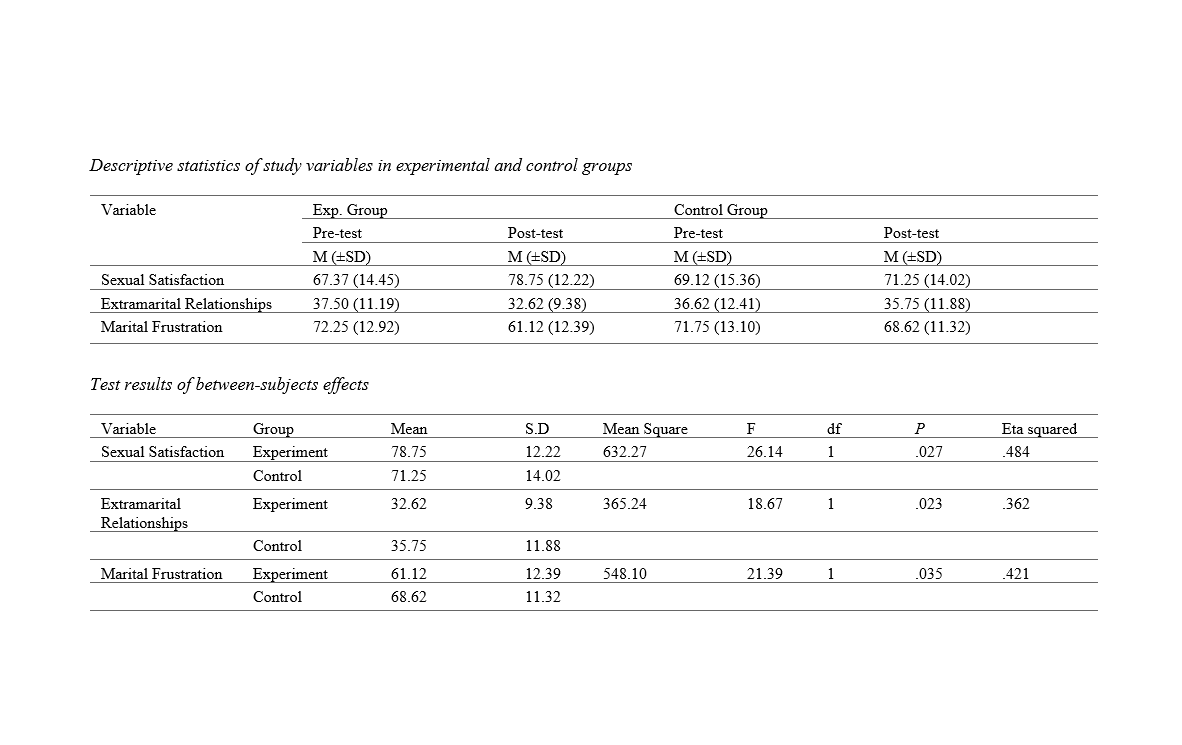
Findings: The inferential analysis indicated statistically significant differences between the intervention and control groups across the study outcomes. After controlling for baseline scores, participants receiving EFT-C demonstrated significantly higher sexual satisfaction than controls, F(1, 22) = 26.14, p < .001, partial η² = .48. The intervention also significantly reduced tendencies toward extramarital relationships, F(1, 22) = 18.67, p < .001, partial η² = .36. Furthermore, marital frustration was significantly lower in the EFT-C group compared with the control group, F(1, 22) = 21.39, p < .001, partial η² = .42. The effect sizes indicated substantial intervention effects across all three dependent variables.
Conclusion: Emotionally Focused Couple Therapy appears to be an effective attachment-based intervention for enhancing sexual satisfaction and reducing extramarital relationship tendencies and marital frustration by strengthening emotional connection, improving responsiveness to attachment needs, and modifying dysfunctional relational interaction patterns among distressed couples.
Downloads
References
Alavimoghadam, S. T., Mafakheri, A., & Jahangiri, A. (2021). Effectiveness of Emotion-Focused Couple Therapy in Marital Burnout, Marital Forgiveness, and Communication Styles of Couples Affected by Extramarital Relationships. Avicenna Journal of Neuro Psycho Physiology, 8(3), 151-156.
Anousheh, S. T., Karami, J., & Ariapooran, S. (2024). Comparison the Effectiveness of Mindfulness-Based Relationship Enhancement and Emotion-Focused Therapies on Marital Satisfaction and Intimacy in Couples with Low Self-Disclosure. Preventive Counseling, 5(3), 26-42.
Asefi Far, F., Shams Esfandabad, H., & Shaterian Mohammadi, F. (2022). Sensation Seeking and Extramarital Relationships: Mediation Role of Marital Frustration. Iranian Evolutionary Educational Psychology Journal, 4(4), 64-75. https://doi.org/10.52547/ieepj.4.4.64
Asgari, A., Asadi, J., & Hosseinae, A. (2022). Comparison of the Effectiveness of Couple Therapy Based on Acceptance and Commitment and Emotionally Focused Couple Therapy on Marital Forgiveness of Women Affected by Extramarital Relationships. Rooyesh-e-Ravanshenasi Journal (RRJ), 10(12), 215-226.
Brubacher, L. L. (2024). Stepping into Emotionally Focused Therapy (EFT). In (pp. 3-23). Routledge. https://doi.org/10.4324/9781003242673-2
Conrad, R., Forstner, A. J., Chung, M. L., Mücke, M., Geiser, F., Schumacher, J., & Carnehl, F. (2021). Significance of Anger Suppression and Preoccupied Attachment in Social Anxiety Disorder: A Cross-Sectional Study. BMC psychiatry, 21(1), 116. https://doi.org/10.1186/s12888-021-03098-1
Fischer, V. J., Andersson, G., Billieux, J., & Vögele, C. (2022). The Relationship between Emotion Regulation and Sexual Function and Satisfaction: A Scoping Review. Sexual Medicine Reviews, 10(2), 195-208. https://doi.org/10.1016/j.sxmr.2021.11.004
Girard, A., & Woolley, S. R. (2017). Using Emotionally Focused Therapy to Treat Sexual Desire Discrepancy in Couples. Journal of sex & marital therapy, 43(8), 720-735. https://doi.org/10.1080/0092623X.2016.1263703
Greenman, P. S., & Johnson, S. M. (2022). Emotionally Focused Therapy: Attachment, Connection, and Health. Current opinion in psychology, 43, 146-150. https://doi.org/10.1016/j.copsyc.2021.06.015
Javdan, M., Bahrampour, T., & Dehghani, M. (2023). The Role of Family Relationships and Conflict Resolution Styles in Marital Burnout of Couples Seeking a Divorce. Journal of Family Relations Studies, 3(8), 32-39.
Johnson, S. M., Simakhodskaya, Z., & Moran, M. (2018). Addressing Issues of Sexuality in Couples Therapy: Emotionally Focused Therapy Meets Sex Therapy. Current Sexual Health Reports, 10(2), 65-71. https://doi.org/10.1007/s11930-018-0146-5
Lewczuk, K., Kobylińska, D., Marchlewska, M., Krysztofiak, M., Glica, A., & Moiseeva, V. (2021). Adult Attachment and Health Symptoms: The Mediating Role of Emotion Regulation Difficulties. Current Psychology, 40(4), 1720-1733. https://doi.org/10.1007/s12144-018-0097-z
Mendelson, D. (2024). The Commitment of a Lifetime: The Role of Emotionally Focused Therapy in Strengthening Attachment Bonds and Improving Relationship Health in Later-Life Couples Rutgers, The State University of New Jersey, Graduate School of Applied and Professional Psychology]. https://doi.org/10.55818/pcsp.v20i1.2150
Paul, R. (2024). How Did We Get Here?: The Impact of Parental Infidelity Discovered in Childhood and Adolescence on Afro-Caribbean Individuals' Experiences in Adulthood Alliant International University].
Saleh, M. A. E. R. (2024). Experiences with Emotional Safety for Married Heterosexual Egyptian American Individuals Alliant International University].
Shabaninia, S., Golparvar, M., & Aghaei, A. (2025). Love in Contrast: Comparing Emotionally Focused Therapy (EFT) and Need-Based Educational Package in Women with Low Sexual Desire. Sexual and Relationship Therapy, 40(2), 482-496. https://doi.org/10.1080/14681994.2025.2469299
Spengler, P. M., Lee, N. A., Wiebe, S. A., & Wittenborn, A. K. (2024). A Comprehensive Meta-Analysis on the Efficacy of Emotionally Focused Couple Therapy. Couple and family psychology: Research and practice, 13(2), 81. https://doi.org/10.1037/cfp0000233
Tadayon, M., Hatami-Manesh, Z., Sharifi, N., Najar, S., Saki, A., & Pajohideh, Z. (2018). The Relationship between Function and Sexual Satisfaction with Sexual Violence among Women in Ahvaz, Iran. Electronic Physician, 10(4), 6608. https://doi.org/10.19082/6608
Timulak, L., Keogh, D., Chigwedere, C., Wilson, C., Ward, F., Hevey, D., & Mahon, S. (2022). A Comparison of Emotion-Focused Therapy and Cognitive-Behavioral Therapy in the Treatment of Generalized Anxiety Disorder: Results of a Feasibility Randomized Controlled Trial. Psychotherapy, 59(1), 84. https://doi.org/10.1037/pst0000427
Vanhee, G., Lemmens, G. M., Moors, A., Hinnekens, C., & Verhofstadt, L. L. (2018). EFT-C's Understanding of Couple Distress: An Overview of Evidence from Couple and Emotion Research. Journal of Family Therapy, 40, S24-S44. https://doi.org/10.1111/1467-6427.12128
Wiebe, S. A., Johnson, S. M., Burgess Moser, M., Dalgleish, T. L., & Tasca, G. A. (2017). Predicting Follow-Up Outcomes in Emotionally Focused Couple Therapy: The Role of Change in Trust, Relationship-Specific Attachment, and Emotional Engagement. Journal of marital and family therapy, 43(2), 213-226. https://doi.org/10.1111/jmft.12199
Downloads
Additional Files
Publication Timeline
- Submitted
- Revised
- Accepted