Predicting Parenting Self-Efficacy from Parental Mindfulness and Perceived Social Support: The Moderating Role of Parenting Stress
Keywords:
Parenting self-efficacy, parental mindfulness, perceived social support, parenting stress, moderation, parents, ColombiaAbstract
parent associations, community organizations, and online parent networks using convenience and snowball sampling. Data were collected using the Parenting Sense of Competence Scale, Interpersonal Mindfulness in Parenting Scale, Multidimensional Scale of Perceived Social Support, Parenting Stress Index–Short Form, and a sociodemographic questionnaire. Pearson correlation coefficients were calculated to examine bivariate associations among the principal variables. Hierarchical multiple regression was used to assess the predictive effects of parental mindfulness, perceived social support, and parenting stress on parenting self-efficacy after controlling for relevant demographic characteristics. Moderation analyses were conducted using interaction terms, simple-slope analysis, and the Johnson-Neyman procedure.
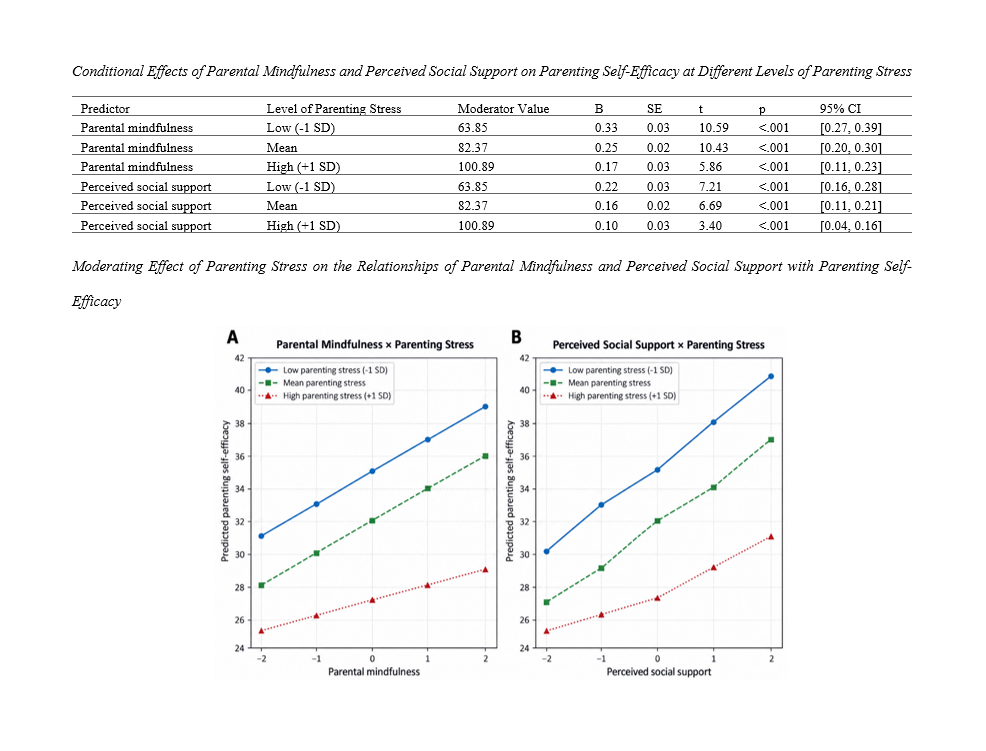
Findings: Parenting self-efficacy was positively correlated with parental mindfulness, r = .58, p < .001, and perceived social support, r = .46, p < .001, and negatively correlated with parenting stress, r = -.52, p < .001. In the adjusted regression model, parental mindfulness, β = .46, p < .001, and perceived social support, β = .27, p < .001, positively predicted parenting self-efficacy, whereas parenting stress negatively predicted it, β = -.29, p < .001. The full moderation model explained 49.1% of the variance in parenting self-efficacy, R² = .491, p < .001. Parenting stress significantly moderated both the parental mindfulness–self-efficacy relationship, B = -0.0043, p = .002, and the perceived social support–self-efficacy relationship, B = -0.0032, p = .009. Simple-slope analyses showed that both positive associations weakened as parenting stress increased.
Conclusion: Parental mindfulness and perceived social support are important positive predictors of parenting self-efficacy, while parenting stress both directly reduces self-efficacy and attenuates the beneficial effects of these psychological and interpersonal resources.
Downloads
References
Akyıl, Y., Erdinç, B., Satıcı, S. A., & Okur, S. (2026). Family Members’ Well-Being, Mindfulness, Loneliness, and Social Support: A Dyadic Approach. Families Systems & Health, 44(1), 79-91. https://doi.org/10.1037/fsh0001043
Álvarez-Fernández, M. L., & Rodríguez, C. (2026). Socio-Emotional Wellbeing in Parents of Children With Neurodevelopmental Disorders: A Systematic Review. Children, 13(1), 99. https://doi.org/10.3390/children13010099
Chelouche-Dwek, G., & Fonagy, P. (2026). Parent Learning Groups in Alternative Provision: A Mixed-Methods Study of Psychoeducation, Mentalization, and Peer Support for Parents of Children With Neurodevelopmental and Conduct Difficulties. Children, 13(3), 431. https://doi.org/10.3390/children13030431
Cho, E., & Shin, G. (2025). The Effect of a Mindful Mothering Nursing Intervention Virtual Program on Mothers With Adverse Childhood Experiences: A Randomized Controlled Trial. Frontiers in Public Health, 13. https://doi.org/10.3389/fpubh.2025.1599604
Doucerain, M. M., & Benkirane, S. (2026). Mindfulness as a Moderator of Associations Between Intergroup Bias and Psychological Health: A Scoping Review. Cultural diversity & ethnic minority psychology, 32(2), 241-256. https://doi.org/10.1037/cdp0000731
Faizah, F., Suminar, D. R., & Yoenanto, N. H. (2024). Cultivating Growth: A Review of Flourishing Students in Higher Education. Adolescents, 4(4), 587-604. https://doi.org/10.3390/adolescents4040041
Hai, Y. (2026). Emotional Stability and Core Self-Evaluation in the Association Between Mindful Parenting and Adolescents' Mindfulness. https://doi.org/10.21203/rs.3.rs-10161670/v1
Jang, S., & Lee, Y. E. (2026). Migrant Mothers’ Acculturative Stress and Young Children’s Social Skills in South Korea: The Mediating Role of Mindful Parenting and the Moderating Roles of Multicultural Sensitivity and Social Support. Behavioral Sciences, 16(6), 940. https://doi.org/10.3390/bs16060940
Jennings, P. A., Álamos, P., Baelen, R. N., Jeon, L., & Nicholas-Hoff, P. Y. (2024). Emotional Schemas: Critical Elements of Educators’ Social and Emotional Competencies to Promote Student SEL. https://doi.org/10.31234/osf.io/ea284
Jiang, F., Fok, Y. L. B., Chiu, C., Yuen, W., Fung, J. W., Tang, A. C. Y., Li, P. F. J., Chui, R. C. F., & Chan, C. K. (2025). Evaluating the Effectiveness of a School-Based Mental Health Training Programme: The Transformative, Resilient, Youth-Led (TRY) Gym. Healthcare, 14(1), 9. https://doi.org/10.3390/healthcare14010009
Jiao, X., Yang, L., & Li, S. (2025). The Roles of Parental Psychological Flexibility, Mindfulness, and Self‐Compassion in Affecting Mental Health and Self‐Efficacy in Parents of Children With or Without Hearing Loss: An Analysis of the Parallel Mediation Model. Nursing Open, 12(4). https://doi.org/10.1002/nop2.70180
Kuswanto, C. N., Stafford, L., Schofield, P., & Sharp, J. (2024). Self-Compassion and Parenting Efficacy Among Mothers Who Are Breast Cancer Survivors: Implications for Psychological Distress. Journal of Health Psychology, 29(5), 425-437. https://doi.org/10.1177/13591053231222162
Labrenz, O., Waedel, L., Kölch, M., Lezius, S., Wacker, C., Paschke, K., Thomasius, R., & Reis, O. (2025). Blended Digital Health Intervention for Adolescents at High Risk With Digital Media Use Disorders: Protocol for a Randomised Controlled Trial Within the Res@t-Consortium. Frontiers in Psychiatry, 15. https://doi.org/10.3389/fpsyt.2024.1478012
Leiferman, J. A., Wilson, J., Farewell, C. V., Walker-Mao, C., & Paulson, J. F. (2025). A Multilevel Framework for the Promotion of Maternal Mental Health and Well-Being During the Perinatal Period. Women S Health Reports, 6(1). https://doi.org/10.1177/26884844251386007
Lin, M. L., & Paat, Y. F. (2024). Perceived Emotional Self-Efficacy and Life Satisfaction of Elementary School Children on the US-Mexico Border. Global Pediatric Health, 11. https://doi.org/10.1177/2333794x241286719
Ma, K. K. Y., Chan, S. S. M., Wong, E. W. Y., Choi, O., Mo, F. Y. M., Shea, C. K. S., Ho, C. S. W., Leung, P. W. L., So, S. H. W., Bögels, S. M., Ng, F. F. Y., Chau, S. W. H., Lai, K. Y. C., Fung, G. P. C., & Wong, O. W. H. (2026). Mindfulness-Based Psychoeducation App to Improve the Well-Being of Parents and Caregivers of Children With Autism: Development and Usability Study. Jmir Pediatrics and Parenting, 9, e84224-e84224. https://doi.org/10.2196/84224
Mariana, C. R., & Sabin, C. (2026). Parental Education as a Tool for Sustainable Development: The Role of Self-Efficacy and Relationship Satisfaction in Family Well-Being. Behavioral Sciences, 16(5), 692. https://doi.org/10.3390/bs16050692
Muratori, P., Catarina, A., Conversano, A., Levantini, V., Villani, S., & Milone, A. (2026). Mindful Parenting for Caregivers of Children With Neurodevelopmental Disorder Diagnosis. Children, 13(3), 325. https://doi.org/10.3390/children13030325
Opie, J. E., Vuong, A., Welsh, E. T., Gray, R., Pearce, N., Marchionda, S., Mutch, R., & Khalil, H. (2024). Outcomes of Best-Practice Guided Digital Mental Health Interventions for Youth and Young Adults With Emerging Symptoms: Part I. A Systematic Review of Socioemotional Outcomes and Recommendations. Clinical Child and Family Psychology Review, 27(2), 424-475. https://doi.org/10.1007/s10567-024-00469-4
Papadopoulos, D., & Maniadaki, K. (2025). Effects of Mindfulness-Based Cognitive Therapy on Parental Mental Health and Child Behavior in Families of Children With Autism Spectrum Disorder: A Randomized Controlled Trial. Children, 13(1), 53. https://doi.org/10.3390/children13010053
Patsakos, E., Patel, S., Simpson, R., Nelson, M., Penner, M., Perrier, L., Bayley, M., & Munce, S. (2024). Conceptualization, Use, and Outcomes Associated With Compassion in the Care of Youth With Childhood-Onset Disabilities: A Scoping Review. Frontiers in psychology, 15. https://doi.org/10.3389/fpsyg.2024.1365205
Pudjiati, S. R. R., Khatimah, K., Marsaulina, T. L., Fadilah, F. F., & Maretha, A. D. (2024). Mindful Parenting, Parenting Self-Efficacy, and Marital Satisfaction of Mother With Toddler on Family Resilience During Pandemic. Humanitas Indonesian Psychological Journal, 65-76. https://doi.org/10.26555/humanitas.v21i1.353
Sparpana, A., & Brock, R. L. (2025). The Interplay Between Prenatal Psychological Flexibility and Couple Secure Base in Promoting Postpartum Parenting. Journal of Family Psychology, 39(7), 929-941. https://doi.org/10.1037/fam0001389
Taştekin, E., Kaymaz, Ç., Işik‐Uslu, A. E., Yüksel‐Doğan, R., Bozkurt‐Yükçü, Ş., & Tok, A. İ. (2025). Coparenting and Mindful Parenting Partially Mediate the Relationship Between Mothers' Stress and Parental Burnout. Family Relations, 74(5), 2411-2431. https://doi.org/10.1111/fare.70027
Villegas-Frei, M. G., Jubin, J., Bucher, C. O., & Bachmann, A. O. (2024). Self-Efficacy, Mindfulness, and Perceived Social Support as Resources to Maintain the Mental Health of Students in Switzerland’s Universities of Applied Sciences: A Cross-Sectional Study. BMC public health, 24(1). https://doi.org/10.1186/s12889-024-17692-x
Ye, M. (2024). A Comprehensive Review on Emotional Support Delving Into Concepts Functions Influential Factors and Theoretical Frameworks. International Theory and Practice in Humanities and Social Sciences, 1(1), 144-161. https://doi.org/10.70693/itphss.v1i1.120
Downloads
Additional Files
Publication Timeline
- Submitted
- Revised
- Accepted