Predicting Parental Psychological Distress from Child Behavioral Problems and Parenting Burden: The Moderating Role of Coparenting Support
Keywords:
parental psychological distress, child behavioral problems, parenting burden, coparenting support, moderation, parenting stress, SpainAbstract
Objective: This study aimed to predict parental psychological distress from child behavioral problems and parenting burden and to examine whether coparenting support moderated these associations among parents in Spain.
Methods and Materials: This quantitative cross-sectional correlational study was conducted with 428 parents of children aged 6–16 years residing in Spain. Participants were recruited through schools and community-based family organizations using a multistage convenience sampling procedure. Data were collected using a demographic questionnaire, the Kessler Psychological Distress Scale (K10), the parent-report Strengths and Difficulties Questionnaire (SDQ), the Parenting Stress Index–Short Form (PSI-SF), and the Coparenting Relationship Scale (CRS). Data were analyzed using Pearson correlations, hierarchical multiple regression, and moderation analysis with the PROCESS macro in SPSS. Continuous predictors were mean-centered before interaction terms were created, and moderation effects were evaluated using 5,000 bootstrap resamples with 95% confidence intervals.
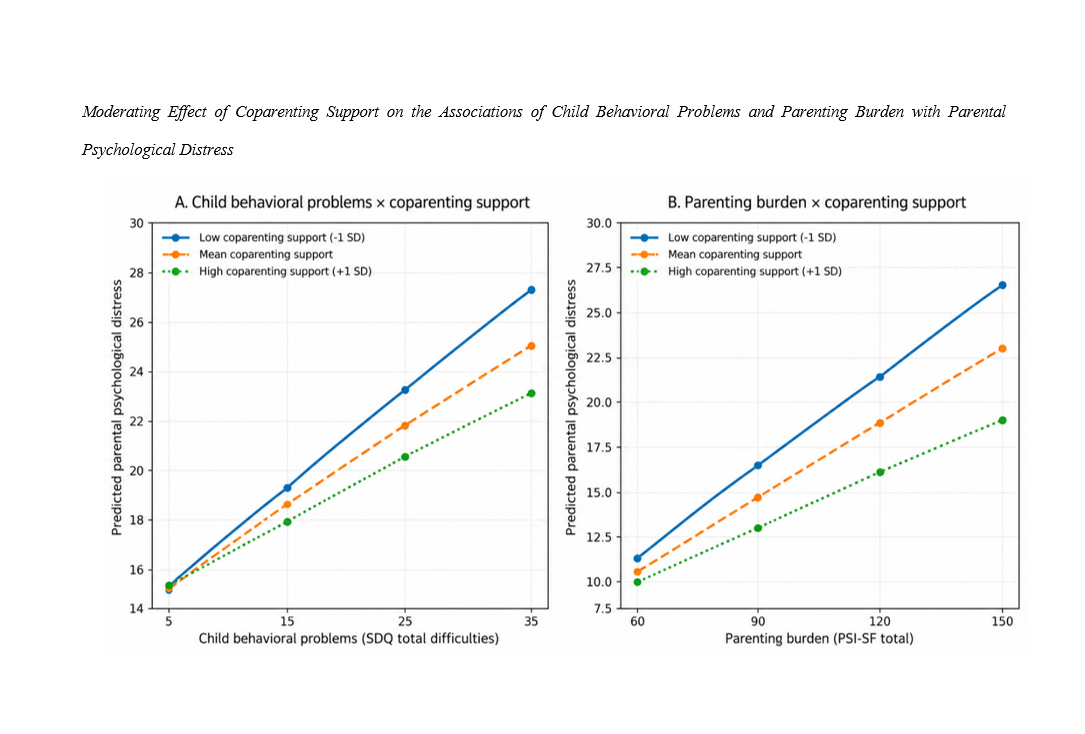
Findings: Child behavioral problems significantly predicted higher parental psychological distress (B = 0.34, SE = 0.04, β = .29, p < .001), while parenting burden showed the strongest positive association with distress (B = 0.14, SE = 0.01, β = .46, p < .001). Coparenting support significantly predicted lower psychological distress (B = -1.53, SE = 0.34, β = -.17, p < .001). The final hierarchical regression model explained 55.4% of the variance in parental psychological distress. Coparenting support significantly moderated the association between child behavioral problems and distress (B = -0.09, SE = 0.03, p = .001) and between parenting burden and distress (B = -0.04, SE = 0.01, p < .001). The full moderation model explained 58.6% of the variance, indicating that both adverse associations became weaker as coparenting support increased.
Conclusion: Child behavioral problems and parenting burden are important predictors of parental psychological distress, whereas coparenting support functions as both a direct protective factor and a buffer that attenuates the psychological impact of parenting-related difficulties.
Downloads
References
Ammerman, R. T., Peugh, J., Teeters, A. R., Sakuma, K.-L. K., Jones, D., Hostetler, M. L., Ginkel, J. B. V., & Feinberg, M. E. (2022). Promoting Parenting in Home Visiting: A CACE Analysis of Family Foundations. Journal of Family Psychology, 36(2), 225-235. https://doi.org/10.1037/fam0000888
Bai, S., Tornello, S. L., Mogle, J., & Feinberg, M. E. (2023). Daily Implementation of Health‐protective Behaviors and Family Life During the Early Months of the COVID‐19 Pandemic. Family Process, 63(1), 428-442. https://doi.org/10.1111/famp.12870
Caparso, C., & Benkert, R. (2022). Family Cohesiveness: A Dying Concern for the Coparent in Families With Parents With Advanced Cancer With Dependent Children. Cancer Nursing, 45(3), 236-241. https://doi.org/10.1097/ncc.0000000000001024
Cox, L., Alfredsson, E., & Psouni, E. (2023). Coparent Exclusion, Prenatal Experiences, and Mental Health During COVID-19 in Sweden. Journal of Family Psychology, 37(7), 1083-1094. https://doi.org/10.1037/fam0001127
d’Orsi, D., Veríssimo, M., & Diniz, E. (2023). Father Involvement and Maternal Stress: The Mediating Role of Coparenting. International journal of environmental research and public health, 20(8), 5457. https://doi.org/10.3390/ijerph20085457
Daks, J. S., Peltz, J. S., & Rogge, R. D. (2022). The Impact of Psychological Flexibility on Family Dynamics Amidst the COVID-19 Pandemic: A Longitudinal Perspective. Journal of Contextual Behavioral Science, 26, 97-113. https://doi.org/10.1016/j.jcbs.2022.08.011
Darwiche, J., Antonietti, J. P., Nunes, C. E., Favez, N., Liekmeier, E., & Roten, Y. d. (2022). Couple Therapy With Parents: Results From a Pragmatic Randomized Controlled Trial Testing the Integrative Brief Systemic Intervention (IBSI). Journal of marital and family therapy, 49(2), 351-369. https://doi.org/10.1111/jmft.12625
Darwiche, J., Nunes, C. E., Vowels, L., Liekmeier, E., & Antonietti, J. P. (2026). Post‐Therapy Trajectories Following Brief Systemic Couple Therapy for Parents. Family Process, 65(1). https://doi.org/10.1111/famp.70114
Favez, N., Max, A., Bader, M., & Tissot, H. (2022). When Not Teaming Up Puts Parents at Risk: Coparenting and Parental Burnout in Dual‐parent Heterosexual Families in Switzerland. Family Process, 62(1), 272-286. https://doi.org/10.1111/famp.12777
Feng, R., & Teti, D. M. (2025). The Link Between Nonstandard Work and Parental Distress Among New Parents: Coparenting as a Moderator. Family Relations, 74(2), 916-930. https://doi.org/10.1111/fare.13144
Giannotti, M., Mazzoni, N., Bentenuto, A., Venuti, P., & Falco, S. d. (2021). Family Adjustment to COVID‐19 Lockdown in Italy: Parental Stress, Coparenting, and Child Externalizing Behavior. Family Process, 61(2), 745-763. https://doi.org/10.1111/famp.12686
Giannotti, M., Mazzoni, N., Facchini, M., Falco, S. d., Venuti, P., & Iandolo, G. (2022). Determinants of Maternal Stress During COVID-19 Outbreak in Italy and Spain: A Cross-Cultural Investigation. Journal of Family Psychology, 36(6), 827-838. https://doi.org/10.1037/fam0000993
Hawkins, A. J., Hokanson, S. C., Loveridge, E., Milius, E. H., Duncan, M., Booth, M., & Pollard, B. (2022). How Effective Are ACF‐funded Couple Relationship Education Programs? A Meta‐analytic Study. Family Process, 61(3), 970-985. https://doi.org/10.1111/famp.12739
Kim, C. Y., & Goodman, S. H. (2024). Satisfaction With Parental Responsibilities and Disorganized Attachment Among Infants of Mothers at Risk for Depression. Journal of Family Psychology, 38(2), 212-222. https://doi.org/10.1037/fam0001179
Kim, C. Y., & Teti, D. M. (2025). Associations Between Infant Nighttime Distress and Coparenting Across the First Year: The Role of Socioeconomic Risk. Social Development, 35(1). https://doi.org/10.1111/sode.70039
Krasodomska, J. (2022). Longitudinal Impact of Parents’ Discrimination Experiences on Children’s Internalizing and Externalizing Symptoms: A 2-Year Study of Families of Autistic Children. Autism, 27(2), 296-308. https://doi.org/10.1177/13623613221093110
Le, Y., Fredman, S. J., Marshall, A. D., Chow, S. M., McDaniel, B. T., Laurenceau, J. P., & Feinberg, M. E. (2022). Relational Impacts of Capitalization in Early Parenthood. Journal of Family Psychology, 36(1), 69-79. https://doi.org/10.1037/fam0000847
Le, Y., Hatch, S., Goodman, Z. T., & Doss, B. D. (2022). Does Coparenting Improve During the OurRelationship Program? Explorations Within a Low-Income Sample During the COVID-19 Pandemic. Journal of Family Psychology, 36(6), 1030-1035. https://doi.org/10.1037/fam0000991
Li, J., Xie, R., Chen, T., Wu, L., Yao, H., Li, W., & Ding, W. (2025). Parents' Perception of Children's Problem Behaviors, Emotional Dysregulation, and Coparenting: Actor–Partner Interdependence Model. Family Process, 64(4). https://doi.org/10.1111/famp.70100
McHale, J. P., Mazzoni, S., Mensi, M. M., Collins, R., Busca, A., Vecchio, A., & Riso, M. (2025). The Use of Child-Centered Ecomaps to Describe Engagement, Teamwork, Conflict and Child Focus in Coparenting Networks: The International Coparenting Collaborative Approach. Genealogy, 9(4), 119. https://doi.org/10.3390/genealogy9040119
McRae, C., Overall, N. C., Henderson, A. M. E., Low, R. S. T., & Chang, V. T. (2021). Parents’ Distress and Poor Parenting During a COVID-19 Lockdown: The Buffering Effects of Partner Support and Cooperative Coparenting. Developmental Psychology, 57(10), 1623-1632. https://doi.org/10.1037/dev0001207
Mendes, T., Nazaré, B., & Crespo, C. (2026). How Coparenting Makes a Difference in Maternal Depressive Symptoms in Pediatric Epilepsy: The Roles of Relationship Burden and Socioeconomic Status. Couple and Family Psychology Research and Practice. https://doi.org/10.1037/cfp0000311
Menéndez, D., Li, Z., Klapper, R. E., Sturge‐Apple, M. L., & Rosengren, K. S. (2024). COVID-19 and Child Adjustment: The Role of Coparenting Conflict and Child Temperament. https://doi.org/10.31234/osf.io/9pxgn
Richardson, E., Mallette, J. K., Futris, T. G., Dai, Y., & DeMeester, K. (2021). Foster Caregivers’ Parenting Stress as a Moderator of Change in Coparenting Following Relationship Education. Journal of Family Issues, 43(10), 2599-2623. https://doi.org/10.1177/0192513x211031521
Sato, N., & Araki, A. (2021). Fathers’ Involvement in Rearing Children With Profound Intellectual and Multiple Disabilities. Journal of Family Nursing, 28(1), 57-68. https://doi.org/10.1177/10748407211037345
Schoppe‐Sullivan, S. J., Donithen, R., Lee, J. K., Simon, L. T., & Wang, J. (2021). The Best and Worst of Times: Predictors of New Fathers’ Parenting Satisfaction and Stress. Adversity and Resilience Science, 2(2), 71-83. https://doi.org/10.1007/s42844-021-00032-y
Schoppe‐Sullivan, S. J., Wang, J., Yang, J., Kim, M., Zhang, Y., & Yoon, S. (2023). Patterns of Coparenting and Young Children's Social–emotional Adjustment in Low-Income Families. Child development, 94(4), 874-888. https://doi.org/10.1111/cdev.13904
Stanford, W. D., Futris, T. G., Richardson, E., Koss, K. J., & Brown, G. L. (2022). Social Integration Buffers the Impact of Financial Distress on Coparenting. Journal of Family Psychology, 36(6), 919-931. https://doi.org/10.1037/fam0000995
Stolz, H. E., Renegar, R. G., Curtis, S. M., & McCaig, J. L. (2025). Financial Stress and Coparenting Among Lower-Income Couples: A Dyadic Exploration. Family Sciences, 1(1), 7. https://doi.org/10.3390/famsci1010007
Tissot, H., & Favez, N. (2023). The Lausanne Trilogue Play: Bringing Together Developmental and Systemic Perspectives in Clinical Settings. Australian and New Zealand Journal of Family Therapy, 44(4), 511-520. https://doi.org/10.1002/anzf.1559
Turgeon, J., Lonergan, M., Bureau, J. F., Schoppe‐Sullivan, S. J., & Lafontaine, M. F. (2023). Parenting Stress, General Distress, and Coparenting Quality: An Actor–Partner Interdependence Moderation Model. Personal Relationships, 30(3), 1117-1134. https://doi.org/10.1111/pere.12498
Wang, L. (2026). Unpacking the Pathway From Coparenting to Adolescent Behavior Problems: Parenting Stress as a Mediator and Evidence From the Longitudinal and Dyadic Approaches. https://doi.org/10.21203/rs.3.rs-10165645/v1
Wu, W., Chen, L., Li, W., & Zheng, J. (2026). Maternal Educational Anxiety and Mother–child Closeness in China: Mediating Roles of Gatekeeping and Father Involvement. Family Relations, 75(3), 1940-1956. https://doi.org/10.1111/fare.70161
Zhang, Y., Calabrese, J. R., Donithen, R., Chang, Y., Schoppe‐Sullivan, S. J., & Yoon, S. (2025). Psychological Distress, Parental Hostility, and Child Behavior Problems: The Gendered Moderating Role of Positive Coparenting. Family Process, 64(4). https://doi.org/10.1111/famp.70102
Zhang, Y., Yoon, S., Wang, J., Benavides, J. L., Chang, Y., & Maguire‐Jack, K. (2025). The Effect of Material Hardship on Child Social Skills via Parental Depression and Coparenting. Family Relations. https://doi.org/10.1111/fare.70046
Downloads
Additional Files
Publication Timeline
- Submitted
- Revised
- Accepted