Exploring the Psychological and Relational Factors Shaping Marital Commitment in Long-Term Relationships
Keywords:
marital commitment, relationship satisfaction, emotional intimacy, attachment insecurity, emotion regulation, communication patterns, relationship investment, long-term relationshipsAbstract
Objective: This study aimed to examine the psychological and relational factors associated with marital commitment in long-term relationships among married adults in Slovenia.
Methods and Materials: This quantitative, cross-sectional, correlational study was conducted with 417 married adults from Slovenia who had been continuously married for at least seven years. Participants completed standardized self-report measures assessing marital commitment, relationship satisfaction, emotional intimacy, constructive and demand-withdraw communication, attachment anxiety, attachment avoidance, emotion-regulation difficulties, relationship investment, and perceived quality of alternatives. Data were analyzed using Pearson correlation coefficients, hierarchical multiple regression, confirmatory factor analysis, and structural equation modeling. Indirect effects were examined using bias-corrected bootstrapping with 5,000 resamples.
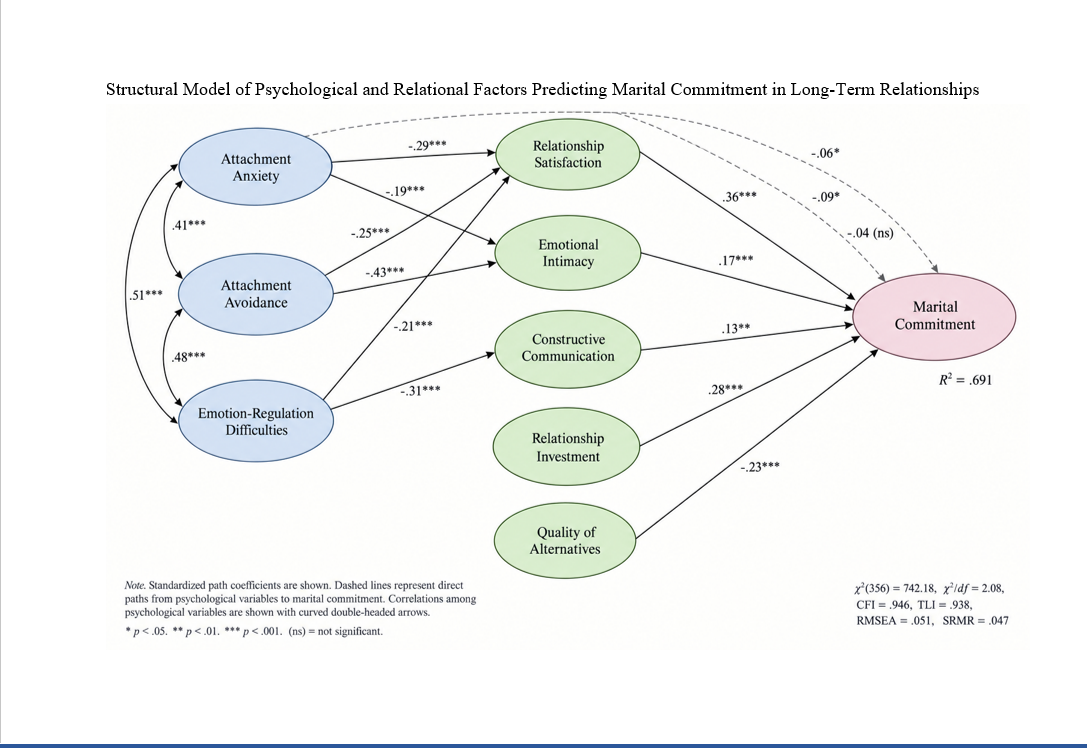
Findings: Hierarchical regression showed that psychological variables significantly increased the explained variance in marital commitment beyond demographic characteristics, ΔR² = .245, p < .001, while relational factors produced a further substantial increase, ΔR² = .388, p < .001. The final regression model explained 67.4% of the variance in commitment. Relationship satisfaction was the strongest positive predictor (β = .34, p < .001), followed by relationship investment (β = .26, p < .001), whereas quality of alternatives was negatively associated with commitment (β = -.22, p < .001). Emotional intimacy and constructive communication were also significant positive predictors, while demand-withdraw communication, attachment anxiety, and attachment avoidance were significant negative predictors. Structural equation modeling demonstrated acceptable fit, χ²/df = 2.08, CFI = .946, TLI = .938, RMSEA = .051, and SRMR = .047, and explained 69.1% of the variance in marital commitment. Significant indirect effects indicated that attachment insecurity and emotion-regulation difficulties influenced commitment partly through relationship satisfaction, emotional intimacy, and constructive communication.
Conclusion: Marital commitment in long-term relationships appears to be shaped primarily by relational quality and investment processes, while psychological vulnerabilities exert both direct and indirect effects through key interpersonal mechanisms.
Downloads
References
Adhikari, A., & Shilpa, K. S. (2025). Understanding Romantic Relationships Using Strength and Strain Model in the Context of COVID-19. Couple and Family Psychology Research and Practice, 14(4), 309-327. https://doi.org/10.1037/cfp0000267
Arora, M., & Chauhan, T. (2024). The Relationship Between Sex-Roles and Romantic Relationship Satisfaction. International Journal for Multidisciplinary Research, 6(3). https://doi.org/10.36948/ijfmr.2024.v06i03.21213
Bimantara, M., & Karsten, H. K. (2024). Exploring the Impact of Secrecy on Marital Happiness: Relationship Authenticity as a Mediator. Bulletin of Counseling and Psychotherapy, 6(1). https://doi.org/10.51214/00202406806000
Chiș, R., Ignat, S., Rad, D., & Macsinga, I. (2022). The Mediation Role of an Individual’s and Couple’s Psychological Factors, Including Parenting in the Prediction of Relational and Marital Satisfaction. International journal of environmental research and public health, 19(17), 11011. https://doi.org/10.3390/ijerph191711011
Dashineau, S. C., Napolitano, S. C., & South, S. C. (2023). The Association Between Personality, Relationship Satisfaction, and Psychopathology in a Three‐wave, Longitudinal Study. Journal of personality, 92(6), 1541-1555. https://doi.org/10.1111/jopy.12910
David, I. G., Samuel, I. T., & Onyegbulem, E. V. (2022). Psycho-Social Factors as a Correlate of Marital Satisfaction Among Couples in Northwest Senatorial District of Benue State, Nigeria. International Journal of Multidisciplinary Research and Growth Evaluation, 74-81. https://doi.org/10.54660/anfo.2022.3.3.7
Delelis, G., Karaca, Y., َAltan-Atalay, A., & Altıntaş, E. (2026). Dyadic Adjustment and Social Value Perception: A Latent Profile Analysis of Gender Differences in French Couples. Couple and Family Psychology Research and Practice. https://doi.org/10.1037/cfp0000309
Ekinci, B., & Canpolat, M. (2025). Romantic Relationship Satisfaction and Marriage Attitudes in Young Adults: The Mediating Role of Cognitive Flexibility. BMC psychology, 13(1). https://doi.org/10.1186/s40359-025-03901-8
Epifani, I., Wisyaningrum, S., & Ediati, A. (2021). Marital Distress and Satisfaction During the COVID-19 Pandemic: A Systematic Review. https://doi.org/10.2991/assehr.k.210423.016
George, I. (2023). Interpersonal Correlates of Marital Harmony Among Seventh-Day Adventists in Akwa Ibom State. JCSD. https://doi.org/10.7176/jcsd/71-02
Gyeong, S., & Shin, H. (2026). Divergent Network Pathways Linking Personality, Approach–avoidance Goals, and Marital Adjustment to Psychological Well-Being. Journal of Social and Personal Relationships, 43(7), 1953-1981. https://doi.org/10.1177/02654075261422436
Hamedani, K. H., Majzoobi, M. R., & Forstmeier, S. (2024). The Relationship Between Perfectionism and Marital Outcomes: A Systematic Review and Meta-Analysis. Frontiers in psychology, 15. https://doi.org/10.3389/fpsyg.2024.1456902
He, Y. (2024). The Impact of Adult Attention-Deficit Hyperactivity Disorder on Couple and Marriage Relationships: A Review of the Literature. Lecture Notes in Education Psychology and Public Media, 46(1), 238-246. https://doi.org/10.54254/2753-7048/46/20230845
Huang, C. Y., Sirikantraporn, S., Pichayayothin, N., & Turner‐Cobb, J. M. (2020). Parental Attachment, Adult-Child Romantic Attachment, and Marital Satisfaction: An Examination of Cultural Context in Taiwanese and Thai Heterosexual Couples. International journal of environmental research and public health, 17(3), 692. https://doi.org/10.3390/ijerph17030692
Jenkins, A. I. C., Fredman, S. J., Le, Y., Sun, X., Brick, T. R., Skinner, O. D., & McHale, S. M. (2020). Prospective Associations Between Depressive Symptoms and Marital Satisfaction in Black Couples. Journal of Family Psychology, 34(1), 12-23. https://doi.org/10.1037/fam0000573
Kahraman, S., & Aktan, E. A. (2024). The Relationship Between Object Relations and Relationship Satisfaction, Marital Adjustment, and Sexual Satisfaction: The Mediating Role of Narcissistic and Borderline Personality Traits. Opus Toplum Araştırmaları Dergisi, 21(3), 189-203. https://doi.org/10.26466/opusjsr.1472521
Kamal, N. M., Rahman, N. A. A., & Wan Nor Hidayah Wan, A. (2023). Antecedents of Quality Interpersonal Communication in Marriage: A View From Divorcess. 132, 83-100. https://doi.org/10.15405/epsbs.2023.11.02.7
Kanth, D. B. (2022). Effects of Personal Relationships on Physical and Mental Health Among Young Adults- A Scoping Review. The Open Psychology Journal, 15(1). https://doi.org/10.2174/18743501-v15-e2208180
Khani, P., Dezfouli, M. A., Nasri, F., Rahemi, M., Ahmadloo, S., Afkhami, H., Saeidi, F., Tereshchenko, S., Bigdeli, M. R., & Modarressi, M. H. (2023). Genetic and Epigenetic Effects on Couple Adjustment in Context of Romantic Relationship: A Scoping Systematic Review. Frontiers in Genetics, 14. https://doi.org/10.3389/fgene.2023.1002048
Krok, D., Telka, E., & Moroń, M. (2023). Marital Satisfaction, Partner Communication, and Illness Acceptance Among Couples Coping With Breast Cancer: A Dyadic Approach. Psycho-Oncology, 32(8), 1240-1247. https://doi.org/10.1002/pon.6174
Li, Q., Ma, S., Ma, A., Chen, Z., & Fang, X. (2026). Longitudinal Links Between Perceived Partner Phubbing, Need Fulfilment and Marital Satisfaction in Chinese Newlywed Couples. Asian Journal of Social Psychology, 29(2). https://doi.org/10.1111/ajsp.70094
Liang, S., Zhu, H., Chen, W., Deng, W., He, J., Zhou, Y., & Fu, H. (2026). How to Reciprocate With Love? The Impact of Gift‐giving on Marital Satisfaction. Family Relations, 75(3), 2092-2111. https://doi.org/10.1111/fare.70167
Mohamad, Z. S., Bakar, K. A. A., Sallehudin, F. U., & May, W. G. C. (2022). The Positive State and Positive Mindset in Building a Positive Relationship: A Review Paper. Malaysian Journal of Social Sciences and Humanities (MJSSH), 7(7), e001640. https://doi.org/10.47405/mjssh.v7i7.1640
Mukba, G., & Oruç, S. (2026). Compassion Fatigue as a Mediator Between Emotional Intelligence and Marital Anxiety Among Unmarried Mental Health Professionals Working in Family and Social Services. Behavioral Sciences, 16(6), 969. https://doi.org/10.3390/bs16060969
Nashef‐Hamuda, R., Estlein, R., Palgi, Y., & Segel‐Karpas, D. (2025). Relational Turbulence Among Retired Couples in Arab Society: An APIM Analysis. Journal of marriage and family, 87(5), 2097-2109. https://doi.org/10.1111/jomf.13118
Niehuis, S. (2020). Disillusionment Predicts Depression. https://doi.org/10.31234/osf.io/ru7t3
Özbay, A., & Balaban, Ö. (2024). Investigating the Relationship Between Emotional Intelligence and Sexual Satisfaction in Late Adolescent University Students. Sexuality Gender & Policy, 7(4), 382-403. https://doi.org/10.1002/sgp2.12117
Parajuli, P. (2024). Adverse Childhood Experiences and Adult Marital Adjustment: The Role of Personality Development and Resilience Factors. The Batuk, 10(2), 97-110. https://doi.org/10.3126/batuk.v10i2.68145
Rice, T. M., Jenkins, A. I. C., Smith, S. M., Alexander, C., & McGregor, C. M. (2023). Racial Discrimination and Romantic Relationship Dynamics Among Black Americans: A Systematic Review. Journal of Family Theory & Review, 15(4), 793-821. https://doi.org/10.1111/jftr.12535
Schmidt, A. M., Jubran, M., Salivar, E. G., & Brochu, P. M. (2022). Couples Losing Kinship: A Systematic Review of Weight Stigma in Romantic Relationships. Journal of Social Issues, 79(1), 196-231. https://doi.org/10.1111/josi.12542
South, S. C. (2021). Pathology in Relationships. Annual Review of Clinical Psychology, 17(1), 577-601. https://doi.org/10.1146/annurev-clinpsy-081219-115420
Tan, K., Jarnecke, A. M., & South, S. C. (2023). Social Anhedonia, Communication, and Marital Satisfaction in Newlywed Couples. Journal of personality, 91(5), 1239-1252. https://doi.org/10.1111/jopy.12798
Thargay, T., & Giri, V. N. (2024). Marital and Life Satisfaction in Eastern Himalayan Foothills: Role of Partner Responsiveness. Journal of Social and Personal Relationships, 41(11), 3456-3479. https://doi.org/10.1177/02654075241268996
Uluyol, F. M., & Özen‐Çıplak, A. (2024). Dyadic Relationship of Adult Attachment Patterns and Interpersonal Schemas in Marital Adjustment: Actor–partner Effect Model. Family Relations, 73(3), 2152-2169. https://doi.org/10.1111/fare.13002
Yöyen, E., Çalık, S., & Barış, T. G. (2025). Predictors of Young Adult Women’s Psychological Well-Being in Romantic Relationships. Behavioral Sciences, 15(1), 82. https://doi.org/10.3390/bs15010082
Zamir, O. (2021). Childhood Maltreatment and Relationship Quality: A Review of Type of Abuse and Mediating and Protective Factors. Trauma Violence & Abuse, 23(4), 1344-1357. https://doi.org/10.1177/1524838021998319
Downloads
Additional Files
Publication Timeline
- Submitted
- Revised
- Accepted