Covariance-Based Structural Equation Modeling of Divorce Intention Based on Attachment Insecurity, Marital Disillusionment, Emotional Loneliness, and Relationship Commitment
Keywords:
Divorce intention, attachment insecurity, marital disillusionment, emotional loneliness, relationship commitmentAbstract
Objective: This study aimed to test a covariance-based structural equation model of divorce intention based on attachment insecurity, marital disillusionment, emotional loneliness, and relationship commitment among married adults in Canada.
Methods and Materials: This cross-sectional correlational study was conducted on 428 legally married adults residing in Canada who were recruited through online community advertisements, family and relationship forums, community organizations, and electronic announcements. Participants completed measures of adult romantic attachment, marital disillusionment, emotional loneliness, relationship commitment, and divorce intention. Data were analyzed using SPSS and AMOS. Preliminary analyses examined normality, multicollinearity, reliability, and bivariate associations. Confirmatory factor analysis was conducted to evaluate the measurement model, followed by covariance-based structural equation modeling using maximum-likelihood estimation. Model fit was evaluated using χ²/df, GFI, CFI, TLI, IFI, RMSEA, and SRMR.
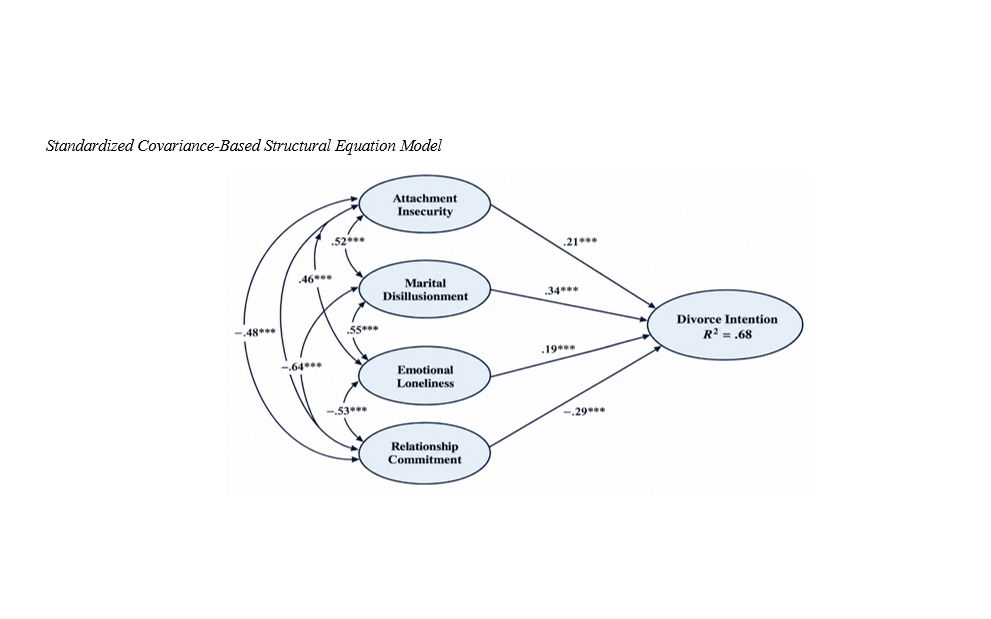
Findings: The structural model demonstrated good fit to the data, χ²(293) = 584.22, χ²/df = 1.99, GFI = .906, CFI = .953, TLI = .947, IFI = .953, RMSEA = .048, and SRMR = .046. Attachment insecurity had a significant positive effect on divorce intention (β = .21, p < .001), as did marital disillusionment (β = .34, p < .001) and emotional loneliness (β = .19, p < .001). Relationship commitment had a significant negative effect on divorce intention (β = -.29, p < .001). Marital disillusionment was the strongest positive predictor. Together, the four predictors explained 68% of the variance in divorce intention.
Conclusion: Divorce intention appears to reflect the combined influence of attachment-related vulnerability, negative marital appraisal, emotional disconnection, and weakened commitment; accordingly, interventions addressing marital instability may benefit from targeting these interconnected relational processes.
Downloads
References
Adhikari, A., & Shilpa, K. S. (2025). Understanding Romantic Relationships Using Strength and Strain Model in the Context of COVID-19. Couple and Family Psychology Research and Practice, 14(4), 309-327. https://doi.org/10.1037/cfp0000267
Ajri‐Khameslou, M., Aghamohammadi, M., Ghobadi, A., Nourani, S., & Shahmari, M. (2026). Exploring the Emotional Divorce Process in Couples: A Grounded Theory Study. https://doi.org/10.21203/rs.3.rs-9654145/v1
Freeman, H., Simons, J. S., & Benson, N. (2023). Romantic Duration, Relationship Quality, and Attachment Insecurity Among Dating Couples. International journal of environmental research and public health, 20(1), 856. https://doi.org/10.3390/ijerph20010856
G., M., & R., D. R. (2024). Exploring the Relationship Between Attachment Styles and Loneliness Levels in Young Adults. International Journal for Multidisciplinary Research, 6(3). https://doi.org/10.36948/ijfmr.2024.v06i03.19869
Genç, E., & Büyükada, E. (2026). The Impact of Obsessive‐Compulsive Relationship Symptoms on Marital Instability: Mediating Role of Infidelity Tendency. Journal of marital and family therapy, 52(2). https://doi.org/10.1111/jmft.70122
Geravandi, A. H., Asgari, P., & Yousefi, Z. (2023). Effectiveness of Narrative Attachment-Based Therapy on Emotional Experience Towards Spouse and Family Executive Functioning Among Married Women. PWJ, 4(2), 17-23. https://doi.org/10.61838/kman.pwj.4.2.3
Guzmán‐González, M., Gómez, F., Lafontaine, M. F., & Tay‐Karapas, K. (2025). Profiles of Psychological Adjustment to Divorce and Separation: Associations With Attachment Insecurity, Forgiveness of the Former Partner, and Emotion Regulation Difficulties. Journal of marital and family therapy, 51(3). https://doi.org/10.1111/jmft.70055
Hajizadeh, Z., Kashani, F. L., Vaziri, S., & Ahi, Q. (2024). Contextual Factors of Men's Online Extramarital Relationships: A Qualitative Study. Jarac, 6(3), 56-69. https://doi.org/10.61838/kman.jarac.6.3.7
Hasim, M. J. M., Hashim, N. H., & Mustafa, H. (2023). Married Life: Measuring Adult Romantic Attachment and Satisfaction. Couple and Family Psychology Research and Practice, 12(3), 119-131. https://doi.org/10.1037/cfp0000188
Kusumawardhani, S. J., Mayangsari, A., Rustyawati, R., & Reswara, I. P. (2024). Staying in Marriage Is Not Enough: Influence of Marital Commitment and Adult Attachment Style on Marital Flourishing. Psympathic Jurnal Ilmiah Psikologi, 11(1), 99-106. https://doi.org/10.15575/psy.v11i1.33974
Malm, E. K., Oti-Boadi, M., Adom-Boakye, N. A., & Andah, A. (2022). Marital Satisfaction and Dissatisfaction Among Ghanaians. Journal of Family Issues, 44(12), 3117-3141. https://doi.org/10.1177/0192513x221126752
Ni, N., Ahrari, S., Zaremohzzabieh, Z., Zarean, M., & Roslan, S. B. (2025). A Meta-Analytic Study of Partner Phubbing and Its Antecedents and Consequences. Frontiers in psychology, 16. https://doi.org/10.3389/fpsyg.2025.1561159
Ogwuche, C. H., Tyav-Tersoo, K. I., Onah, C., & Orafa, D. T. (2024). Marital Infidelity Among Married Couples: Roles of Emotional Intelligence and Narcissistic Personality Traits in Makurdi, Benue State. Journal of Innovation in Psychology Education and Didactics, 28(1), 27-26. https://doi.org/10.29081/jiped.2024.28.1.03
Okonkwo, K. (2024). The Role of Attachment Styles in Marital Stability: A Psychological Approach to Strengthening Relationships. American Journal of Psychology, 6(4), 35-50. https://doi.org/10.47672/ajp.2474
Raja, D. (2026). Silent Bedrooms, Speaking Bodies: A Case Series on Hidden Emotional and Intimacy-Related Distress Behind Chronic Psychosomatic Symptoms in Women. Cureus. https://doi.org/10.7759/cureus.110392
Ramírez‐Coronel, A. A., Mahdavi, A., Abdu, W. J., Azis, R., Al-Salami, A. A. A., Margiana, R., Al-Khafaji, F. A. H., & Beheshtizadeh, N. (2023). Religious Beliefs, Addiction Tendency, Sexual Dysfunction and Intention to Divorce Among Muslim Couples. HTS Teologiese Studies / Theological Studies, 79(1). https://doi.org/10.4102/hts.v79i1.8400
Rigby, R. A., & Cobb, R. J. (2022). Positive Illusions About Dyadic Perspective-Taking as a Moderator of the Association Between Attachment Insecurity and Marital Satisfaction. Journal of Social and Personal Relationships, 40(4), 1223-1249. https://doi.org/10.1177/02654075221127241
Rokach, A., & Chan, S. H. (2023). Love and Infidelity: Causes and Consequences. International journal of environmental research and public health, 20(5), 3904. https://doi.org/10.3390/ijerph20053904
Shmakova, A. I. (2023). Parenting and Family Relationships Factors in the Intergenerational Transmission of Partnerships: A Research Review. Perspectives of Science and Education, 62(2), 536-548. https://doi.org/10.32744/pse.2023.2.31
Shrestha, P. S., Shaver, S. R., Perlman, T. T., & Walsham, W. (2023). Emotional Dimensions of Infidelity: An Analysis of Psychological and Emotional Factors Affecting Relationship Infidelity. Jurnal Sosial Sains Terapan Dan Riset (Sosateris), 11(2), 88-103. https://doi.org/10.35335/85rbw180
Talib, M. A., Guo, J., Nordin, N. M., & Anne Noor Sri Juwaneeta, J. (2025). Integrative Behavioral Couple Therapy (IBCT) for Marital Reconciliation: A Systematic Review of Outcomes. The Family Journal, 34(1), 54-64. https://doi.org/10.1177/10664807251384198
Tavaloli, T., Kimiaei, S. A., & Mohammadian, H. A. (2022). The Effectiveness of Marriage Enrichment Training of TIME Plan on Improving Marital Intimacy and Women’s Psychological Security. Practice in Clinical Psychology, 10(3), 259-274. https://doi.org/10.32598/jpcp.10.3.857.1
Tolmacz, R., Bachner‐Melman, R., Lev‐Ari, L., & Almagor, K. (2022). Interparental Conflict and Relational Attitudes Within Romantic Relationships: The Mediating Role of Attachment Orientations. Journal of Social and Personal Relationships, 39(6), 1648-1668. https://doi.org/10.1177/02654075211061617
Torani, R. A., & Fard, M. S. (2024). Efficacy of Emotion-Focused Couple Therapy on Intimacy, Marital Adjustment, and Forgiveness Among Couples With a History of Extramarital Affairs. Aftj, 5(2), 95-102. https://doi.org/10.61838/kman.aftj.5.2.11
Yousefi, S., Bafghi, Z. R., Ahmadi, A., Joulaei, H., Bolhari, J., & Mirzai, M. (2023). Spirituality Enhanced With Cognitive-Behavioral Techniques in Extramarital Infidelity: A Literature Review. Zahedan Journal of Research in Medical Sciences, 26(2). https://doi.org/10.5812/zjrms-135837
Yousefpouri, M., Zomorodi, S., & Bazzāziān, S. (2024). Effectiveness of Acceptance and Commitment-Based Couples Therapy on Attitudes Towards Marital Infidelity and Emotional Regulation in Married Women. Aftj, 5(2), 103-111. https://doi.org/10.61838/kman.aftj.5.2.12
Zardini, S. Z., Jafari, A., & Ghamari, M. (2021). Prediction of Marital Burnout Based on Feelings of Loneliness and Emotional Divorce in Infertile Women. Journal of Research and Health, 11(5), 323-332. https://doi.org/10.32598/jrh.11.5.1854.1
Zarifi, M., Menashadi, M. D., & ّFallah, M. H. (2026). Identifying the Harms Experienced by Married Women With Relationship Obsessive– Compulsive Disorder. https://doi.org/10.21203/rs.3.rs-8407007/v1
Downloads
Additional Files
Publication Timeline
- Submitted
- Revised
- Accepted