Hierarchical Moderated Regression Analysis of Marital Burnout Based on Work–Family Conflict, Emotional Exhaustion, Spousal Support, and Psychological Flexibility
Keywords:
Marital burnout, Work–family conflict, Emotional exhaustion, Spousal support, Psychological flexibility, Moderated regressionAbstract
Objective: The present study aimed to examine the predictive roles of work–family conflict and emotional exhaustion in marital burnout and to determine whether spousal support and psychological flexibility moderate these associations among married employed adults.
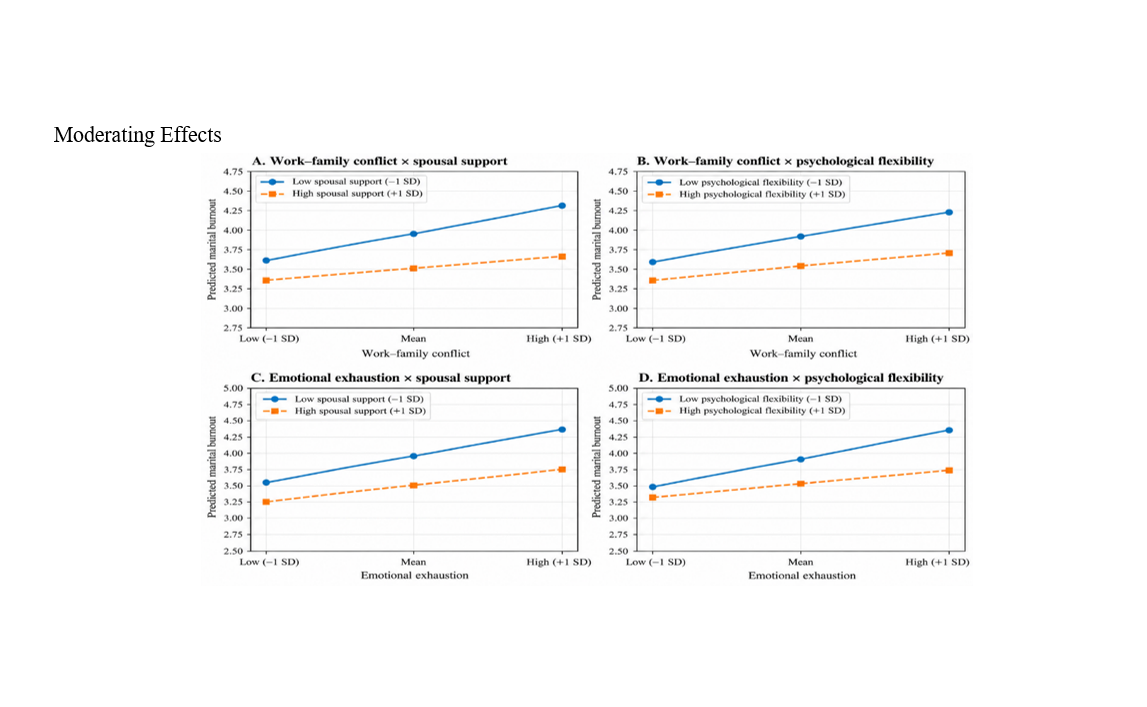
Methods and Materials: This cross-sectional correlational study was conducted among 412 married employed adults residing in Canada. Participants completed standardized measures of marital burnout, work–family conflict, emotional exhaustion, perceived spousal support, and psychological flexibility. Data were analyzed using Pearson correlation coefficients and hierarchical moderated multiple regression. Demographic and occupational covariates were entered in the first step, work–family conflict and emotional exhaustion in the second step, spousal support and psychological flexibility in the third step, and four interaction terms in the final step. Significant interactions were examined using simple-slope analyses at low, mean, and high levels of the moderators.
Findings: Work–family conflict and emotional exhaustion were significant positive predictors of marital burnout, whereas spousal support and psychological flexibility were significant negative predictors. The final regression model explained 61.1% of the variance in marital burnout, R² = .611, adjusted R² = .598, p < .001. Emotional exhaustion showed the strongest positive association with marital burnout (β = .31, p < .001), followed by work–family conflict (β = .24, p < .001). Spousal support (β = −.21, p < .001) and psychological flexibility (β = −.18, p < .001) were inversely associated with marital burnout. Significant interactions were observed for work–family conflict × spousal support (β = −.12, p = .002), work–family conflict × psychological flexibility (β = −.08, p = .024), emotional exhaustion × spousal support (β = −.07, p = .038), and emotional exhaustion × psychological flexibility (β = −.14, p < .001).
Conclusion: Marital burnout was associated with both occupational-family strain and emotional depletion, while greater spousal support and psychological flexibility were associated with lower burnout and attenuated the strength of these relationships.
Downloads
References
Abadoo-Brew, H. (2025). The Role of a Supportive Spouse or Partner in GP Career Success. Innovait Education and Inspiration for General Practice, 18(9), 504-506. https://doi.org/10.1177/17557380251318005
Abdi, K., Latifian, M., & Esmaeili, S. (2026). Experiences and Consequences of Working Mothers in Healthcare Settings: A Qualitative Content Analysis. https://doi.org/10.21203/rs.3.rs-10256688/v1
Adl, H. a., Pirāni, Z., & Abbasi, M. (2024). Comparison of the Effectiveness of Enhanced Cognitive‐behavioral Couple Therapy on Emotional Self‐regulation and Couple Burnout of Self‐assigned and Court‐referred Incompatible Couples. Journal of marital and family therapy, 50(4), 785-800. https://doi.org/10.1111/jmft.12722
Bagheri, R., Ostovar, S., Griffiths, M. D., & Hashim, I. H. M. (2023). Server Connection Versus Marital Disconnection: An Investigation of the Effect of Internet Addiction on Couple Burnout in Iran. Technology in Society, 72, 102163. https://doi.org/10.1016/j.techsoc.2022.102163
Camadan, F. (2025). The Mediating Role of Social Connectedness and Perceived Spousal Support in Explaining the Relationship Between Parental Burnout, and Their Interpersonal Cognitive Distortions. Sage Open, 15(3). https://doi.org/10.1177/21582440251378391
Chughtai, S., Kamath, S., Patel, K., & Patel, P. (2026). Predictors and Contributors of Burnout Among Hospitalists in Central Michigan. Journal of Healthcare Risk Management, 46(1), 18-24. https://doi.org/10.1002/jhrm.70029
Clarke, M. A., Walker, K. D., Spurr, S., & Squires, V. (2022). Role-Related Stress and Adversity Impacting Christian Clergy Resilience: A Pan-Canadian Study. Journal of Pastoral Care & Counseling Advancing Theory and Professional Practice Through Scholarly and Reflective Publications, 77(1), 51-63. https://doi.org/10.1177/15423050221133033
Ede, M. O., & Okeke, C. (2022). Testing the Impacts of Rational-Emotive Couple Intervention in a Sample of Parents Seeking Divorce. Psychological Reports, 127(4), 1652-1677. https://doi.org/10.1177/00332941221139994
Feng, Z., Zhang, C., Huang, F., Hao, J., Liu, B., Sun, H., & Cheng, N. (2026). Marital Satisfaction and Parental Burnout: Longitudinal Indirect Effects of Family Emotional Expressiveness. Journal of marriage and family, 88(5), 1318-1335. https://doi.org/10.1111/jomf.70076
Ghanbarian, S., Faramarzi, S., & Tabrizi, M. (2024). The Lived Experience of Mothers on the Verge of Separation: A Case Study of Isfahan City. Aftj, 5(1), 89-96. https://doi.org/10.61838/kman.aftj.5.1.10
Glavin, R. E., Silver, E. M., Frick, S. L., & Silver, J. K. (2025). Surgeon Burnout and Relationships: A Missing Component in the Ongoing Conversation. HSS Journal® the Musculoskeletal Journal of Hospital for Special Surgery, 21(2), 130-137. https://doi.org/10.1177/15563316241313364
Grimmer, S. A., & Jacquin, K. M. (2023). When Perceived Physician Burnout Leads to Family Burnout: How Secondary Emotional Trauma Impacts Physician Spouses. Mental Health Science, 1(4), 231-241. https://doi.org/10.1002/mhs2.38
Gyasi, K. W. (2024). Exploring the State of Spousal Communication Among Shift Workers: A Case Study of Health Sector Workers in Cape Coast, Ghana. African Journal of Applied Research, 9(2), 271-283. https://doi.org/10.26437/ajar.v9i2.594
Hashemizadeh, F. s., Atashpour, S. H., & Farhadi, H. (2023). Comparison of the Effectiveness of Paradoxical Timetable Cure (PTC), Acceptance and Commitment Therapy Matrix (ACTM), and Emotion-Focused Therapy (EFT) on Self-Esteem and Marital Boredom in Women With Marital Conflict. PWJ, 4(4), 27-38. https://doi.org/10.61838/kman.pwj.4.4.4
Honda, A. (2025). Balancing and Conflict Between Work and Family Life of Sandwiched Caregivers: A Scoping Review. Safety and Health at Work, 16(2), 156-163. https://doi.org/10.1016/j.shaw.2025.04.004
Huang, Y., Mao, Y., & Zhan, Y. (2023). Spillover and Crossover From Work Overload to Spouse-Rated Work-to-Family Conflict: The Moderating Role of Cross-Role Trait Consistency. Fundamental Research, 3(6), 997-1004. https://doi.org/10.1016/j.fmre.2023.02.027
Kerman, K. T., Albayrak, S., Arkan, G., Ozabrahamyan, S., & Beşer, A. (2022). The Effect of the COVID‐19 Social Distancing Measures on Turkish Women's Mental Well‐being and Burnout Levels: A Cross‐sectional Study. International journal of mental health nursing, 31(4), 985-1001. https://doi.org/10.1111/inm.13009
Lee, N., & Lee, H.-J. (2025). Home Difficulties Experienced by Male Firefighters in South Korea: A Qualitative Study on Work–Family Conflict. Healthcare, 13(18), 2300. https://doi.org/10.3390/healthcare13182300
Li, J., Li, S., Li, L., Yuan, Y., Huang, X., & Tan, Y. (2026). The Relationship Between Spousal Support and Nurse Burnout: A Parallel Dual-Mediator Model of Work-Family Conflict and Work-Family Facilitation. https://doi.org/10.21203/rs.3.rs-9516548/v1
Medeiros, T. J., Barbosa, G. C., Ludmyla Caroline de Souza, A., & Gratão, A. C. M. (2022). Work-Family Balance Among Caregivers of Elderly People: A Systematic Review. Cadernos Brasileiros De Terapia Ocupacional, 30. https://doi.org/10.1590/2526-8910.ctoar241831542
Mweta, N. (2024). Work-Family Conflict Among Women in Higher Learning Institutions in Malawi: A Case Study of Malawi University of Science and Technology. Journal of Social Work in Developing Societies, 6(3), 57-75. https://doi.org/10.4314/jswds.v6i3.4
Najibzadegan, A., Bahrainian, S. A., & Shahabizadeh, F. (2024). Efficacy of Acceptance and Commitment Therapy on Intimacy, Marital Forgiveness, and Marital Burnout in Women Affected by Extramarital Relationships. Aftj, 5(3), 102-112. https://doi.org/10.61838/kman.aftj.5.3.11
Nwachuku, B. (2025). Don’t Let Them See You Sweat: Mental Health and the Modern-Day Married Single Mother. The Family Journal, 34(2), 261-267. https://doi.org/10.1177/10664807251396958
Özdemir, P. (2025). Does Sacrifice Always Lead to Burnout in Romantic Relationships? The Role of Relational Equity and Appreciation. Journal of Social and Personal Relationships, 42(10), 3056-3081. https://doi.org/10.1177/02654075251359607
Pearl, A., Saleh, K. J., & Quick, J. C. (2023). Identifying and Addressing Burnout in the Orthopaedic Surgeon. Journal of the American Academy of Orthopaedic Surgeons, 31(5), 229-238. https://doi.org/10.5435/jaaos-d-22-00722
Peisah, C., & Lele, K. (2022). Intimate Relationships Among Physicians—A Critical Revisit. Journal of Psychosexual Health, 4(3), 157-161. https://doi.org/10.1177/26318318221108522
Pluut, H., Ilieș, R., Su, R., Weng, Q., & Liang, A. X. (2022). How Social Stressors at Work Influence Marital Behaviors at Home: An Interpersonal Model of Work–family Spillover. Journal of occupational health psychology, 27(1), 74-88. https://doi.org/10.1037/ocp0000298
Rizal, G. L., Fikry, Z., & Yasmin, M. (2023). The Effect of Spousal Support on Work-Family Conflict of Women With Dual-Career Family in Padang City. 3-18. https://doi.org/10.2991/978-94-6463-212-5_2
Sharp, M. L., Solomon, N., Harrison, V., Gribble, R., Cramm, H., Pike, G. E., & Fear, N. T. (2022). The Mental Health and Wellbeing of Spouses, Partners and Children of Emergency Responders: A Systematic Review. PLoS One, 17(6), e0269659. https://doi.org/10.1371/journal.pone.0269659
Stevenson, M. C., Schaefer, C. T., & Ravipati, V. M. (2022). COVID-19 Patient Care Predicts Nurses' Parental Burnout and Child Abuse: Mediating Effects of Compassion Fatigue. Child abuse & neglect, 130, 105458. https://doi.org/10.1016/j.chiabu.2021.105458
Wan, M., Carlson, D. S., Kacmar, K. M., Perry, S. J., & Thompson, M. J. (2024). Love on the Rocks: Unraveling Effects of Remote Employees' Work–family Conflict on Couples' Divorce Intentions. Applied Psychology, 73(4), 1808-1832. https://doi.org/10.1111/apps.12527
Wang, X., & Yu, D. (2024). The Influence of Work–Family Conflict on Parental Burnout in China: Moderating Effect of Spousal Support and Its Gender Differences. Journal of Family Issues, 46(2), 351-375. https://doi.org/10.1177/0192513x241259777
Xu, X., & Hanafi, Z. (2024). How Is Parenting Stress Related to Parental Burnout Among Children’s Mothers in China: The Mediating Role of Marital Satisfaction and the Moderating Role of Socioeconomic Status. Frontiers in Public Health, 12. https://doi.org/10.3389/fpubh.2024.1431598
Yan, Y., Li, J., & Geng, Y. (2025). Evolving Trends in Work-Family Balance Research: A Bibliometric Perspective. Medicine, 104(46), e45851. https://doi.org/10.1097/md.0000000000045851
Yang, J., Mokhtar, D. M. M., & Abdullah, N.-A. (2024). The Relationship Between Workplace Bullying and Family Functioning: A Systematic Review. PLoS One, 19(9), e0310300. https://doi.org/10.1371/journal.pone.0310300
Downloads
Additional Files
Publication Timeline
- Submitted
- Revised
- Accepted