Multi-Group Structural Equation Modeling of Adolescent Externalizing Problems Based on Interparental Conflict, Emotional Insecurity, Parent–Adolescent Attachment, and Family Cohesion
Keywords:
Adolescent Externalizing Problems, Interparental Conflict, Emotional Insecurity, Parent–Adolescent Attachment, Family CohesionAbstract
Objective: This study aimed to examine the structural relationships of interparental conflict, emotional insecurity, parent–adolescent attachment, and family cohesion with adolescent externalizing problems and to determine whether these relationships differed between male and female adolescents.
Methods and Materials: This cross-sectional correlational study was conducted among 684 adolescents aged 13–18 years enrolled in public secondary schools in Toronto, Canada, during the 2025–2026 academic year. Participants were selected using multistage cluster sampling and included 332 boys and 352 girls. Data were collected using the Children’s Perception of Interparental Conflict Scale, Security in the Interparental Subsystem Scale, Inventory of Parent and Peer Attachment, Family Adaptability and Cohesion Evaluation Scales IV, and Youth Self-Report. Data were analyzed using confirmatory factor analysis and multi-group covariance-based structural equation modeling. Configural, metric, scalar, and strict measurement invariance were examined before comparing structural paths across gender groups. Indirect effects were tested using bias-corrected bootstrapping with 5,000 resamples.
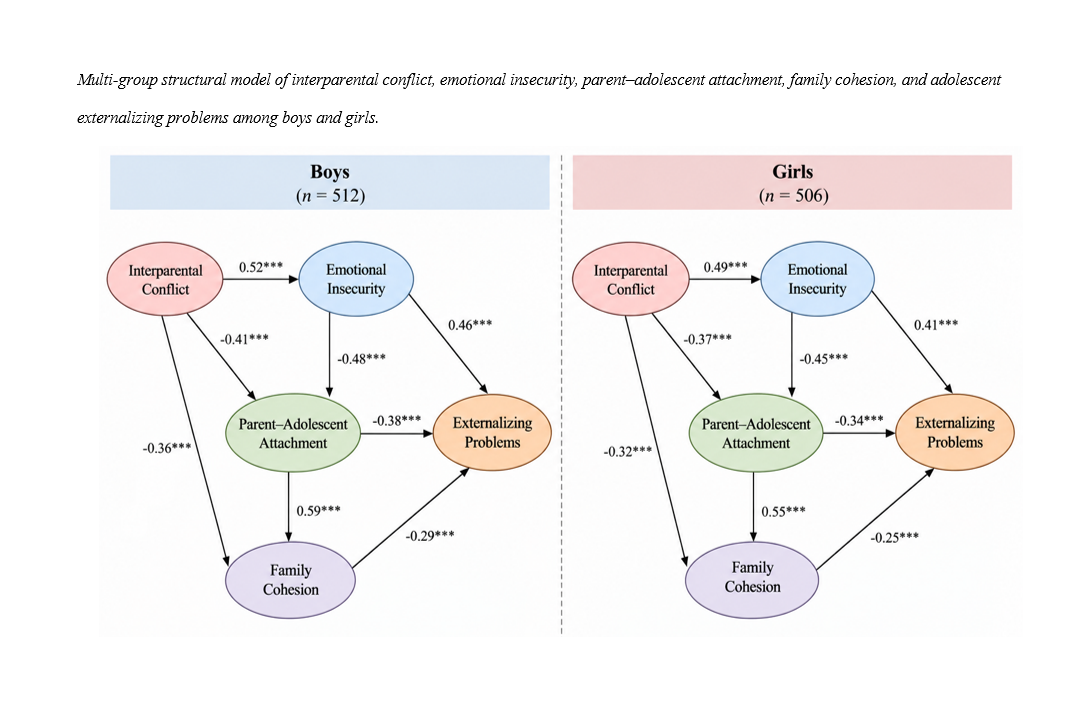
Findings: The structural model demonstrated good fit, χ²(548) = 1012.74, χ²/df = 1.85, CFI = .952, TLI = .947, RMSEA = .035, and SRMR = .044. Interparental conflict significantly predicted greater emotional insecurity, weaker parent–adolescent attachment, lower family cohesion, and higher externalizing problems in both groups. Emotional insecurity positively predicted externalizing problems, whereas attachment and cohesion showed significant negative effects. The direct effect of interparental conflict on externalizing problems was stronger among boys (β = .25) than girls (β = .12, p = .026), whereas the effects of interparental conflict on emotional insecurity and emotional insecurity on externalizing problems were stronger among girls. All three indirect effects were significant. The model explained 48% and 53% of the variance in externalizing problems among boys and girls, respectively.
Conclusion: Adolescent externalizing problems appear to be embedded in interconnected family processes, with interparental conflict exerting both direct and indirect associations through emotional insecurity, attachment, and family cohesion.
Downloads
References
Allen, J. P., Costello, M. A., Pettit, C., Bailey, N., & Stern, J. (2024). Unique Roles of Adolescents’ Friends and Fathers in Predicting Verbal Aggression in Future Adult Romantic Relationships. Development and Psychopathology, 37(1), 393-402. https://doi.org/10.1017/s0954579423001670
Bcherraoui, M. A., Volling, B. L., Tan, L., & Gonzalez, R. (2026). Attachment Network, Interparental Conflict, and Older Siblings’ Behavior Predicting Toddler Behavior Problems. Journal of Family Psychology, 40(4), 494-503. https://doi.org/10.1037/fam0001442
Bi, S. (2025). Typologies of Family Dynamics in Chinese Families and Implications for Child Adjustment: A Person-Centered Approach. Journal of Family Psychology, 39(5), 652-663. https://doi.org/10.1037/fam0001343
Cao, H., Fine, M. A., & Zhou, N. (2022). The Divorce Process and Child Adaptation Trajectory Typology (DPCATT) Model: The Shaping Role of Predivorce and Postdivorce Interparental Conflict. Clinical Child and Family Psychology Review, 25(3), 500-528. https://doi.org/10.1007/s10567-022-00379-3
Chen, L., Sloan, C. J., Jones, D., & Fosco, G. M. (2026). Evaluating General Parent‐adolescent Relations as a Context for Daily Relationship Processes and Adolescent Mood. Journal of Research on Adolescence, 36(3). https://doi.org/10.1111/jora.70224
Cloutier, A., & Barling, J. I. (2022). Witnessing Interparental Violence and Leader Role Occupancy: The roles of Insecure Attachment and Gender. Equality Diversity and Inclusion an International Journal, 41(6), 866-888. https://doi.org/10.1108/edi-10-2021-0279
Daw, S., Kharmatz, A., & Scharf, M. (2025). Interparental Relationships, Attachment Orientations, and Arab Adolescents' Consumption of Sexually Explicit Materials. Family Relations, 74(5), 3060-3076. https://doi.org/10.1111/fare.70010
Dennis, S. H., Mills, A. L., Feda, A., & Cummings, E. M. (2023). Randomized Preventive Intervention for Families: Adolescents’ Emotional Insecurity and Attachment to Fathers. Journal of Family Psychology, 37(1), 79-91. https://doi.org/10.1037/fam0001042
Dennis, S. H., Vetterly, S., & Cummings, E. M. (2024). Long‐term Effects of a Preventive Intervention on Multiple Components of Adolescents' Emotional Insecurity. Family Process, 63(4), 2385-2399. https://doi.org/10.1111/famp.13005
Devonshire, J. M., Cummings, E. M., & Wang, L. (2023). Long-Term Interparental Conflict Behavior and Knowledge Change After a Brief Family Intervention. Journal of Family Psychology, 37(1), 92-104. https://doi.org/10.1037/fam0001033
Fatmasari, A. E., Nur’Aini, H., & Ardi, R. (2026). Adolescents’ Appraisals of Family Relationships in Intact Family Contexts: A Scoping Review. Adolescents, 6(4), 50. https://doi.org/10.3390/adolescents6040050
Hong, S., & Han, S. (2025). From Domestic Violence to Juvenile Delinquency: Examining Gender Differences. Crime & Delinquency, 72(12), 3801-3829. https://doi.org/10.1177/00111287251363565
Jia, J., Ma, L., Tong, W., Wu, T., & Fang, X. (2026). Understanding the Dynamics of Interparental Conflict, Adolescents’ Responses, and Adjustment Problems: A Network Analysis. Developmental Psychology, 62(11), 2307-2321. https://doi.org/10.1037/dev0002221
Jiménez, E. M. O., Gómez‐Benito, J., Llach, S. L., Lamarca, M., & Ochoa, S. (2025). Interparental Violence: Child Emotional Awareness, Protective Factors, and Symptom Profiles in a Comparative Analysis. Frontiers in Psychiatry, 16. https://doi.org/10.3389/fpsyt.2025.1418332
Joseph, J. E., & Canlas, R. P. (2024). Self-Empowerment Program (SEP) to Reduce the Externalizing Behaviors of Adolescents Exposed to Interparental Conflict in India. Journal of Social and Political Sciences, 7(4). https://doi.org/10.31014/aior.1991.07.04.521
Liu, Q., & He, Y. (2025). Interparental Conflict and Academic Performance in Chinese High School Students: A Serial Mediation Model. Psychology in the Schools, 62(9), 2942-2954. https://doi.org/10.1002/pits.23514
Liu, Q., Wang, N., & Wang, Z. (2022). Character Strengths as a Link Between Family Psychosocial Environment and Depression Symptoms Among Chinese Adolescents. Children & Society, 36(6), 1319-1335. https://doi.org/10.1111/chso.12578
O’Hara, K. L., Cummings, E. M., & Davies, P. T. (2023). Interparental Conflict and Adolescent Emotional Security Across Family Structures. Family Process, 63(1), 265-283. https://doi.org/10.1111/famp.12872
Platts, C. R., Sturge‐Apple, M. L., Davies, P. T., & Martin, M. (2022). The Interplay Between Father–adolescent Phenotypic Resemblance and Interparental Conflict in Predicting Harsh Discipline. Journal of Family Psychology, 36(7), 1132-1141. https://doi.org/10.1037/fam0001002
Singh, S., & Thomas, E. A. (2022). Interparental Conflict and Young Adult Romantic Relationships: A Systematic Review. Trauma Violence & Abuse, 24(4), 2630-2647. https://doi.org/10.1177/15248380221109787
Tao, Z., Zhao, X., Wang, Z., Yu, C., & Zhang, W. (2022). Rejection Sensitivity Mediates the Interparental Conflict and Adolescent Internet Addiction: School Connectedness as a Moderator. Frontiers in psychology, 13. https://doi.org/10.3389/fpsyg.2022.1038470
Thompson, M. J., Davies, P. T., Hentges, R. F., & Sturge‐Apple, M. L. (2021). Delineating the Developmental Sequelae of Children's Risky Involvement in Interparental Conflict. Development and Psychopathology, 34(3), 922-935. https://doi.org/10.1017/s0954579420001959
Wang, M., Sun, S., Liu, X., Yang, Y., Liu, C., Huang, A., & Liu, S. (2023). Interparental Conflict and Early Adolescent Depressive Symptoms: Parent-Child Triangulation as the Mediator and Grandparent Support as the Moderator. Journal of youth and adolescence, 53(1), 186-199. https://doi.org/10.1007/s10964-023-01923-2
Wang, Y. (2021). The Impact of Interparental Conflicts on Online Game Addiction Symptomatology: The Mediating Roles of the Parent-Adolescent Relationship and Loneliness in Adolescents. Psychological Reports, 125(5), 2337-2356. https://doi.org/10.1177/00332941211016751
Wang, Z., Li, C., & Ai, K. (2022). Family Economic Strain and Adolescent Aggression During the COVID-19 Pandemic: Roles of Interparental Conflict and Parent–Child Conflict. Applied Research in Quality of Life, 17(4), 2369-2385. https://doi.org/10.1007/s11482-022-10042-2
Wilson, S. V., Szwedo, D. E., & Allen, J. P. (2024). Interparental and Parent–Teen Relationships During Adolescence as Predictors of Intra- And Interpersonal Emotion Regulation in Young Adulthood. Youth, 4(4), 1417-1436. https://doi.org/10.3390/youth4040090
Yan, C., Liu, Y., Xiao, T., Pan, M., Zhang, T., He, Z., & Gan, Y. (2026). Parental Marital Conflict and Adolescent Anxiety: The Moderating Roles of Physical Activity and Gender. Psychology and Psychotherapy Theory Research and Practice, 99(2), 484-500. https://doi.org/10.1111/papt.70037
Yang, M., Qi, H., Meng, Z., Duan, X., & Zhang, L. (2022). Destructive Interparental Conflict Affects Chinese Children’s Emotional and Behavioral Problems: Indirect Pathways via Parent–child Attachment and Emotional Insecurity. Frontiers in psychology, 13. https://doi.org/10.3389/fpsyg.2022.1024325
Zemp, M., Friedrich, A.-S., Schirl, J., Dantchev, S., Voracek, M., & Tran, U. S. (2021). A Systematic Review and Meta-Analysis of the Associations Between Interparental and Sibling Relationships: Positive or Negative? PLoS One, 16(9), e0257874. https://doi.org/10.1371/journal.pone.0257874
Zeng, S., Liu, Z., & Zheng, L. (2026). Interparental Conflict and Adolescent Online Flaming: The Chain Mediating Roles of Psychological Stress and Online Disinhibition. Frontiers in psychology, 17. https://doi.org/10.3389/fpsyg.2026.1840562
Zhao, H. (2021). The Effect of Parental Relationship on Children Psychological Growth. 582. https://doi.org/10.2991/assehr.k.211011.072
Zhu, Y. (2023). The Role of Self-Regulation in Internet Addiction During Adolescence. Lecture Notes in Education Psychology and Public Media, 18(1), 69-75. https://doi.org/10.54254/2753-7048/18/20231291
Downloads
Additional Files
Publication Timeline
- Submitted
- Revised
- Accepted