Effectiveness of Social Problem-Solving-Based Life Skills Training on Self-Criticism, Self-Regulation, and Self-Efficacy in Women with Divorce Experience
Keywords:
Life Skills, Social Problem, Solving, Self, Criticism, Regulation, Efficacy, Women with Divorce ExperienceAbstract
Objective: This study aimed to determine the effectiveness of social problem-solving-based life skills training in reducing self-criticism and improving self-regulation and self-efficacy among women with divorce experience.
Methods and Materials: This quasi-experimental study employed a pretest–posttest design with a control group. The statistical population comprised all women with divorce experience who had active records at the Social Health Unit of the Welfare Administration of Amol County during the first quarter of 2026. Thirty eligible women were recruited through convenience sampling and randomly assigned to an experimental group (n = 15) or a control group (n = 15). The experimental group received a structured life skills training program based on D’Zurilla and Nezu’s social problem-solving approach in eight weekly 90-minute sessions, whereas the control group received no intervention. Data were collected using the Levels of Self-Criticism Scale, the Short Self-Regulation Questionnaire, and the General Self-Efficacy Scale. Multivariate analysis of covariance (MANCOVA) and univariate analysis of covariance (ANCOVA) were conducted using SPSS version 26.
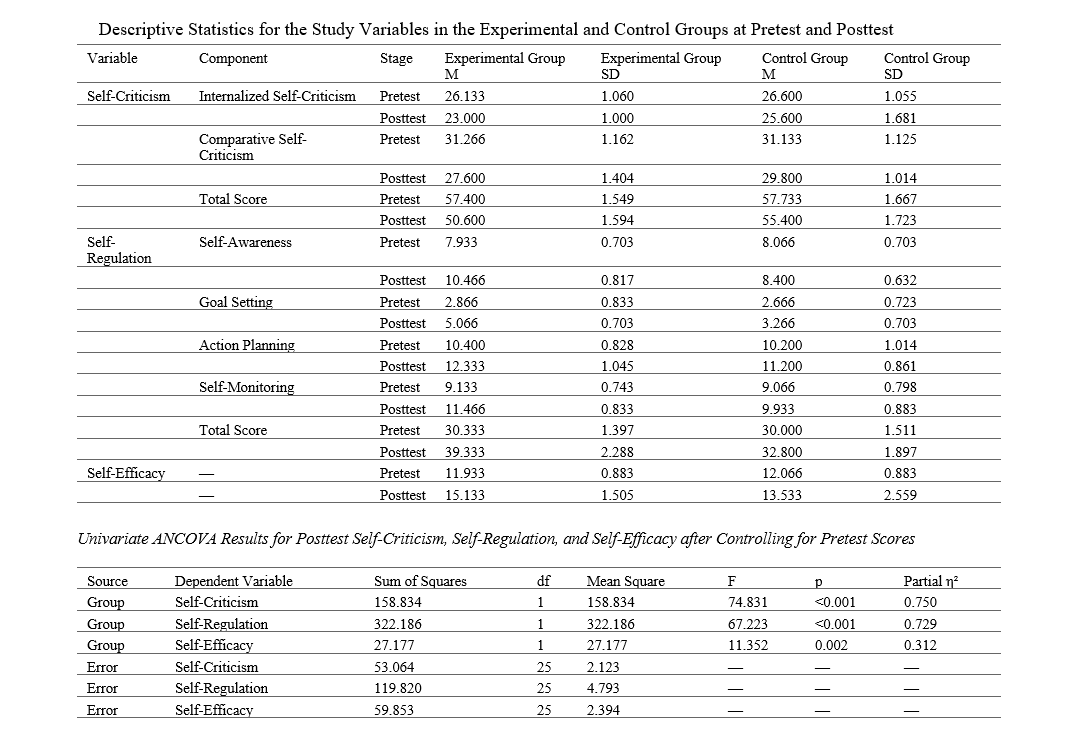
Findings: After controlling for pretest scores, the multivariate analysis indicated a statistically significant overall difference between the experimental and control groups across the combined dependent variables at posttest (P < 0.001). Subsequent univariate covariance analyses showed significant between-group differences in self-criticism, self-regulation, and self-efficacy (P < 0.001). Specifically, participation in social problem-solving-based life skills training was associated with significantly lower posttest self-criticism and significantly higher posttest self-regulation and self-efficacy compared with the control condition.
Conclusion: Social problem-solving-based life skills training appears to be an effective educational and psychological intervention for decreasing self-critical tendencies while strengthening self-regulatory capacities and perceived self-efficacy among women with divorce experience. The intervention may therefore be incorporated into psychosocial support and empowerment programs designed for women adjusting to the psychological and social consequences of divorce.
Downloads
References
Abdelmouttelb, A. A., Elewa, S. M. M., Abdelsalhen, F. A., & Ibrahim, F. M. (2026). Life-Skills Training Program: Its Effect on Self-Efficacy among Patients with Substance Use Disorders. BMC psychology, 14, 119. https://doi.org/10.1186/s40359-025-03907-2
Akbari, A., Torabizadeh, C., Nick, N., Setoodeh, G., & Ghaemmaghami, P. (2025). The Effects of Training Female Students in Emotion Regulation Techniques on Their Social Problem-Solving Skills and Social Anxiety: A Randomized Controlled Trial. Child and adolescent psychiatry and mental health, 19, 3. https://doi.org/10.1186/s13034-025-00860-1
Akeren, İ., Çelik, E., Yayla, İ. E., & Özgöl, M. (2025). The Effect of Self-Regulation on the Need for Psychological Help through Happiness, Resilience, Problem Solving, Self-Efficacy, and Adjustment: A Parallel Mediation Study in Adolescent Groups. Children, 12(4), 445. https://doi.org/10.3390/children12040445
D’Zurilla, T. J., & Nezu, A. M. (2010). Problem-Solving Therapy. In Handbook of Cognitive-Behavioral Therapies (3rd ed., pp. 197-225). Guilford Press.
D’Zurilla, T. J., Nezu, A. M., & Maydeu-Olivares, A. (2004). Social Problem Solving: Theory and Assessment. In Social Problem Solving: Theory, Research, and Training (pp. 11-27). American Psychological Association. https://doi.org/10.1037/10805-001
Dadvand, F., Manzartoukoli, R., & Khorrami, F. (2026). The Effectiveness of Creative Problem-Solving Skills Training Package on Self-Efficacy and Personal Growth Initiative in Students. Journal of Adolescent and Youth Psychological Studies, 7, 1-13.
Davarinejad, O., Ghasemi, A., Hall, S. S., Meyers, L. S., Shirzadifar, M., Shirzadi, M., Rahro Mehrabani, A., Ramezanzadeh Rostami, T., & Shahi, H. (2022). Give Yourself a Break: Self-Compassion Mediates Insecure Attachment and Divorce Maladjustment among Iranian Women. Journal of Social and Personal Relationships, 39(8), 2340-2365. https://doi.org/10.1177/02654075221077971
Farshbaf Dadkhah, M., Pourali Vakili Miandoab, M., Baheri Eslami, N., & Shalchi, B. (2024). The Effect of Social Problem-Solving Training on Loneliness, Hope for Life, and Self-Efficacy in Women with Substance Use Disorder. Addiction Research Quarterly, 18(73), 135-154.
Heller, I., Bolliger, C., Holmer, P., Schladerer, S. P., & Michel, G. (2026). The Role of Social Skills Training in the Treatment of Social Anxiety: A Systematic Review. Sage Open, 16(1), 1-22. https://doi.org/10.1177/21582440251409451
Jin, S., Xu, S., Zhao, Y., Huang, H., Zhu, H., & Zhou, C. (2025). Effectiveness of Social Problem-Solving Interventions for Children with Autism Spectrum Disorder: A Systematic Review and Meta-Analysis. Behavioral Sciences, 15(12), 1708. https://doi.org/10.3390/bs15121708
Jokar, M., Kamali, S., & Motaghi, R. (2025). The Effectiveness of Life Skills Training on Self-Efficacy and Resilience in Children and Adolescents of Divorce. Nursing Education, 14(1), 76-88.
Kamisli, S. (2026). The Effects of a Psychodrama-Based Social Problem-Solving Course on Undergraduate Health Professional Students: A Quasi-Experimental Study. Nigerian Journal of Clinical Practice, 29(2), 237-244. https://doi.org/10.4103/njcp.njcp_518_25
Motamed-Jahromi, M., Kaveh, M. H., Mohammadpour, A., & Asadollahi, A. (2022). Psychometric Validation of the Persian Version of the Short Form Self-Regulation Questionnaire in Community-Dwelling Older Adults. Frontiers in psychology, 13, 844871. https://doi.org/10.3389/fpsyg.2022.844871
Mousavi, A., & Ghorbani, N. (2006). Self-Knowledge, Self-Criticism, and Mental Health. Psychological studies, 2(3-4), 75-91.
Nourbakhsh, S. V., Alizadehfard, S., & Davoodi, A. (2024). The Effect of Problem-Solving Skills Training Based on Personal Competencies on Self-Efficacy Beliefs and Epistemological Beliefs in Adolescents. Mental Health and Lifestyle Journal, 2(4), 48-55. https://doi.org/10.61838/mhlj.2.4.6
Sadeghian, S., & Toozandehjani, H. (2016). Effectiveness of Problem-Solving Skills Training in the Attributional Style and Socialization of Divorced Women. International Journal of Medical Research & Health Sciences, 5(7), 110-117.
Sadiq, U., Irfan, A., Baig, K. B., & Flesia, L. (2026). Enhancing Self-Awareness in Late Adolescents and Emerging Adults in Pakistan: A Randomized Controlled Trial of UNICEF’s Basic Life Skills Program. Adolescents, 6(2), 27. https://doi.org/10.3390/adolescents6020027
Sbarra, D. A., Hasselmo, K., & Bourassa, K. J. (2015). Divorce and Health: Beyond Individual Differences. Current Directions in Psychological Science, 24(2), 109-113. https://doi.org/10.1177/0963721414559125
Şenocak, S. Ü., & Demirkıran, F. (2023). Effects of Problem-Solving Skills Development Training on Resilience, Perceived Stress, and Self-Efficacy in Nursing Students: A Randomised Controlled Trial. Nurse Education in Practice, 72, 103795. https://doi.org/10.1016/j.nepr.2023.103795
Shavandi, H., & Veshki, S. K. (2021). Effectiveness of Compassion-Focused Therapy on Self-Criticism of Women Applying for Divorce. Journal of education and health promotion, 10, 15. https://doi.org/10.4103/jehp.jehp_495_20
Taghipour, Z., & Naseri, A. (2026). The Effectiveness of Life Skills Training on Self-Handicapping among Students of Islamic Azad University, Shiraz Branch. Journal of Adolescent and Youth Psychological Studies, 7(1), 1-11. https://doi.org/10.61838/kman.jayps.6435
Thompson, R., & Zuroff, D. C. (2004). The Levels of Self-Criticism Scale: Comparative Self-Criticism and Internalized Self-Criticism. Personality and individual differences, 36(2), 419-430. https://doi.org/10.1016/S0191-8869(03)00106-5
Weiyi, W., Ma’rof, A. M., & Burhanuddin, N. A. N. (2025). A Scoping Review on Social Problem-Solving Interventions for College Students. Frontiers in Education, 10, 1509641. https://doi.org/10.3389/feduc.2025.1509641
Yun, J., & Jin, B. (2026). Attachment and Post-Divorce Growth among Korean Women: Indirect Pathways via Self-Efficacy Moderated by Social Support. The American Journal of Family Therapy. https://doi.org/10.1080/01926187.2026.2631373
Downloads
Additional Files
Publication Timeline
- Submitted
- Revised
- Accepted