The Effectiveness of Family-Centered Mindfulness-Based Therapy on Intergenerational Conflicts and Family Structure in Families with Adolescents
Keywords:
Family, Centered Mindfulness, Intergenerational Conflict, Family Structure, Adolescents, Family Therapy, Mindfulness, Based TherapyAbstract
Objective: This study aimed to determine the effectiveness of family-centered mindfulness-based therapy in reducing intergenerational conflicts and improving family structure among families with adolescents in Tehran.
Methods and Materials: This quasi-experimental study employed a pretest–posttest design with a control group and a two-month follow-up. The statistical population consisted of families with adolescents aged 13–17 years who were referred to counseling and psychological service centers in Tehran during 2025–2026. Thirty eligible families were selected through purposive sampling and randomly assigned to an experimental group and a control group, with 15 families in each group. The experimental group received eight weekly 90-minute sessions of family-centered mindfulness-based therapy, whereas the control group received no structured psychological intervention during the study period. Intergenerational conflict was assessed using the Conflict Behavior Questionnaire, and family structure was evaluated using the Family Adaptability and Cohesion Evaluation Scales, Fourth Edition. Data were analyzed using mixed repeated-measures analysis of variance and Bonferroni-adjusted pairwise comparisons at a significance level of p < .05.
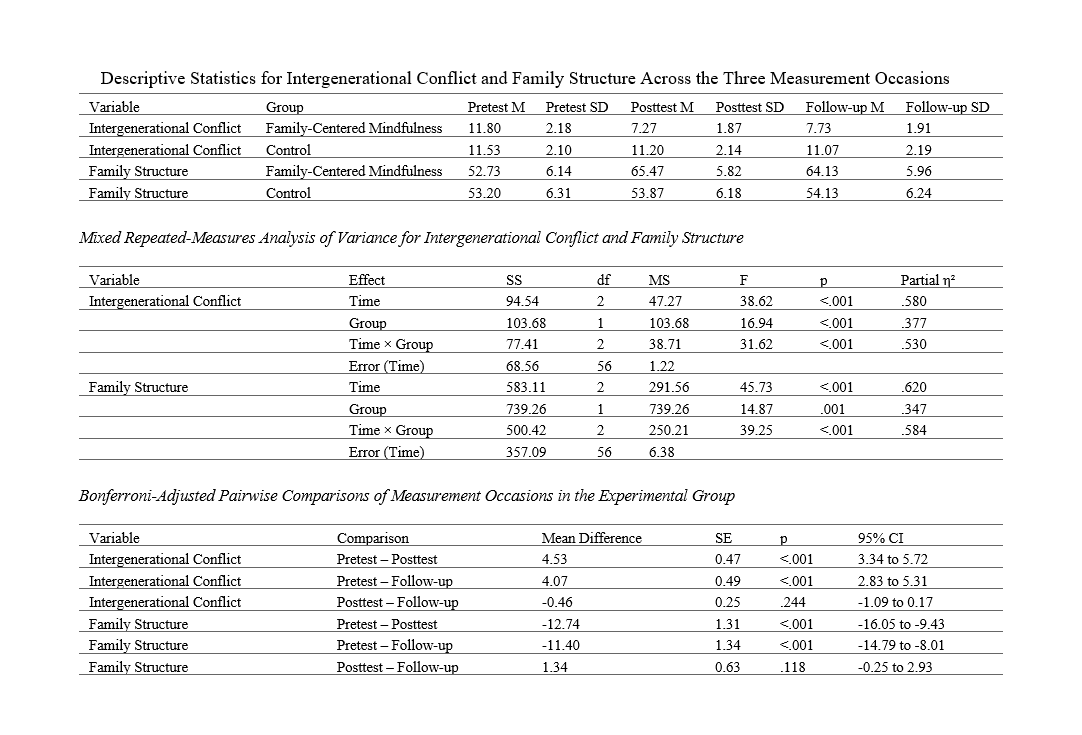
Findings: The mixed repeated-measures analysis showed a significant time-by-group interaction for intergenerational conflict, F(2, 56) = 31.62, p < .001, partial η² = .530, and family structure, F(2, 56) = 39.25, p < .001, partial η² = .584. Bonferroni comparisons indicated significant improvements from pretest to posttest and from pretest to follow-up for both intergenerational conflict and family structure (all p < .001), whereas the differences between posttest and follow-up were not statistically significant (p > .05), indicating maintenance of treatment gains over the two-month follow-up period.
Conclusion: Family-centered mindfulness-based therapy appears to be an effective intervention for reducing intergenerational conflicts and improving family structure in families with adolescents, with treatment effects remaining stable over a two-month follow-up period.
Downloads
References
Akyıl, Y., Erdinç, B., Satıcı, S. A., & Okur, S. (2026). Family Members’ Well-Being, Mindfulness, Loneliness, and Social Support: A Dyadic Approach. Families Systems & Health, 44(1), 79-91. https://doi.org/10.1037/fsh0001043
Calatrava, M., Martins, M. V., Schweer-Collins, M., Duch-Ceballos, C., & Rodríguez-González, M. (2022). Differentiation of self: A scoping review of Bowen Family Systems Theory’s core construct. Clinical psychology review, 91, 102101. https://doi.org/10.1016/j.cpr.2021.102101
Chunkai, L., Shan, J., & Xinwen, Z. (2019). Intergenerational relationship, family social support, and depression among Chinese elderly: A structural equation modeling analysis. Journal of affective disorders, 248, 73-80. https://doi.org/10.1016/j.jad.2019.01.032
Kheirabadi, Z. (2025). Designing a Structural Model of Marital Empathy Based on Mindfulness in Couple Relationships with the Mediating Role of Communication Patterns among Married Women in District 4 of Tehran Islamic Azad University, Roudehen Branch].
Körün, A. B., Satıcı, S. A., Erdinç, B., & Akyıl, Y. (2026). Mediating Role of Mindfulness Between Loneliness and Relationship Quality in Married Couples Dyadic Approach. The Family Journal, 10664807261415880. https://doi.org/10.1177/10664807261415880
Nouri Pargo, M., Foroozandeh, E., Baradaran, M., & KhoshAkhlagh, H. (2025). Comparing the Efficacy of Internal Family Systems Therapy and Mindfulness-Based Cognitive Therapy on Symptoms of Depression and Body Dysmorphic Disorder in Women with Childhood Trauma Experiences. Journal of Psychological Science, 24(148), 193-209. https://doi.org/10.52547/JPS.24.148.193
Paknejad, F., & Ahmadi, k. (2022). The comparison of the differentiation indices in Bowen's intergenerational theory with perceived differentiation indices in the community of Iranian parents resident in Tehran. Family Counseling and Psychotherapy, 7(1), 65-84. https://doi.org/10.22034/fcp.2022.48962
Park, C., & Harris, V. W. (2025). The Association Between Mindfulness, Shared Relationship Activity Engagement, Connectedness, and Positive Interaction in Couple Relationships. Journal of marital and family therapy, 51(4). https://doi.org/10.1111/jmft.70081
Park, C., & Harris, V. W. (2025). Associations between Mindfulness and Conflict Resolution in Couple Relationships: Dyadic Data Analysis. The American Journal of Family Therapy, 54(1), 56-78. https://doi.org/10.1080/01926187.2025.2469171
Rassart, C. A., Paradis, A., Herba, C. M., & Godbout, N. (2024). Childhood Interpersonal Trauma and Postpartum Parenting Alliance: The Role of Mindfulness in Couples. Journal of Family Psychology, 38(2), 223-235. https://doi.org/10.1037/fam0001174
Seyyed Aghaei, Z. S. P., & Karami, A. (2026). A Network Analysis of the Relationship Between Interpersonal Mindfulness, Emotion Regulation, and Emotional Divorce Among Iranian Couples. The American Journal of Family Therapy, 1-27. https://www.researchgate.net/publication/407259423_A_Network_Analysis_of_the_Relationship_Between_Interpersonal_Mindfulness_Emotion_Regulation_and_Emotional_Divorce_Among_Iranian_Couples
Soleimani, M., Ghadampour, E., & Abbasi, M. (2024). A causal model of successful academic identity based on family emotional climate: The role of mindfulness as a mediating variable. Family and Research Journal, 21(3), 161-178. https://qjfr.ir/article-1-2207-fa.html
Thomas, P. A., Liu, H., & Umberson, D. (2017). Family Relationships and Well-Being. Innovation in Aging, 1(3). https://doi.org/10.1093/geroni/igx025
Zheng, Y. (2025). Mindfulness-Based Couple Interventions: For Whom and under What Conditions Do They Have Relationship Benefits? Family Process, 64(3), e70067. https://doi.org/10.1111/famp.70067
Zhou, S., Kwan, C. K., Ai, Y., & Ma, Y. (2025). Parent-Adolescent Intergenerational Transmission of Distress: The Roles of Family Climate, Adolescents’ Self-Compassion and Mindfulness. Frontiers in psychology, 16. https://doi.org/10.3389/fpsyg.2025.1595515
Zoller, B. K., Bögels, S. M., Meppelink, R., & Bruin, E. I. d. (2026). Mechanisms of Change in Mindfulness-Based Family Intervention (MYmind) Versus Methylphenidate for Childhood ADHD: A Randomized Controlled Trial. Children, 13(3), 434. https://doi.org/10.3390/children13030434
Downloads
Additional Files
Publication Timeline
- Submitted
- Revised
- Accepted