
The Process of Formation and Continuation of Extramarital Emotional Relationships in Cyberspace: A Grounded Theory Study
Keywords:
Extramarital Emotional Relationships, Cyberspace, Marital Relationships, Grounded Theory, Social NetworksAbstract
Objective: This study aimed to explain the process through which extramarital emotional relationships are formed and maintained in cyberspace and to identify the principal factors influencing their development and continuation.
Methods and Materials: This qualitative study employed grounded theory based on the systematic approach of Strauss and Corbin. Participants comprised 16 specialists and counselors in family studies and educational sciences who were selected through purposive sampling according to relevant professional expertise and practical experience. Data were collected through in-depth semi-structured interviews and analyzed using open, axial, and selective coding. Data collection and analysis proceeded iteratively to identify concepts, categories, their interrelationships, and the central phenomenon underlying the process of online extramarital emotional involvement.
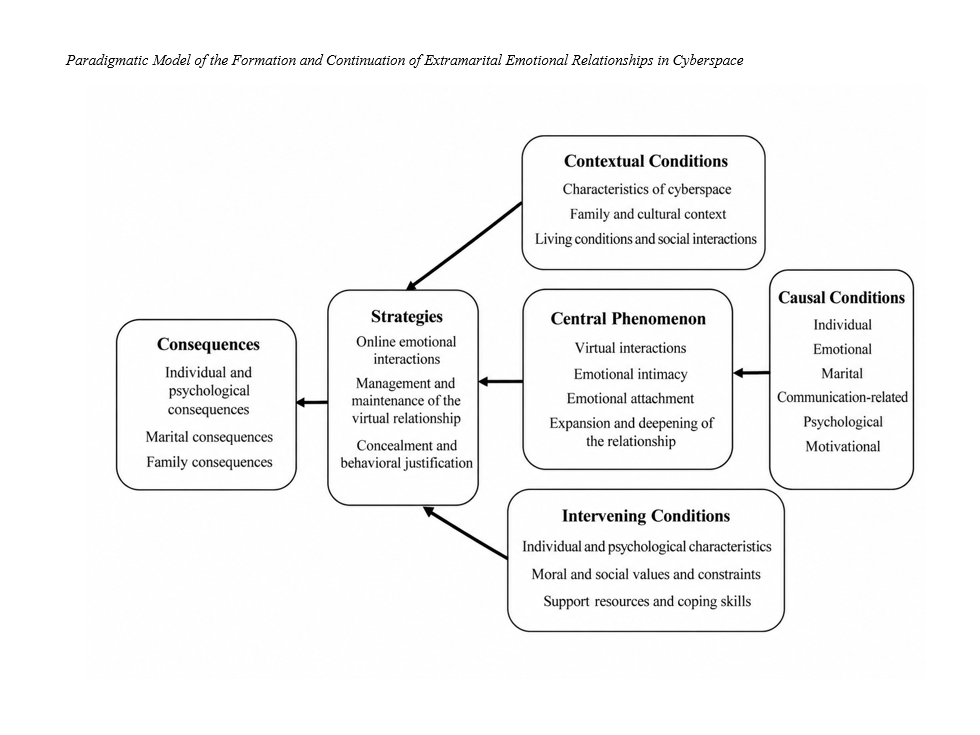
Findings: The resulting paradigmatic model explained the formation and continuation of extramarital emotional relationships in cyberspace through six interconnected dimensions. Causal conditions comprised individual, emotional, marital, communicational, psychological, and motivational factors. The core phenomenon emerged as a gradual process beginning with online interactions, progressing through emotional intimacy and emotional attachment, and culminating in the expansion and deepening of the relationship. Contextual conditions included characteristics of cyberspace, family and cultural environments, and broader social interactions and living circumstances. Intervening conditions encompassed individual and psychological characteristics, moral and social values and constraints, supportive resources, and coping skills. Strategies involved online emotional interactions, management and maintenance of the virtual relationship, and concealment or behavioral justification. Consequences were organized into individual-psychological, marital, and family domains.
Conclusion: Extramarital emotional relationships in cyberspace represent a multidimensional and progressive process shaped by the interaction of personal, relational, psychological, sociocultural, and technological conditions. The proposed grounded theory framework provides an integrated explanation of this phenomenon and may inform future research as well as the development of preventive and counseling interventions tailored to couples experiencing vulnerabilities related to online emotional relationships.
Downloads
References
Adams, A. N. (2017). Social Networking Sites and Online Infidelity
Alizadeh Same, S., & Pouraman, M. (2023). Reidentifying the Causes of Couples' Tendency toward Illicit Relationships in the Context of Cyberspace Fourth National Conference on Cyber Defense, Maragheh.
Amirnejad, S., Parvin Joda, H., & Sadri, E. (2024). The Impact of Cyberspace on Marital Relationships and Couples' Commitment 11th National Conference on New Developments in Positive Psychology, Bandar Abbas.
Clayton, R. B., Nagurney, A., & Smith, J. R. (2013). Cheating, Breakup, and Divorce: Is Facebook Use to Blame? Cyberpsychology, Behavior, and Social Networking, 16(10), 717-720. https://doi.org/10.1089/cyber.2012.0424
Corbin, J. (2021). Strauss's Grounded Theory. In Developing Grounded Theory (pp. 25-44). Routledge. https://doi.org/10.4324/9781315169170-4
Docan-Morgan, T., & Docan, C. A. (2007). Internet Infidelity: Double Standards and the Differing Views of Women and Men. Communication Quarterly, 55(3), 317-342. https://doi.org/10.1080/01463370701492519
Eichenberg, C., Huss, J., & Küsel, C. (2017). From Online Dating to Online Divorce: An Overview of Couple and Family Relationships Shaped through Digital Media. Contemporary Family Therapy, 39(4), 249-260. https://doi.org/10.1007/s10591-017-9434-x
Erber, R., & Erber, M. W. (2024). Intimate Relationships: Issues, Theories, and Research. Routledge. https://doi.org/10.4324/9781003356790
Gheibi, M. N., Sani, P. K., & Karimi, Q. (2025). Presenting a Model to Reduce Infidelity in Cyber Space with Phenomenological Analysis of Individual, Interpersonal and Social Factors. Journal of Preventive, 6(1), 114-132.
Hertlein, K. M., & Piercy, F. P. (2006). Internet Infidelity: A Critical Review of the Literature. The Family Journal, 14(4), 366-371. https://doi.org/10.1177/1066480706290508
Heydari, H. (2020). A Sociological Study of the Impact of Virtual Social Networks on Relationships between Couples: A Case Study of Tehran. socio-cultural Development Studies, 9(2), 67-90.
Kaya, M. M., & Şakiroǧlu, M. (2023). Factors Affecting Online Infidelity: A Review. Psikiyatride Guncel Yaklasimlar, 15(1), 29-37. https://doi.org/10.18863/pgy.1070731
Khamsan, A., Talebzadeh Shoushtari, L., Behlgerdi, M., & Masnani, Z. (2021). Extramarital Relationships among Individuals Referred to Counselors and Prevention Strategies: Developing a Model Based on Grounded Theory. Applied Psychological Research Quarterly, 12(1), 145-166.
Lee, J., Gillath, O., & Miller, A. (2019). Effects of Self- and Partner's Online Disclosure on Relationship Intimacy and Satisfaction. PLoS One, 14(3), e0212186. https://doi.org/10.1371/journal.pone.0212186
Malekzadeh, A., Pourmaveddat, K., Aslami, E., & Mirmotahar, M. (2025). The Digital Dilemma: Extramarital Relationships in Social Networks and the Mediating Role of Spirituality and Religious Attitudes. Interdisciplinary Journal of Virtual Learning in Medical Sciences, 16(2), 165-178.
McDaniel, B. T., Drouin, M., & Cravens, J. D. (2017). Do You Have Anything to Hide? Infidelity-Related Behaviors on Social Media Sites and Marital Satisfaction. Computers in human Behavior, 66, 88-95. https://doi.org/10.1016/j.chb.2016.09.031
Oliullah, M. (2025). Explication of Online Infidelity in Romantic Relationships. https://doi.org/10.2139/ssrn.5404578
Oliullah, M., & Murtuza, H. M. (2025). Exploring the Impact of Deepfakes on Cognitive Processing in Political Contexts: A Systematic Review. https://doi.org/10.2139/ssrn.5390735
Oliullah, M., & Murtuza, H. M. (2026). Explication of Online Infidelity in Virtual Romantic Relationships. The Family Journal, 34(3), 590-601. https://doi.org/10.1177/10664807261448229
Potter, M. H. (2021). Social Support and Divorce among American Couples. Journal of Family Issues, 42(1), 88-109. https://doi.org/10.1177/0192513X20916830
Safa, D. (2024). The Role of Virtual Social Networks in Transforming Communication Patterns among Young Couples: A Study of Women's Lived Experiences Based on Grounded Theory. Socio-Cultural Knowledge, 16(1), 113-138.
Shalchi, V., Rezaei Farahabad, A., & Taghiabadi, M. (2020). The Role of Cyberspace Use in Couples' Emotional Relationships: A Case Study of Tehran Families. Socio-Cultural Changes, 17(2), 62-83.
Sprecher, S., Wenzel, A., & Harvey, J. (2018). Self-Disclosure and Starting a Close Relationship. In Handbook of Relationship Initiation (pp. 164-185). Psychology Press. https://doi.org/10.4324/9780429020513-16
Tajbakhsh, G. (2021). An Analysis of Factors Underlying Extramarital Relationships. Women in Development and Politics (Women's Research), 19(4), 595-614.
Vossler, A., & Moller, N. P. (2020). Internet Affairs: Partners' Perceptions and Experiences of Internet Infidelity. Journal of sex & marital therapy, 46(1), 67-77. https://doi.org/10.1080/0092623X.2019.1654577
Wen, Y. (2024). Love in the Digital Age: Exploring the Transformation Impact of the Internet on Romantic Relationships. Highlights in Business, Economics and Management, 41, 59-64. https://doi.org/10.54097/tw465p97
Yuan, S., & Weiser, D. A. (2019). Relationship Dissolution Following Marital Infidelity: Comparing European Americans and Asian Americans. Marriage & Family Review, 55(7), 631-650. https://doi.org/10.1080/01494929.2019.1589614
Downloads
Additional Files
Publication Timeline
- Submitted
- Revised
- Accepted