Predicting Adolescent Emotional Problems From Parenting Styles, Family Functioning, and Parent–Child Communication Using LightGBM
Keywords:
adolescent emotional problems, LightGBM, parenting styles, family functioning, parent–child communication, machine learning, SHAPAbstract
Objective: This study aimed to develop and interpret a Light Gradient Boosting Machine (LightGBM) model for predicting adolescent emotional problems from authoritative, authoritarian, and permissive parenting styles, family functioning, and parent–child communication.
Methods and Materials: A cross-sectional predictive study was conducted among 742 adolescents aged 12–17 years (M = 14.63, SD = 1.61) recruited from secondary schools across five regions of France using multistage cluster sampling. Emotional problems were assessed using the Emotional Symptoms subscale of the Strengths and Difficulties Questionnaire, parenting styles using the Parental Authority Questionnaire, family functioning using the General Functioning subscale of the McMaster Family Assessment Device, and parent–child communication using the Parent–Adolescent Communication Scale. The sample was randomly divided into a training set (n = 594) and an independent holdout test set (n = 148). Five-fold cross-validation was used for LightGBM hyperparameter optimization. Predictive performance was evaluated using R², root mean squared error (RMSE), and mean absolute error (MAE), and model performance was compared with XGBoost, Random Forest, and Elastic Net regression. SHapley Additive exPlanations (SHAP) were used to interpret feature importance and direction.
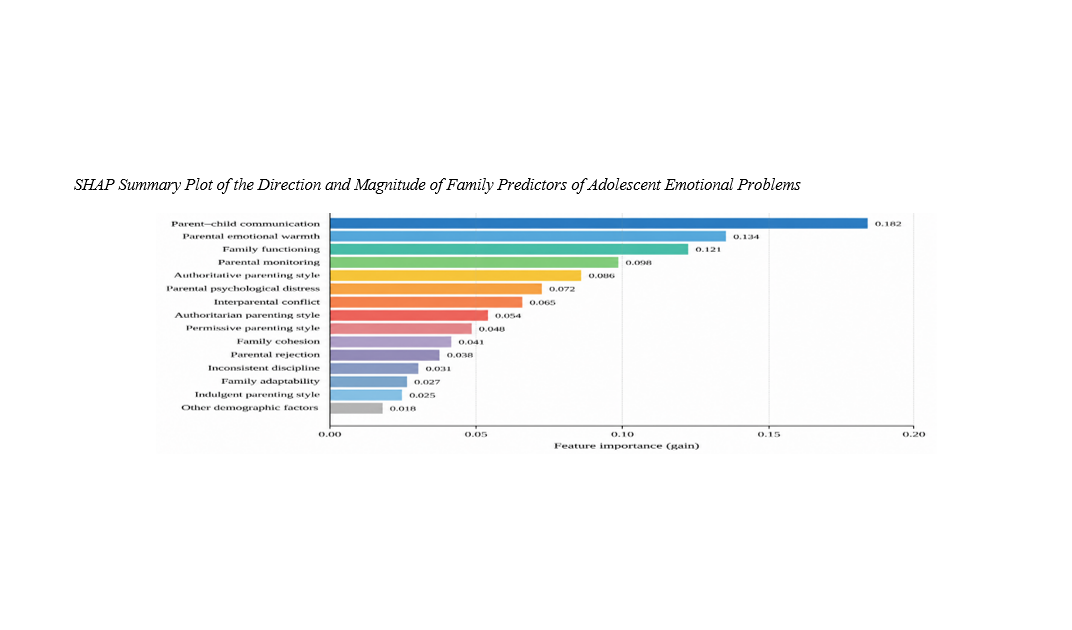
Findings: LightGBM demonstrated stable cross-validated performance, with a mean R² of .623, RMSE of 1.47, and MAE of 1.12. In the independent holdout sample, the model explained 63.8% of the variance in emotional-problem scores (R² = .638, RMSE = 1.44, MAE = 1.10), outperforming XGBoost (R² = .609), Random Forest (R² = .572), and Elastic Net regression (R² = .506). SHAP analysis identified family dysfunction as the strongest predictor, followed by problematic parent–child communication, open communication, authoritarian parenting, authoritative parenting, and permissive parenting. Higher family dysfunction, problematic communication, and authoritarian parenting were associated with higher predicted emotional problems, whereas open communication and authoritative parenting showed protective predictive patterns.
Conclusion: LightGBM provided strong and interpretable prediction of adolescent emotional problems, highlighting family functioning and parent–child communication as especially influential family-level predictors.
Downloads
References
Objective: This study aimed to develop and interpret a Light Gradient Boosting Machine (LightGBM) model for predicting adolescent emotional problems from authoritative, authoritarian, and permissive parenting styles, family functioning, and parent–child communication.
Methods and Materials: A cross-sectional predictive study was conducted among 742 adolescents aged 12–17 years (M = 14.63, SD = 1.61) recruited from secondary schools across five regions of France using multistage cluster sampling. Emotional problems were assessed using the Emotional Symptoms subscale of the Strengths and Difficulties Questionnaire, parenting styles using the Parental Authority Questionnaire, family functioning using the General Functioning subscale of the McMaster Family Assessment Device, and parent–child communication using the Parent–Adolescent Communication Scale. The sample was randomly divided into a training set (n = 594) and an independent holdout test set (n = 148). Five-fold cross-validation was used for LightGBM hyperparameter optimization. Predictive performance was evaluated using R², root mean squared error (RMSE), and mean absolute error (MAE), and model performance was compared with XGBoost, Random Forest, and Elastic Net regression. SHapley Additive exPlanations (SHAP) were used to interpret feature importance and direction.
Findings: LightGBM demonstrated stable cross-validated performance, with a mean R² of .623, RMSE of 1.47, and MAE of 1.12. In the independent holdout sample, the model explained 63.8% of the variance in emotional-problem scores (R² = .638, RMSE = 1.44, MAE = 1.10), outperforming XGBoost (R² = .609), Random Forest (R² = .572), and Elastic Net regression (R² = .506). SHAP analysis identified family dysfunction as the strongest predictor, followed by problematic parent–child communication, open communication, authoritarian parenting, authoritative parenting, and permissive parenting. Higher family dysfunction, problematic communication, and authoritarian parenting were associated with higher predicted emotional problems, whereas open communication and authoritative parenting showed protective predictive patterns.
Conclusion: LightGBM provided strong and interpretable prediction of adolescent emotional problems, highlighting family functioning and parent–child communication as especially influential family-level predictors.
Downloads
Additional Files
Publication Timeline
- Submitted
- Revised
- Accepted