Lived Experiences of Co-Parenting After Divorce: Challenges, Negotiations, and Adaptive Strategies
Keywords:
co, parenting, divorce, lived experience, phenomenology, parental conflict, shared parenting, qualitative research, family adaptationAbstract
Objective: This study aimed to explore the lived experiences of divorced mothers and fathers in Spain regarding the challenges, negotiation processes, and adaptive strategies involved in post-divorce co-parenting.
Methods and Materials: This qualitative study used a phenomenologically informed design and reflexive thematic analysis. Participants were 28 divorced parents, including 16 mothers and 12 fathers, recruited purposively from family mediation centers, community family-support services, parent associations, and online groups in Madrid and Valencia, Spain. Eligible participants had been legally divorced for at least one year, had at least one child younger than 18 years with their former spouse, and maintained ongoing co-parenting responsibilities. Individual semi-structured interviews lasting 58–104 minutes explored communication, decision-making, residential arrangements, financial responsibilities, conflict, household differences, children's transitions, and adaptive responses. Interviews were audio-recorded, transcribed verbatim, coded inductively, and analyzed iteratively to identify recurrent patterns of meaning. Reflexive memos, negative-case analysis, an audit trail, secondary researcher review, and participant feedback were used to strengthen analytic rigor.
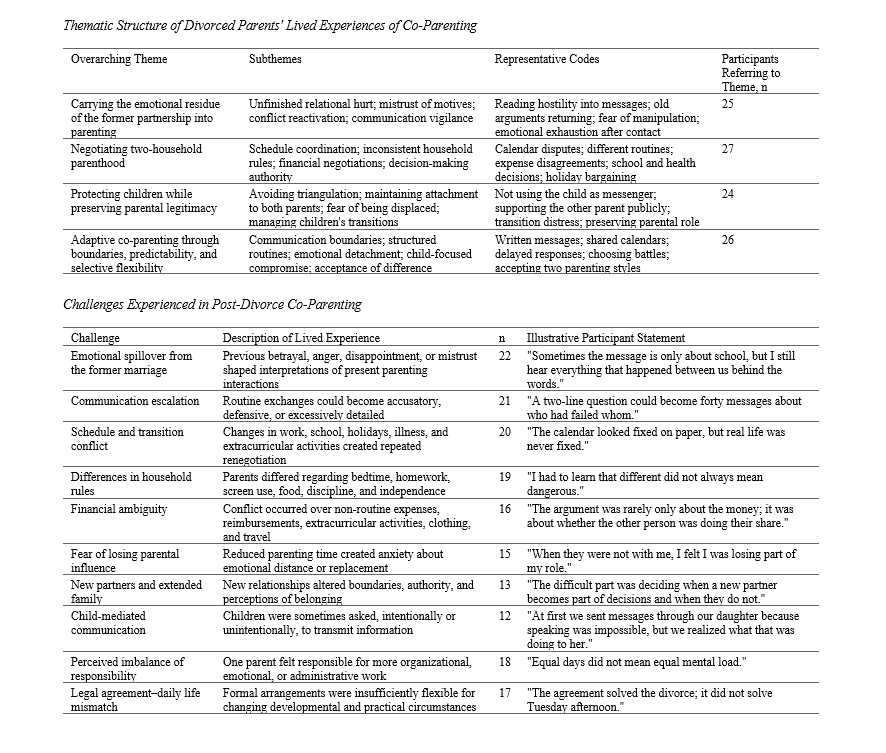
Findings: Four overarching themes were identified: carrying the emotional residue of the former partnership into parenting; negotiating two-household parenthood; protecting children while preserving parental legitimacy; and developing adaptive co-parenting through boundaries, predictability, and selective flexibility. Participants described how unresolved marital hurt and mistrust often intensified routine parenting interactions, while disagreements regarding schedules, household rules, finances, and parental authority repeatedly required negotiation. More adaptive arrangements emerged when parents used structured communication, shared calendars, delayed responses, child-centered decision-making, direct parent-to-parent information exchange, and clearly defined boundaries.
Conclusion: Post-divorce co-parenting is a dynamic process in which sustainable adaptation depends on separating former-partner conflict from parenting responsibilities, establishing predictable boundaries, protecting children from interparental tension, and combining structured coordination with context-sensitive flexibility.
Downloads
References
Anitta, M., & Ramshida, A. P. (2024). An Exploration Into Parallel Stories of Co-Parenting. International Journal for Multidisciplinary Research, 6(6). https://doi.org/10.36948/ijfmr.2024.v06i06.29956
Augustijn, L. (2021a). The Association Between Joint Physical Custody and Children’s Mental Health. Do Children’s Experiences of Parental Loyalty Conflicts Moderate the Relationship? Children & Society, 36(4), 494-510. https://doi.org/10.1111/chso.12508
Augustijn, L. (2021b). Children’s Experiences of Stress in Joint Physical Custody. Child & Youth Care Forum, 51(5), 867-884. https://doi.org/10.1007/s10566-021-09659-5
Augustijn, L. (2021c). The Relation Between Joint Physical Custody, Interparental Conflict, and Children's Mental Health. Journal of Family Research, 33(3), 613-636. https://doi.org/10.20377/jfr-621
Autonen-Vaaraniemi, L. (2022). Family Professionals’ Attitudes and Stance-Taking on Post-Divorce Fatherhood: A Qualitative Attitude Approach. International Journal of Child Youth and Family Studies, 13(1), 56-81. https://doi.org/10.18357/ijcyfs131202220658
Beckmeyer, J. J., & Russell, L. (2024). Identifying a Typology of Helpful Post‐divorce Family Assets: Implications for Divorce Education. Family Court Review, 62(3), 455-473. https://doi.org/10.1111/fcre.12808
Cao, H., Fine, M. A., & Zhou, N. (2022). The Divorce Process and Child Adaptation Trajectory Typology (DPCATT) Model: The Shaping Role of Predivorce and Postdivorce Interparental Conflict. Clinical Child and Family Psychology Review, 25(3), 500-528. https://doi.org/10.1007/s10567-022-00379-3
Crapo, J. S., Turner, J. J., Higginbotham, B. J., & Bradford, K. (2024). The Effects of Resolution Method of Child Custody and Support Plans on Parental Well‐being During the Divorce Process: Implications From and for Divorce Education. Family Court Review, 62(3), 474-492. https://doi.org/10.1111/fcre.12809
d’Orsi, D., & Diniz, E. (2025). Navigating Shared Custody With Young Children: A Qualitative Study of Fathers’ Experiences. The Journal of Men S Studies, 33(3), 481-501. https://doi.org/10.1177/10608265251326439
Darwiche, J., Nunes, C. E., Ghaziri, N. E., Imesch, C., & Bessero, S. (2021). Coparenting Interventions and Shared Physical Custody: Insights and Challenges. 253-282. https://doi.org/10.1007/978-3-030-68479-2_12
Ferraro, A. J., Wilkins‐Clark, R. E., Beckmeyer, J. J., Russell, L., Brimhall, A. S., & Markham, M. S. (2024). Rethinking Utility in Divorce Education: Use of Multi‐program Evaluation Data to Uncover Markers of Post‐divorce Adjustment. Family Court Review, 62(3), 493-511. https://doi.org/10.1111/fcre.12807
Goldberg, A. E., Allen, K. R., & Smith, J. Z. (2021). Divorced and Separated Parents During the COVID‐19 Pandemic. Family Process, 60(3), 866-887. https://doi.org/10.1111/famp.12693
Hamano, T. (2021). Examining the Problem of Joint Custody in Japan: State Familialism and Family Law Reform. International Journal of Social Welfare, 30(4), 410-418. https://doi.org/10.1111/ijsw.12486
Jacob, N. (2023). Parental Education and Child Development: Long and Short Term Outcomes. https://doi.org/10.21203/rs.3.rs-3676107/v1
Josimar Antônio de Alcântara, M., & Ormerod, T. C. (2021). A Comparative Look at Divorce, Laws and the Best Interests of the Child After Parental Separation in Brazil and England. Revista Da Faculdade De Direito Ufpr, 66(2), 95. https://doi.org/10.5380/rfdufpr.v66i2.74001
Josimar Antônio de Alcântara, M., & Ormerod, T. C. (2022a). Uncertainty in Child Custody Cases After Parental Separation: Context and Decision-Making Process. https://doi.org/10.21203/rs.3.rs-2109096/v3
Josimar Antônio de Alcântara, M., & Ormerod, T. C. (2022b). Uncertainty in Child Custody Cases After Parental Separation: Context and Decisionmaking Process. https://doi.org/10.21203/rs.3.rs-2109096/v2
Josimar Antônio de Alcântara, M., & Ormerod, T. C. (2024). Making Sense Out of Uncertainty: Cognitive Strategies in the Child Custody Decision-Making Process. Frontiers in psychology, 15. https://doi.org/10.3389/fpsyg.2024.1387549
Karahan, A. S. (2021). Boşanma Sürecinde Ortak Ebeveynlik Ve Ortak Velayete İlişkin Bir Derleme. Opus Uluslararası Toplum Araştırmaları Dergisi. https://doi.org/10.26466/opus.970966
Kenneth, K. K. (2024). A Comparative Analysis of Child Custody and Access Rights After Divorce or Separation in Kenya and England. Essays of Faculty of Law University of Pécs Yearbook of [Year](1). https://doi.org/10.15170/studia.2024.01.11
Larouche, K., Drapeau, S., Lachance, V., Ivers, H., Baude, A., Gagné, M. H., & Dussault, S. (2024). Post‐separation Parental Conflict and Father–child Physical Contact: A Bidirectional Study. Personal Relationships, 31(3), 816-835. https://doi.org/10.1111/pere.12564
Markoç, İ. (2023). Feeling Like Home Again: After Divorce Processes From Different Family Perspective. Journal of Family Counseling and Education, 7(2), 55-72. https://doi.org/10.32568/jfce.1175330
Menon, S. (2024). International Family Justice as Collaborative Justice. Family Court Review, 62(2), 290-308. https://doi.org/10.1111/fcre.12781
Park, S. Y., Hardesty, J. L., & Ogolsky, B. G. (2026). Examining the Impact of Divorce Law Reform on Divorce Processes and Parenting Arrangements in Illinois. Family Relations, 75(4), 2505-2522. https://doi.org/10.1111/fare.70177
Peixoto, J., Gonçalves, M. A. V., Gaspar, M. F., & Matos, M. (2022). Developing a Valid and Reliable Cross-Cultural Measure of Coparenting Conflict Between Divorced Parents: The Portuguese Version of the Acrimony Scale. Journal of Child and Family Studies, 31(6), 1664-1682. https://doi.org/10.1007/s10826-022-02233-0
Pires, M., & Martins, M. C. (2021). Parenting Styles, Coparenting, and Early Child Adjustment in Separated Families With Child Physical Custody Processes Ongoing in Family Court. Children, 8(8), 629. https://doi.org/10.3390/children8080629
Reimann, M. (2023). At Mum’s Place, at Dad’s Place, at Home. How Children Do Family in Joint Physical Custody Arrangements. Problemy Polityki Społecznej Studia I Dyskusje, 61(2), 1-15. https://doi.org/10.31971/pps/170163
Riser, Q. H. (2024). Joint Physical Custody and Children’s Physical and Mental Health. https://doi.org/10.21203/rs.3.rs-5390634/v1
Riyaz, A. (2024). Post-Divorce Challenges Faced by Men in the Maldives: An Exploratory Study. The Maldives National Journal of Research, 12(2), 19-42. https://doi.org/10.62338/m02hjr40
Sandberg, K. (2023). Shared Parenting and Father Involvement After Divorce in Denmark. Frontiers in psychology, 14. https://doi.org/10.3389/fpsyg.2023.1223574
Steinbach, A. (2023). Coparenting as a Mediator Between Physical Custody Arrangements and Children's Mental Health. Family Process, 63(1), 284-298. https://doi.org/10.1111/famp.12844
Steinbach, A., Augustijn, L., & Corkadi, G. (2020). Joint Physical Custody and Adolescents’ Life Satisfaction in 37 North American and European Countries. Family Process, 60(1), 145-158. https://doi.org/10.1111/famp.12536
Stock, N. M., Costa, B., Parnell, J., Johns, A. L., Crerand, C. E., Feragen, K. B., Stueckle, L. P., Magee, L., Hotton, M., Tumblin, M., Schefer, A., Drake, A. F., & Heike, C. L. (2024). A Conceptual Thematic Framework of Psychological Adjustment in Caregivers of Children With Craniofacial Microsomia. The Cleft Palate-Craniofacial Journal, 62(7), 1228-1240. https://doi.org/10.1177/10556656241245284
Sururie, R. W., Hopipah, E. N., Witro, D., Diana, R., & Sopiyan, M. (2024). Co-Parenting Model in Resolving Child Custody Disputes in Urban Muslim Families. Petita Jurnal Kajian Ilmu Hukum Dan Syariah, 9(1), 250-268. https://doi.org/10.22373/petita.v9i1.277
Walper, S., Entleitner-Phleps, C., & Langmeyer, A. N. (2021). Shared Physical Custody After Parental Separation: Evidence From Germany. 285-308. https://doi.org/10.1007/978-3-030-68479-2_13
Wong, H. P. C., & Bansak, C. (2025). Child Custody Laws and Partners' Cooperation: An Analysis of Married and Unmarried Mothers During the Time of COVID‐19. Economic Inquiry, 63(3), 759-784. https://doi.org/10.1111/ecin.13276
Zartler, U. (2021). Children and Parents After Separation. https://doi.org/10.4337/9781788975544.00029
Downloads
Additional Files
Publication Timeline
- Submitted
- Revised
- Accepted