A Qualitative Study of the Psychological Empowerment of Women with a Healthy Adult Mode
DOI:
https://doi.org/10.61838/kman.aftj.5.4.13Keywords:
Healthy Adult, psychological empowerment, women, schema mode, schema therapyAbstract
Objective: The Healthy Adult mode is one of the primary modes in schema therapy, reflecting maturity, mental health, and good judgment. The present study aimed to qualitatively investigate the psychological empowerment of women with a Healthy Adult mode.
Methods: This qualitative study was conducted using a phenomenological approach. Participants included women aged 20-40 from Isfahan Province in 2023, selected through purposive sampling based on inclusion criteria. Data were examined using semi-structured, in-depth interviews. Data saturation was achieved with 20 interviews. Data were analyzed using Colaizzi's seven-step method.
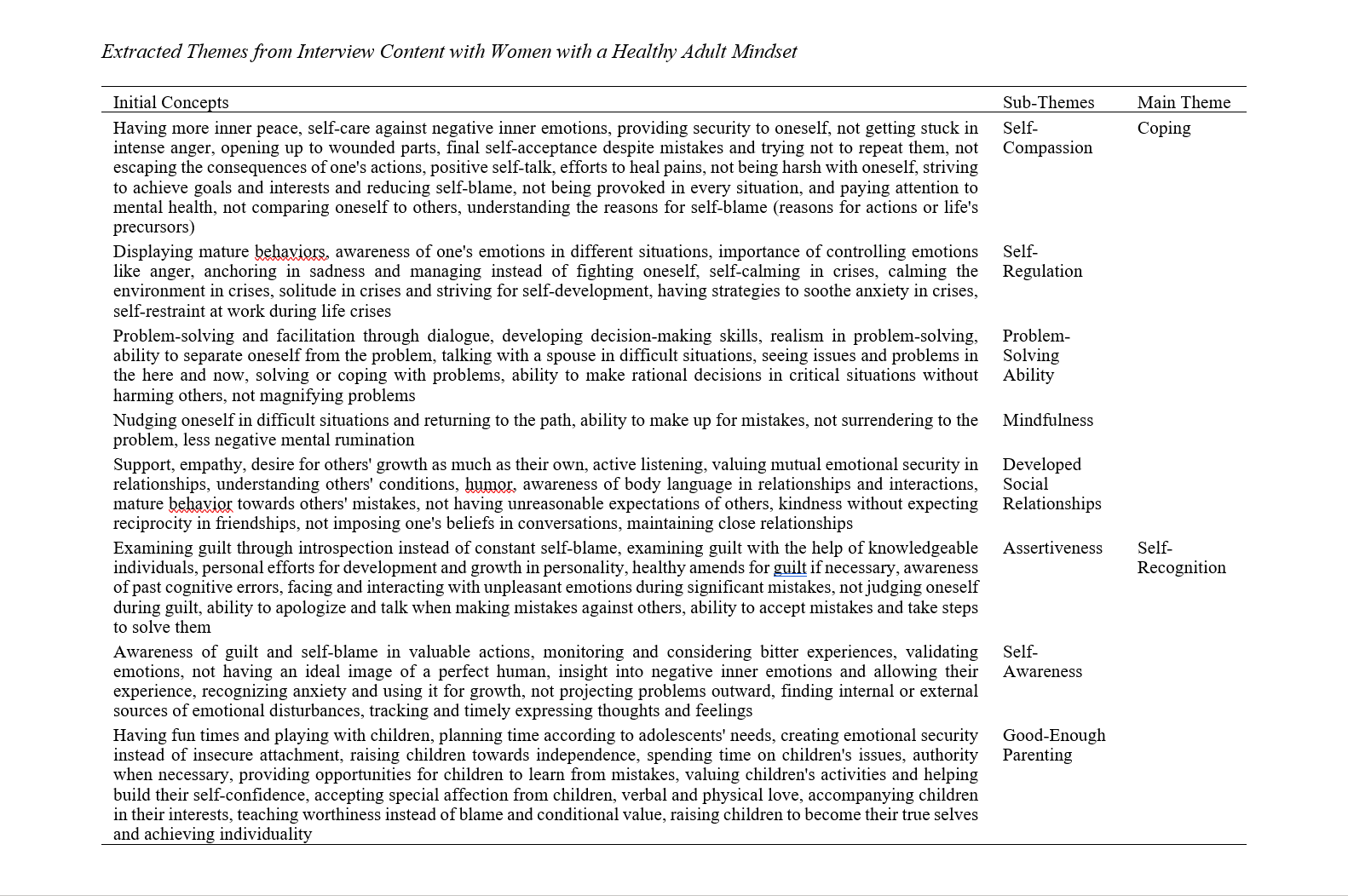
Findings: After interviewing women with a Healthy Adult mode and analyzing the data, 80 initial codes, 8 sub-themes, and 2 main themes were extracted. Coping and self-awareness were classified under the main themes, and self-compassion, self-regulation, problem-solving ability, mindfulness, developed social relationships, assertiveness, self-awareness, and the concept of a "good enough" parent were classified under the sub-themes.
Conclusion: Based on the findings of this study, it can be concluded that Iranian women with a Healthy Adult mode have developed components of psychological empowerment. Ultimately, it is suggested that counseling centers and organizations use practical services based on the findings of this research to enhance the psychological empowerment and promote the adult state of personality in women.
Downloads
References
Bagherzade, S., Hosseini Tabaghdehi, S. L., & Hafezian, M. (2018). Relationship of self-awareness and self-regulated learning to social adjustment among girl high school students. Journal of Educational Psychology Studies, 15(30), 29-50. https://doi.org/10.22111/jeps.2018.3607
Basile, B., Tenore, K., & Mancini, F. (2018). Investigating schema therapy constructs in individuals with depression. J Psychol Clin Psychiatry, 9(2), 214-221. https://apc.it/wp-content/uploads/2018/05/2018-Investigating-schema-therapy-Basile-et-al.pdf
Cassidy, J., & Shaver, P. R. (1999). Handbook of attachment: Theory, research, and clinical applications. Rough Guides. https://books.google.com/books?hl=en&lr=&id=haEfq-nKqjgC&oi=fnd&pg=PA3&dq=26.+Cassidy,+J.,+%26+Shaver,+PR.+(2002).+Handbook+of+Attachment:+Theory,+Research,+and+Clinical+Applications:+Guilford+Publications.&ots=Tn3G6c4jkO&sig=EN2S_cL7Df9Oe3fiGWyrp9BEH8A
Duflo, E. (2012). Women Empowerment and Economic Development. Journal of Economic Literature, 50(4), 1051–1079. https://doi.org/10.1257/jel.50.4.1051
Edwards, D. J. A. (2022). Using Schema Modes for Case Conceptualization in Schema Therapy: An Applied Clinical Approach [Review]. Frontiers in psychology, 12. https://doi.org/10.3389/fpsyg.2021.763670
Faghirpoor, M., & Ahmadi, E. (2019). Study of the Relationship between Psychological Empowerment and Mental Health in Female Heads of Households in Rasht. Family and Health, 9(1), 13-27. https://journal.astara.ir/article_246684.html
Ghabadizade, S. H., Yosefi, N., & Ghadery, F. (2019). The role of early maladaptive schemas, coping styles and cognitive emotion regulation strategies in predicting students' tendency to addiction. Journal of School Psychology, 7(4), 121-142. https://doi.org/10.22098/jsp.2019.751
Ghasemi, M., Badsar, M., & Falahati, L. (2023). Investigating the Role of Psychological Variables on the Rural Women's Empowerment in Environmental Conservation. Environmental Researches, 13(26), 335-354. https://doi.org/10.22034/eiap.2023.170002
Gilbert, P. (2009). Introducing compassion-focused therapy. Advances in psychiatric treatment, 15(3), 199-208. https://doi.org/10.1192/apt.bp.107.005264
Haeyen, S. (2019). Strengthening the Healthy Adult Self in Art Therapy: Using Schema Therapy as a Positive Psychological Intervention for People Diagnosed With Personality Disorders [Hypothesis and Theory]. Frontiers in psychology, 10. https://doi.org/10.3389/fpsyg.2019.00644
Kazemian, S., Fadakar Davarani, F., & Seifi, M. (2019). Study and Comparison of Psychological Empowerment Indices of Rural and Urban Women in Crisis. Woman in Development & Politics, 17(3), 349-368. https://doi.org/10.22059/jwdp.2020.286143.1007690
Khaledi, A., Cherami, M., Amadi, R., & Sharifi, T. (2022). Validation and Effectiveness of Women’s Psychological Empowerment Package on Resilience and Mental Health of Women with Veteran Husbands. ajaums-mcs, 9(3), 216-230. http://mcs.ajaums.ac.ir/article-1-537-en.html
Lobbestael, J., Arntz, A., & Sieswerda, S. (2005). Schema modes and childhood abuse in borderline and antisocial personality disorders. Journal of Behavior Therapy and Experimental Psychiatry, 36(3), 240-253. https://doi.org/10.1016/j.jbtep.2005.05.006
Phillips, K., Brockman, R., Bailey, P. E., & Kneebone, I. I. (2020). Schema in older adults: does the schema mode model apply? Behavioural and Cognitive Psychotherapy, 48(3), 341-349. https://doi.org/10.1017/S1352465819000602
Renner, F., DeRubeis, R., Arntz, A., Peeters, F., Lobbestael, J., & Huibers, M. J. H. (2018). Exploring mechanisms of change in schema therapy for chronic depression. Journal of Behavior Therapy and Experimental Psychiatry, 58, 97-105. https://doi.org/10.1016/j.jbtep.2017.10.002
Roediger, E., Stevens, B. A., & Brockman, R. (2018). Contextual schema therapy: An integrative approach to personality disorders, emotional dysregulation, and interpersonal functioning. New Harbinger Publications. https://www.researchgate.net/publication/325430387_Contextual_Schema_Therapy_An_Integrative_Approach_to_Personality_Disorders_Emotional_Dysregulation_and_Interpersonal_Functioning
Roelofs, J., Muris, P., & Lobbestael, J. (2015). Acting and Feeling Like a Vulnerable Child, an Internalized “Bad” Parent, or a Healthy Person: The Assessment of Schema Modes in Non-Clinical Adolescents. Journal of personality disorders, 30(4), 469-482. https://doi.org/10.1521/pedi_2015_29_209
Shaeban, M., Peyvastegar, m., & khosravi, z. (2021). The effectiveness of the localized model of schema therapy on changing the schema of therapists. Journal-of-Psychological-Science, 20(100), 511-520. http://psychologicalscience.ir/article-1-821-en.html
Thomas, K. W., & Velthouse, B. A. (1990). Cognitive Elements of Empowerment: An "Interpretive" Model of Intrinsic Task Motivation. The Academy of Management Review, 15(4), 666-681. https://doi.org/10.2307/258687
Videler, A. C., van Royen, R. J. J., Legra, M. J. H., & Ouwens, M. A. (2020). Positive schemas in schema therapy with older adults: clinical implications and research suggestions. Behavioural and Cognitive Psychotherapy, 48(4), 481-491. https://doi.org/10.1017/S1352465820000077
Wu, Y., Yu, W., Wu, X., Wan, H., Wang, Y., & Lu, G. (2020). Psychological resilience and positive coping styles among Chinese undergraduate students: a cross-sectional study. BMC psychology, 8(1), 79. https://doi.org/10.1186/s40359-020-00444-y
Downloads
Additional Files
Publication Timeline
- Submitted
- Revised
- Accepted
Issue
Section
License

This work is licensed under a Creative Commons Attribution-NonCommercial 4.0 International License.