The Role of Modern Marital Therapies: A Comparative Analysis of the Effectiveness of the Gottman Approach and Cognitive-Behavioral Therapy on Marital Satisfaction (A Case Study of Married Students at Islamic Azad University, Hamedan Branch)
DOI:
https://doi.org/10.61838/kman.aftj.6.3.4Keywords:
Gottman couple therapy, cognitive-behavioral couple therapy, marital satisfaction, married studentsAbstract
Objective: This study aimed to compare the effectiveness of Gottman couple therapy and cognitive-behavioral couple therapy in improving marital satisfaction among married students at Islamic Azad University, Hamedan Branch.
Methods: The study utilized a quasi-experimental pretest-posttest design with a control group. A total of 45 married students were selected through convenience sampling and randomly assigned into three groups: Gottman couple therapy (n = 15), cognitive-behavioral couple therapy (n = 15), and a control group (n = 15). The intervention groups received 10 sessions of Gottman couple therapy or 8 sessions of cognitive-behavioral couple therapy, while the control group received no intervention. The ENRICH Marital Satisfaction Questionnaire (47-item short form) was used to assess marital satisfaction before and after the interventions. Data were analyzed using SPSS-24 software, employing multivariate analysis of covariance (MANCOVA) and one-way analysis of variance (ANOVA) to compare the effects of the interventions.
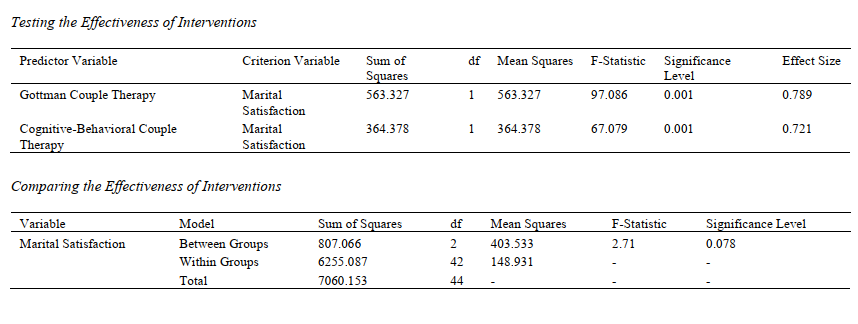
Findings: The results indicated that both Gottman couple therapy and cognitive-behavioral couple therapy significantly improved marital satisfaction compared to the control group (p < 0.05). The effect size analysis revealed that Gottman couple therapy had a greater impact (η² = 0.789) compared to cognitive-behavioral couple therapy (η² = 0.721), particularly in areas related to emotional communication, conflict management, and decision-making. However, the ANOVA results showed no statistically significant difference between the two intervention groups (p > 0.05), indicating that both approaches were similarly effective in enhancing marital satisfaction.
Conclusion: Both Gottman couple therapy and cognitive-behavioral couple therapy were effective in increasing marital satisfaction among married students, with Gottman couple therapy demonstrating a slightly greater impact. Given the shared principles of these approaches, future research should explore the potential benefits of integrating them to create a more comprehensive intervention for couples.
Downloads
References
Amini, S., Mardanirad, M., Babadi, A. A. K., & Poshaneh, K. (2024). The Structural Model of Marital Satisfaction Based on Relational Beliefs With the Mediating Role of Cognitive Emotion Regulation in Married Women. Shenakht Journal of Psychology and Psychiatry, 11(03), 99-109. https://doi.org/10.32598/shenakht.11.3.99
Ashkenazi, S., Wagner, J., Cunningham, M., & Matson, R. (2024). Body image and its impact on marital satisfaction. Journal of Marriage Studies, 22(1), 54-70.
Azami, M., & Nobakht, M. (2020). The effectiveness of the Gottman couple therapy method on marital satisfaction among law enforcement personnel in Kermanshah. Seventh International Conference on New Research Achievements in Educational Sciences, Psychology, and Social Sciences. https://civilica.com/doc/1122629
Babapour Kheiraddin, J., Nazari, M. A., & Rashidzadeh, L. (2011). The effectiveness of cognitive-behavioral therapy on marital satisfaction and intimacy among chemically injured veteran couples. Modern Psychological Research (University of Tabriz Psychology), 6(24), 1-18. https://www.sid.ir/fa/journal/ViewPaper.aspx?ID=211248
Borhani Kakhki, M., Narimani, M., & Mousazadeh, T. (2020). The effectiveness of cognitive-behavioral couple therapy on the quality of life and marital satisfaction in couples seeking unresolved divorce. Women and Family Studies, 13(50), 133-147. https://jwsf.tabriz.iau.ir/article_676307.html
Capuzzi, D., & Stauffer, M. D. (2016). Foundations of Couples, Marriage, and Family Counseling. Jungle. https://www.amazon.com/Foundations-Couples-Marriage-Family-Counseling/dp/1118710991
Dadashzadeh Sangari, Y., & Ghanbari, F. (2022). A review of cognitive-behavioral couple therapy. Scientific Congress of Psychology, Educational Sciences, and Counseling Students,
Dattilio, F. M., & Beck, A. T. (2013). Cognitive-Behavioral Therapy with Couples and Families: A Comprehensive Guide for Clinicians. Guilford Press. https://www.guilford.com/books/Cognitive-Behavioral-Therapy-with-Couples-and-Families/Frank-Dattilio/9781462514168?srsltid=AfmBOoq2cXkrQLCpg43VbfJodLRV9B4fpAhSEhN9P_ioFBsR8AImvFhz
DeCrimp, A., Robbins, M., & Green, J. (2021). Marital intimacy and life satisfaction. Family Psychology Journal, 38(2), 112-129.
Defanti, R. (2025). The Role of Emotional Intelligence in Moderating the Relationship Between Perceived Interparental Conflict and Marital Satisfaction Among Married Individuals. Jurnal Ilmu Keluarga Dan Konsumen, 18(1), 53-65. https://doi.org/10.24156/jikk.2025.18.1.53
Dobrowolska, M., Groyecka-Bernard, A., Sorokowski, P., Randall, A. K., Hilpert, P., Ahmadi, K., & Sorokowska, A. (2020). Global perspective on marital satisfaction. Sustainability, 12(21), 8817. https://doi.org/10.3390/su12218817
Dugal, C., Bakhos, G., Bélanger, C., & Godbout, N. (2018). Cognitive-behavioral psychotherapy for couples: An insight into the treatment of couple hardships and struggles. Cognitive Behavioral Therapy and Clinical Applications, 3(2), 125-135. https://doi.org/10.5772/intechopen.72104
Durães, R. S. S., Khafif, T. C., Lotufo-Neto, F., & Serafim, A. D. P. (2020). Effectiveness of cognitive behavioral couple therapy on reducing depression and anxiety symptoms and increasing dyadic adjustment and marital social skills: An exploratory study. The Family Journal, 28(4), 344-355. https://doi.org/10.1177/1066480720902410
Farhadnia, Z. (2016). The effectiveness of Gottman couple therapy on increasing intimacy and reducing marital problems in conflicting couples Ferdowsi University of Mashhad, Faculty of Educational Sciences and Psychology].
Fincham, F. D., Bradley, S., & Beach, S. R. (2018). Assessing marital satisfaction: A large-scale study. Family Psychology Journal, 35(1), 16-27. https://www.fincham.info/papers/decade%20review.pdf
Gholamrezaei, S., Hosseini, H., & Kariminejad, K. (2016). The effect of a cognitive-behavioral training program on marital satisfaction in women with hypoactive sexual desire disorder. Journal of Family Counseling and Enrichment, 2(2), 15-30. http://ensani.ir/fa/article/371993/
Gottman, J. M. (1999). The marriage clinic: A scientifically-based marital therapy. W. W. Norton & Company. https://www.amazon.com/Marriage-Clinic-Scientifically-Professional-Hardcover/dp/0393702820
Gottman, J. M. (2008). Gottman couple therapy. In A. S. Gurman (Ed.), Clinical Handbook of Couple Therapy (pp. 92-123). The Guilford Press. https://www.amazon.com/Clinical-Handbook-Couple-Therapy-Fourth/dp/1593858213
Gurman, A. S., Lebow, J. L., & Snyder, D. K. (2015). Clinical Handbook of Couple Therapy. Guilford Press. https://www.guilford.com/books/Clinical-Handbook-of-Couple-Therapy/Lebow-Snyder/9781462550128?srsltid=AfmBOopuU6spIvqIuCTIpl5F115Iyaco7ZgbXyS_BSfk6xAjjYkT0Zix
Hamedi, B., Shafiabadi, A., Navabi Nejad, S., & Dalavar, A. (2013). Investigating the effectiveness of the emotion-focused therapy approach on increasing marital intimacy and self-efficacy in student couples. Educational Management Research, 4(3), 43-56. https://www.noormags.ir/view/fa/articlepage/1100712/
Holzmann, I. G. (2015). Quality of Life and Health. Blackwell Wissenschafts-Verlag. https://journals.ihu.ac.ir/article_206026.html
Hossein Ghorban, N., & Abbaspour Azar, Z. (2019). The effectiveness of cognitive-behavioral couple therapy on marital quality and intimacy in couples on the verge of divorce. Family and Health Quarterly, 9(3), 100-113. https://journal.astara.ir/article_249616.html
Hosseini, S. O., & Khajouei Zadeh, Z. (2016). The relationship between mindfulness and marital satisfaction in married men and women working in the Kurdistan Welfare Organization. Journal of Family Counseling and Enrichment, 2, 14-24. https://fpcej.ir/article-1-94-fa.html
Hou, Y., Jiang, F., & Wang, X. (2019). Marital commitment, communication and marital satisfaction: An analysis based on actor-partner interdependence model. International journal of psychology, 54(3), 369-376. https://doi.org/10.1002/ijop.12473
Kavitha, C., Rangan, U., & Nirmalan, P. K. (2014). Quality of life and marital adjustment after cognitive behavioural therapy and behavioural marital therapy in couples with anxiety disorders. JOURNAL of CLINICAL and DIAGNOSTIC RESEARCH, 8(8), 1-4. https://pmc.ncbi.nlm.nih.gov/articles/PMC4190776/
Khanjani Voshki, S., Shafiabadi, A., Farzad, V., & Fatahi Zadeh, M. (2016). Comparison of the effectiveness of cognitive-behavioral couple therapy and acceptance and commitment therapy on marital intimacy in conflicting couples in Isfahan. Knowledge and research in applied psychology, 17(4), 31-40. https://www.sid.ir/paper/163829/fa
Kim, D., Kwon, Y., & Xin, S. (2021). The Effects of Enjoyable Couple Activity and Common Dyadic Coping on Marital Satisfaction through Mediation of Sexual Intimacy: Focusing on Urban Chinese Women in the Early Years of Marriage. Family and Environment Research, 59(1), 45-58. https://doi.org/10.6115/fer.2021.004
King, M. E. (2016). Marital satisfaction. Encyclopedia of family studies, 1-2. https://doi.org/10.1002/9781119085621.wbefs054
Mahallati, A., Porshehiyari, M. S., & Sepehri, Z. (2019). Comparison of the effectiveness of Gottman couple therapy and Dattilio couple therapy on improving sexual satisfaction in couples. Journal of Social Health, 7(1), 95-106. https://www.sid.ir/paper/392249/en
Saeimi, H., Besharat, M. A., & Asgharnezhad Farid, A. A. (2020). Comparing the effectiveness of Gottman couple therapy and emotion-focused couple therapy on marital intimacy. Family Psychology, 5(2), 39-52. https://www.sid.ir/paper/370948/
Safarpour, A., Zehrakar, K., & Farzad, V. (2022). The effectiveness of Gottman couple therapy on improving quality of life and reducing marital burnout. Applied Family Therapy, 3(12), 580-599. https://doi.org/10.61838/kman.aftj.3.3.33
Saki Zadeh, F. (2013). Investigating the effectiveness of marital skills training based on the Gottman model on marital stress and happiness in women Kharazmi University, Tehran]. https://elmnet.ir/article/10635337-11252/
Sanagooei Zadeh, M. (2021). A structured self-care model for marital intimacy based on Islamic perspectives. Cultural Psychology, 5(1), 166-194. https://www.sid.ir/paper/1057336/fa
Shayan, A., Taravati, M., Garousian, M., Babakhani, N., Faradmal, J., & Masoumi, S. Z. (2018). The effect of cognitive behavioral therapy on marital quality among women. International journal of fertility & sterility, 12(2), 99. https://www.ijfs.ir/article_45474.html
Shokoohi-Yekta, M., Akbari Zardkhaneh, S., Alavinezhad, S., & Sajjadi Anari, S. (2019). Teaching emotion regulation skills based on cognitive-behavioral approach and its efficacy on marital satisfaction and couple's happiness. Journal of Psychological Science, 18(80), 887-896. https://psychologicalscience.ir/article-1-483-fa.html
Soufi Amleshi, R., Zamordi, S., & Razavi, M. A.-S. (2018). The effectiveness of Gottman-based couple therapy on marital satisfaction in married women. National Conference on Innovative Ideas in Psychology and Educational Sciences with Emphasis on Recent Scientific Research,
Vand, N. A. (2022). The Effect of Group Cognitive-Behavioral Couple Therapy on Marital Relationships. https://www.ejcmpr.com/article_171397.html
Villabø, M. A., & Compton, S. N. (2019). Cognitive Behavioral Therapy. In S. N. Compton, M. A. Villabø, & H. Kristensen (Eds.), Pediatric Anxiety Disorders (pp. 317-334). Academic Press. https://doi.org/10.1016/B978-0-12-813004-9.00015-3
Wilcox, B., Lawrence, A., & Griffin, D. (2021). The effects of marital intimacy on mental health. Psychological review, 84, 22-38. https://link.springer.com/article/10.1007/s11482-019-09742-z
Downloads
Additional Files
Publication Timeline
- Submitted
- Revised
- Accepted
Issue
Section
License
Copyright (c) 2025 Abdolreza Saravi (Corresponding Author); Ahmad Ali jadidyan, Arezo Nejatian Tanha (Author)

This work is licensed under a Creative Commons Attribution-NonCommercial 4.0 International License.