Designing a Structural Model of Marital Satisfaction Based on the Components of Systemic–Spiritual Couple Therapy with the Mediating Role of Power Structure in the Family
DOI:
https://doi.org/10.61838/kman.aftj.4255Keywords:
Marital satisfaction, systemic–spiritual couple therapy, family power structure, structural equation modeling, couples counselingAbstract
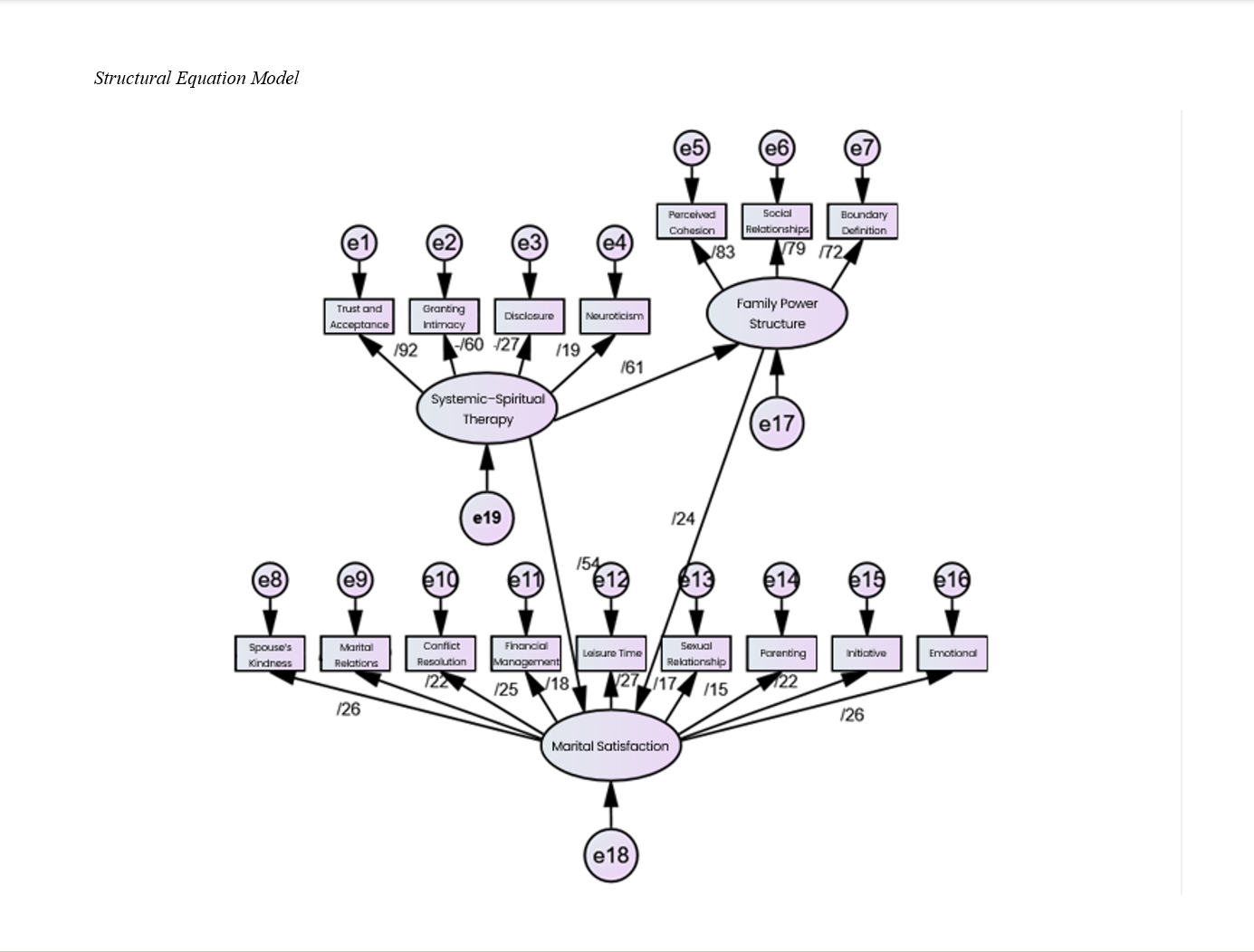
Objective: This study aimed to design and validate a structural model of marital satisfaction based on the components of systemic–spiritual couple therapy, with the mediating role of the family power structure.
Methods and Materials: The research adopted a descriptive–correlational design with an applied objective. The statistical population included all couples in Isfahan who had been married for at least five years. Using convenience sampling, 384 participants (192 couples) were selected from counseling centers. Participants completed the ENRICH Marital Satisfaction Questionnaire, the Family Power Structure Questionnaire, and the Systemic–Spiritual Couple Therapy Scale. Data were analyzed using Pearson correlation, multiple regression, and structural equation modeling (SEM) with AMOS software.
Findings: Results showed that systemic–spiritual couple therapy had a significant positive effect on marital satisfaction (β = 0.54, p < 0.001) and on the family power structure (β = 0.61, p < 0.001). The family power structure also significantly predicted marital satisfaction (β = 0.24, p < 0.01), confirming its mediating role. The overall model demonstrated good fit indices, supporting the hypothesized relationships among variables. Regression analysis also revealed that the components of systemic–spiritual couple therapy and family power structure together explained 25% of the variance in marital satisfaction (R² = 0.25, F = 66.51, p < 0.001).
Conclusion: The findings support the effectiveness of systemic–spiritual couple therapy in enhancing marital satisfaction, both directly and indirectly through improvements in family power dynamics. The proposed model underscores the importance of integrating spiritual and systemic interventions with structural family variables to improve relationship outcomes.
Downloads
References
Abedi, G., Ataeifar, R., & Ghamari, M. (2024). The Effectiveness of Group Marital Conflict Resolution Training Based on Choice Theory on Emotional Divorce and Hope for Life in Married Women. International Journal of Education and Cognitive Sciences, 5(3), 136-146. https://doi.org/10.61838/kman.ijecs.5.3.10
Ashori, S., Zade-Mohammadi, A., Ramezani, M. A., Vafaei, A., & Karimi, R. (2022). The Mediating Role of Spiritual Tendencies in the Relationship between Cognitive Emotion Regulation and Marital Adjustment. Journal of Pizhūhish dar dīn va Salāmat (i.e., Research on Religion & Health), 8(2), 89-102. https://doi.org/10.22037/jrrh.v8i2.33590
Derakhshan , N., Shafiabadi , A., & Naeimi , E. (2023). Evaluation of effective factors in family continuity in infertile couples with marital satisfaction. Journal of Woman and Study of Family, 16(60), 227-244. https://www.magiran.com/paper/2638717
Hakimi Dezfouli, Z. S., & Ebrahimpour, G. (2024). The role of psychological flexibility, emotional empathy and spiritual experiences in predicting marital satisfaction of married women. Studies in Islam and Psychology. https://islamicpsy.rihu.ac.ir/article_2162.html?lang=en
Hakimi Dezfuli, Z. S., & Ibrahimpour, Q. (2023). The role of psychological flexibility, emotional empathy and spiritual experiences in predicting marital satisfaction of married women. Islamic Studies and Psychology. https://www.researchgate.net/publication/386051631_The_Role_of_Psychological_Flexibility_Emotional_Empathy_and_Spiritual_Experiences_in_the_Prediction_of_Marital_Satisfaction_of_Married_Women
Heydarnia, A., Abbassi, H., & Safari, S. (2021). Identifying Marital Enrichment Skills based on Culture. Journal of Family Research, 17(3), 328-351. https://doi.org/10.52547/jfr.17.3.328
Jan Bozorgi, M. (2016). The effect of spiritual systemic family therapy on marital satisfaction and family functioning (Mehr and power model). Journal of Islamic Women and Family Studies. https://journals.miu.ac.ir/article_1029.html
Kabiri, A., & Khakpour, R. (2020). Actional Space within the Family and Marital life Satisfaction (Case Study: Married Women in Urmia). Quarterly of Social Studies and Research in Iran, 9(2), 423-447. https://doi.org/10.22059/jisr.2020.300513.1050
Khakpour, I., Nazari, A. M., & Zahrakar, K. (2015). The role of family power structure dimensions in marital adjustment. Women and Family Cultural and Educational Journal, 9(30), 7-26. https://cwfs.ihu.ac.ir/article_201654.html
Khalili Baseri, E., Suleiman Nejad, H., Safara, M., & Ahmadi, V. (2023). The mediating role of adjustment styles in the relationship between spiritual health and marital satisfaction of nurses. Iranian Journal of Nursing Research, 18(5), 1-11. https://ijnr.ir/browse.php?a_id=2833&slc_lang=en&sid=1&printcase=1&hbnr=1&hmb=1
Movahed, M., Enayat, H., & Mardani, M. (2012). A study of the background factors related to the power distribution structure in the family (case study of married women in Shiraz). Studies and Social Research in Iran, 3(1), 159-178. https://jisr.ut.ac.ir/article_36566_1.html?lang=fa
Nasiri, Z., Hounarparvaran, N., Javadzadehshahshahani, F., & Samani, S. (2022). Investigating the precipitating and exhibiting factors of marital infidelity: a qualitative study. Journal of Applied Family Therapy, 3(1), 110-135. https://doi.org/10.22034/aftj.2022.305871.1208
Ramadhina, F., Wardani, R., & Rohinsa, M. (2023). Spirituality and Marital Satisfaction as Predictors of Subjective Happiness in Married Couples. https://doi.org/10.4108/eai.15-9-2022.2335887
Taghipour, Z., & Panah Ali, A. (2023). The effectiveness of spiritual therapy based on conscientiousness on increasing marital satisfaction and intimacy of couples in Tabriz city. Spiritual research in health sciences, 1(2), 120-130. https://doi.org/10.34172/srhs.2023.011
Tolo Takmili Torabi, N., Vakili, P., & Fattahi Andebil, A. (2020). The relationship between personality traits and marital satisfaction based on the mediation role of religious orientation. Applied Psychology, 14(1), 99-118. https://doi.org/10.52547/apsy.14.1.99
Downloads
Additional Files
Publication Timeline
- Submitted
- Revised
- Accepted
Issue
Section
License
Copyright (c) 2025 Sepideh Yavari (Author); Masoud Janbozorgi (Corresponding Author); Jafar Houshyari (Author)

This work is licensed under a Creative Commons Attribution-NonCommercial 4.0 International License.