Effectiveness of Emotion-Focused Therapy and Schema Therapy on Attachment Styles and Emotion Regulation in Women Affected by Infidelity
DOI:
https://doi.org/10.61838/kman.aftj.4389Keywords:
emotion-focused therapy, schema therapy, attachment styles, emotion regulation, marital infidelity, women affectedAbstract
Objective: The present study aimed to examine and compare the effectiveness of emotion-focused therapy and schema therapy on attachment styles and emotion regulation in women affected by infidelity.
Methods and Materials: This research employed a quasi-experimental design with a pretest–posttest and control group. The statistical population included all women affected by infidelity who referred to counseling centers in Tehran in 2023. From this population, 45 participants were selected using purposive sampling and randomly assigned to three groups: the first experimental group (emotion-focused therapy, 15 participants), the second experimental group (schema therapy, 15 participants), and the control group (15 participants). The experimental groups received the respective interventions across a set number of sessions, while the control group did not receive any intervention. All three groups were assessed at pretest, posttest, and follow-up stages using the Attachment Styles Questionnaire and the Emotion Regulation Questionnaire.
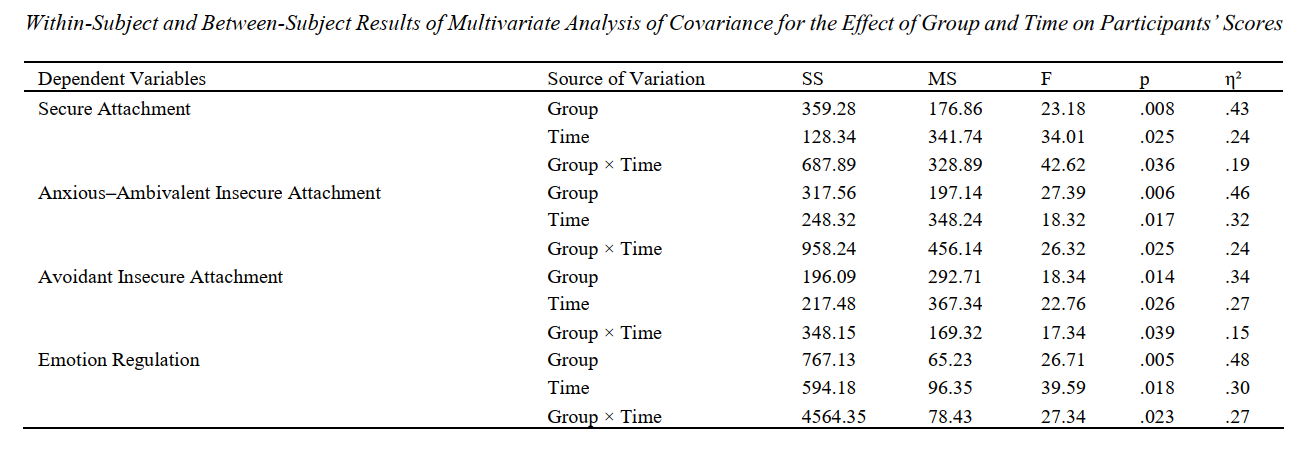
Findings: Data analysis using repeated measures analysis of variance and post hoc tests indicated that both therapeutic approaches led to significant improvements in attachment styles and enhanced emotion regulation abilities in women affected by infidelity (p < .05). Moreover, a comparison of results showed that schema therapy demonstrated greater effectiveness than emotion-focused therapy in certain indices.
Conclusion: Based on the findings, emotion-focused therapy and schema therapy can be considered effective approaches for promoting secure attachment styles and improving emotion regulation among women affected by infidelity.
Downloads
References
Abotalebi, H., Yazdchi, N., & Esmakhani Akbari Nejad, H. (2022). The effectiveness of cognitive emotion regulation training on psychological well-being and cognitive emotion regulation in addicted men in Isfahan. Community Health, 16(1), 23-33. https://www.sid.ir/paper/992841/en
Afsar, M., Hasani, F., & Farzad, V. L. (2022). The effectiveness of emotion-focused therapy on emotion regulation and attachment styles in women with borderline personality disorder. Journal of Faculty of Medicine, Mashhad University of Medical Sciences, 65(2), 654-666. https://mjms.mums.ac.ir/article_21232_en.html
Aghaee, A., Karezahi, F., & Farnam, A. (2021). Comparing the Effectiveness of Group Schema Therapy and Emotional Couple Therapy on Couples' Maladaptive Schemas. SALĀMAT-I IJTIMĀĪ (Community Health), 8(3), 371-385. https://journals.sbmu.ac.ir
Aghaei, A., Kharazee, F., & Farnam, A. (2021). A comparison of the effectiveness of schema therapy and group-based Emotion-Focused Couples Therapy on maladaptive schemas in couples. Social Health, 8(3), 375-385. https://www.academia.edu
Al-Yasin, S. A., & Mahmoudi, S. (2023). The effectiveness of schema therapy on attachment styles in individuals with dark personality traits. Proceedings of the 4th National Conference on Management, Psychology, and Behavioral Sciences, Tehran.
Amini, A., Ghorban-Shiroudi, S., & Khalatbari, J. (2022). Comparing the effectiveness of emotion management strategies training based on Emotion-Focused Couples Therapy and schema therapy-based couples therapy on sexual satisfaction and family functioning. Health System Research, 18(4), 297-306. http://hsr.mui.ac.ir
Asadu, N., & Egbuche, M. (2020). Effect of marital infidelity on the family: A perception study of Ihe/Owerre in Nsukka Local Government Area of Enugu State. Renaissance University Journal of Management and Social Sciences, 6(1), 21-31. http://rujmass.com/Journals/rujmass_2020_003.pdf
Bach, B., Lockwood, G., & Young, J. E. (2018). A new look at the schema therapy model: organization and role of early maladaptive schemas. Cognitive behaviour therapy, 47(4), 328-349. https://doi.org/10.1080/16506073.2017.1410566
Ben-Zur, H. (2020). Emotion-focused coping. In Encyclopedia of Personality and Individual Differences (pp. 1343-1345). https://doi.org/10.1007/978-3-319-24612-3_512
Bi̇çer, R. (2023). The effect of parenting style and emotional needs on partner preference: Examination from the Schema Therapy model (Publication Number Master's thesis) İzmir Ekonomi Üniversitesi]. https://www.researchgate.net
D'Rozario, A. B., & Pilkington, P. D. (2022). Parental separation or divorce and adulthood attachment: The mediating role of the Abandonment schema. Clinical Psychology & Psychotherapy, 29(2), 664-675. https://doi.org/10.1002/cpp.2659
Ecker, B., Ticic, R., & Hulley, L. (2024). Emotion-Focused Therapy (EFT). In Unlocking the Emotional Brain (pp. 172-179). Routledge. https://doi.org/10.4324/9781003231431-10
Edwards, D. J. A. (2022). Using schema modes for case conceptualization in schema therapy: an applied clinical approach. Frontiers in psychology, 12, 763670. https://doi.org/10.3389/fpsyg.2021.763670
Ferdowsi, S. (2018). Predicting attitudes toward marital infidelity based on attachment behaviors in marital relationships, quality of marital relationships, and attachment styles in married women. Contemporary psychology, 13(2), 149-157. https://doi.org/10.29252/bjcp.13.2.149
Gurvich, C., Thomas, N., Thomas, E. H., Hudaib, A. R., Sood, L., Fabiatos, K., & Kulkarni, J. (2021). Coping styles and mental health in response to societal changes during the COVID-19 pandemic. International Journal of Social Psychiatry, 67(5), 540-549. https://doi.org/10.1177/0020764020961790
Handelzalts, J. E., Levy, S., Molmen-Lichter, M., Ayers, S., Krissi, H., Wiznitzer, A., & Peled, Y. (2021). The association of attachment style, postpartum PTSD and depression with bonding-A longitudinal path analysis model, from childbirth to six months. Journal of affective disorders, 280, 17-25. https://doi.org/10.1016/j.jad.2020.10.068
Hovelius, E., Lindén, E., Bengtsson, H., & Håkansson, A. (2021). Self-schema, attachment style, and treatment outcome of patients in an opiate maintenance treatment unit. Frontiers in psychology, 12, 595883. https://doi.org/10.3389/fpsyg.2021.595883
Razaqi, S., Mansoubi Far, M., Havasie Sumar, N., & Tahmorsi, N. (2023). The effectiveness of Emotion-Focused Therapy on emotional regulation and quality of life in music students exhibiting social anxiety disorder traits. Journal of Psychological Sciences, 22(27), 1335-1352. http://psychologicalscience.ir
Roshan Chesli, R., Farahani, H., & Morvaridi, M. (2023). Structural model fitting of the relationship between attachment styles and emotional schemas considering the mediating variables of emotional regulation and cognitive flexibility with marriage willingness. Clinical Psychology and Personality, 21(1), 57-72. https://cpap.shahed.ac.ir
Sun, J., & Miller, C. H. (2023). Insecure attachment styles and phubbing: The mediating role of problematic smartphone use. Human Behavior and Emerging Technologies, 2023(1), 4331787. https://doi.org/10.1155/2023/4331787
Suveg, C., Jones, A., Davis, M., Jacob, M. L., Morelen, D., Thomassin, K., & Whitehead, M. (2018). Emotion-focused cognitive-behavioral therapy for youth with anxiety disorders: A randomized trial. Journal of abnormal child psychology, 46, 569-580. https://doi.org/10.1007/s10802-017-0319-0
Teymoori, Z., Mojtabaei, M., & Rezazadeh Seyed, M. (2021). Comparing the effectiveness of Emotion-Focused Couples Therapy and Compassion-Focused Therapy on emotion regulation in women affected by spousal infidelity. Gilan Medical Sciences Journal, 30(2), 130-143. https://journal.gums.ac.ir
Theodoratou, M., Farmakopoulou, I., Kougioumtzis, G., Kaltsouda, A., Siouti, Z., Sofologi, M., & Tsitsas, G. (2023). Emotion-focused coping, social support and active coping among university students: Gender differences. Journal of Psychology & Clinical Psychiatry, 14(1), 5-9. https://doi.org/10.15406/jpcpy.2023.14.00720
Timulak, L., Keogh, D., Chigwedere, C., Wilson, C., Ward, F., Hevey, D., & Mahon, S. (2022). A comparison of emotion-focused therapy and cognitive-behavioral therapy in the treatment of generalized anxiety disorder: Results of a feasibility randomized controlled trial. Psychotherapy, 59(1), 84. https://doi.org/10.1037/pst0000427
Toqeer, S., Aqeel, M., Shuja, K. H., Bibi, A., & Abbas, J. (2021). Attachment styles, facebook addiction, dissociation and alexithymia in university students; a mediational model. Nature-Nurture Journal of Psychology, 1(1), 28-37. https://www.researchgate.net
Torani, R. A., & Fard, M. S. (2024). Efficacy of Emotion-Focused Couple Therapy on Intimacy, Marital Adjustment, and Forgiveness among Couples with a History of Extramarital Affairs. Applied Family Therapy Journal (AFTJ), 5(2), 95-102. https://doi.org/10.61838/kman.aftj.5.2.11
van der Linde, R. P., Huntjens, R. J., Bachrach, N., & Rijkeboer, M. M. (2023). Personality disorder traits, maladaptive schemas, modes and coping styles in participants with complex dissociative disorders, borderline personality disorder and avoidant personality disorder. Clinical Psychology & Psychotherapy, 30(6), 1234-1245. https://doi.org/10.1002/cpp.2892
Young, L., Kolubinski, D. C., & Frings, D. (2020). Attachment style moderates the relationship between social media use and user mental health and wellbeing. Heliyon, 6(6). https://doi.org/10.1016/j.heliyon.2020.e04056
Zahrabnia, E., Sanai Zakir, B., Kia Manesh, A., & Zehrakar, K. (2021). Determining the effectiveness of emotion-focused therapy on post-divorce adjustment and emotion regulation in divorced women. Disability Studies, 11(1), 17-26. https://www.sid.ir/paper/1030262/en
Downloads
Additional Files
Publication Timeline
- Submitted
- Revised
- Accepted
Issue
Section
License
Copyright (c) 2025 Zohreh Tahavvori (Author); Mahdi Lashgari (Corresponding Author); Mahboobeh Taher (Author)

This work is licensed under a Creative Commons Attribution-NonCommercial 4.0 International License.