Identifying Factors Shaping Parental Responses to Children’s Negative Emotions
DOI:
https://doi.org/10.61838/kman.aftj.4407Keywords:
parental responses, negative emotions, emotion socialization, qualitative study, Chile, thematic analysisAbstract
Objective: This study aimed to explore the individual, relational, and contextual factors that shape how parents respond to their children’s negative emotions.
Methods and Materials: A qualitative design was employed to capture the lived experiences of parents in managing children’s emotional challenges. Twenty-two parents from Chile participated in semi-structured interviews, focusing on their perceptions, attitudes, and practices when responding to children’s negative emotions such as sadness, anger, and frustration. Participants were recruited through community centers and parenting networks, ensuring diversity in socio-demographic backgrounds. Interviews were audio-recorded, transcribed verbatim, and analyzed using thematic analysis with the support of NVivo 14 software. Data collection continued until theoretical saturation was reached. Trustworthiness was ensured through peer debriefing, reflexive memos, and constant comparison during coding.
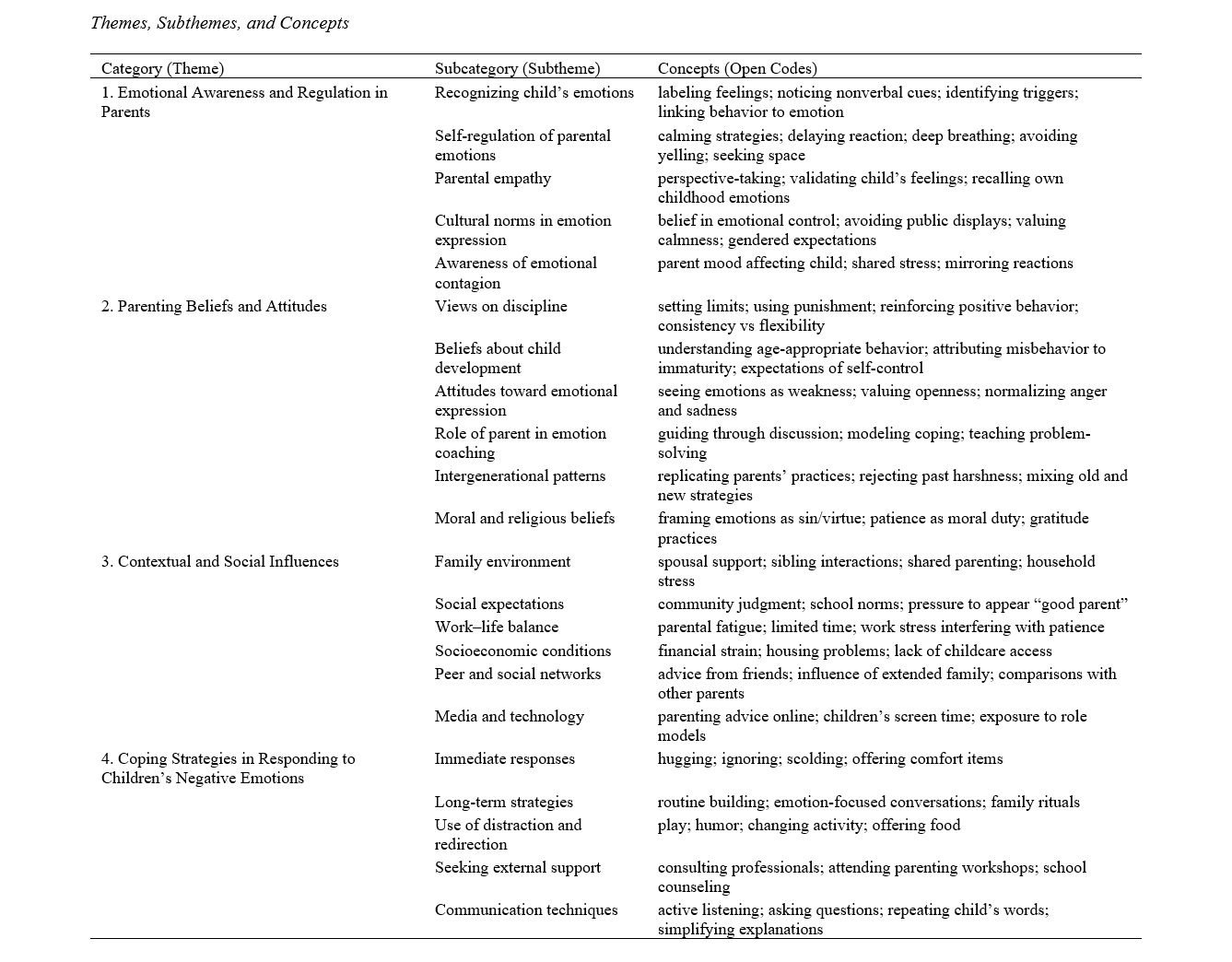
Findings: Analysis revealed four overarching themes. (1) Emotional awareness and regulation in parents highlighted recognition of children’s emotions, self-regulation strategies, empathy, cultural norms in emotional expression, and awareness of emotional contagion. (2) Parenting beliefs and attitudes encompassed views on discipline, developmental understanding, attitudes toward emotional expression, emotion-coaching roles, intergenerational patterns, and moral or religious values. (3) Contextual and social influences included family environment, societal expectations, work–life balance, socioeconomic challenges, peer and social networks, and media exposure. (4) Coping strategies in responding to children’s negative emotions featured immediate reactions, long-term approaches, distraction and redirection, seeking external support, and communication techniques. Illustrative quotations underscored the variability and complexity of parental practices.
Conclusion: The findings suggest that parents’ responses to children’s negative emotions are multifaceted, shaped not only by individual self-regulation and beliefs but also by cultural expectations, social contexts, and available coping resources. These insights underscore the need for interventions that support parental emotional awareness, resilience, and communication skills, while addressing contextual stressors to promote more adaptive emotion socialization.
Downloads
References
Aktar, E., Venetikidi, M., Bockstaele, B. V., Giessen, D. V. d., & Pérez‐Edgar, K. (2024). Pupillary Responses to Dynamic Negative Versus Positive Facial Expressions of Emotion in Children and Parents: Links to Depression and Anxiety. Developmental Psychobiology, 66(6). https://doi.org/10.1002/dev.22522
An, D., & Kochanska, G. (2022). Sequelae of Infants’ Negative Affectivity in the Contexts of Emerging Distinct Attachment Organizations: Multifinality in Mother-Child and Father-Child Dyads Across the First Year. Development and Psychopathology, 35(4), 2011-2027. https://doi.org/10.1017/s0954579422000669
Anikiej‐Wiczenbach, P., & Kaźmierczak, M. (2022). The Effects of the COVID-19 Pandemic on the Parenting of Infants: A Couples Study. International journal of environmental research and public health, 19(24), 16883. https://doi.org/10.3390/ijerph192416883
Çelebi, Ş., & Acar, İ. H. (2024). Investigating Correlates of Children's Emotional Well‐being: Parenting Stress and Child Temperament. Infant and Child Development, 33(6). https://doi.org/10.1002/icd.2539
Hafiz, M., Nelson, J. A., Patel, N. H., & Holub, S. C. (2023). Parent Dysregulation and Child Negativity in Relation to Parent Responses to Child Negative Emotions. Family Relations, 73(2), 737-752. https://doi.org/10.1111/fare.12950
Kerns, K. A., Kochendorfer, L. B., Obeldobel, C. A., & Brumariu, L. E. (2023). Parent-Child Attachment and Emotion Regulation Dynamics in Late Middle Childhood. Merrill-Palmer Quarterly, 69(1), 84-117. https://doi.org/10.1353/mpq.2023.a909260
Legg, E., & Rose, J. (2022). Write It Out: Examining Recreational Youth Sport Parent Emotions Through an Expressive Writing Exercise. Journal of Park and Recreation Administration, 40(2). https://doi.org/10.18666/jpra-2020-10669
Li, J., Liu, X., Zhu, D., & Jiang, H. (2024). Effects of Parent Involvement in Homework on Students’ Negative Emotions in Chinese Students: Moderating Role of Parent–Child Communication and Mediating Role of Family Responsibility. Behavioral Sciences, 14(12), 1139. https://doi.org/10.3390/bs14121139
Marchetti, D., & Sawrikar, V. (2023). Parents' Illness Representations of Their Child With Anorexia Nervosa: A Systematic Review of Qualitative Studies Using the Common‐sense Model. International Journal of Eating Disorders, 57(5), 1049-1068. https://doi.org/10.1002/eat.24081
Markoulaki, M. (2025). Parental Emotion Socialization and Child Adjustment in Greek Families: Supportive vs. Non-Supportive Parenting. Children, 12(7), 807. https://doi.org/10.3390/children12070807
Pereira, A. I., Santos, C., Barros, L., Roberto, M. S., Rato, J. R., Prata, A. P., & Marques, C. (2022). Patterns of Parental Reactions to Their Children’s Negative Emotions: A Cluster Analysis With a Clinical Sample. International journal of environmental research and public health, 19(11), 6844. https://doi.org/10.3390/ijerph19116844
Post, G. (2024). Resilient Parents; Resilient Kids: How Parental Self-Awareness Is Critical to Helping Smart Kids Thrive. Gifted Education International, 41(1), 92-111. https://doi.org/10.1177/02614294241274442
Riggs, R. E., Rasmussen, E. E., & Wakefield, S. (2025). Exploring Predictors of Parents’ Negative Emotional Response to Adolescents’ Mental Illness Disclosures. Journal of Child Health Care. https://doi.org/10.1177/13674935251344649
Soydan, S., & Akalın, N. (2022). Emotional Regulation and Aggression in Children: The Regulatory Role of Turkish Mothers' Emotion Socialization Reactions. Family Relations, 72(4), 1709-1724. https://doi.org/10.1111/fare.12785
Takamatsu, R. (2024). Anhedonia and Daily Emotional Experiences Among Mothers of Preschool Children: An Experiential Sampling Study. https://doi.org/10.21203/rs.3.rs-4179805/v1
Zhang, X., Han, Z. R., & Gatzke‐Kopp, L. M. (2021). A Biopsychosocial Approach to Emotion-Related Parenting: Physiological Responses to Child Frustration Among Urban Chinese Parents. Journal of Family Psychology, 35(5), 639-648. https://doi.org/10.1037/fam0000824
Downloads
Additional Files
Publication Timeline
- Submitted
- Revised
- Accepted
Issue
Section
License

This work is licensed under a Creative Commons Attribution-NonCommercial 4.0 International License.