Contexts of Power Asymmetry in Academic–Nonacademic Partner Dyads: A Qualitative Study
DOI:
https://doi.org/10.61838/kman.aftj.6.3.12Keywords:
Power asymmetry, romantic relationships, academic partners, nonacademic partnersAbstract
Objective: This study aimed to explore and interpret the relational contexts and mechanisms that create and sustain power asymmetry in romantic relationships where one partner is an academic professional and the other is nonacademic.
Methods and Materials: A qualitative research design was employed using purposive sampling to recruit 20 Indonesian adults currently involved in academic–nonacademic romantic partnerships. Data were gathered through in-depth semi-structured interviews that focused on relationship dynamics, perceptions of influence and authority, and coping strategies. Interviews continued until theoretical saturation was reached, and all were transcribed verbatim. Thematic analysis was performed using NVivo 14 software. Codes were iteratively developed and clustered into subthemes and overarching themes to capture the multifaceted nature of power relations within these dyads. Credibility was ensured through member checking and peer debriefing.
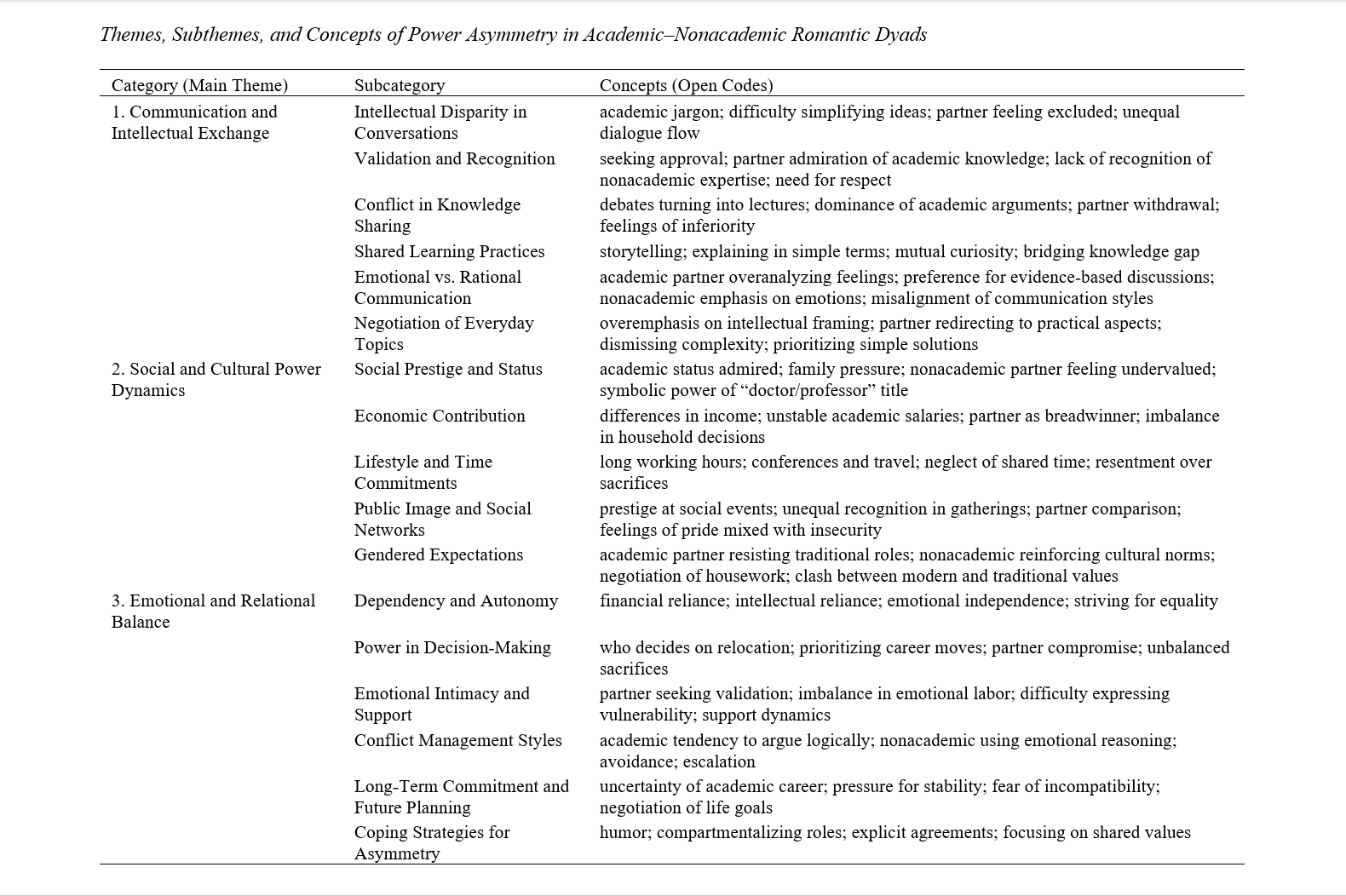
Findings: Analysis revealed three overarching themes: communication and intellectual exchange, social and cultural power dynamics, and emotional and relational balance. Participants reported that academic partners often held symbolic intellectual authority, creating conversational imbalance and feelings of exclusion. Social prestige linked to academic titles reinforced status differences, while financial contributions and career stability sometimes shifted power toward the nonacademic partner. Career mobility and relocation often disrupted the nonacademic partner’s professional development, fostering dependence and tension. Couples who actively validated each other’s contributions, translated disciplinary knowledge, and set explicit boundaries were better able to manage and renegotiate power imbalances.
Conclusion: Power asymmetry in academic–nonacademic romantic dyads is dynamic and context-dependent, shaped by intellectual capital, mobility demands, and social recognition. Relational resilience emerges when couples address asymmetry openly and create strategies to balance influence and support.
Downloads
References
Ãlvarez, I., Horáčková, C., & Všetečková, J. (2024). Early Career Mobility and Health and Wellbeing of Female Doctorate Holders: A Narrative Review of the International Literature. Gender Work and Organization, 32(1), 202-242. https://doi.org/10.1111/gwao.13138
Brooks, T. P., Hughes, A., Azim, K. A., Bender, S. H., Jones, J. L. B., Parker-Barnes, L., Frazier, K. E., Greene, J., Pennell, S. M., Richardson, I., Bielski, L. M., & Raftery‐Helmer, J. N. (2025). Exploring the Identities, Barriers, and Interventions for Motherscholars During a Global Pandemic. Journal of Career Development, 52(3), 385-406. https://doi.org/10.1177/08948453251323814
Buckland, N., Richardson, K., & Ehata, R. (2024). Applying Behaviour Change Theory to Understand PhD Supervisors' Barriers and Enablers to Supporting PhD Students With Academic and Other-Sector Careers. https://doi.org/10.32388/y2s1i9.2
Bujaki, M., Gaudet, S., & Bourgeault, I. L. (2025). Generating Academic Capital Through Travel: Academic Mothers Navigating the Ideal of Mobility. Gender Work and Organization, 32(5), 2024-2038. https://doi.org/10.1111/gwao.13261
Folke, O., Gruneau, M. F., & Rickne, J. (2025). Family Matters. https://doi.org/10.1017/9781009437837
Hajrizi, B., Berisha-Shaqiri, A., & Veliu, L. (2025). Advancing Innovation Through University-Industry Collaboration: Empirical Evidence From a Developed Economy. Multidisciplinary Science Journal, 7(8), 2025435. https://doi.org/10.31893/multiscience.2025435
Hansen, E. M. (2025). “So, Who’s the Real Mother?”. 160-170. https://doi.org/10.1093/9780197793534.003.0019
Kizilirmak, J. M., Steinkampf, L.-M., Buchholz, S., & Ordemann, J. (2025). Beyond Tradition: Successful Career Paths to Full Professorship. https://doi.org/10.31235/osf.io/7c6z5
Liu, S., & Au, A. (2024). Mobility Spaces: Geographical and Professional Distances in Career Mobility. The Journal of Applied Behavioral Science, 61(2), 195-224. https://doi.org/10.1177/00218863241305182
MacIver, E., Greenhalgh, T., & Ovseiko, P. V. (2025). Exploring the Lived Experiences of Early/Mid-Career Female Academic GPs in the UK: A Qualitative Study. British Journal of General Practice, 75(suppl 1), bjgp25X741849. https://doi.org/10.3399/bjgp25x741849
Marquardt, A. U., & Medeiros, A. S. (2025). The Challenge of Meaningful Knowledge Mobilization of Climate Change Research in the Canadian Arctic for Early-Career Researchers. Facets, 10, 1-12. https://doi.org/10.1139/facets-2024-0077
Oecd. (2024). The State of Academic Careers in OECD Countries. https://doi.org/10.1787/ea9d3108-en
Pardi, P., & Herdi, H. (2024). Career Support Programme to Expand Career Interests of Partners. Edukasi, 18(1), 85-94. https://doi.org/10.15294/edukasi.v18i1.8431
Ramsarghey, K. (2023). From Bean Counting to Teaching: Pathways to Accounting Academia in South Africa. Isea. https://doi.org/10.7176/isea/s2-09
Schels, B., Connolly, S., Fuchs, S., Herschberg, C., & Vinkenburg, C. J. (2024). Navigating Treacherous Waters. Exploring the Dual Career Experiences of European Research Council Applicants. 341-371. https://doi.org/10.5771/9783748925590-341
Silva, P. A. (2025). Breaking Barriers: Strategies for Achieving Equity in Academic Careers in ICT/Informatics/STEM. 243-267. https://doi.org/10.1007/978-3-031-78432-3_11
Spieler, D., Stein, L., & Nóbrega, R. (2025). Navigating Parenthood as an Early Career Scientist: Insights and Challenges From Hydrological Sciences. https://doi.org/10.5194/egusphere-egu24-9435
Varbanov, M., Bensoussan, D., & Devocelle, M. (2023). Pre-Professional International Mobility of European Pharmacy Students—A French Example. Pharmacy, 11(2), 59. https://doi.org/10.3390/pharmacy11020059
Velicu, A., Fauvelais, M., Jerke, J., Lemaitre, B., & Rauhut, H. (2025). Does Love in the Ivory Tower Fix the Leaky Pipeline? How Academia’s Homogamous Relationships Shape Careers. https://doi.org/10.31219/osf.io/qnw9j_v1
Downloads
Additional Files
Publication Timeline
- Submitted
- Revised
- Accepted
Issue
Section
License

This work is licensed under a Creative Commons Attribution-NonCommercial 4.0 International License.