Examining the Role of Women’s Coping Strategies and Interaction Patterns in Spousal Addiction: A Qualitative Study
DOI:
https://doi.org/10.61838/kman.aftj.4915Keywords:
Addiction, men, women, interaction pattern, coping strategy, qualitativeAbstract
Objective: The objective of this study was to examine the role of women’s coping strategies and interaction patterns in their husbands’ addiction.
Methods and Materials: The present study employed a qualitative design using an interpretative phenomenological approach. Among married women residing in Tehran who had sought counseling and psychotherapy services in the city of Tehran due to their husbands’ substance use disorder and whose husbands had a history of substance abuse exceeding one year, 26 participants were selected through purposive sampling and interviewed. The interviews were analyzed using Diekelmann, Allen, and Tanner’s interpretative phenomenological analysis method.
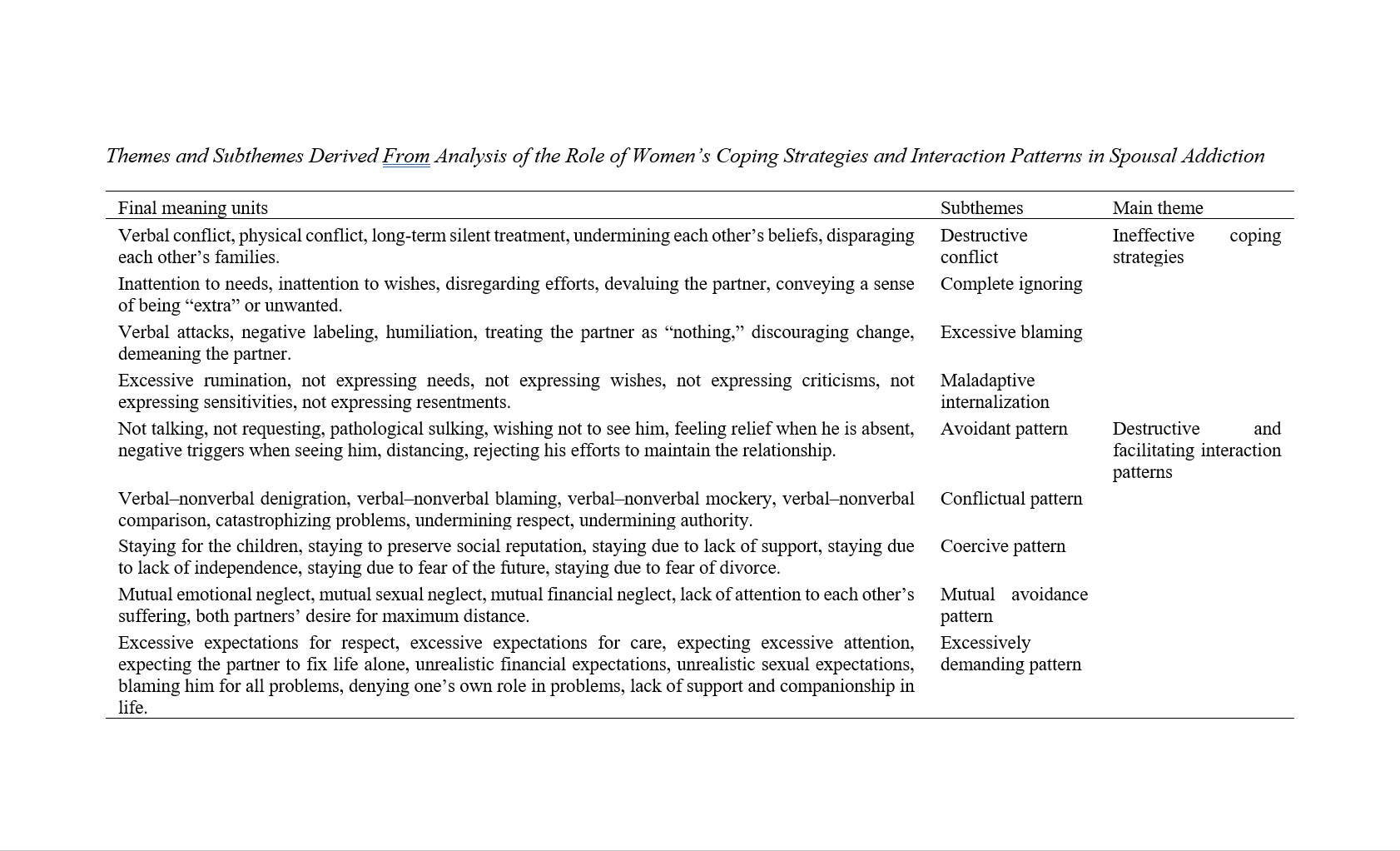
Findings: Analysis of the participants’ lived experiences led to the identification of two main themes and nine subthemes: (1) Ineffective coping strategies: destructive conflict, absolute ignoring, excessive blaming, and pathological internalization; (2) Destructive and facilitating interaction patterns: avoidant pattern, conflicting pattern, coercive pattern, mutual avoidance pattern, and excessively demanding pattern.
Conclusion: Elucidating these factors not only enhances knowledge and awareness regarding the reasons for and mechanisms through which women influence their spouses’ inclination toward substance use and its persistence and escalation, but also reveals that focusing on women and improving certain intrapersonal and interpersonal aspects of their functioning can complement preventive and therapeutic programs in the field of men’s addiction.
Downloads
References
Adams, Z. M., Ginapp, C. M., Price, C. R., Qin, Y., Madden, L. M., Yonkers, K., & Meyer, J. P. (2021). "A good mother": Impact of motherhood identity on women's substance use and engagement in treatment across the lifespan. Journal of Substance Abuse Treatment, 130, 108474. https://doi.org/10.1016/j.jsat.2021.108474
Chaman, R., Ebrahimi Kalin, M., Dastorpoor, M., Jahaanbin, P., Kootari, R., & Miller, R. (2020). Tendency to Drug Addiction and Related Risk Factors: A Case-Control Study. Journal of Substance Abuse, 6(4), 1-15. https://www.semanticscholar.org/paper/267541b6525dfa7569556bb24809d32e19bbf63d
Edwards, A. C., Larsson Lönn, S., Sundquist, J., Kendler, K. S., & Sundquist, K. (2018). Associations Between Divorce and Onset of Drug Abuse in a Swedish National Sample. American Journal of Epidemiology, 187(5), 1010-1018. https://doi.org/10.1093/aje/kwx321
Estaki Organi, M., & Gorji, Y. (2023). The Effectiveness of Schema Therapy on Differentiation in Women with Addicted Husbands in Shahin Shahr.
Fonseca, F., Robles-Martínez, M., Tirado-Muñoz, J., Alías-Ferri, M., Mestre-Pintó, J. I., Coratu, A. M., & Torrens, M. (2021). A Gender Perspective of Addictive Disorders. Current Addiction Reports, 8(1), 89-99. https://doi.org/10.1007/s40429-021-00357-9
Fridman, E. (2019). Insecure Attachment and Drug Misuse among Women. Journal of Social Work Practice in the Addictions, 19(3), 223-237. https://doi.org/10.1080/1533256X.2019.1637229
Ghadigaonkar, D. S., & Murthy, P. (2019). Sexual Dysfunction in Persons with Substance Use Disorders. Journal of Psychosexual Health, 1(2), 117-121. https://doi.org/10.1177/2631831819849365
Gilchrist, E., Johnson, A., Thomson, K., Stephens-Lewis, D., Henderson, J., Gadd, D., Radcliffe, P., Halliwell, G., & Gilchrist, G. (2023). Substance Use and Intimate Partner Abuse (IPA): A Descriptive Model of the Pathways Between Substance Use and IPA Perpetration for Men. Journal of family violence, 38(5), 855-868. https://doi.org/10.1007/s10896-022-00395-5
Gori, A., Russo, S., & Topino, E. (2023). Love Addiction, Adult Attachment Patterns and Self-Esteem: Testing for Mediation Using Path Analysis. Journal of Personalized Medicine, 13(2), 247-257. https://doi.org/10.3390/jpm13020247
Haghparast, Z., Riazi, H., Shams, J., & Montazeri, A. (2023). Couple Burnout and Partner's Substance-Dependency: Is there any Association? Health Services Research and Managerial Epidemiology, 10, 23333928221144445. https://doi.org/10.1177/23333928221144445
Jepsen, D., Luck, T., Bernard, M., Moor, I., & Watzke, S. (2023). Study protocol: Hypersexual and hyposexual behavior among adults diagnosed with alcohol- and substance use disorders-Associations between traumatic experiences and problematic sexual behavior. Frontiers in Psychiatry, 14, 1088747. https://doi.org/10.3389/fpsyt.2023.1088747
Johannessen, A., Tevik, K., Engedal, K., Tjelta, T., & Helvik, A. S. (2023). Family members' experiences of their older relative's alcohol and substance misuse. International Journal of Qualitative Studies on Health and Well-Being, 17(1), 2094059. https://doi.org/10.1080/17482631.2022.2094059
Karimi Harz Abadi, A., Mohammadi Shirmahaleh, F., Rafiee, Z., Gholami Tooran Poshti, M., & Peyvandi, P. (2022). A Model Predicting Codependency in Women with Addicted Husbands Based on Self-Differentiation with the Mediating Role of Emotional Regulation. Journal of Applied Family Therapy, 3(1), 426-444. https://doi.org/10.61838/kman.aftj.3.1.21
Kialha, S. (2022). Addiction in Adolescents: A Review of the Role of Family Functioning. Novel Ideas in Psychology, 12(16), 1-22. https://jnip.ir/browse.php?a_id=682&sid=1&slc_lang=en
Leahy, L. G., & Caverly, S. E. (2022). COVID-19: Changing the Landscape of Substance Use. Journal of the American Psychiatric Nurses Association, 28(1), 5-8. https://doi.org/10.1177/10783903211059532
Madaki, K. (2023). The burden of drug abuse: Predictors of prescription drug abuse among women in Northern Nigeria. A systematic review. Scientific African, 22(1), 1-13. https://doi.org/10.1016/j.sciaf.2023.e01952
Mehr, J. B., Bennett, E. R., Price, J. L., de Souza, N. L., Buckman, J. F., Wilde, E. A., Tate, D. F., Marshall, A. D., Dams-O'Connor, K., & Esopenko, C. (2022). Intimate partner violence, substance use, and health comorbidities among women: A narrative review. Frontiers in psychology, 13(1), 1028375. https://doi.org/10.3389/fpsyg.2022.1028375
Mir Arab Reza, M. R., Shariat Nia, K., & Hoseiniyayi, A. (2023). Comparing the Effectiveness of Short-Term Solution-Focused Therapy and Acceptance and Commitment Therapy on Sexual Intimacy and Marital Instability in the Wives of Addicted Men. Psychological Science Journal, 130(22), 2081-2098. https://psychologicalscience.ir/article-1-2039-fa.html
Mohammadzadeh, F., & Jangi, P. (2023). Predicting Tendency to Opioid Abuse Among Adolescents Based on Psychological Disturbances and Family Health. Scientific Journal of Addiction Research, 17(69), 181-200. https://doi.org/10.61186/etiadpajohi.17.69.181
Monarque, M., Sabetti, J., & Ferrari, M. (2023). Digital interventions for substance use disorders in young people: rapid review. Substance Abuse Treatment, Prevention, and Policy, 18(1), 13-23. https://doi.org/10.1186/s13011-023-00518-1
Motyka, M. A., Al-Imam, A., Haligowska, A., & Michalak, M. (2022). Helping Women Suffering from Drug Addiction: Needs, Barriers, and Challenges. International journal of environmental research and public health, 19(21), 14039. https://doi.org/10.3390/ijerph192114039
Naghshbandi, A., & Amini, M. (2023). Drug Addiction in High School Students.
Ostad Rahimi, A., & Fathi, A. (2021). The Role of Family Communication Patterns and School Culture in Addiction Tendency Among Students. Journal of Addiction Research, 15(59), 275-292. https://doi.org/10.52547/etiadpajohi.15.59.275
Pirvand Bori, Z., Taimouri, F., Najafi, R., & Maroofiazar, L. (2021). Examining Early Maladaptive Schemas in Women with Substance Use Disorder.
Rao, R., Kathiresan, P., Kishore, K., Kumar, P., Sharma, C., & Mishra, J. K. (2022). Physical and mental health status of women whose spouses inject drugs - A cross-sectional, multisite study. Indian Journal of Public Health, 66(1), 57-60. https://doi.org/10.4103/ijph.IJPH_1249_20
Salvatore, J. E., Larsson Lönn, S., Sundquist, J., Kendler, K. S., & Sundquist, K. (2023). Social genetic effects for drug use disorder among spouses. Addiction (Abingdon, England), 118(5), 880-889. https://doi.org/10.1111/add.16108
Sattler, S., Zolala, F., Baneshi, M. R., Ghasemi, J., & Amirzadeh Googhari, S. (2021). Public Stigma Toward Female and Male Opium and Heroin Users: An Experimental Test of Attribution Theory and the Familiarity Hypothesis. Frontiers in Public Health, 9(2), 2-13. https://doi.org/10.3389/fpubh.2021.652876
Shah, S. F., Punjani, N. S., Rizvi, S. N., Sheikh, S. S., & Jan, R. (2023). Knowledge, Attitudes, and Practices Regarding Menstrual Hygiene among Girls in Ghizer, Gilgit, Pakistan. International journal of environmental research and public health, 20(14), 6424. https://doi.org/10.3390/ijerph20146424
Shearer, R. D., Shippee, N. D., Vickery, K. D., Stevens, M. A., & Winkelman, T. N. A. (2022). A longitudinal cross-sectional analysis of substance use treatment trends for individuals experiencing homelessness, criminal justice involvement, both, or neither - United States, 2006-2018. The Lancet Regional Health - Americas, 7, 100174. https://doi.org/10.1016/j.lana.2021.100174
Shoaa Kazemi, M., Mahamid, F., & Hamamra, B. (2025). The lived experiences of women overcoming addiction and self-harming behaviors. Journal of Ethnicity in Substance Abuse, 1-16. https://doi.org/10.1080/15332640.2025.2479608
Shokri, A., Younesi, S. J., & Zare Bahramabadi, M. (2025). Examining the Role of Women's Interpersonal Facilitators in Spousal Addiction: A Qualitative Study. Psychology of Woman Journal, 6(1), 34-45. https://doi.org/10.61838/kman.pwj.6.1.5
Sobol-Goldberg, S., Izhaki, R., & Gavriel-Fried, B. (2024). Social messages toward women living with spouses who have alcohol use disorder. Family Relations, 73(2), 1329-1345. https://doi.org/10.1111/fare.12914
Steinfeld, M. R., & Torregrossa, M. M. (2023). Consequences of adolescent drug use. Translational psychiatry, 13(1), 313-323. https://doi.org/10.1038/s41398-023-02590-4
Stellern, J., Xiao, K. B., Grennell, E., Sanches, M., Gowin, J. L., & Sloan, M. E. (2023). Emotion regulation in substance use disorders: a systematic review and meta-analysis. Addiction (Abingdon, England), 118(1), 30-47. https://doi.org/10.1111/add.16001
Taheri, S., Hashemi Razini, H., & Vakili, S. (2022). Effectiveness of Group Meaning Therapy on Depression and Quality of Life in Women with Addicted Husbands. Addiction Research, 14(55), 213-228. https://doi.org/10.29252/etiadpajohi.14.55.213
Uhlhaas, P. J., Davey, C. G., Mehta, U. M., Shah, J., Torous, J., Allen, N. B., Avenevoli, S., Bella-Awusah, T., Chanen, A., Chen, E. Y. H., Correll, C. U., Do, K. Q., Fisher, H. L., Frangou, S., Hickie, I. B., Keshavan, M. S., Konrad, K., Lee, F. S., Liu, C. H., . . . Wood, S. J. (2023). Towards a youth mental health paradigm: a perspective and roadmap. Molecular Psychiatry, 28(8), 3171-3181. https://doi.org/10.1038/s41380-023-02202-z
Villalba, K., Domenico, L. H., Cook, R. L., O'Connor, J., Michael-Samaroo, K., Espejo, M. J. D. P., Martin, P., & Dévieux, J. G. (2023). Emotion regulation and cognitive function as mediating factors for the association between lifetime abuse and risky behaviors in women of color. PLoS One, 18(10), e0279325. https://doi.org/10.1371/journal.pone.0279325
Weiss, N. H., Hogan, J., Brem, M., Massa, A. A., Kirby, C. M., & Flanagan, J. C. (2021). Advancing our understanding of the intersection between emotion regulation and alcohol and drug use problems: Dyadic analysis in couples with intimate partner violence and alcohol use disorder. Drug and Alcohol Dependence, 228, 109066. https://doi.org/10.1016/j.drugalcdep.2021.109066
Yazdani Gachini, M., & Mahmoudi, M. (2022). Pathology of Factors Related to Drug Addiction Among Adolescents and Young Adults.
Zeng, X., & Tan, C. (2022). The Relationship between the Family Functioning of Individuals with Drug Addiction and Relapse Tendency: A Moderated Mediation Model. International journal of environmental research and public health, 18(2). https://pmc.ncbi.nlm.nih.gov/articles/PMC7828550/
Downloads
Additional Files
Publication Timeline
- Submitted
- Revised
- Accepted