The Role of Psychological Capital and Trust in Predicting Marital Intimacy among Married Individuals in Pakistan
DOI:
https://doi.org/10.61838/kman.aftj.5016Keywords:
Marital intimacy, psychological capital, trust, marital relationships, positive psychologyAbstract
Objective: This study aimed to investigate the predictive roles of psychological capital and trust in determining levels of marital intimacy among married individuals in Pakistan.
Methods and Materials: A correlational descriptive research design was employed to explore the relationships among psychological capital, trust, and marital intimacy. The study sample consisted of 410 married participants (196 males and 214 females) selected through a simple random sampling method based on the Morgan and Krejcie table. Participants completed three standardized instruments: the Marital Intimacy Scale (Waring & Reddon, 1983), the Psychological Capital Questionnaire (PCQ-24) (Luthans et al., 2007), and the Dyadic Trust Scale (Larzelere & Huston, 1980). Data were analyzed using SPSS version 27 through Pearson correlation and multiple linear regression to determine the direction and strength of relationships between the variables.
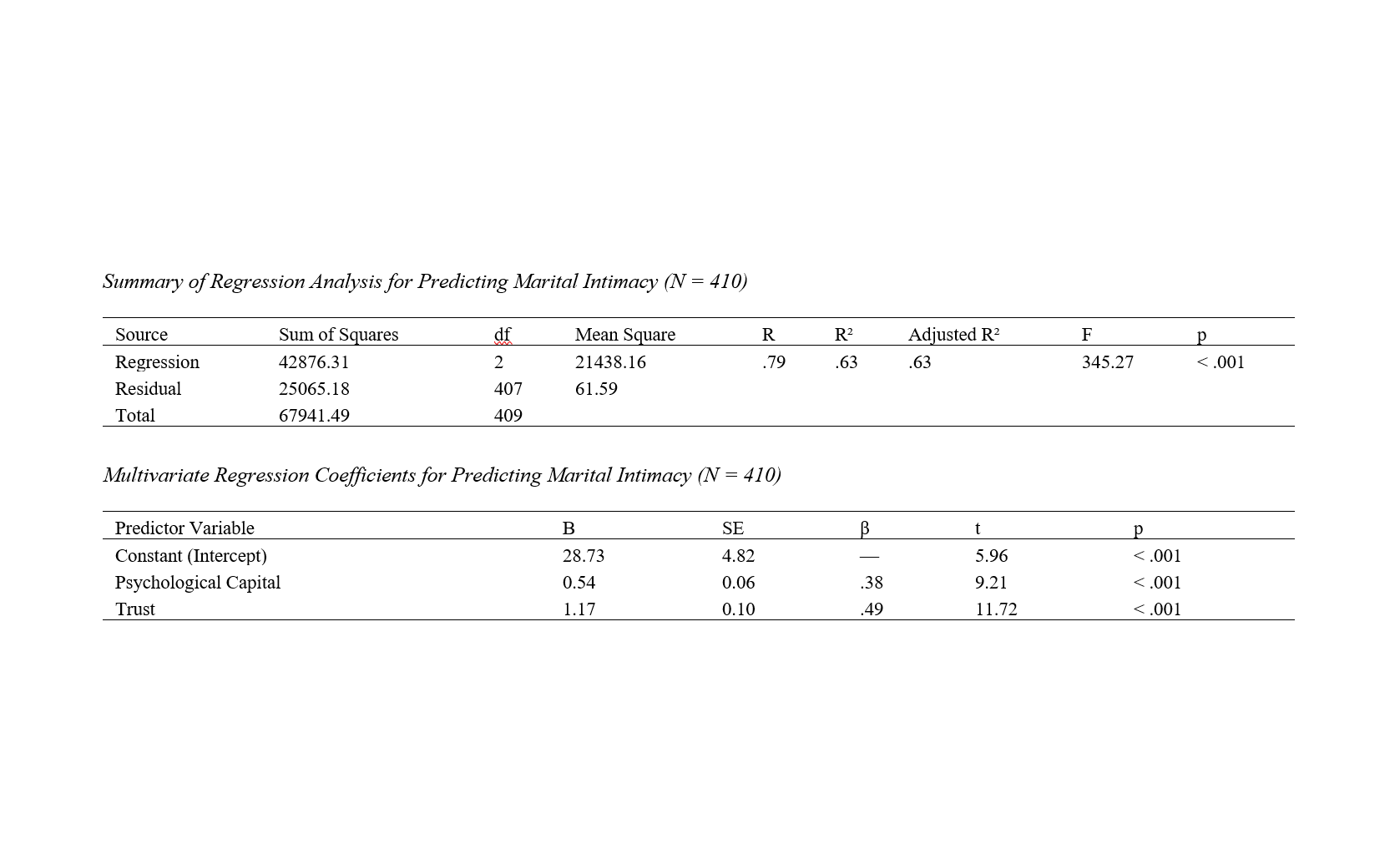
Findings: The results indicated strong positive correlations between marital intimacy and both psychological capital (r = .68, p < .001) and trust (r = .72, p < .001). The regression model predicting marital intimacy was statistically significant (F(2, 407) = 345.27, p < .001), explaining 63% of the variance (R² = .63). Both psychological capital (β = .38, p < .001) and trust (β = .49, p < .001) were significant predictors of marital intimacy. These results demonstrate that individuals with higher psychological resources and greater trust in their partners reported stronger emotional, cognitive, and relational closeness.
Conclusion: Psychological capital and trust significantly and positively predict marital intimacy, underscoring the importance of both internal psychological strengths and interpersonal trust in maintaining healthy, satisfying marital relationships. The findings suggest that interventions aimed at enhancing optimism, resilience, and mutual trust may effectively strengthen marital bonds.
Downloads
References
Avneesh Kumar, N. I. M., & Apeksha, T. (2024). Reimagining Marriage: The Depiction of Modern Relationships in Contemporary Fiction. Pj, 15(02), 91. https://doi.org/10.59467/pj.2024.15.91
Badanfiroz, A., Abolghasemi, A., Khosrojavid, M., & Shal, R. S. (2024). Effectiveness of Dialectical Behavior Therapy on Emotional Control, Communication Patterns, and Marital Intimacy in Women With Marital Infidelity Experience. PWJ, 5(3), 86-96. https://doi.org/10.61838/kman.pwj.5.3.11
Bagheri, R., Bakhshayesh, A., & Mahmoodabadi, H. Z. (2024). Predicting Family Stability Based on Emotion Regulation and Sexual Self-Efficacy: The Mediating Role of Marital Intimacy. Journal of Social Behavior and Community Health. https://doi.org/10.18502/jsbch.v8i2.16982
Fathurrohman, M., Mahendra, V. B., Basalamah, F., & Amrulloh, M. I. (2024). Methods of Prenatal Education From the Perspective of Al-Qur'an and as Sunnah. At Turots Jurnal Pendidikan Islam, 896-908. https://doi.org/10.51468/jpi.v6i2.731
Ghahari, S., Sheybani, F., Ghazanfari, Z., Afshar, P. F., & Jamil, L. (2023). Comparison of the Three Methods of Psychotherapy on Marital Satisfaction and Intimacy in Married Women. Clinical Psychology and Special Education, 12(1), 1-17. https://doi.org/10.17759/cpse.2023120101
Gharehdaghi, M., & Kachooei, M. (2023). Comparison of Mother With Father of Children With Cancer in Terms of Marital Intimacy, Parental Self-Efficacy and Cognitive Emotion Regulation Strategies. Aftj, 4(3), 323-336. https://doi.org/10.61838/kman.aftj.4.3.21
Gurung, S. K., Chapagain, R., & Sharma, S. (2023). Exploring the Lived Experiences of Marital Intimacy Among Nepali Married Couples: A Transcendental Phenomenological Approach. Asian Journal of Population Sciences, 17-36. https://doi.org/10.3126/ajps.v2i1.51088
Homaei, F., Shahlapour, S., Omidbakhtiari, N., & Mirzaei, Z. (2023). The Effectiveness of McMaster's Systemic Couple Therapy on Self-Differentiation and Marital Boredom and Intimacy of Couples With Emotional Divorce. Jarac, 5(2), 41-47. https://doi.org/10.61838/kman.jarac.5.2.6
Javid, M. M., Sexton, J. E., Siavashani, F. T., Taridashti, S., Tabibian, N., & Dorer, J. (2025). Differential Impacts of Transactional Analysis Training on Marital Intimacy Dimensions. The Family Journal. https://doi.org/10.1177/10664807251384277
Jemima, N. A. A. L. (2025a). Factors Affecting Marital Satisfaction and Relationship Quality Among Christians in Ghana. International Journal of Social Science and Human Research, 08(09). https://doi.org/10.47191/ijsshr/v8-i9-25
Jemima, N. A. A. L. (2025b). The Role of Intimacy, Trust, and Commitment in Sustaining Healthy Marriages. (Ijhrsss), 02(09). https://doi.org/10.55677/ijhrsss/05-2025-vol02i9
Kao, G. Y. (2025). My Body, Their Baby: A Progressive Christian Vision for Surrogacy. Perspectives on Science and Christian Faith, 77(1), 55-56. https://doi.org/10.56315/pscf3-25kao
Navabinejad, S., Rostami, M., & Parsakia, K. (2024). Influences of Family Structure and Intimacy on Emotional Divorce: A Cross-Sectional Analysis. JPRFC, 23-30. https://doi.org/10.61838/kman.jprfc.2.1.5
Nokman, M. S., & Rosidi, M. H. (2025). The Validity of Fasakh Due to Non-Cohabitation: An Analysis of Marital Intimacy and Its Implications Within the Framework of Maqasid Al-Shariah. International Journal of Research and Innovation in Social Science, IX(VII), 2213-2222. https://doi.org/10.47772/ijriss.2025.907000182
Nugrahani, A., Prameswari, Y., & Napitupulu, R. P. (2025). Dual-Earner Dynamics: How Emotional Intimacy Shields Marital Satisfaction From Role Conflict. The Family Journal. https://doi.org/10.1177/10664807251346973
Nurjanis. (2025). Peran Kemaafan Pasangan Dalam Menjaga Stabilitas Hubungan Romantis Pada Awal Pernikahan. Journal of Education and Culture, 5(2), 17-25. https://doi.org/10.58707/jec.v5i2.1332
Salarfard, M., Mahmoudinia, M., Rahimi, M., & Roudsari, R. L. (2025). A Systematic Review of Counselling Approaches and Their Impact on Marital Intimacy Among Women and Couples Experiencing Infertility. BMC psychology, 13(1). https://doi.org/10.1186/s40359-025-03430-4
Sunmonu, H. O., Tiamiyu, K. A., Yusuf, J., & Ahmed, M. (2025). Emotionally-Focused Therapy and Marital Bonding: Counselling Implications for Nigerian Couples. Coution Journal of Counseling and Education, 6(2), 83-97. https://doi.org/10.47453/coution.v6i2.3533
Tianqi, X., & Jinhao, J. (2024). Intimacy and Trust in Interpersonal Relationships: A Sociological Perspective. Journal of Sociology and Ethnology, 6(3). https://doi.org/10.23977/jsoce.2024.060306
Vakilian, K., Ebrahimi, S., Fouladvand, M., Moslemi, A., & Najdi, N. (2024). Predicting Commitment of Married Women Based on Emotional Intimacy, Cognitive Flexibility, and Irrational Beliefs of Infertile Couples in Arak City in the 2021:A Cross-Sectional Study. The Open Public Health Journal, 17(1). https://doi.org/10.2174/0118749445267020240209073345
Downloads
Additional Files
Publication Timeline
- Submitted
- Revised
- Accepted